Balcony Solar Calculator
Estimate yearly output, savings and payback for a plug-in balcony solar kit with an 800 W inverter, from your location and mounting.
Quick answer
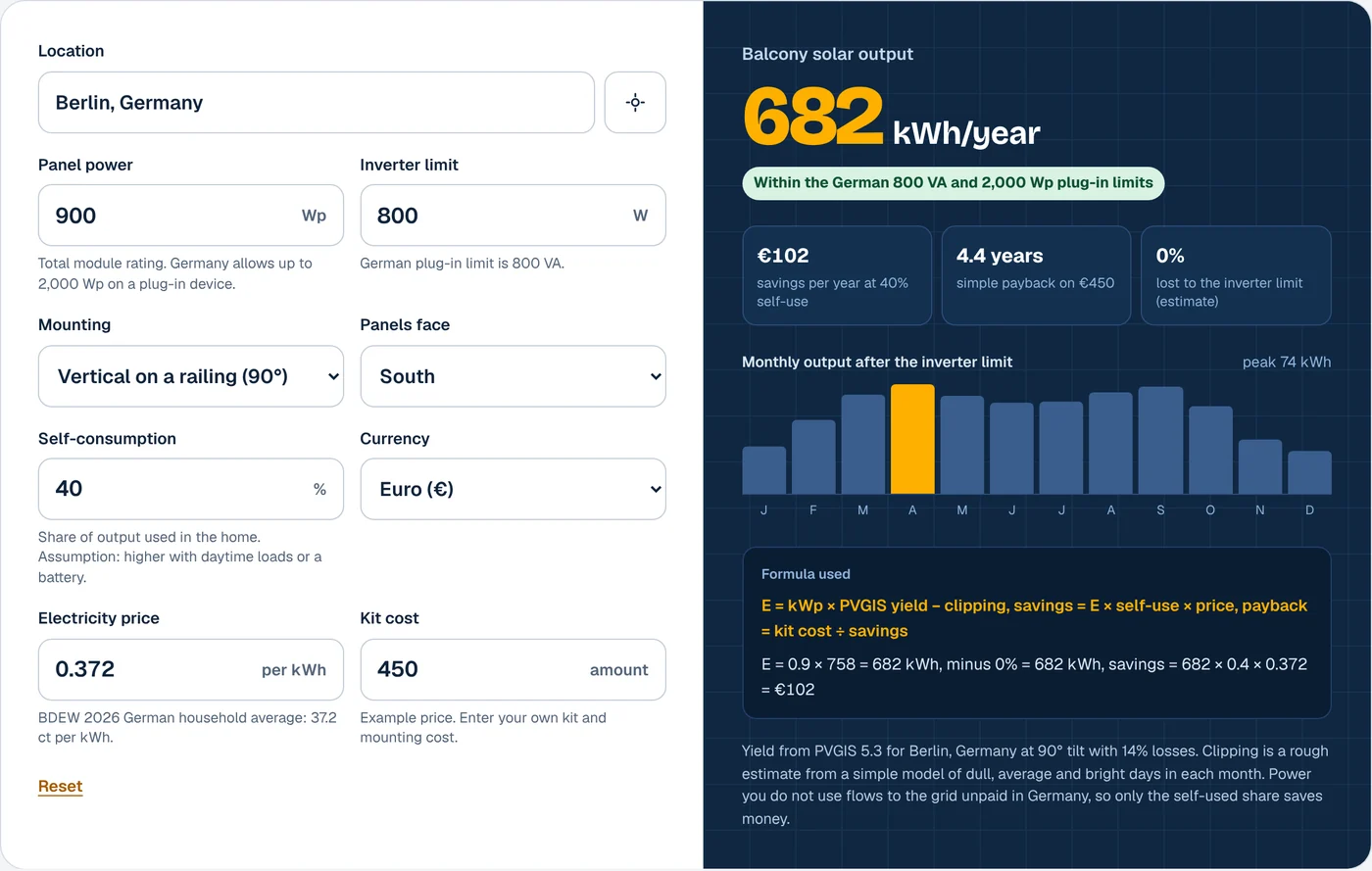
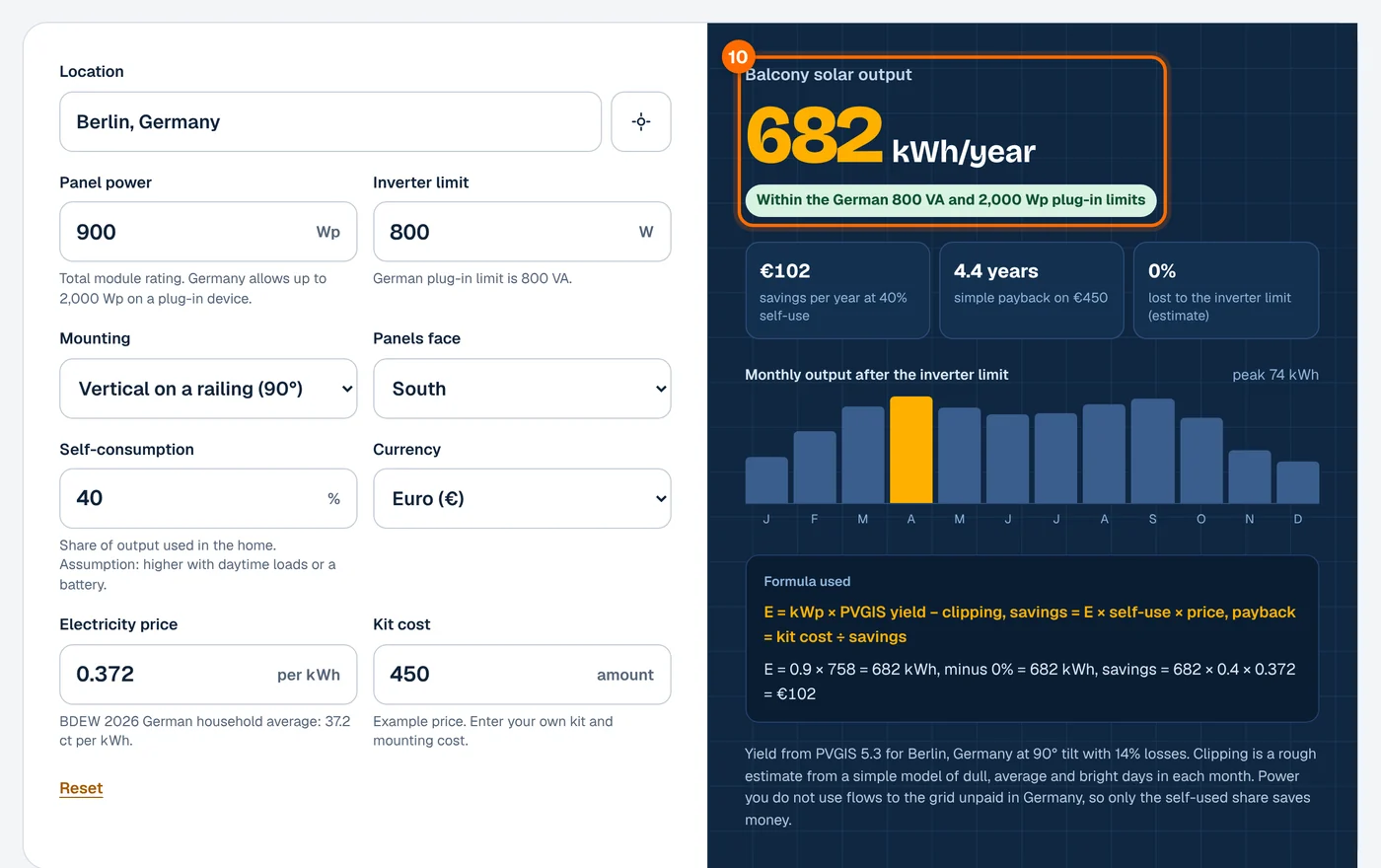
A balcony solar kit’s yearly output is panel kWp times the local yield for its tilt and direction, minus what the 800 W inverter clips. Savings = output × self-used share × electricity price. In Berlin, 900 Wp hung vertically facing south makes about 682 kWh a year and saves about €102 at 40% self-use and 37.2 ct per kWh.
How to use the balcony solar calculator
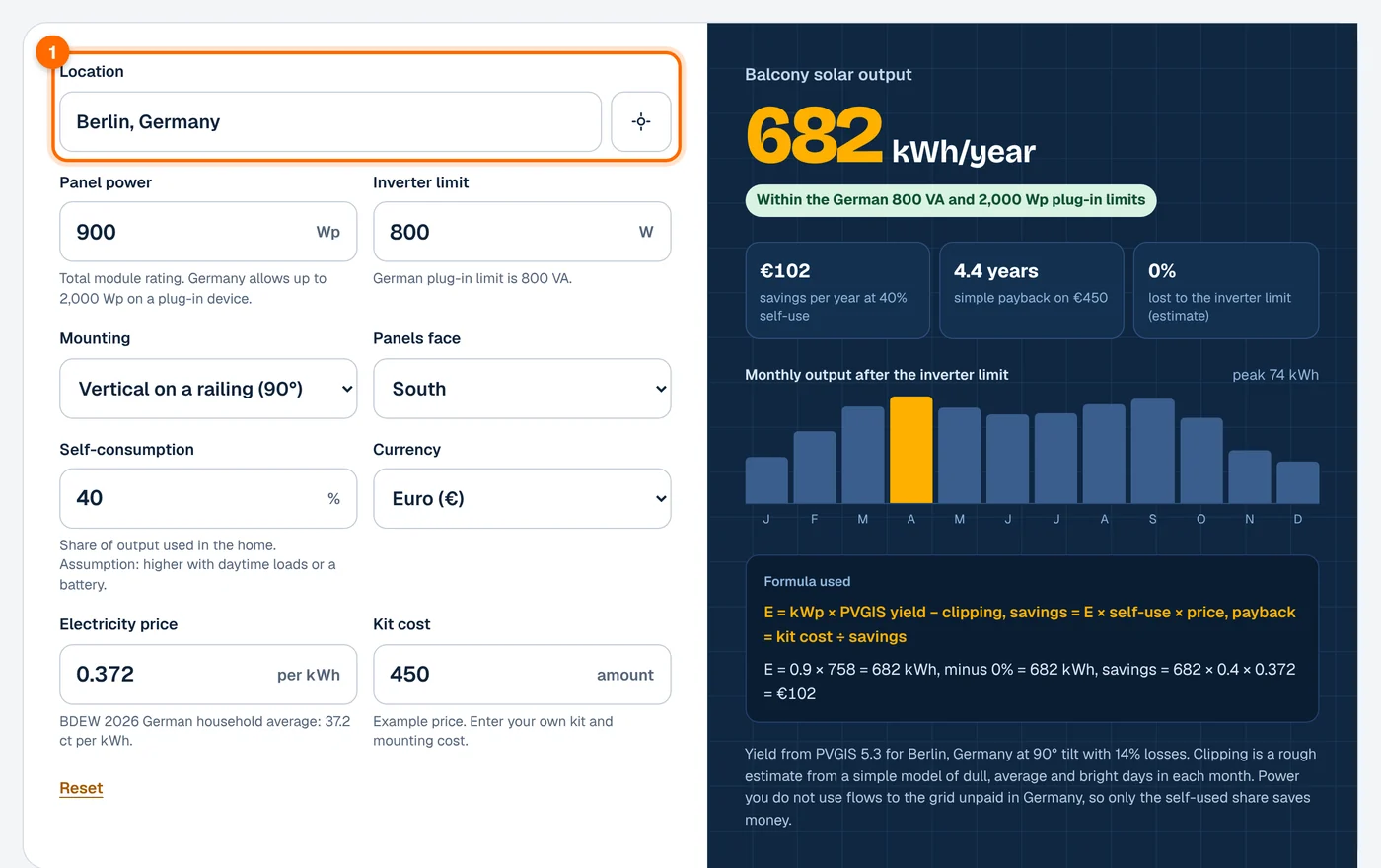
- Set your location. Search for your town or use your device location. The calculator pulls long-term sun data for that point from PVGIS, run by the European Commission.
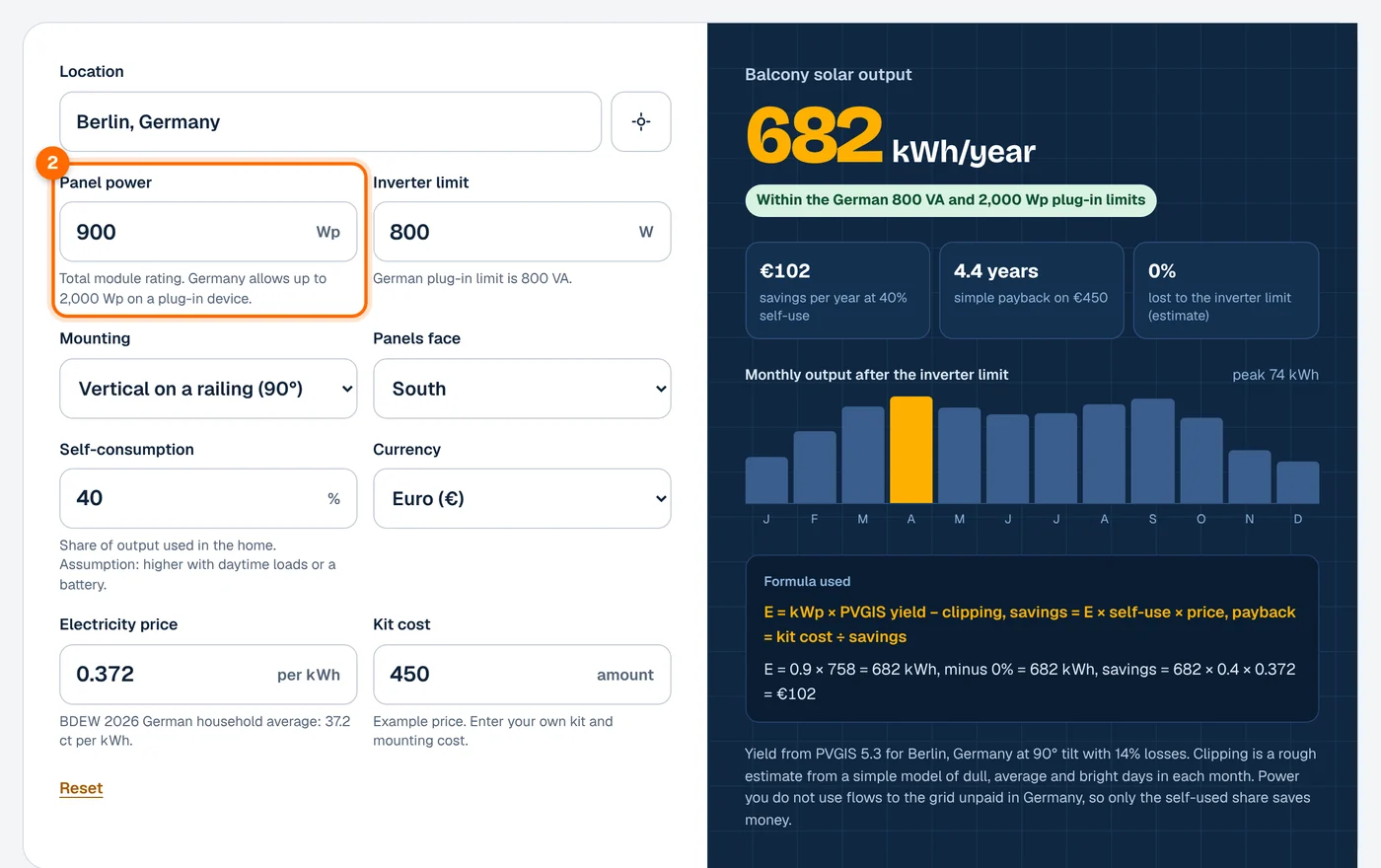
- Enter the panel power. Add up the Wp rating of all panels in the kit, for example 2 × 450 Wp = 900 Wp. Germany allows up to 2,000 Wp on a plug-in device.
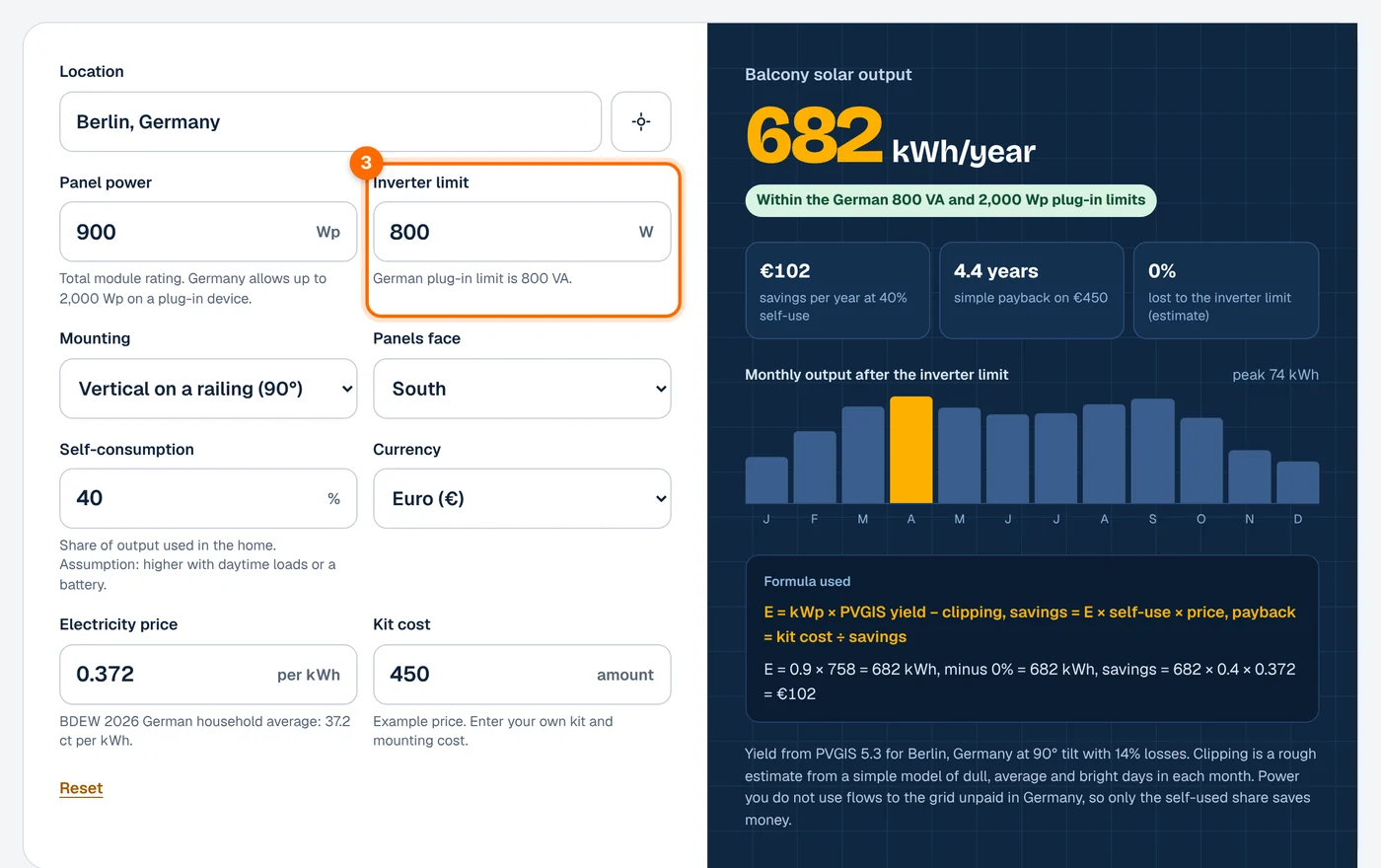
- Enter the inverter limit. This is the maximum AC output of the micro-inverter. The German plug-in limit is 800 VA, so most kits sold there are set to 800 W.
- Choose the mounting. Vertical on a railing (90°) is the most common balcony setup. A tilted stand on a terrace or flat roof catches far more sun.
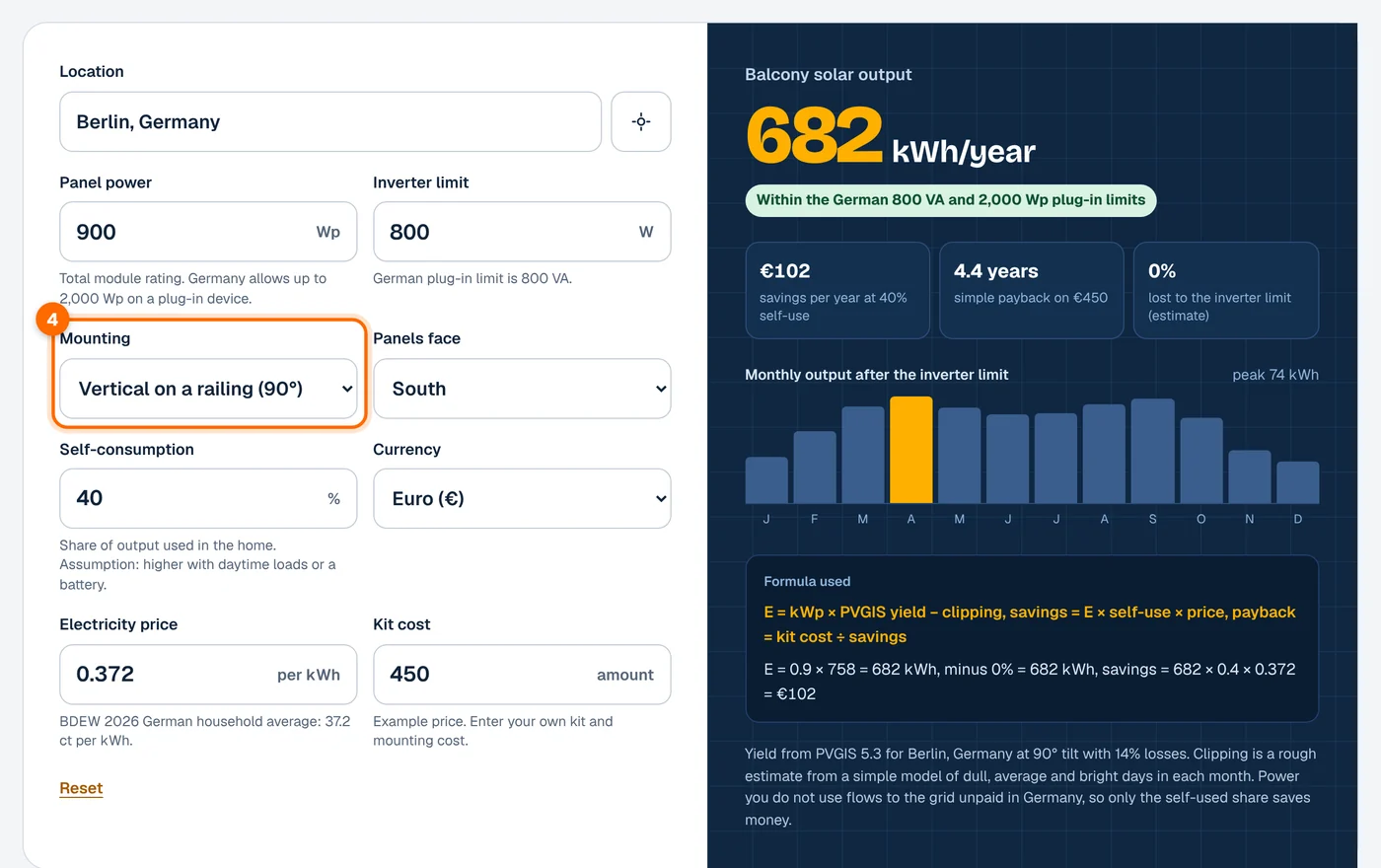
- Choose the direction the panels face. South is best in Germany. East and west give less in total but spread output across the morning or evening.
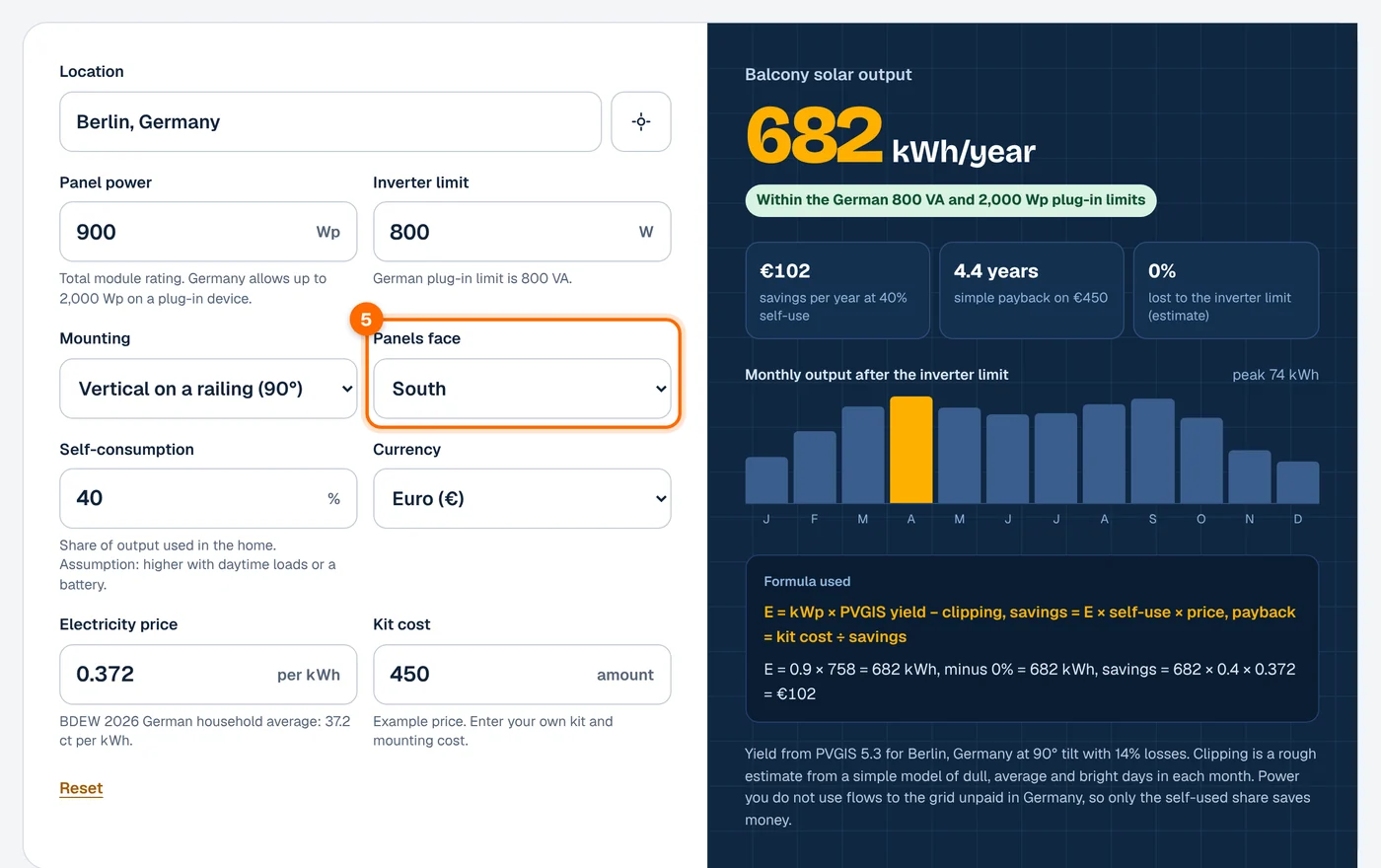
- Enter your self-consumption. This is the share of the kit’s output your home uses at the moment it is produced. The default of 40% is an assumption. A fridge, router and other always-on devices use some, and daytime appliance use raises it.
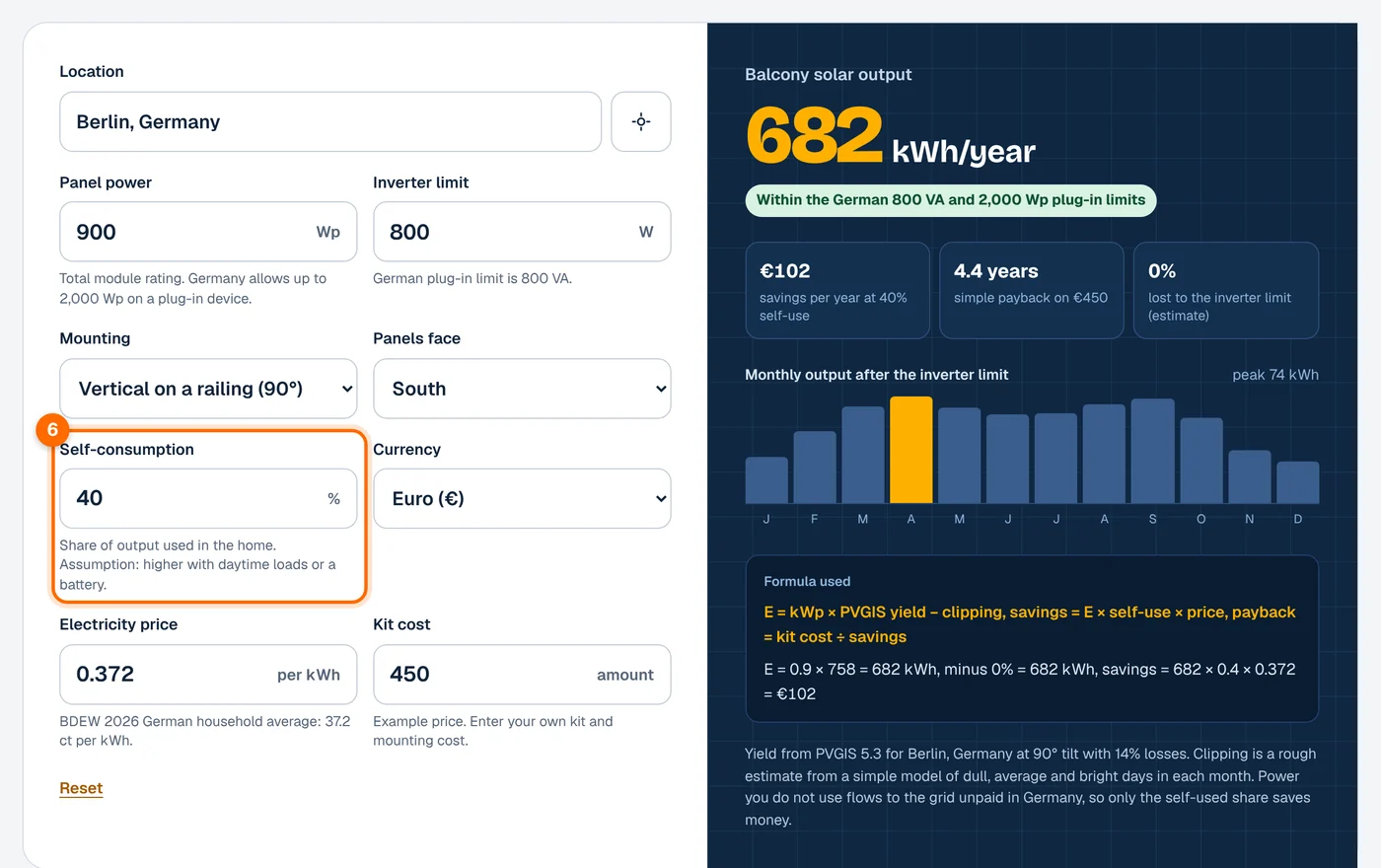
- Choose your currency. The default is euro. Pick pounds or dollars if you use the calculator outside the euro area.
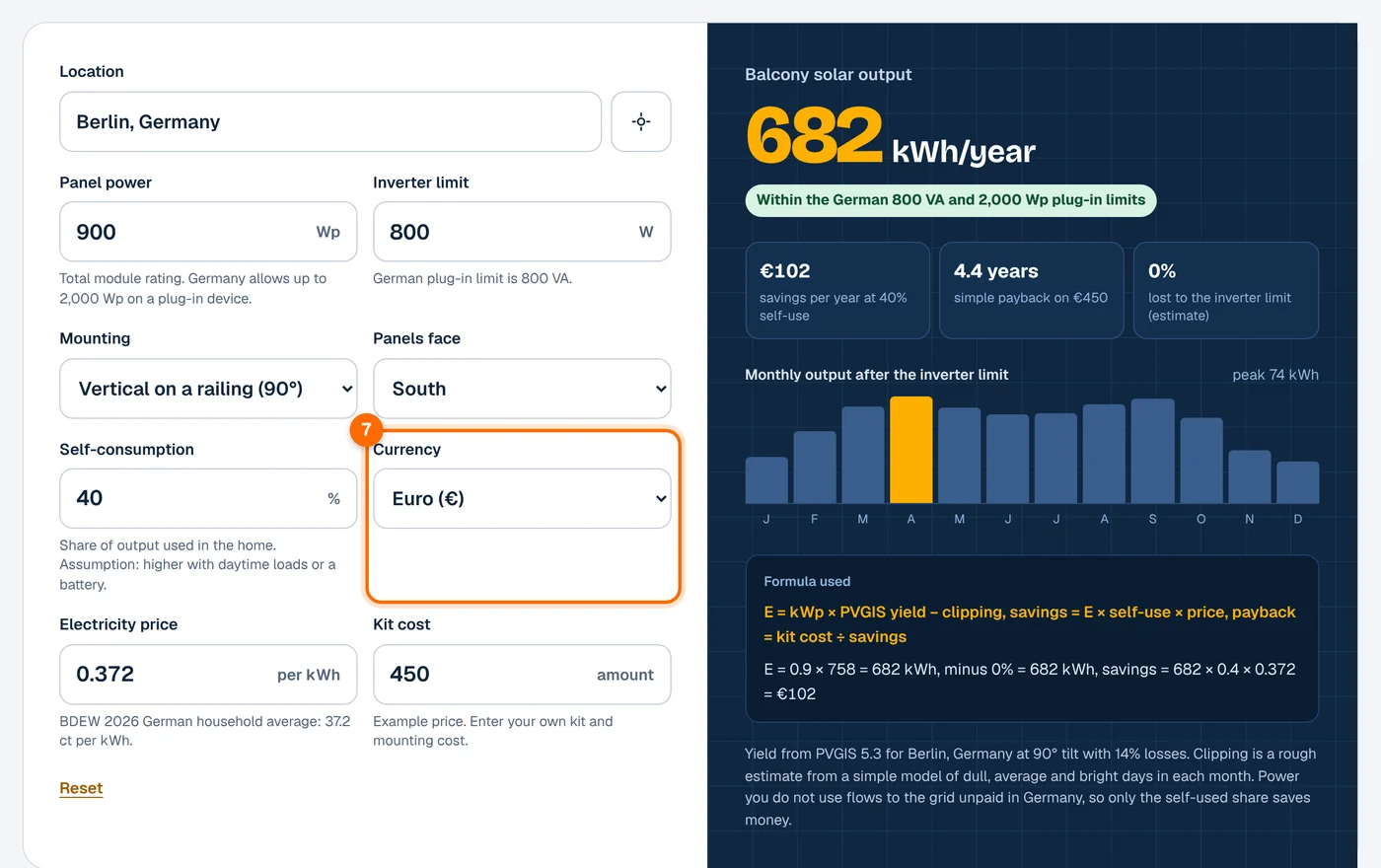
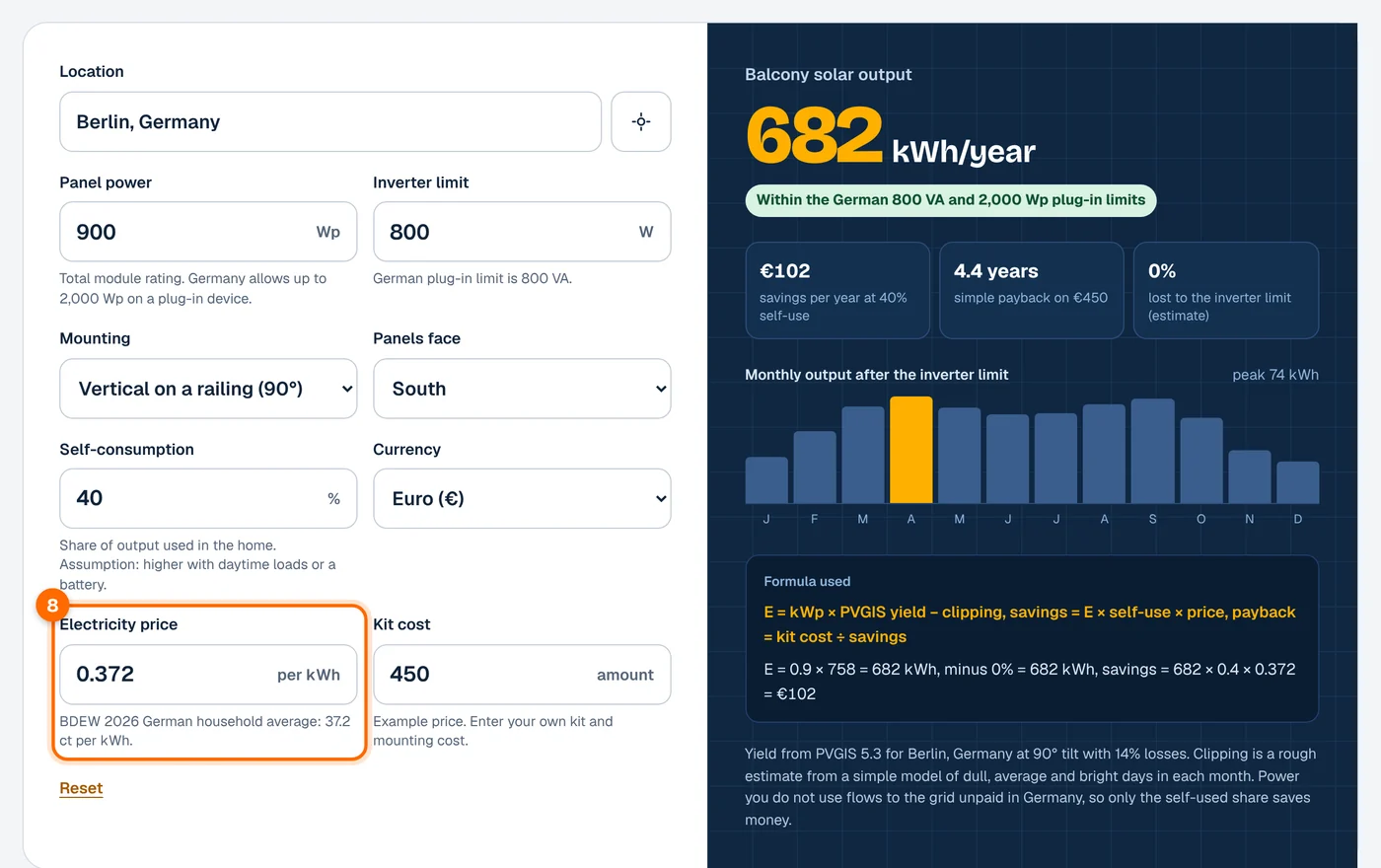
- Enter your electricity price. Use your price per kWh including taxes. The default is 0.372, the 2026 German household average.
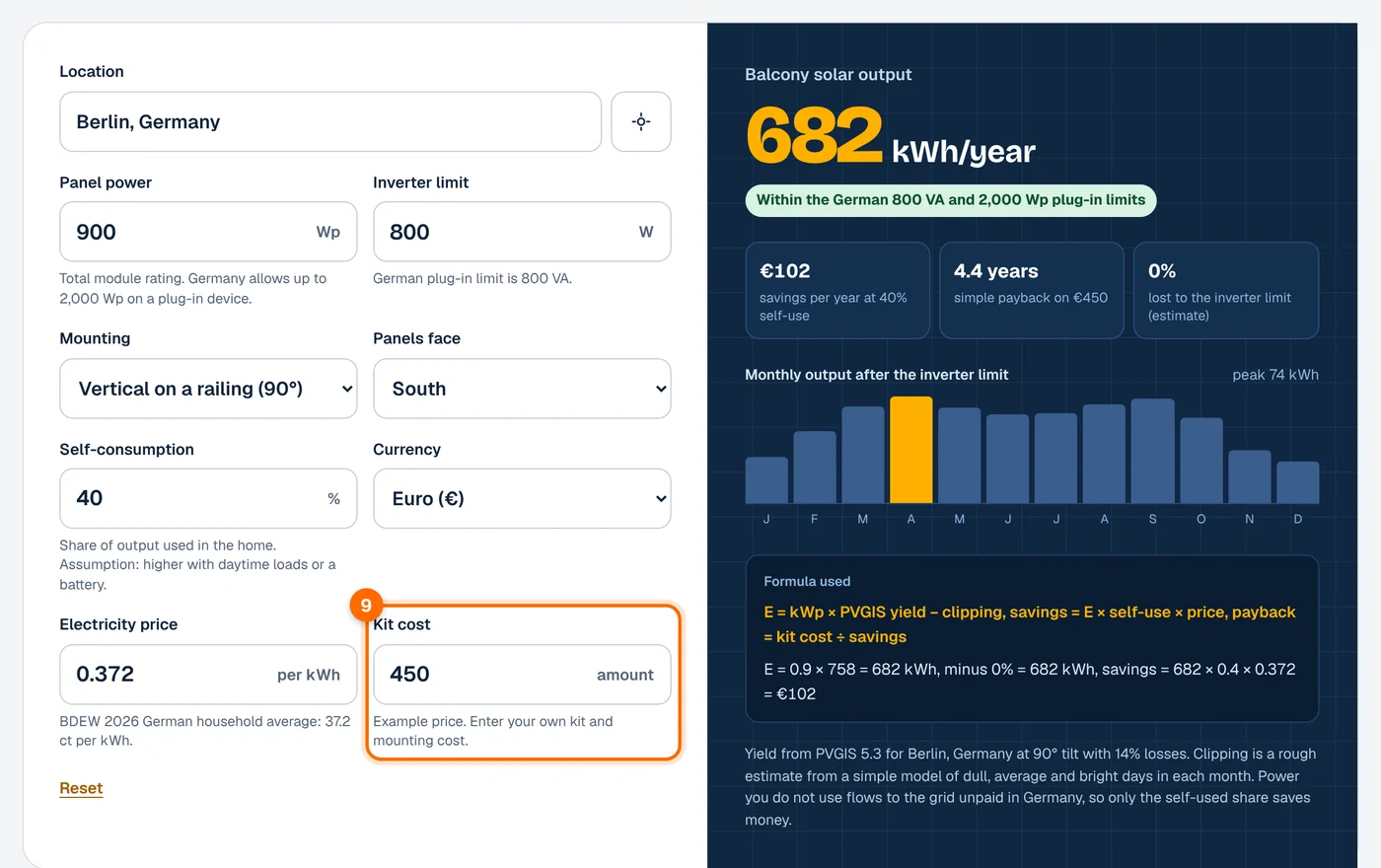
- Enter the kit cost. Include the panels, inverter, mounting and cable. The default of 450 is an example only.
- Read the yearly output. The big number is kWh per year after the inverter limit. The cards show yearly savings, simple payback and the estimated share lost to clipping.
Balcony solar formula
Where:
- E is yearly output in kWh after the inverter limit.
- P is the total panel power in kWp.
- Y is the yearly yield of 1 kWp at your tilt and direction, from PVGIS 5.3 with 14% system losses.
- k is the share of energy clipped when the panels could produce more than the inverter allows. The calculator estimates it month by month with a simple model of dull, average and bright days, so treat it as a guide.
- s is self-consumption as a decimal and c is your electricity price per kWh.
Only the self-used share saves money. Under section 8(5a) of the German Renewable Energy Sources Act (EEG), plug-in devices of up to 2 kW of panels and 800 VA of inverter power that feed in without payment can be connected under simplified rules. Registration in the Marktstammdatenregister still applies.
Worked examples
Example 1: 900 Wp on a south-facing railing in Berlin
PVGIS gives about 758 kWh per kWp a year for vertical panels facing south in Berlin. At 900 Wp the panels never reach 800 W on an average day, so clipping is close to zero.
With a €450 kit, simple payback is 450 ÷ 101.50 = 4.4 years.
Example 2: 2,000 Wp on a tilted stand in Berlin
At 35° facing south, PVGIS gives about 1,049 kWh per kWp. Before the inverter limit, 2 kWp would make 2 × 1,049 = 2,099 kWh. The model estimates that the 800 W limit clips about 20.5% of that in bright conditions.
With a hypothetical €800 kit, payback is about 2.6 years.
Example 3: 800 Wp facing east
Two 400 Wp panels at 35° facing east yield about 835 kWh per kWp in Berlin: 0.8 × 835 = 668 kWh, saving about €99 a year at 40% self-use.
Yearly output by panel power and mounting in Berlin
Estimates from this calculator using PVGIS 5.3 data for Berlin, facing south, 14% losses and an 800 W inverter limit, retrieved October 2026.
| Panel power | Vertical railing (90°) | Tilted stand (35°) |
|---|---|---|
| 800 Wp | 606 kWh | 840 kWh |
| 900 Wp | 682 kWh | 944 kWh |
| 1,600 Wp | 1,153 kWh | 1,480 kWh |
| 2,000 Wp | 1,346 kWh | 1,669 kWh |
Doubling panel power does not double output, because the 800 W inverter caps the sunniest hours.
What affects the result
Mounting angle and direction
Vertical panels on a railing produce about 28% less per kWp than a 35° stand in Berlin, using PVGIS data. They do relatively better in winter, when the sun is low: PVGIS gives a vertical panel slightly more than a 35° panel in December and January in Berlin.
Self-consumption
In Germany, power you do not use flows into the grid without payment, so self-consumption drives the savings. A small battery or running the dishwasher and washing machine at midday can raise it.
Inverter limit and panel oversizing
Adding panels beyond 800 Wp still helps in the morning, the evening and on cloudy days, when the inverter has spare capacity. The gain shrinks as clipping rises.
Electricity price
Savings scale with your price per kWh. Fraunhofer ISE’s Recent Facts about Photovoltaics in Germany (August 2026) cites a BDEW average of 37.2 ct per kWh for a household using 3,500 kWh in 2026. Check your own tariff.
Frequently asked questions
How much does a balcony solar kit produce per year?
In Germany, a typical 800 to 900 Wp kit produces roughly 600 to 950 kWh a year, depending on mounting. In Berlin, PVGIS data give about 682 kWh for 900 Wp hung vertically facing south and about 944 kWh on a 35° stand. Southern Germany yields a little more.
How many watts of panels can I use on a balcony power plant in Germany?
The EEG’s simplified rules cover plug-in devices with up to 2 kW of installed panel power and up to 800 VA of inverter output. You can fit more panel watts than the inverter rating, and the inverter limits what reaches your home’s wiring.
Does a balcony solar kit pay for itself?
It can within a few years. At 37.2 ct per kWh, a 900 Wp vertical kit in Berlin that saves about €102 a year pays back a €450 cost in about 4.4 years. Lower self-consumption, shade or a higher kit price lengthen payback.
Do I get paid for power my balcony kit exports?
Not in Germany. The simplified rules for plug-in devices apply when exported power is fed in without payment. That is why the calculator counts savings only on the self-used share. Rules differ in other countries, so check the local rules on plug-in solar, export payments and registration before you buy a kit.
Is a vertical railing mount much worse than a tilted one?
For yearly energy, yes. In Berlin, PVGIS gives about 758 kWh per kWp for vertical south-facing panels and about 1,049 kWh per kWp at 35°, so the vertical mount yields about 28% less. A vertical mount is often the only option on a balcony.