Solar Panel Calculator
Find the solar system size, panel count and yearly output you need from your bill or kWh use, using real sun data for your location.
Quick answer
To size a solar system, divide your yearly electricity use by the yearly output of 1 kW of panels at your location, then multiply by the share you want to cover. kW = annual kWh × offset ÷ yield. A home using 10,000 kWh a year in Phoenix, where 1 kW yields about 1,831 kWh, needs about 5.5 kW.
How to use the solar panel calculator
- Choose how to size the system. Pick Monthly bill if you only know what you pay. Pick Monthly kWh if your bill shows your usage, which gives a more accurate result.

- Enter your average monthly bill. Use an average of the last 12 months, because summer and winter bills differ. If you can, subtract fixed connection fees, since solar does not reduce them.

- Enter your electricity rate. This is the price per kWh on your bill. The calculator divides your bill by this rate to estimate your monthly usage.

- Set your location. Search for your city or use your device location. The calculator pulls long-term sun data for that spot from PVGIS, the European Commission’s solar database.

- Pick the panel wattage. Most new home panels are rated 350 to 450 W. Higher wattage means fewer panels for the same system size.

- Set the offset target. 100% aims to cover all your yearly usage. Choose less if your roof is small or your utility pays little for exported power.

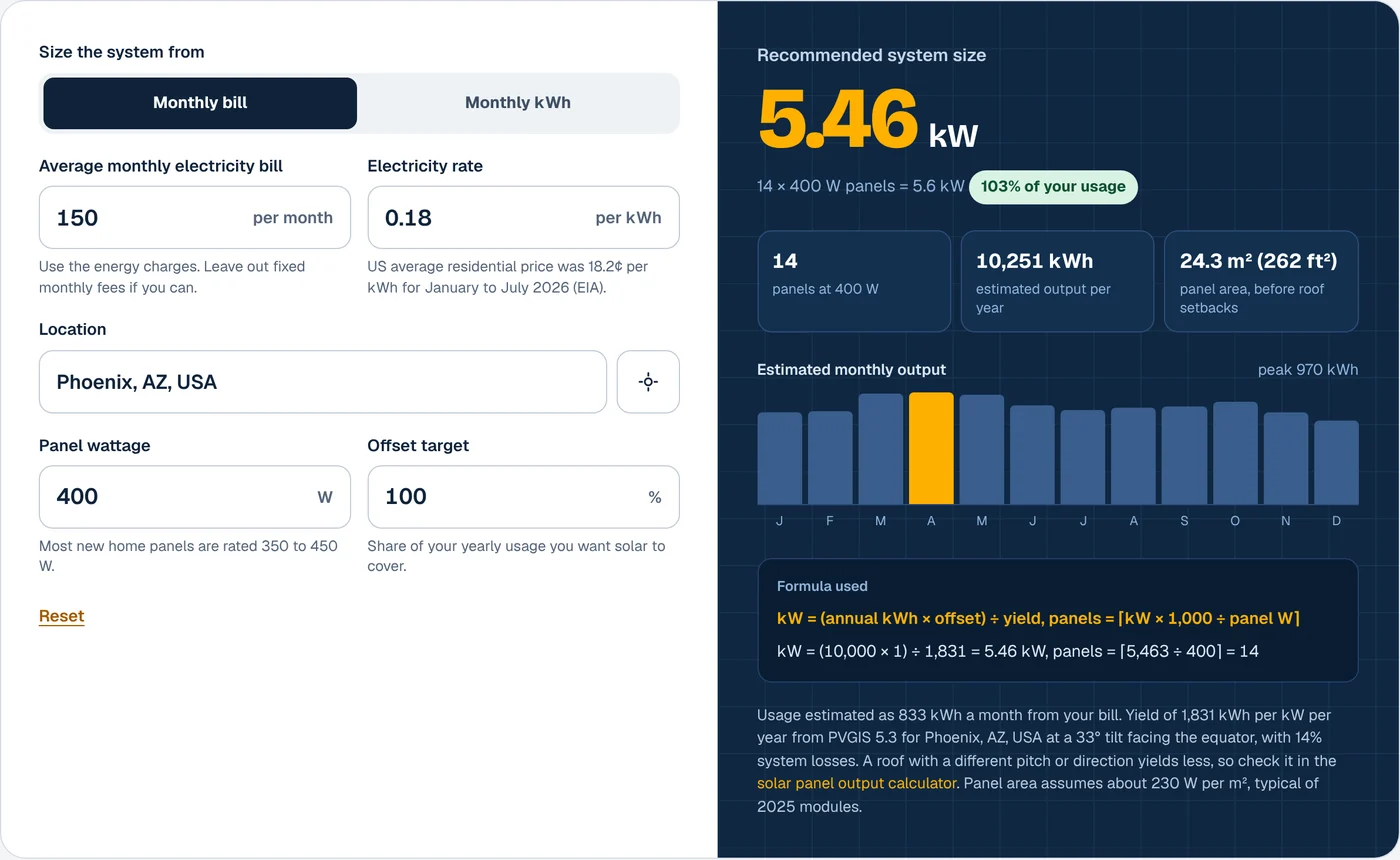
- Read the recommended system size. The big number is the kW you need. Below it you see the panel count, the yearly output, the panel area and a month by month output chart.

Solar panel calculator formula
The calculator works in three steps: find your yearly usage, find how much 1 kW of panels produces where you live, then divide.
Where:
- Annual kWh is the electricity your home uses in a year.
- Offset is the share of that usage you want solar to cover, as a decimal (100% = 1.0).
- Yield is the yearly output of 1 kW of panels at your location, in kWh per kW. The calculator takes it from PVGIS 5.3 at the best tilt facing the equator, with 14% system losses.
- Panel W is the rated power of one panel. The ⌈ ⌉ brackets mean round up to a whole panel.
- 230 is watts per square meter of module. Fraunhofer ISE reports that typical new silicon modules reached close to 23% efficiency in 2025, or about 230 W per m², in its Recent Facts about Photovoltaics in Germany.
The 14% loss figure is the default in the PVGIS user manual. It covers wiring, inverter, dirt and ageing losses.
Worked examples
Example 1: $150 monthly bill in Phoenix
The rate is $0.18 per kWh. Monthly usage is 150 ÷ 0.18 = 833 kWh, so yearly usage is about 10,000 kWh. PVGIS gives about 1,831 kWh per kW per year in Phoenix.
Fourteen 400 W panels make 5.6 kW, which produces about 10,250 kWh a year, or roughly 103% of usage. The panels cover about 24.3 m² (262 ft²).
Example 2: 900 kWh a month in New York, 80% offset
Yearly usage is 900 × 12 = 10,800 kWh. The target is 80%, or 8,640 kWh. PVGIS gives about 1,405 kWh per kW in New York City.
Fifteen 425 W panels make 6.375 kW, which produces about 8,957 kWh a year. That covers about 83% of usage, a little over the target because of rounding up.
Example 3: 300 kWh a month in London
Yearly usage is 3,600 kWh. PVGIS gives about 1,023 kWh per kW in London.
With 450 W panels, 3,520 ÷ 450 = 7.82, so 8 panels (3.6 kW) on about 15.7 m² of roof.
System size for 10,000 kWh a year by city
Yields are PVGIS 5.3 long-term averages at a near-optimal tilt facing the equator, with 14% losses, retrieved October 2026. Your own roof angle and shade will change them.
| City | Yield (kWh per kW per year) | kW for 10,000 kWh | 400 W panels |
|---|---|---|---|
| Phoenix, AZ | 1,831 | 5.46 | 14 |
| Los Angeles, CA | 1,782 | 5.61 | 15 |
| Dallas, TX | 1,499 | 6.67 | 17 |
| Miami, FL | 1,529 | 6.54 | 17 |
| New York, NY | 1,405 | 7.12 | 18 |
| Seattle, WA | 1,166 | 8.58 | 22 |
| London, UK | 1,023 | 9.78 | 25 |
| Munich, Germany | 1,141 | 8.76 | 22 |
| Sydney, Australia | 1,559 | 6.41 | 17 |
| Perth, Australia | 1,691 | 5.91 | 15 |
What affects the result
Your real usage
Sizing from a bill is an estimate. Fixed fees, taxes and tiered or time-of-use rates make bill ÷ rate inexact. If your bill or utility account shows 12 months of kWh, switch to Monthly kWh and use the average. Plan ahead for new loads such as an electric car or heat pump.
Roof tilt, direction and shade
The calculator assumes the best tilt facing the equator. A south-facing US roof at a common pitch loses only a little, but east or west roofs can lose 10 to 20% or more. Shade from trees or chimneys cuts output further. Check your actual roof in the solar panel output calculator.
Offset target and export credit
If your utility credits exports at the full retail rate, a 100% offset often makes sense. Where exports earn much less, a smaller system sized to your daytime use can pay back faster. The net metering calculator shows the difference.
Panel wattage and roof space
Panel wattage does not change the kW you need, only the number of panels. Higher wattage panels are larger, so the roof area for a given kW stays close to the same. Leave room for fire setbacks and walkways, which local codes often require.
Frequently asked questions
How big a solar system do I need for a $150 electric bill?
At $0.18 per kWh, a $150 bill means about 833 kWh a month, or 10,000 kWh a year. In Phoenix that needs about 5.5 kW. In New York it needs about 7.1 kW, and in Seattle about 8.6 kW. Your rate and location change the answer, so enter both above.
How many kWh does a 1 kW solar system produce per year?
It depends on sunshine. PVGIS long-term data give about 1,830 kWh per kW in Phoenix, 1,400 in New York, 1,020 in London and 1,560 in Sydney at a good tilt with 14% losses. Divide your yearly usage by this yield to find the kW you need.
Should I size solar to cover 100% of my usage?
Not always. Under 1:1 net metering, 100% usually gives the best value. Under net billing, exports earn far less than imports cost, so a system closer to your daytime use may pay back sooner. Roof space and budget also limit size. Try 70% to 100% and compare.
How much roof space do solar panels need?
Typical new panels produce about 230 W per square meter, so each kW needs roughly 4.3 m² (47 ft²) of panel area. A 6 kW system needs about 26 m² (280 ft²) of panels, plus space for setbacks and gaps between rows. Steep or broken roofs fit less.
Is this the same as a quote from an installer?
No. It is a planning estimate from long-term sun data. An installer checks your roof angle, shade, structure, electrical panel and local rules, then designs the exact layout. Use this result to sense-check quotes and to compare offers on cost per watt.