Solar Panel Angle Calculator
Find the best fixed tilt angle for solar panels at your location from PVGIS, with the latitude rule, seasonal angles and the yield on your own roof.
Quick answer
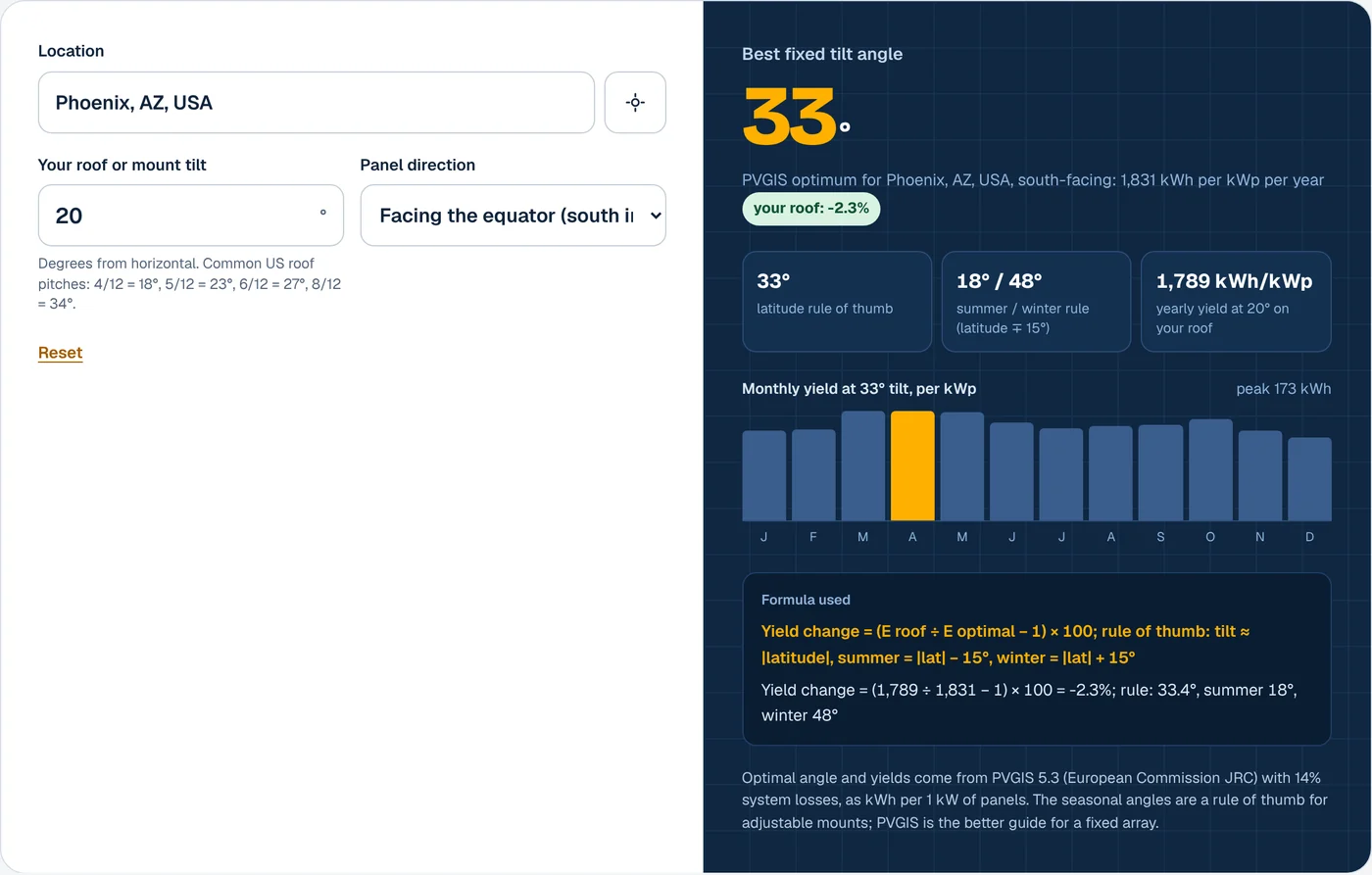
The best fixed tilt for solar panels is close to your latitude, and often a few degrees flatter in cloudy climates. Phoenix, Arizona (33.4° N) has a PVGIS optimum of 33°. For adjustable mounts, a common rule of thumb is latitude − 15° in summer and latitude + 15° in winter, and small tilt errors cost only a few percent.
How to use the solar panel angle calculator
- Choose your location. Search for a city or ZIP code, or use your device location. The calculator sends the coordinates to PVGIS to find the optimal angle and yearly yield for that spot.

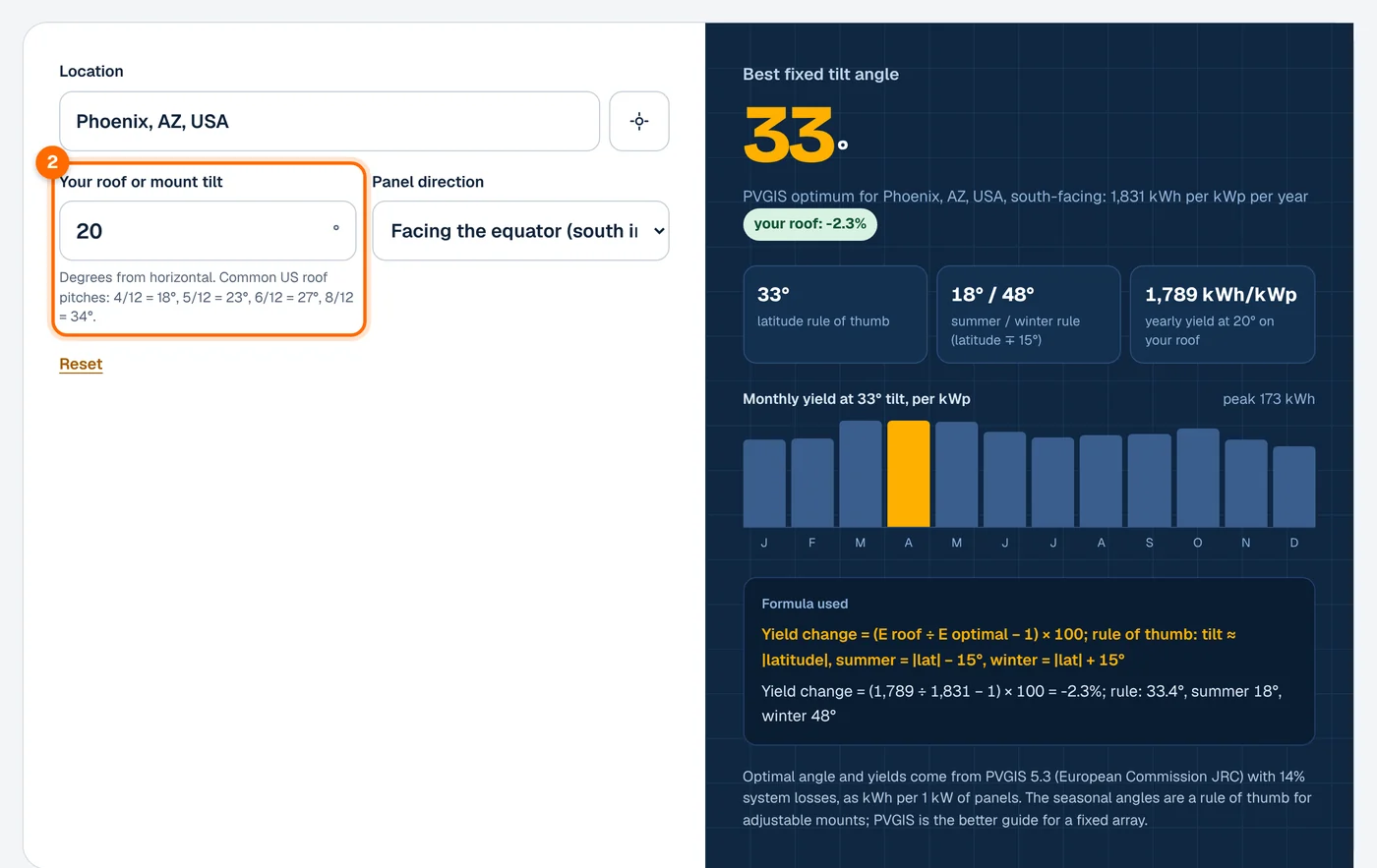
- Enter your roof or mount tilt. Use degrees from horizontal. If you know the roof pitch, 4/12 is about 18°, 6/12 about 27° and 8/12 about 34°.
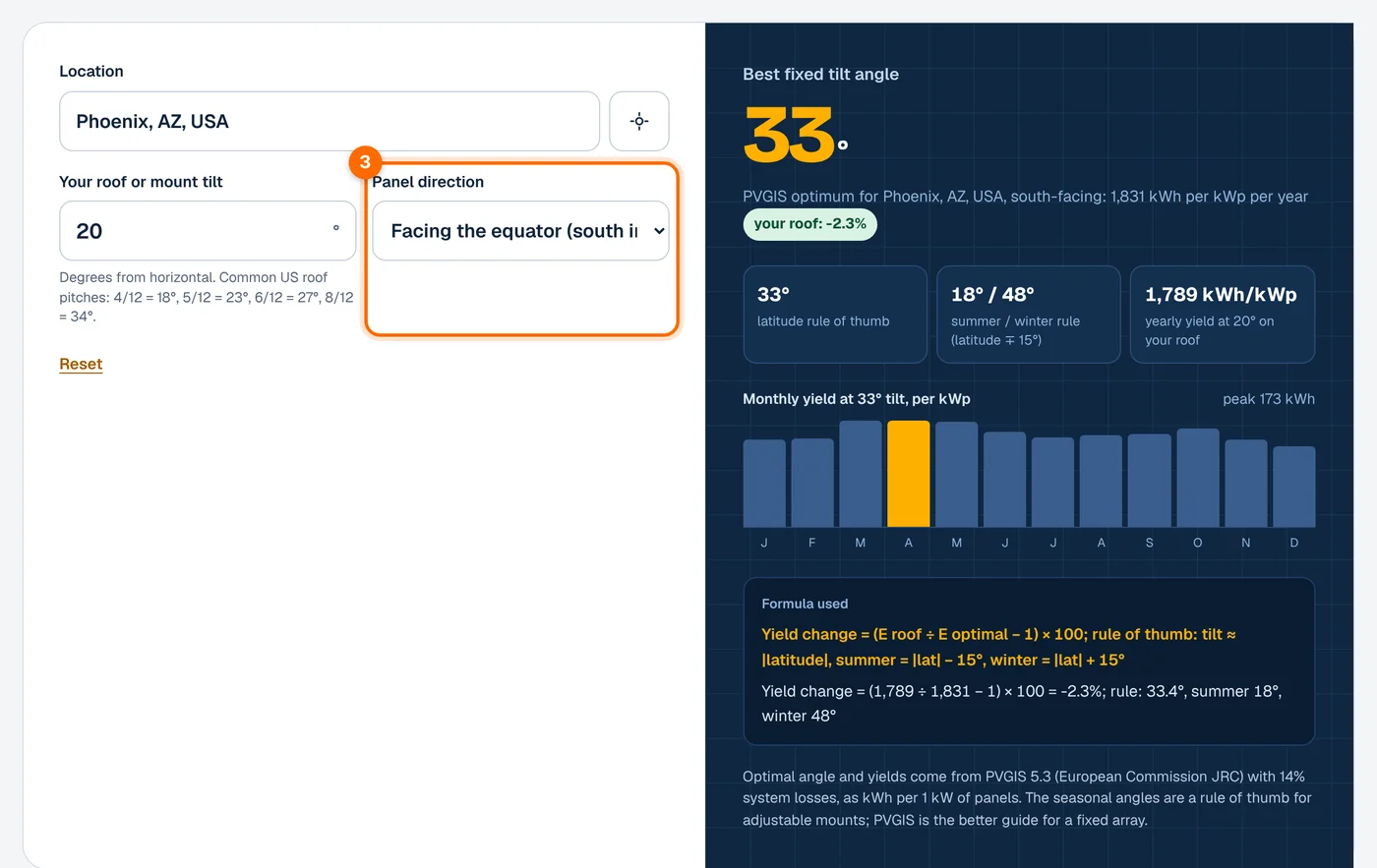
- Choose the panel direction. Pick the way the panels face. In the US, facing the equator means facing south; in the southern hemisphere, the calculator flips this to north automatically.
- Read the best tilt angle. The big number is the PVGIS optimal fixed tilt. The cards show the latitude rule of thumb, the seasonal angles, and the yearly yield on your roof with its percentage difference from the optimum.

Solar panel angle formula
The main result comes from PVGIS, which simulates a full year of hourly sun data at your location and searches for the tilt and direction that give the most energy. The calculator then compares your roof against that optimum.
It also shows the classic rules of thumb:
Where:
- φ is your latitude in degrees. The absolute value is used, so the rules work in both hemispheres.
- Eopt is the yearly yield in kWh per kW of panels at the PVGIS optimal angle.
- Eroof is the yearly yield at your tilt and direction.
- ΔE is the percentage difference. A negative value means your roof makes less than the optimum.
The seasonal ±15° rule is a rule of thumb for adjustable mounts, not a precise optimum. Yields use PVGIS from the European Commission’s Joint Research Centre with 14% system losses.
Worked examples
These figures come from PVGIS 5.3 (ERA5 sun data, 14% losses), checked in October 2026.
Example 1: Phoenix, Arizona, on a 20° roof
Latitude 33.4° N. PVGIS gives an optimal tilt of 33° and 1,831 kWh per kWp per year. A south-facing 20° roof gives 1,789 kWh per kWp.
The rule of thumb gives 33° year-round, 18° for summer and 48° for winter. The same 20° roof facing east would give 1,551 kWh per kWp, about 15.3% below the optimum, so direction matters more than a few degrees of tilt.
Example 2: Seattle, Washington, on a 27° roof
Latitude 47.6° N. PVGIS gives an optimum of only 39°, with 1,166 kWh per kWp. Cloudy skies send more diffuse light, which favors flatter panels.
Both lose less than 2%, so building a tilt frame on a 27° roof would add little.
Example 3: New York, an 18° roof facing southwest
Latitude 40.7° N. The optimum is 38° with 1,405 kWh per kWp. An 18° roof facing 45° west of south gives 1,264 kWh per kWp.
A 10% shortfall is worth knowing when you size the array, but a southwest roof is still a sound place for panels.
Optimal tilt by US city
PVGIS 5.3 optimal fixed tilt and yearly yield per kW of panels, 14% losses, checked October 2026.
| City | Latitude | PVGIS optimal tilt | Yield at optimum (kWh/kWp/yr) |
|---|---|---|---|
| Miami, FL | 25.8° N | 26° | 1,529 |
| Houston, TX | 29.8° N | 28° | 1,401 |
| Phoenix, AZ | 33.4° N | 33° | 1,831 |
| Los Angeles, CA | 34.1° N | 32° | 1,782 |
| Denver, CO | 39.7° N | 40° | 1,834 |
| New York, NY | 40.7° N | 38° | 1,405 |
| Chicago, IL | 41.9° N | 38° | 1,392 |
| Seattle, WA | 47.6° N | 39° | 1,166 |
| Anchorage, AK | 61.2° N | 49° | 1,005 |
In sunny, dry places the optimum sits close to latitude. In cloudy or high-latitude places it is often several degrees flatter.
What affects the result
Latitude
The sun sits lower in the sky the farther you are from the equator, so the best tilt rises with latitude. As a Penn State solar course puts it, a tilt equal to latitude is a rule of thumb, and real optimums can differ by several degrees.
Cloud cover and diffuse light
On cloudy days light arrives from the whole sky, not just the sun’s direction. Flatter panels see more of that sky, which is why Seattle and Anchorage have optimums well below their latitude.
Panel direction
Facing away from the equator usually costs more than a tilt error. In the Phoenix example, an east-facing 20° roof loses about 15%, while the same roof facing south loses only 2.3%. Run your own direction through the calculator to see the effect at your site.
Seasonal goals
Off-grid systems that must work in winter benefit from a steeper tilt, which also sheds snow. Grid-tied systems with net metering usually aim for the most energy over the whole year.
Frequently asked questions
What is the best angle for solar panels?
For a fixed array, the angle that gives the most yearly energy is usually close to your latitude, and often a little flatter in cloudy places. The calculator gets the exact figure for your location from PVGIS. In the examples on this page, roofs 12° to 13° off the optimum lose only about 2%.
Should I adjust my solar panel angle by season?
If your mount is adjustable, tilting flatter in summer and steeper in winter can add some energy. A common rule of thumb is latitude − 15° for summer and latitude + 15° for winter. Most rooftop systems stay fixed because the gain is small compared with the effort.
Is it worth tilting panels on a flat roof?
Tilting panels on a flat roof usually raises yearly output and helps rain wash them clean. But tilted rows need spacing to avoid shading each other, so you fit fewer panels. Compare the yield at 0° and at a tilt with the calculator before deciding.
How do I convert roof pitch to degrees?
Divide the rise by the run and take the arctangent. A 4/12 pitch is arctan(4 ÷ 12) = 18.4°. A 6/12 pitch is 26.6°, an 8/12 pitch is 33.7° and a 12/12 pitch is 45°. Enter the result as your roof tilt.
Which way should solar panels face in the southern hemisphere?
In the southern hemisphere, panels should face north, toward the equator. The calculator handles this automatically when your location has a negative latitude: “facing the equator” becomes north-facing. The tilt rules use the absolute latitude, so they work the same way.