STC Calculator
Calculate how many STCs your Australian solar system or home battery earns and what the rebate is worth, using current CER rules.
Quick answer
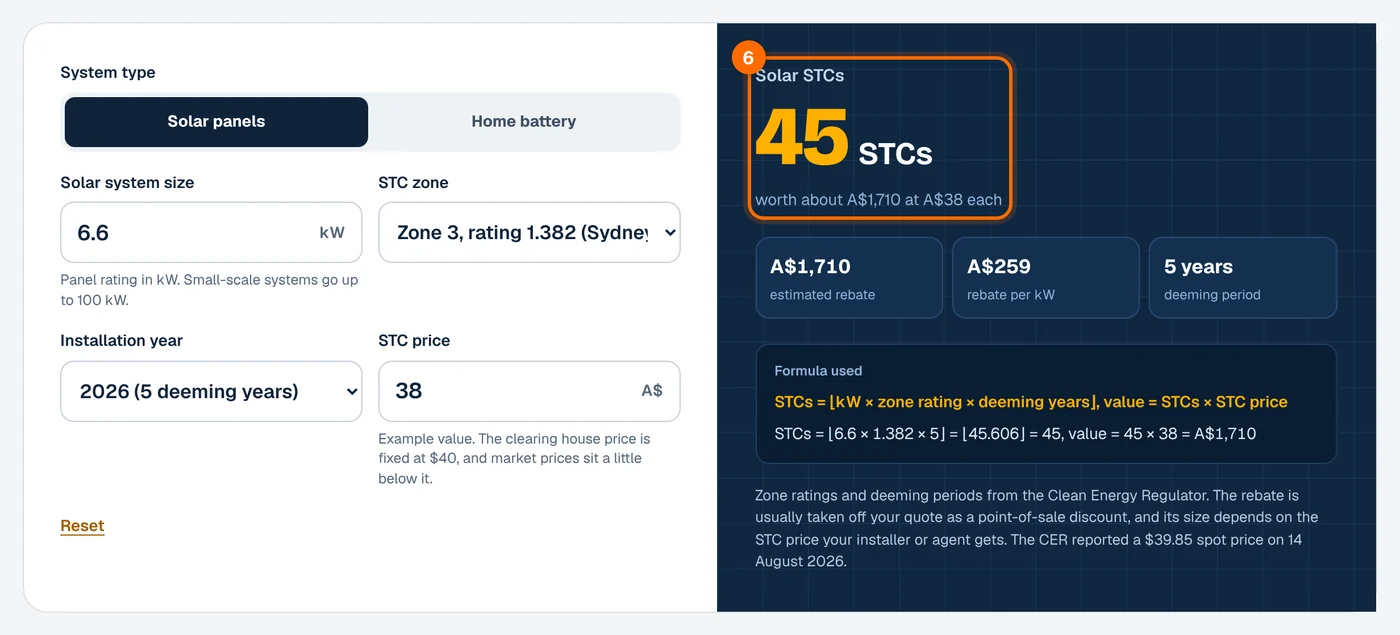
For solar panels in Australia, STCs = system kW × zone rating × deeming years, rounded down. A 6.6 kW system in zone 3 installed in 2026 earns ⌊6.6 × 1.382 × 5⌋ = 45 STCs, worth about A$1,710 at A$38 each. Home batteries use a tiered STC factor of 6.8 per usable kWh from 1 May 2026.
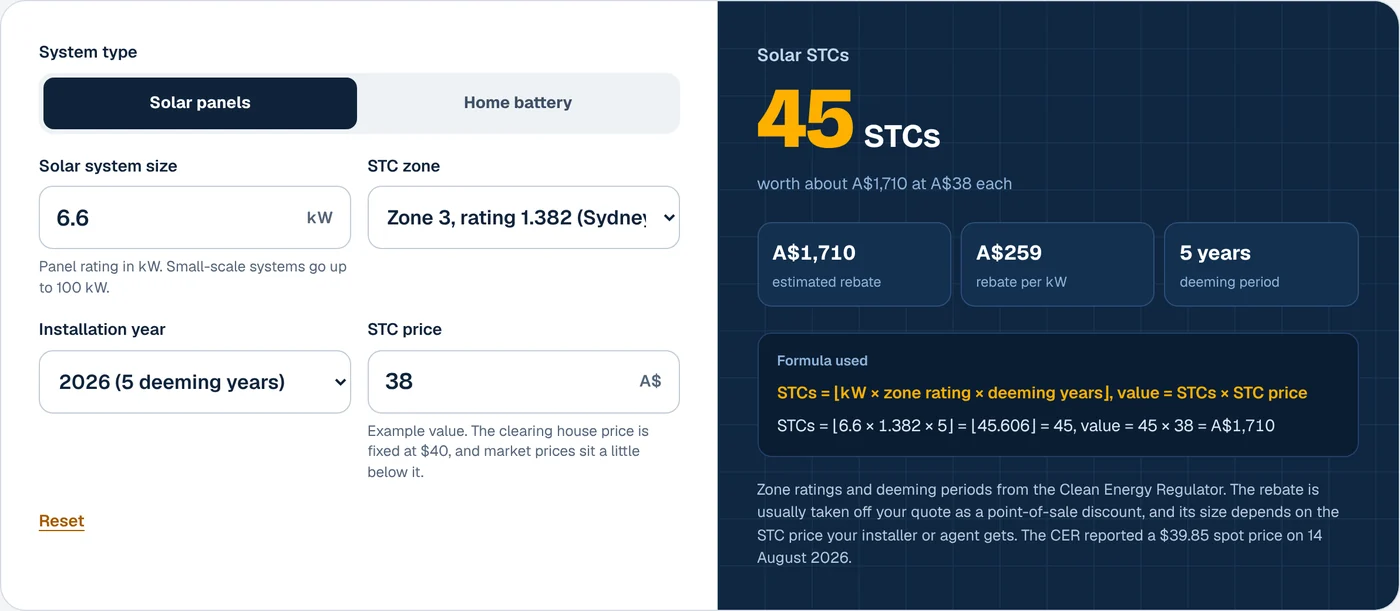
How to use the STC calculator
- Choose the system type. Pick Solar panels for a rooftop PV system. Pick Home battery to estimate STCs under the Cheaper Home Batteries Program, then enter the usable capacity and installation period.
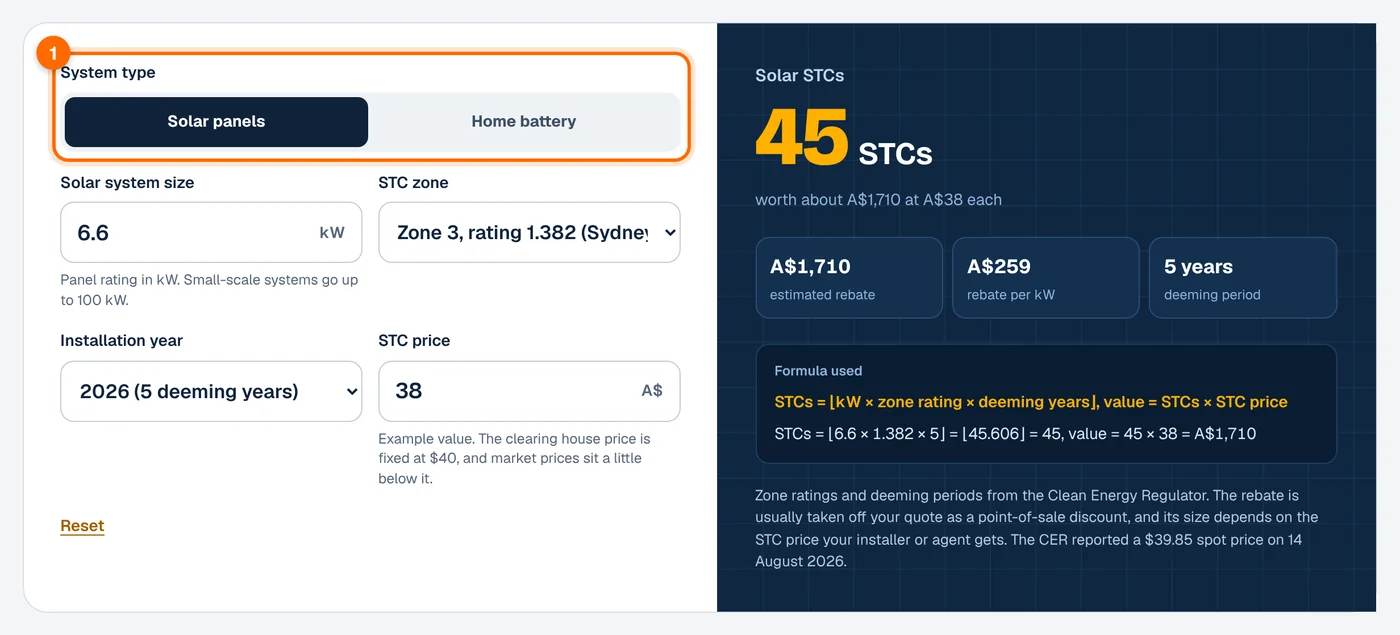
- Enter the solar system size. Use the total panel rating in kW. Small-scale systems go up to 100 kW; larger systems earn a different certificate.
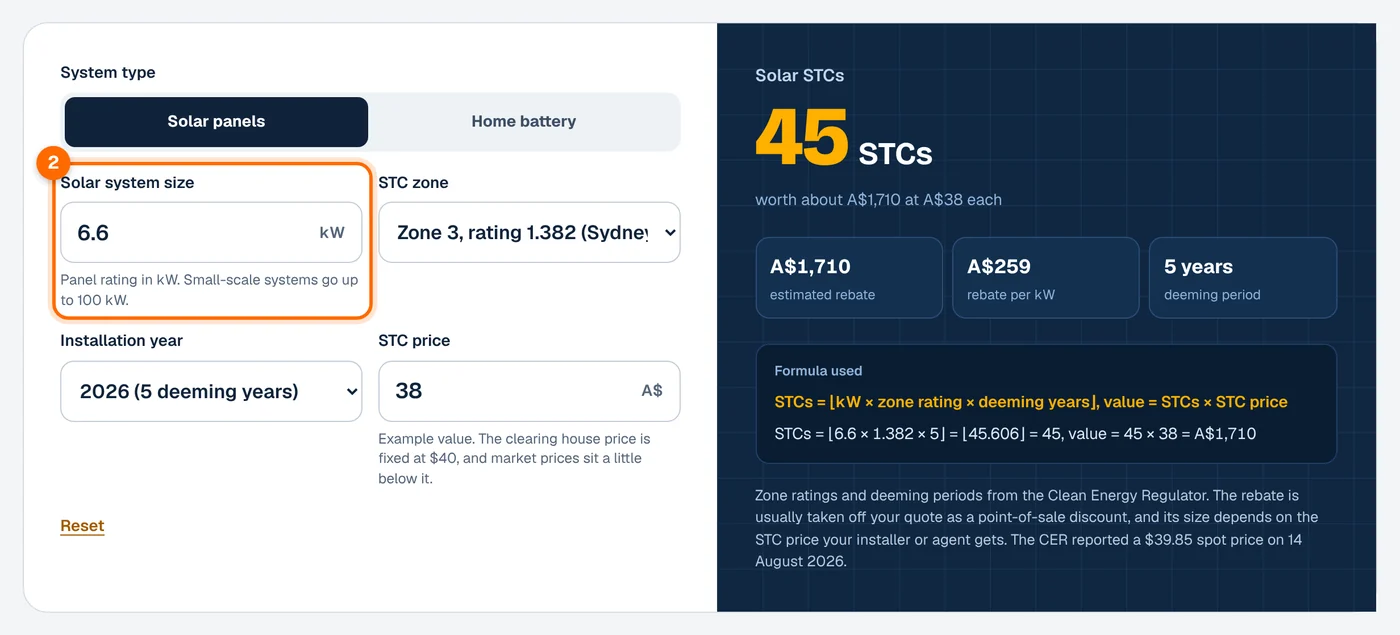
- Choose your STC zone. The zone depends on your postcode and reflects how much sun the area gets. Zone 3 covers most capital cities, while Melbourne and Hobart are zone 4.
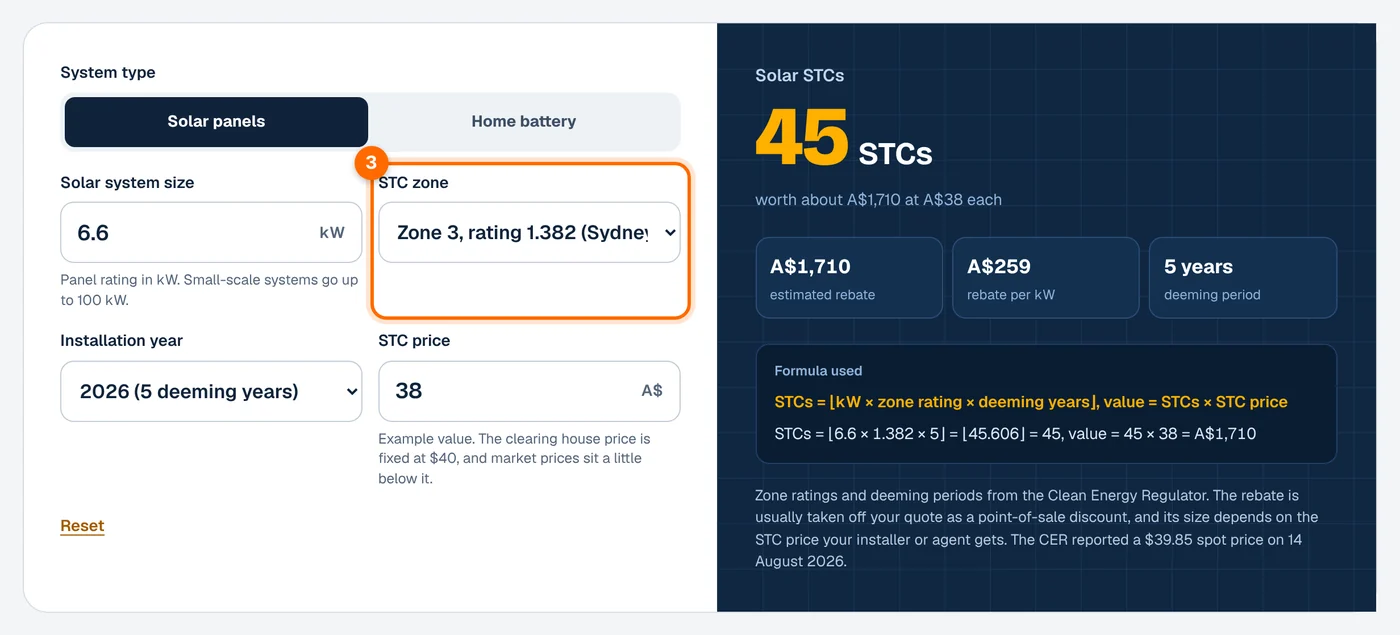
- Choose the installation year. The deeming period falls by one year each year until the scheme ends in 2030, so the same system earns fewer STCs each year.
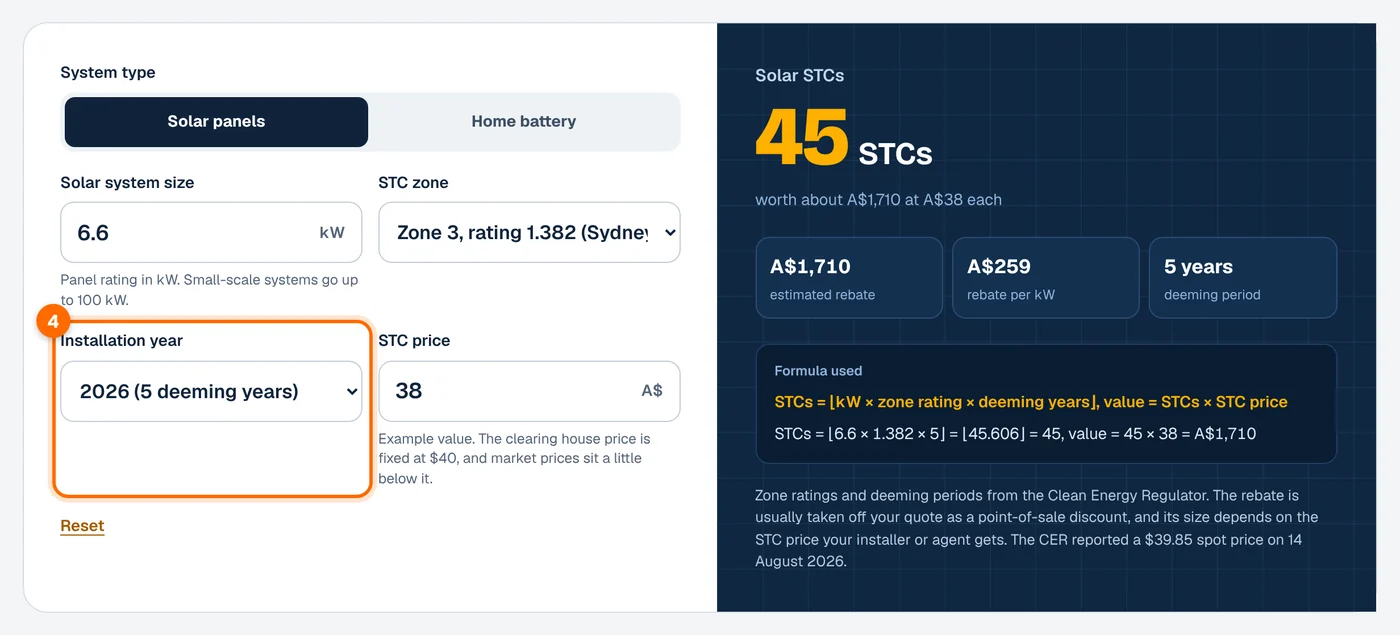
- Enter the STC price. This is the dollar value per certificate. The default of A$38 is an editable example below the recent market price.
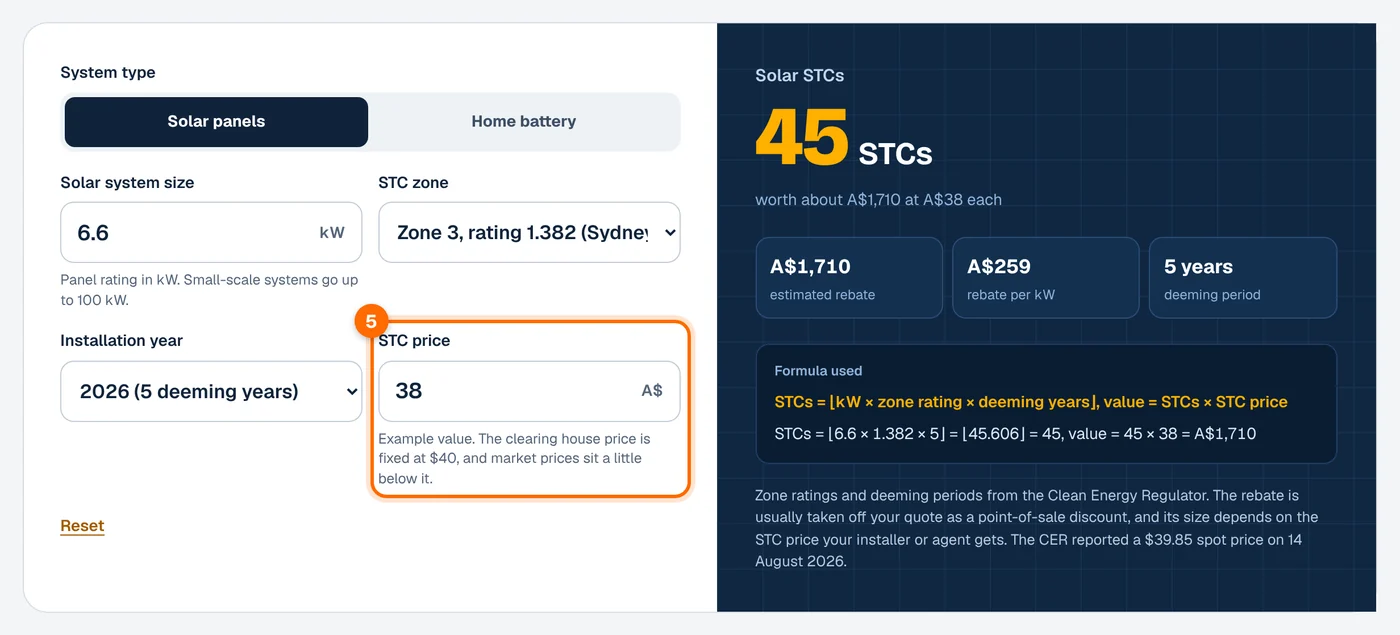
- Read the number of STCs. The big number is your certificate count. The cards show the estimated rebate in dollars and the rebate per kW or per kWh.
STC formula
Solar panels
- P is the rated power output of the panels in kW.
- Z is the zone rating: 1.622 (zone 1), 1.536 (zone 2), 1.382 (zone 3) or 1.185 (zone 4).
- D is the deeming period in years: 5 for 2026, 4 for 2027, 3 for 2028, 2 for 2029 and 1 for 2030.
- ⌊ ⌋ means round down to a whole certificate, as the Renewable Energy (Electricity) Regulations require.
The zone ratings and deeming periods come from the Clean Energy Regulator’s page on how to calculate STC entitlements, last updated 18 September 2026.
Home batteries (installed from 1 May 2026)
- C is the battery’s usable capacity in kWh. Each tier term only applies when C is above its lower bound.
- F is the STC factor for the period the battery is installed: 6.8 for 1 May to 31 December 2026, then 5.7, 5.2, 4.6, 4.1, 3.6, 3.1, 2.6 and 2.1 for each half-year to the end of 2030.
This method is set out in regulation 20(7), inserted by the Renewable Energy Legislation Amendment (2026 Measures No. 1) Regulations 2026. Only the first 50 kWh of usable capacity earns STCs. The battery must have a nominal capacity of 5 to 100 kWh and be installed with solar PV.
Worked examples
Example 1: 6.6 kW in Sydney, 2026
Sydney is in zone 3, rating 1.382.
Example 2: 10 kW in Melbourne, 2026
Melbourne is in zone 4, rating 1.185.
Example 3: batteries installed in late 2026
A battery with 13.5 kWh usable capacity sits fully in the first tier:
A 40 kWh battery spans all three tiers:
That is worth about A$6,232. Tripling the capacity from 13.5 to 40 kWh adds only 80% more STCs because of the taper.
STCs for a 6.6 kW solar system by zone and year
| Zone (rating) | 2026 | 2027 | 2028 | 2029 | 2030 |
|---|---|---|---|---|---|
| Zone 1 (1.622) | 53 | 42 | 32 | 21 | 10 |
| Zone 2 (1.536) | 50 | 40 | 30 | 20 | 10 |
| Zone 3 (1.382) | 45 | 36 | 27 | 18 | 9 |
| Zone 4 (1.185) | 39 | 31 | 23 | 15 | 7 |
Multiply by the STC price to get the rebate. At A$38, 45 STCs are worth A$1,710.
What affects the result
Installation date
For solar, the deeming period drops each 1 January, so a system installed in December 2026 earns 25% more STCs than the same system in January 2027. For batteries, the factor drops every six months.
Zone
Sunnier zones earn more. A 6.6 kW system earns 53 STCs in zone 1 but 39 in zone 4 in 2026. Check your postcode against the Regulator’s zone list.
STC price
The Clean Energy Regulator’s clearing house price is fixed at A$40, and its quarterly carbon market report showed a spot price of A$39.85 on 14 August 2026. Installers or their agents usually buy your STCs, so the discount on your quote depends on the price they apply.
Battery size
The battery taper means each kWh above 14 earns 60% of the factor and each kWh above 28 earns 15%. Capacity above 50 kWh earns nothing.
Frequently asked questions
How much is the solar rebate for a 6.6 kW system in 2026?
It depends on your zone. In zone 3, which includes Sydney, Brisbane, Perth, Adelaide and Canberra, a 6.6 kW system earns 45 STCs. At A$38 each, the rebate is about A$1,710. In zone 4, which includes Melbourne and Hobart, it earns 39 STCs, about A$1,482.
What is the deeming period for STCs in 2026?
Five years for solar panel systems installed in 2026. The Clean Energy Regulator lists it falling by one year each year: 4 years in 2027, 3 in 2028, 2 in 2029 and 1 in 2030, when the scheme ends. The installation date, not the contract date, sets it.
How are battery STCs calculated after 1 May 2026?
Multiply usable capacity by the STC factor in three tiers: 100% for the first 14 kWh, 60% for 14 to 28 kWh and 15% for 28 to 50 kWh. Add the tiers and round down. The factor is 6.8 for batteries installed from 1 May to 31 December 2026.
Do I get the STC rebate as cash?
Usually not. Most installers take the STCs and subtract their value from your quote as a point-of-sale discount. You can create and sell STCs yourself through the REC Registry, but that takes paperwork and time. Check that your quote shows the STC discount as a separate line.
Can I get STCs for both solar panels and a battery?
Yes. Solar panels earn STCs under the small generation unit rules, and an eligible battery installed with solar earns STCs under the Cheaper Home Batteries Program. Work out each one separately with this calculator and add the two values together.