Battery Calculator
Size a solar or backup battery bank in Ah and kWh from your daily load, days of autonomy and depth of discharge, with the series and parallel layout.
Quick answer
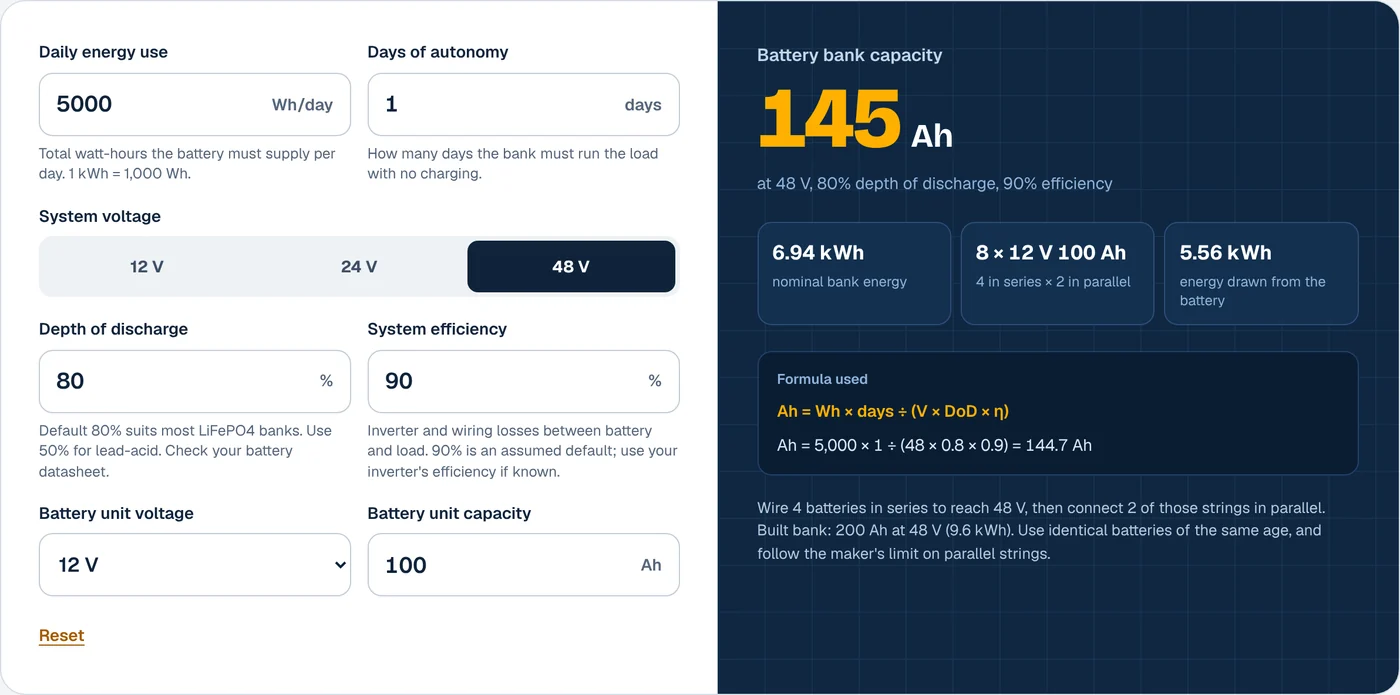
To size a battery bank, multiply your daily watt-hours by the days of autonomy, then divide by system voltage × depth of discharge × efficiency: Ah = Wh × days ÷ (V × DoD × η). A 5,000 Wh daily load for one day on a 48 V LiFePO4 bank at 80% DoD and 90% efficiency needs about 145 Ah.
How to use the battery calculator
- Enter your daily energy use. Add up watts × hours for every load the battery will run in a day. A utility bill shows kWh per month; divide by 30 and multiply by 1,000 to get Wh per day.

- Set the days of autonomy. This is how long the bank must carry the load with no solar or grid charging. Backup systems often use 1 day; remote off-grid cabins often plan for 2 to 3.

- Choose the system voltage. Pick 12 V for small RV and van builds, 24 V for mid-size systems and 48 V for whole-home and larger off-grid systems.

- Enter the depth of discharge. This is the share of rated capacity you plan to use. Use your battery maker’s figure; 80% is the default here for LiFePO4 and 50% is common for lead-acid.
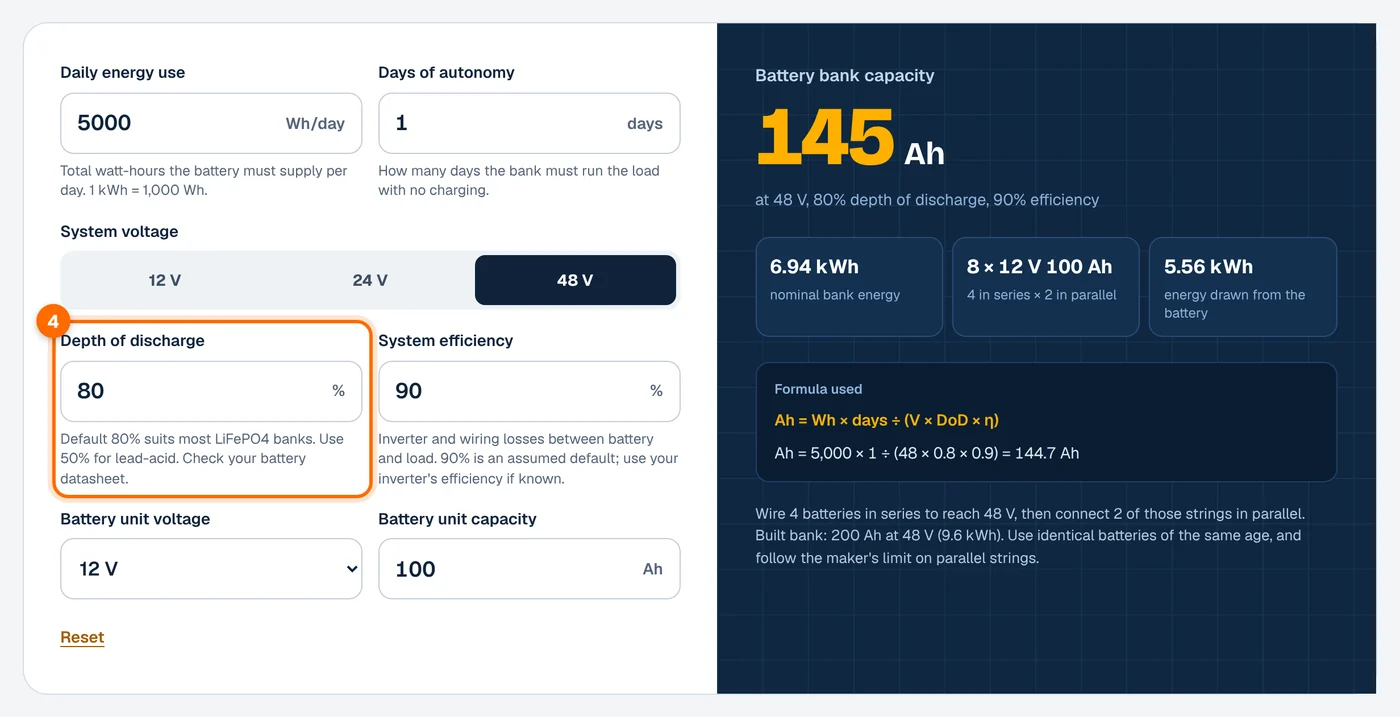
- Enter the system efficiency. This covers inverter and wiring losses between the battery and your appliances. The 90% default is an assumption; use your inverter’s datasheet efficiency if you have it.

- Pick the battery unit voltage. This is the nominal voltage of one battery you plan to buy, such as a 12 V module or a 48 V rack battery.
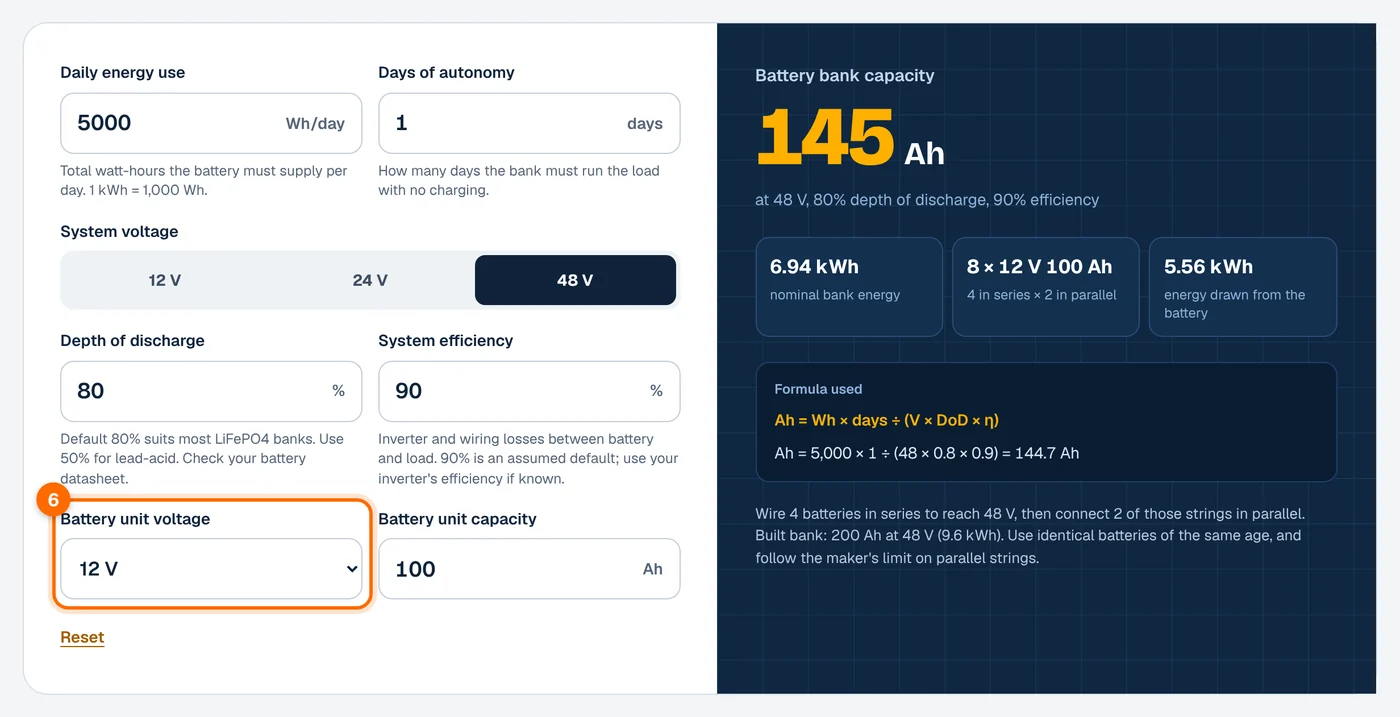
- Enter the battery unit capacity. Use the amp-hour rating on the label or datasheet, for example 100 Ah.

- Read the battery bank size. The big number is the required capacity in amp-hours at your system voltage. The cards show the bank energy in kWh and how many batteries you need in series and in parallel.

Battery calculator formula
The calculator converts your energy need into amp-hours at the bank voltage, then works out the series and parallel layout.
Where:
- Eday is daily energy use in watt-hours (Wh).
- D is days of autonomy.
- V is the nominal system (bank) voltage.
- DoD is the depth of discharge as a decimal, so 80% = 0.8.
- η is the efficiency from battery to load as a decimal.
- Vunit and Ahunit are the voltage and capacity of one battery.
Batteries in series add voltage. Strings in parallel add amp-hours. The total battery count is Nseries × Nparallel.
Worked examples
Example 1: 48 V home backup with 12 V batteries
An example home load uses 5,000 Wh per day. The owner wants 1 day of autonomy on a 48 V LiFePO4 bank at 80% DoD and 90% efficiency.
That is 144.7 × 48 ÷ 1,000 = 6.94 kWh of nominal capacity. With 12 V 100 Ah batteries, 48 ÷ 12 = 4 go in series, and 144.7 ÷ 100 rounds up to 2 strings in parallel. The result is 8 batteries giving 200 Ah at 48 V, or 9.6 kWh.
Example 2: lead-acid cabin, 3 days of autonomy
An example cabin uses 1,200 Wh per day and needs 3 days of storage. The bank is lead-acid at 50% DoD and 85% efficiency.
With 12 V 200 Ah batteries, the 12 V design needs 4 in parallel. The 24 V design needs 2 in series × 2 in parallel. Both use 4 batteries, but the 24 V bank has only 2 parallel strings and half the current, so it is easier to balance and wire.
Example 3: 48 V rack batteries for a larger home
An example load of 10,000 Wh per day needs 1.5 days of backup, using 48 V 100 Ah rack batteries at 90% DoD and 92% efficiency.
Each rack battery is already 48 V, so 1 goes in series and 377.4 ÷ 100 rounds up to 4 in parallel: 400 Ah, or 19.2 kWh.
Amp-hours needed per 1 kWh of daily use
This table shows the bank size for each 1,000 Wh of daily load over 1 day, at 90% efficiency. Multiply by your kWh per day and days of autonomy.
| System voltage | 50% DoD | 80% DoD | 90% DoD | 100% DoD |
|---|---|---|---|---|
| 12 V | 185.2 Ah | 115.7 Ah | 102.9 Ah | 92.6 Ah |
| 24 V | 92.6 Ah | 57.9 Ah | 51.4 Ah | 46.3 Ah |
| 48 V | 46.3 Ah | 28.9 Ah | 25.7 Ah | 23.1 Ah |
Doubling the voltage halves the amp-hours for the same energy. The kWh you store stays the same.
What affects the result
Battery chemistry and depth of discharge
Lead-acid batteries age quickly when drained deeply. Victron’s Energy Unlimited guide recommends never leaving a lead-acid battery more than 50% discharged. LiFePO4 batteries tolerate deeper cycling, but the usable share and cycle life vary by product, so use the datasheet value.
Days of autonomy
Autonomy scales the bank directly. Two days doubles the size of one day. Off-grid systems in cloudy climates need more than grid-tied backup.
Efficiency and losses
Inverters, cables and the battery itself all lose some energy. A lower efficiency means a larger bank for the same appliance energy. DC loads that skip the inverter, such as 12 V lights and fans, lose less.
Temperature and aging
Cold weather reduces the capacity a battery can deliver, and every battery loses capacity as it ages. Many designers add a margin on top of the calculated size to cover both. This calculator does not add one, so round up when choosing batteries.
Series and parallel limits
Only combine identical batteries of the same model, capacity and age. Many makers limit how many strings you can connect in parallel. If the result needs many parallel strings, a higher system voltage or larger batteries is often the cleaner choice.
Frequently asked questions
How many batteries do I need for a 48 V system?
With 12 V batteries, you need 4 in series for every 48 V string. The number of strings in parallel depends on the amp-hours you need. For example, a 145 Ah requirement with 12 V 100 Ah batteries needs 2 strings, so 8 batteries in total. A single 48 V rack battery forms a string on its own.
How do I convert kWh to amp-hours?
Divide watt-hours by voltage. A 10 kWh bank at 48 V is 10,000 ÷ 48 = 208 Ah. The same 10 kWh at 12 V is 833 Ah. Amp-hours only make sense with a voltage attached, so compare batteries in kWh when they have different voltages.
What depth of discharge should I use?
Use the figure your battery maker gives for the cycle life you want. For lead-acid, 50% is a common planning value, because deeper cycling shortens its life. LiFePO4 batteries are often rated for 80% or more. A lower DoD gives a larger bank that lasts longer.
How many days of autonomy do I need?
It depends on how long you may go without charging. A grid-tied home with backup batteries may only need to bridge a short outage. An off-grid cabin may need 2 to 3 days to ride through cloudy weather. A generator for backup charging lets you plan for fewer days.
Is it better to use 12 V, 24 V or 48 V?
Higher voltage carries the same power with less current, so cables, fuses and losses are smaller. 12 V suits small vans and boats with 12 V appliances. 24 V suits mid-size systems. 48 V is the usual choice for whole-home batteries and inverters of several kilowatts.