What Is Net Metering and How Does It Work for Solar?
Short answer
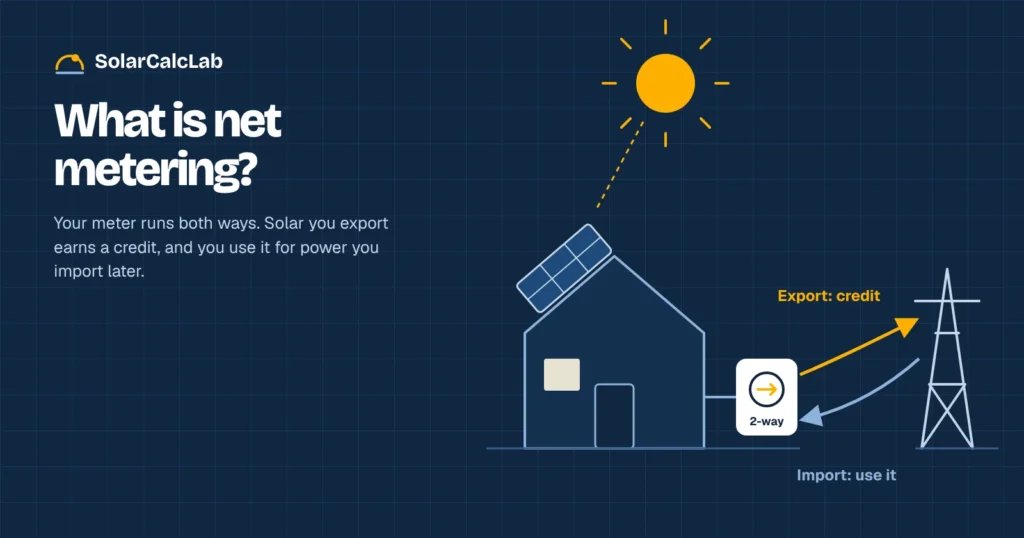
Net metering is a utility billing arrangement that credits solar owners for the electricity their panels send to the grid. Each exported kilowatt-hour offsets a kilowatt-hour you later buy, usually at or near the full retail rate. You pay only for your net consumption, and unused credits typically roll forward until an annual true-up.
If you are pricing a rooftop system, the first policy question to answer is what is net metering, and whether your utility still offers it. The answer decides how much each exported kilowatt-hour (kWh) is worth, and that value often matters as much as the panels themselves.
This guide explains how net metering works for solar, how it differs from net billing and feed-in tariffs, what California changed with NEM 3.0, how credits and the annual true-up behave, and where to find the exact rules for your address. Every example number below is labeled as illustrative.
What is net metering for solar?
A solar array produces power during daylight, but a household uses power around the clock. At noon your panels may produce more than the house needs. At 8 p.m. they produce nothing. Net metering is the billing rule that settles that mismatch.
The Solar Energy Industries Association describes net metering as an arrangement that credits solar customers for electricity they send to the grid, with those credits offsetting power they draw later. Most programs pay in bill credits, not cash. SEIA also notes that most US states have some form of net metering or net billing, with rules that vary by state and utility.
The defining feature of classic net metering is a one-for-one swap: a kWh exported earns roughly the same value as a kWh imported. Programs that pay less than retail for exports are usually called net billing, which we cover below.
How does net metering work?
The mechanics follow the same sequence at most utilities.
- Your panels produce DC power, and an inverter converts it to AC power the house can use.
- The house uses solar first. Whatever your appliances draw at that moment comes from the panels before anything leaves the property. This is called self-consumption.
- Surplus flows to the grid. When production exceeds demand, the extra power passes through your meter and onto the utility’s lines.
- A bidirectional meter records both directions. It logs kWh imported from the grid and kWh exported to it, usually as two separate registers.
- The utility nets the two at the end of each interval. Under classic net metering, the interval is the monthly billing period. You pay for imports minus exports.
- Excess credits roll forward. If you exported more than you imported, the surplus becomes a credit on the next bill, usually until an annual settlement date.
A simple meter example
Take an illustrative month with round numbers. The home uses 800 kWh in total. The panels produce 600 kWh. Of that, 350 kWh is used on site as it is produced, and 250 kWh is exported. The home then imports 450 kWh from the grid at night and on cloudy days.
The meter shows 450 kWh in and 250 kWh out. Under monthly net metering, the utility bills you for 450 minus 250, or 200 kWh. That is exactly the home’s total use (800 kWh) minus total solar output (600 kWh), which is why net metering is easy to model: every kWh the panels make is worth the retail rate, whether you used it or exported it.
Estimate your system. See how many kWh a roof like yours could produce.
Why the netting interval matters
The netting interval is the period over which imports and exports cancel out. Monthly netting is the most generous. Shorter intervals value exports and imports in different hours separately. The shorter the interval, the more your savings depend on using solar power at the moment it is produced. Regulators in Nevada, for example, adopted a new netting interval for one utility in the third quarter of 2025, according to the NC Clean Energy Technology Center.
Net metering vs net billing vs feed-in tariffs
Three compensation models cover most residential solar programs worldwide. They differ mainly in what an exported kWh earns.
| Feature | Net metering | Net billing | Feed-in tariff / export payment |
|---|---|---|---|
| Value of an exported kWh | About the retail rate | An export rate, usually below retail | A set or supplier-chosen export rate |
| How imports are billed | Netted against exports | Full retail or time-of-use rate | Full retail rate, billed separately |
| Typical basis for export value | Retail rate | Avoided cost or wholesale value | Regulated minimum or market offer |
| Best strategy | Size to annual use | Maximize self-consumption, consider a battery | Maximize self-consumption |
| Examples | Legacy NEM 1.0 and 2.0 in California, many US states | California Net Billing Tariff, West Virginia (Appalachian Power and Wheeling Power) | UK Smart Export Guarantee, Australian feed-in tariffs |
Avoided cost is the cost a utility avoids by not having to generate or buy that energy itself. Because it excludes the utility’s fixed costs for wires, poles and customer service, it is almost always lower than the retail rate. When a program pays an export credit based on avoided cost, an exported kWh is worth less than a self-consumed one.
What changed: California NEM 3.0 and the shift to net billing
California’s changes are the best documented example of the shift away from retail-rate credits. The California Public Utilities Commission (CPUC) adopted Decision D.22-12-056 on 15 December 2022, creating the Net Billing Tariff. The industry calls it NEM 3.0. It applies to customers who submitted an interconnection application on or after 15 April 2023.
Key terms, as published by the CPUC:
- Export value: credits are based on the grid value of energy, using the CPUC’s Avoided Cost Calculator. These values are usually below retail import rates, though they can exceed them on late summer evenings.
- Rate plan: customers must take an electrification time-of-use rate (E-ELEC at PG&E, TOU-D-PRIME at SCE, EV-TOU-5 at SDG&E), with lower off-peak and higher on-peak prices.
- Term: the original customer keeps the Net Billing Tariff for nine years.
- Adder: residential PG&E and SCE customers who apply to interconnect before the end of 2027 get slightly higher export credits for nine years. SDG&E customers and homes required to install solar under building code do not.
- Billing: charges are due monthly, and excess credits carry forward until the annual true-up.
Customers who interconnected under the earlier NEM 2.0 tariff may stay on it for 20 years from their interconnection date, according to the CPUC. That grandfathering is why two neighbors with similar roofs can see very different bills.
Other states moving in the same direction
California is not alone. The NC Clean Energy Technology Center’s quarterly “50 States of Solar” reports track a steady stream of changes:
- In Q3 2025, the center counted 57 net metering actions nationwide. West Virginia’s Public Service Commission approved net billing for Appalachian Power and Wheeling Power, and PacifiCorp requested a net metering successor tariff in Washington.
- In Q2 2026, it counted 53 net metering actions. Connecticut legislators mandated a net metering successor program, Maryland lawmakers required one, and Virginia regulators issued a decision on Dominion Energy’s successor tariff.
Many states are replacing retail-rate credits with lower export values. If a quote assumes full net metering, confirm the tariff a new customer would receive today.
How credits roll over and the annual true-up
Most net metering programs bill monthly but settle annually. During spring and summer, a well-sized system often exports more than the house imports, building a credit bank. In winter, production drops and the home draws down that bank.
The true-up is the annual settlement at the end of the 12-month cycle. What happens to leftover credits depends on the program, and California shows the typical pattern:
- Legacy NEM: surplus is trued up as net surplus compensation of about 2 to 3 cents per kWh, according to the CPUC.
- Net Billing Tariff: surplus is credited at the wholesale price of energy.
- Other states and utilities: rules differ, so read the true-up section of your own tariff before sizing a system.
The practical lesson: a system that massively overproduces earns little for the surplus. The best financial size under most net metering rules is close to your annual consumption, not larger.
Know your annual usage first. Add up appliance loads to see how many kWh your household uses per day, month and year.
Does net metering make solar worth it?
Net metering raises the value of every exported kWh, which shortens payback. Net billing lowers it. The worked example below uses the same illustrative month as earlier to show the gap.
Net metering bill (energy portion)
Bill = (Imported kWh − Exported kWh) × Retail rate
Net billing bill (energy portion)
Bill = (Imported kWh × Retail rate) − (Exported kWh × Export rate)
Illustrative inputs: 450 kWh imported, 250 kWh exported, retail rate $0.20 per kWh, export rate $0.06 per kWh.
Net metering: (450 − 250) × $0.20 = $40.00
Net billing: (450 × $0.20) − (250 × $0.06) = $90.00 − $15.00 = $75.00
Difference: $35.00 for the month. All figures are illustrative round numbers, not real tariff rates.
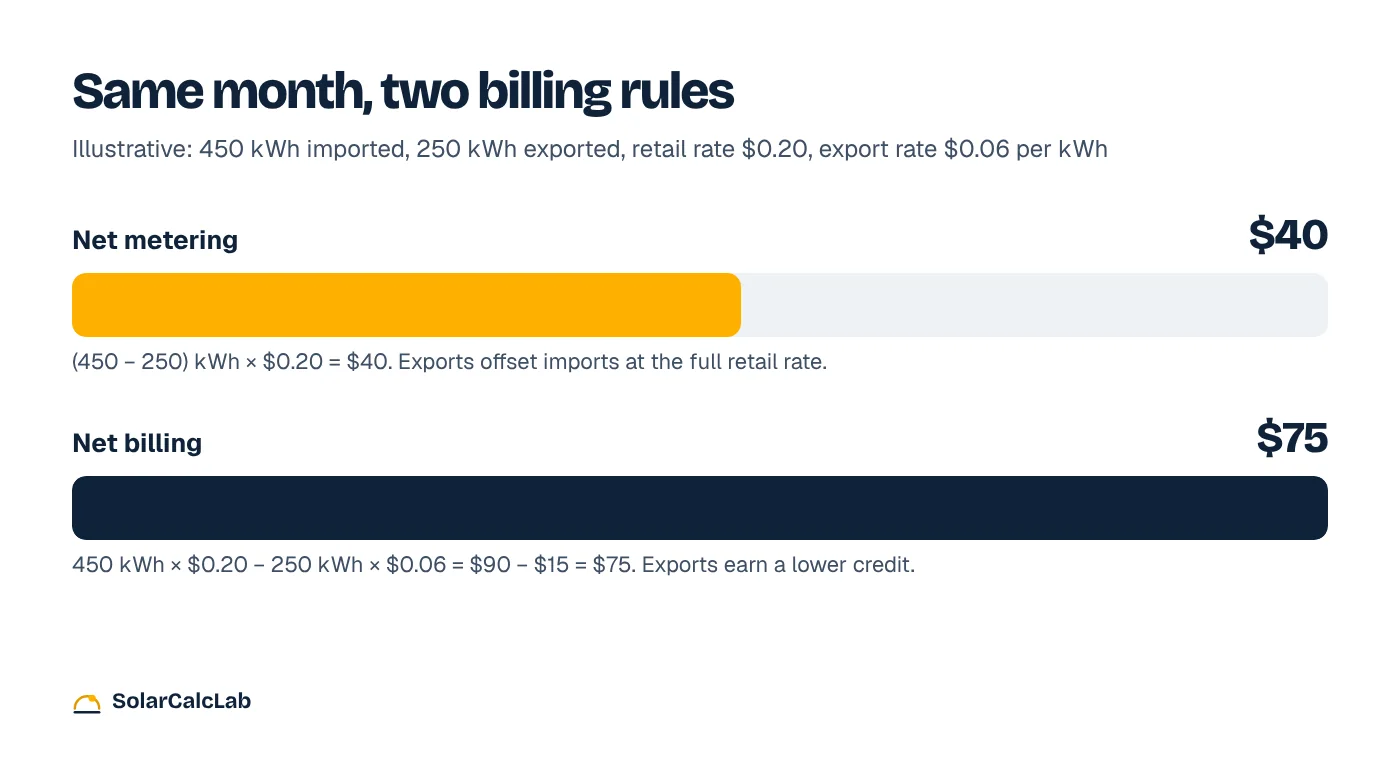
In this example, the same panels save $35 less per month under net billing. The fix is not to give up on solar. It is to change how the system is designed:
- Raise self-consumption. Run dishwashers, laundry, pool pumps and EV charging during solar hours.
- Consider a battery. SEIA notes that storage offers the greatest financial benefit in net billing or time-of-use states, because stored solar can cover expensive evening imports.
- Size to daytime and evening load, not just annual kWh. Under net billing, extra panels mostly add low-value exports.
Upfront cost also changed. The IRS states that the federal Residential Clean Energy Credit (Section 25D) is not available for property placed in service after 31 December 2025. Homeowners buying a system in 2026 should model payback without that 30% credit unless a state or utility incentive applies.
Net metering outside the US
United Kingdom: Smart Export Guarantee
Great Britain does not use net metering. Since 1 January 2020, the Smart Export Guarantee (SEG) has required electricity suppliers with at least 150,000 domestic customers to offer a tariff for exported low-carbon power, according to Ofgem. Smaller suppliers can opt in. Each supplier chooses its own rate, contract length and terms, but the rate must always be above zero. Eligible solar installations go up to 5 MW. Imports are billed at your normal rate, so this works like net billing with a supplier-set export price.
Australia: feed-in tariffs
Australian homes are paid a feed-in tariff for each exported kWh, while imports are billed separately. In Victoria, the Essential Services Commission set a minimum flat feed-in tariff of 0.04 cents per kWh from 1 July 2025. Its time-varying minimums range from 6.57 cents per kWh in the evening peak to 0.00 cents per kWh during the day. Low midday export values make self-consumption and batteries central to the economics there too.
How to check your state’s net metering rules
Rules can differ between utilities in the same state.
- Search DSIRE. The Database of State Incentives for Renewables & Efficiency, run by the N.C. Clean Energy Technology Center at N.C. State University, lets you search policies by ZIP code or state.
- Read your utility’s tariff. Look for a rate schedule named net metering, net energy metering, net billing or distributed generation. Note the export rate, netting interval and true-up month.
- Check your state utility commission. Pending dockets show whether a successor tariff is coming, and whether existing customers are grandfathered.
Frequently asked questions
What is net metering in simple terms?
Net metering is a billing rule for solar homes. When your panels make more power than you use, the extra goes to the grid and you earn a credit. When you need grid power later, the credit pays for it. You are billed only for the net difference over the billing period.
Is net metering the same as net billing?
No. Net metering credits exported electricity at about the retail rate, so every kWh you export offsets one you buy. Net billing pays a separate export rate, often based on avoided cost, which is usually lower than retail. California’s NEM 3.0 is a net billing program, not classic net metering.
What happens to unused solar credits at the true-up?
It depends on your utility. At the annual true-up, leftover credits are settled under your tariff’s rules. In California, legacy NEM surplus earns about 2 to 3 cents per kWh, and Net Billing Tariff surplus earns the wholesale energy price. Either way, surplus is worth far less than retail, so avoid oversizing.
Do I need a special meter for net metering?
You need a meter that records electricity flowing both ways, often called a bidirectional or net meter. Many utilities install or reprogram one after approving your interconnection application. Some newer smart meters already measure imports and exports separately. Your utility handles the meter as part of connecting the system.
Is solar still worth it without full net metering?
It can be, but the design changes. Under net billing, exported power earns less, so savings depend on using solar while it is produced. Shifting loads to daytime and adding a battery can recover much of the value. Run numbers using your utility’s actual export rate, not retail-rate assumptions.
Does the UK or Australia have net metering?
Not in the US sense. Great Britain uses the Smart Export Guarantee, where suppliers pay a rate above zero for each exported kWh and imports are billed normally. Australia uses feed-in tariffs. Victoria’s minimum flat feed-in tariff from 1 July 2025 is 0.04 cents per kWh.