kWh Calculator
Work out the kilowatt-hours any device uses from its power and run time, and see what that energy costs at your electricity rate.
Quick answer
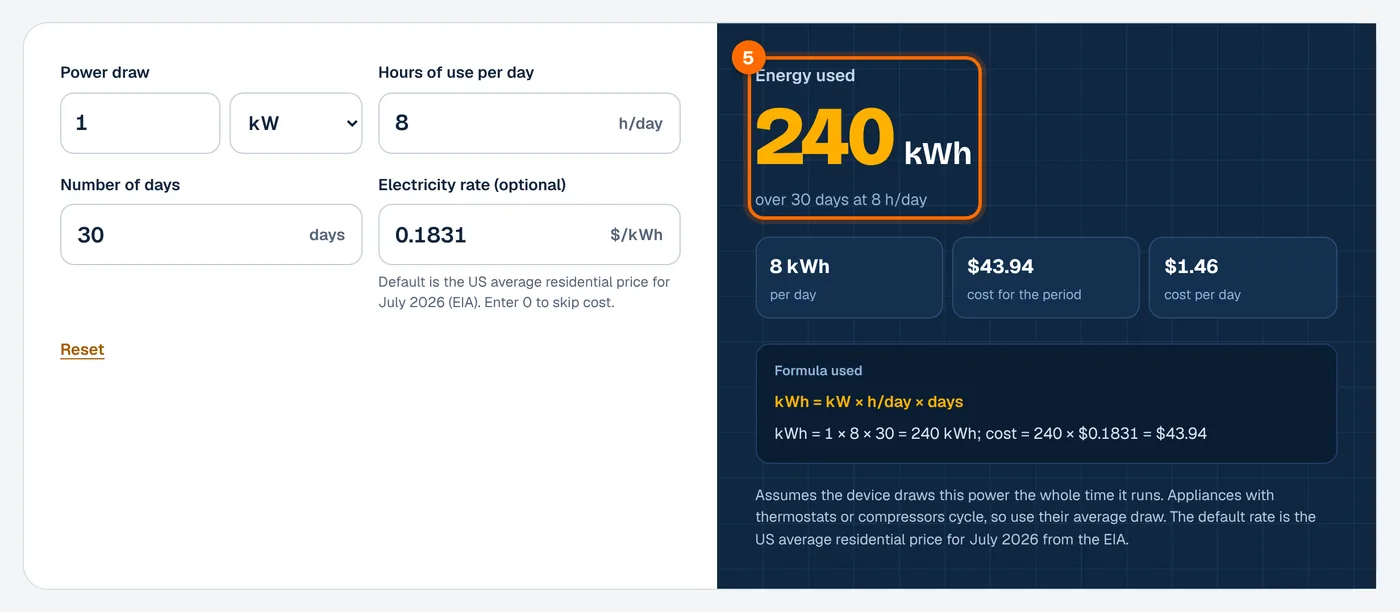
To calculate kWh, multiply power in kilowatts by the hours of use. Energy (kWh) = kW × hours per day × days. A 1 kW load running 8 hours a day for 30 days uses 1 × 8 × 30 = 240 kWh. Multiply the kWh by your electricity rate to get the cost.
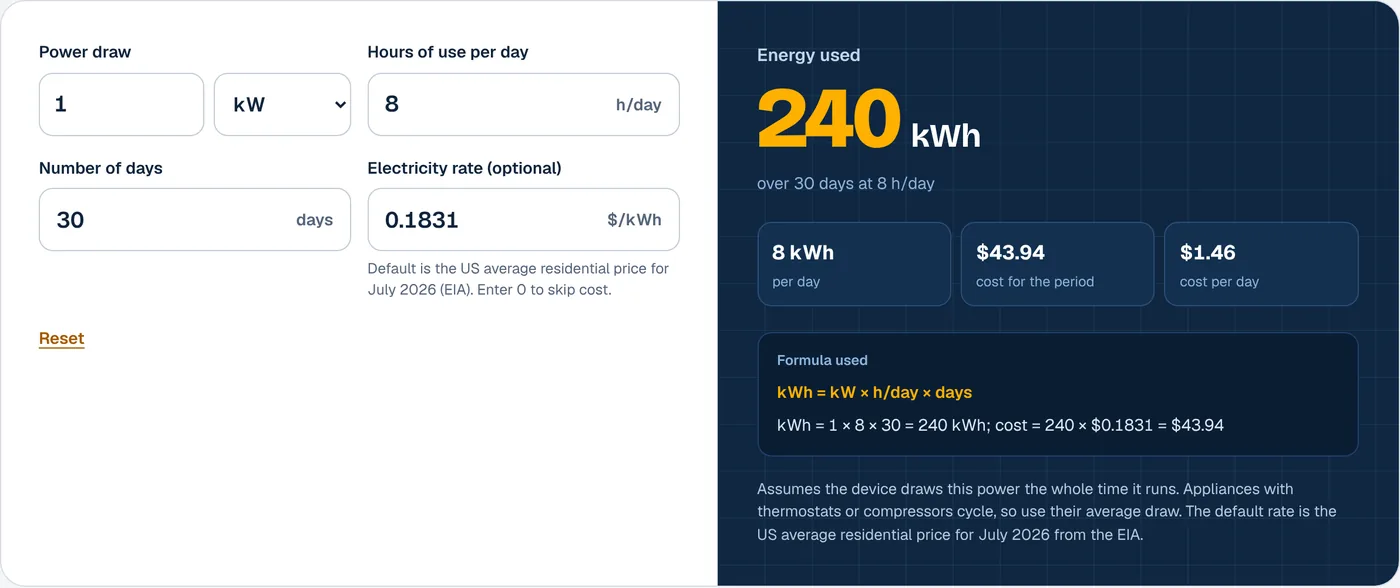
How to use the kWh calculator
- Enter the power draw. Type the power and choose W or kW from the dropdown. Use the input wattage on the nameplate, or a reading from a plug-in energy meter for appliances that cycle on and off.
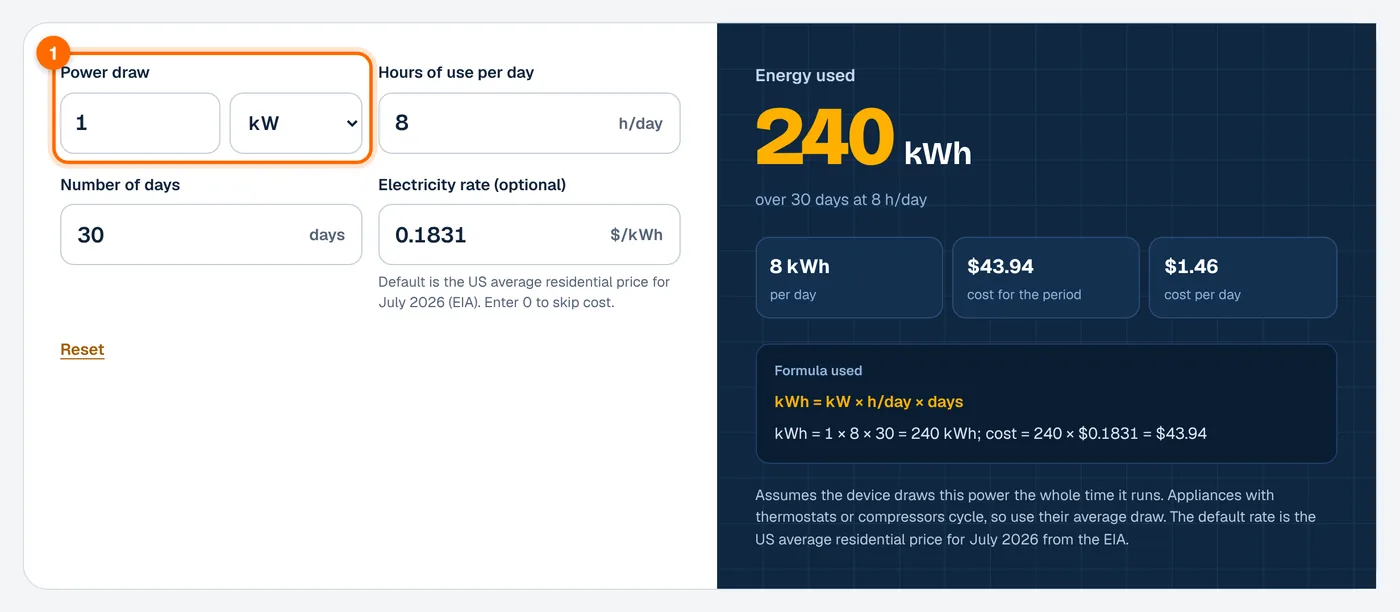
- Enter the hours of use per day. Count only the hours the device actually draws that power. A space heater on a thermostat may run 4 hours in an 8 hour evening.
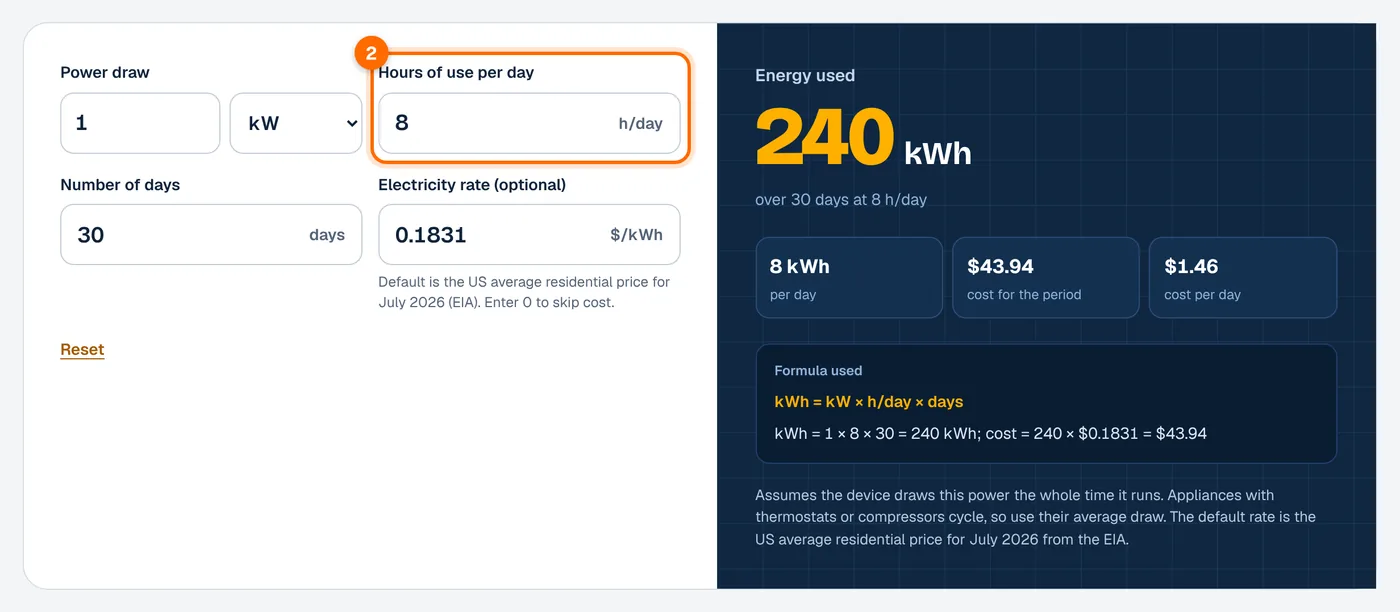
- Enter the number of days. Use 1 for a single day, 30 for a typical month or 365 for a full year. The result is the total energy for that period.
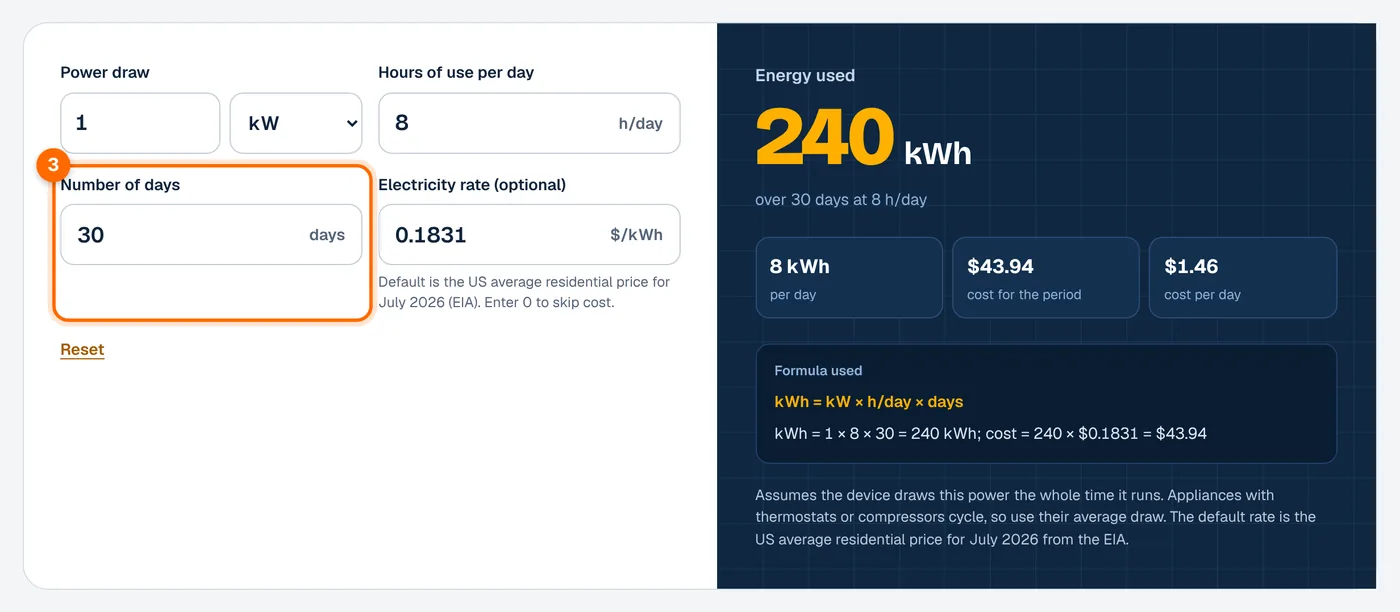
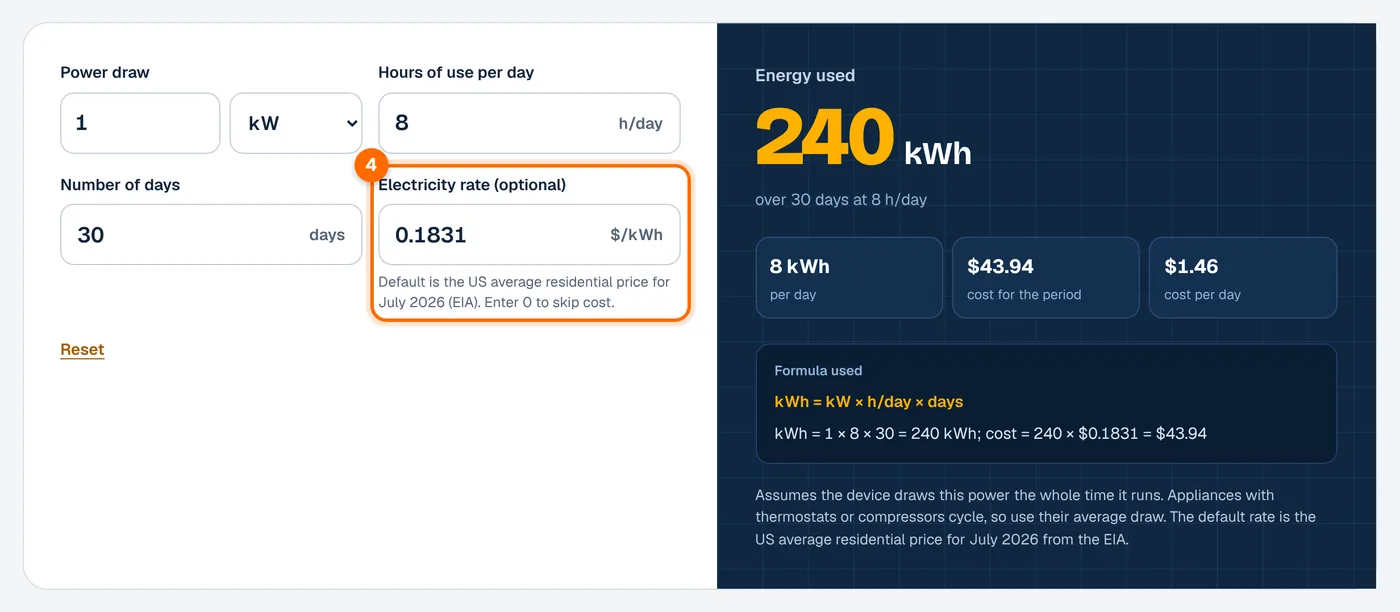
- Enter your electricity rate. The default is the US average residential price. Replace it with the price per kWh from your bill, or enter 0 if you only want the energy figure.
- Read the total kWh. The large number is the energy used over the whole period. The cards show the daily kWh, the cost for the period and the cost per day.
kWh calculator formula
A kilowatt-hour is one kilowatt of power used for one hour. The calculator multiplies power by time and then by the price of each unit.
Where:
- E is the energy in kilowatt-hours (kWh).
- P is the power in kilowatts (kW). To convert watts, divide by 1,000, so 1,500 W = 1.5 kW.
- h is the hours of use per day.
- d is the number of days.
- R is the electricity rate in dollars per kWh ($/kWh).
The unit on your utility bill is the same kWh, so the result compares directly with the usage line on the bill.
Worked examples
Example 1: 1.5 kW space heater for a month
A heater draws 1,500 W (1.5 kW) and runs 6 hours a day for 30 days. The rate in this example is $0.1831 per kWh.
The heater uses 270 kWh and adds about $49.44 to the monthly bill.
Example 2: 120 W television
A TV draws 120 W (0.12 kW) for 5 hours a day over 30 days, at the same example rate.
The TV uses 18 kWh a month, which costs about $3.30.
Example 3: one evening of EV charging
A Level 2 charger delivers 7.2 kW for 4 hours on one day (d = 1). This example ignores charging losses.
One session uses 28.8 kWh and costs about $5.27 at the example rate.
kWh by power and run time
Use this table to estimate energy quickly. Each cell is kW × hours. The 30 day column assumes 8 hours of use a day.
| Power | 1 hour | 8 hours | 24 hours | 30 days at 8 h/day |
|---|---|---|---|---|
| 100 W | 0.1 kWh | 0.8 kWh | 2.4 kWh | 24 kWh |
| 500 W | 0.5 kWh | 4 kWh | 12 kWh | 120 kWh |
| 1 kW | 1 kWh | 8 kWh | 24 kWh | 240 kWh |
| 1.5 kW | 1.5 kWh | 12 kWh | 36 kWh | 360 kWh |
| 3 kW | 3 kWh | 24 kWh | 72 kWh | 720 kWh |
| 7.2 kW | 7.2 kWh | 57.6 kWh | 172.8 kWh | 1,728 kWh |
What affects the result
Duty cycle
Refrigerators, freezers, air conditioners and heaters with thermostats switch on and off. Their nameplate wattage applies only while the compressor or element runs. Enter the hours it actually runs, or use the average watts from a plug-in meter over a full day.
Rated vs measured power
Nameplate ratings are often a maximum. A laptop charger rated at 90 W may draw far less once the battery is full. A measured reading gives a more realistic kWh figure than the label.
Standby power
Many devices draw a few watts when switched off. A 5 W standby load running 24 hours a day for 365 days uses 5 × 24 × 365 ÷ 1,000 = 43.8 kWh a year. Model standby as a separate run with its own wattage and hours.
Your electricity rate
The default rate of $0.1831 per kWh is the US average residential price for July 2026 from the EIA Electric Power Monthly state price table. State averages ranged from 12.72 cents in Louisiana to 48 cents in Hawaii that month, and time-of-use plans change the price by hour. Fixed monthly charges are not included.
Frequently asked questions
How do I calculate kWh from watts?
Divide the watts by 1,000 to get kilowatts, then multiply by the hours of use. A 2,000 W appliance running for 3 hours uses 2,000 ÷ 1,000 × 3 = 6 kWh. Multiply by the number of days to get the total for a week, month or year.
What is the difference between kW and kWh?
A kilowatt (kW) measures power, the rate at which energy is used at a given moment. A kilowatt-hour (kWh) measures energy, the amount used over time. A 1 kW heater running for 1 hour uses 1 kWh. Running it for 5 hours uses 5 kWh.
How many kWh does a house use per day?
It depends on the size of the home, the climate and the heating and cooling systems. The best figure is on your own bill: divide the monthly kWh by the number of days in the billing period. Use this calculator for individual appliances to see which ones make up that total.
How much does 1 kWh cost?
The US average residential price was 18.31 cents per kWh in July 2026, according to EIA preliminary data. Your price depends on your state, utility and rate plan. Check the energy charge per kWh on your bill and enter it in the rate field for an accurate cost.
Can I use this calculator for a solar panel or battery?
Yes, for a simple estimate. Enter the average power output and the hours it runs. A 400 W panel producing an average of 300 W for 5 hours makes 0.3 × 5 = 1.5 kWh in a day. Real solar output varies with sunlight, tilt and temperature, so use a solar output calculator for planning.