kVA to kW Calculator
Convert kVA to kW with any power factor and see the reactive power in kVAR for generators, UPS units and transformers.
Quick answer
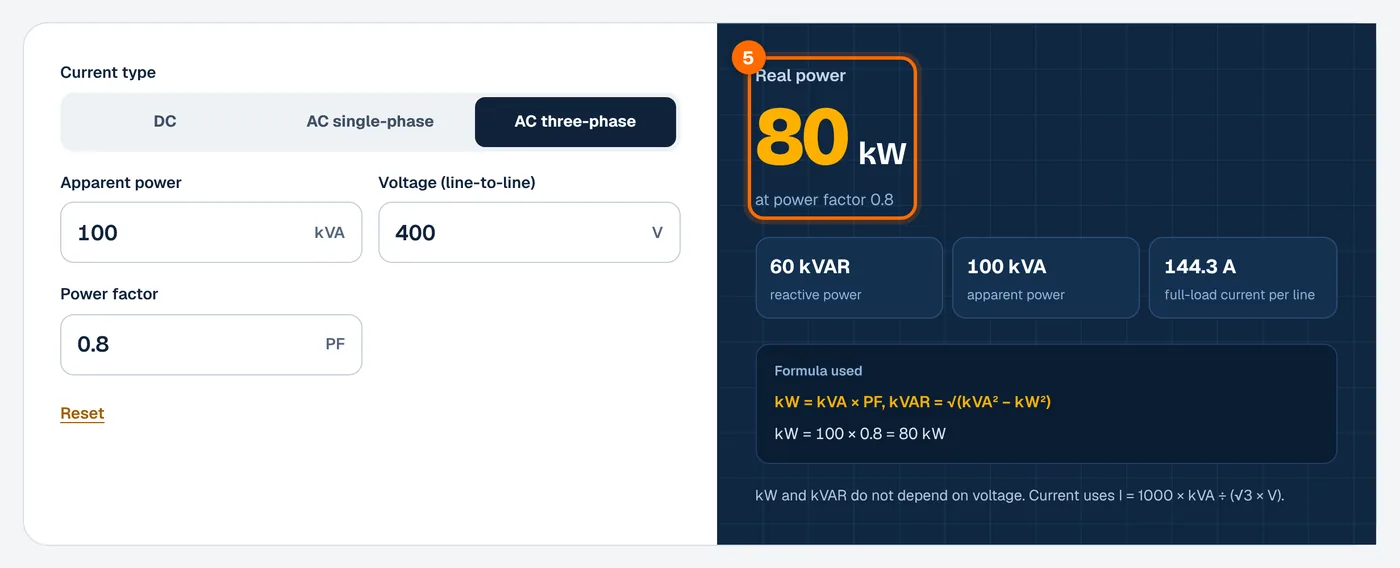
To convert kVA to kW, multiply apparent power by the power factor: kW = kVA × PF. A 100 kVA generator at the standard 0.8 power factor delivers 80 kW of real power. The remaining reactive power is kVAR = √(kVA² − kW²), which is 60 kVAR in this example.
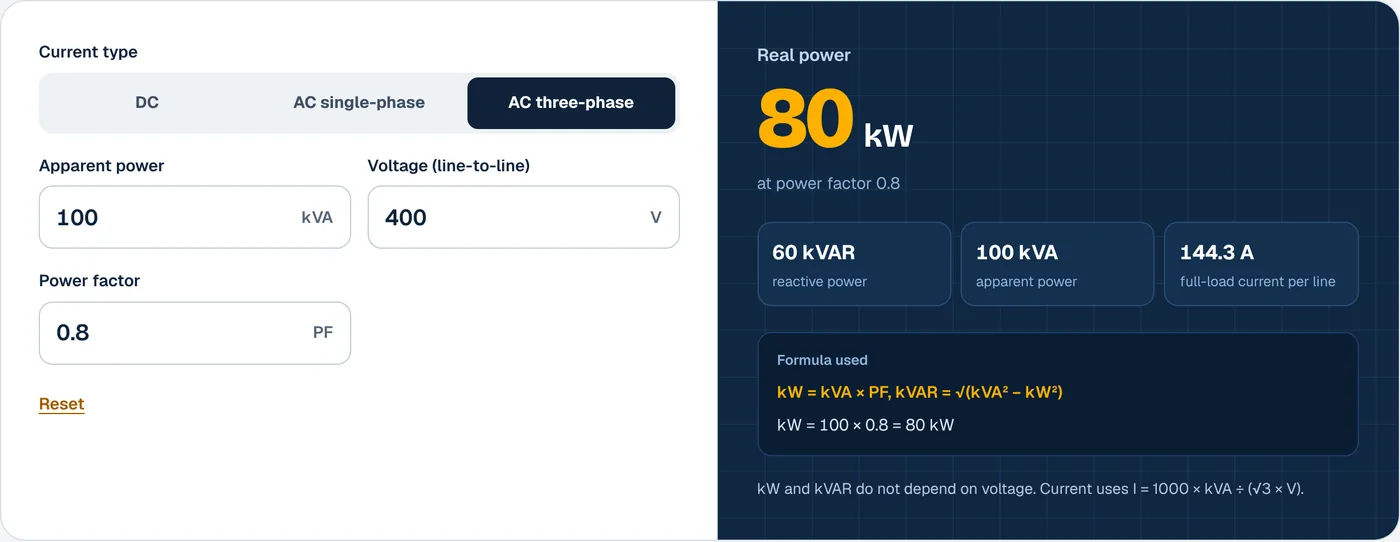
How to use the kVA to kW calculator
- Choose the current type. Select single-phase or three-phase AC to match your generator, UPS or transformer. The kVA to kW conversion is the same for both. For DC there is no reactive power, so kW always equals kVA.
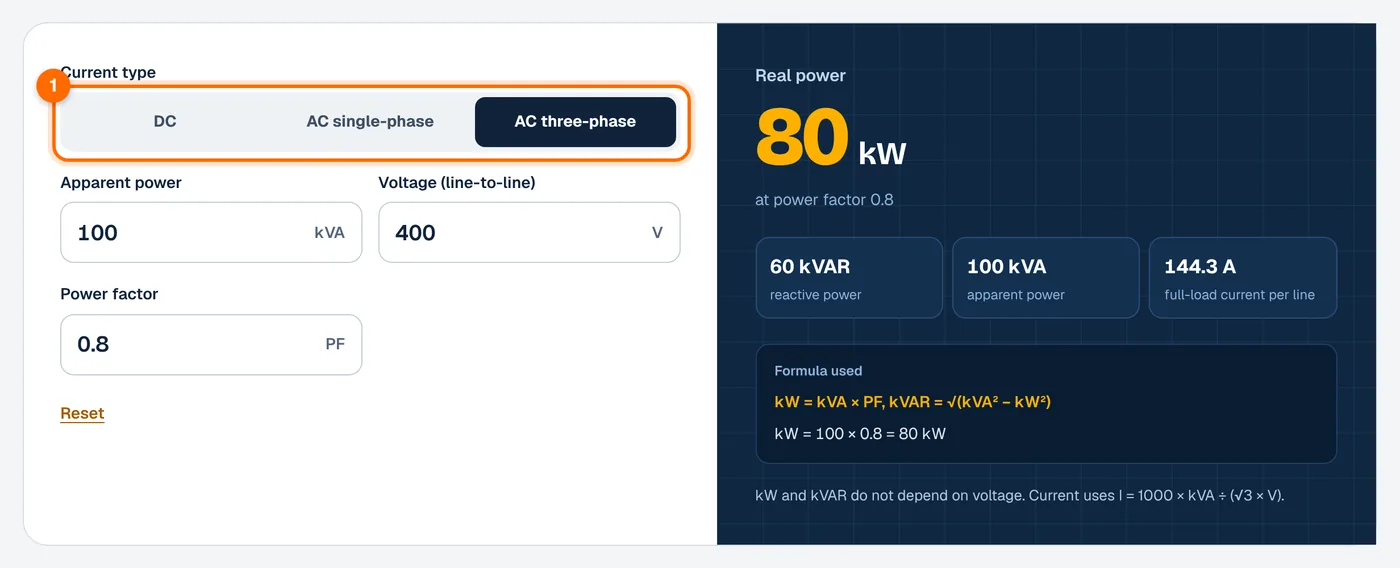
- Enter the apparent power in kVA. Take this from the nameplate of the generator, UPS or transformer.
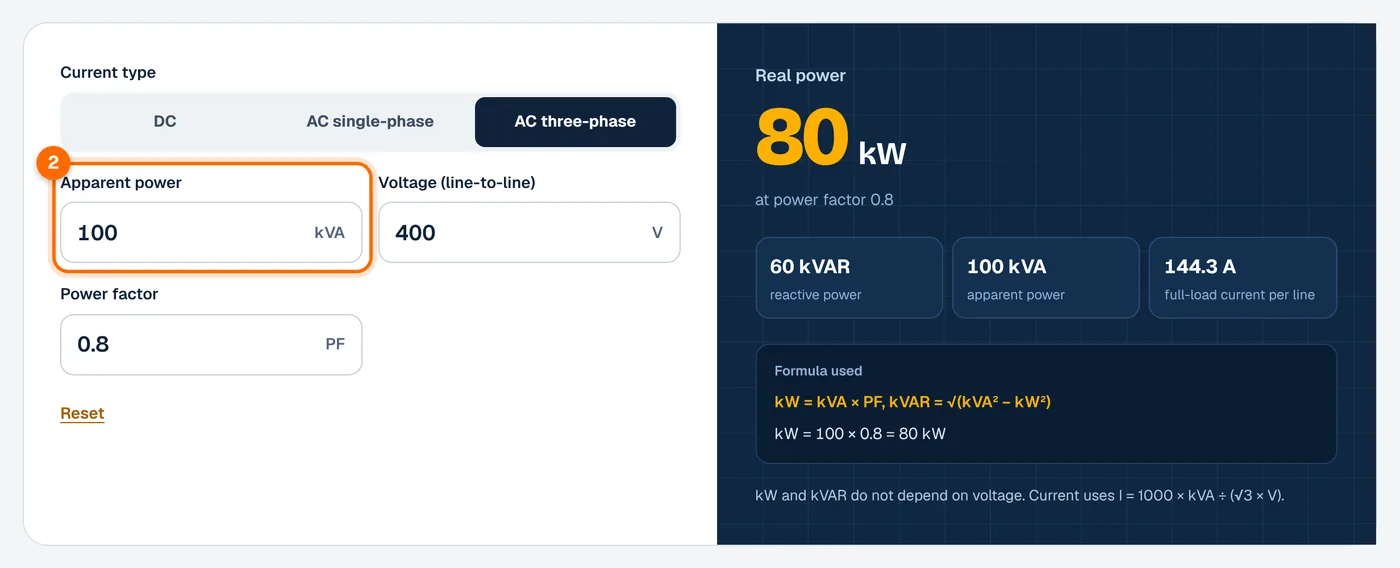
- Enter the voltage. Use the system voltage of the equipment. The kW and kVAR results do not depend on it, because both scale directly from the kVA rating.
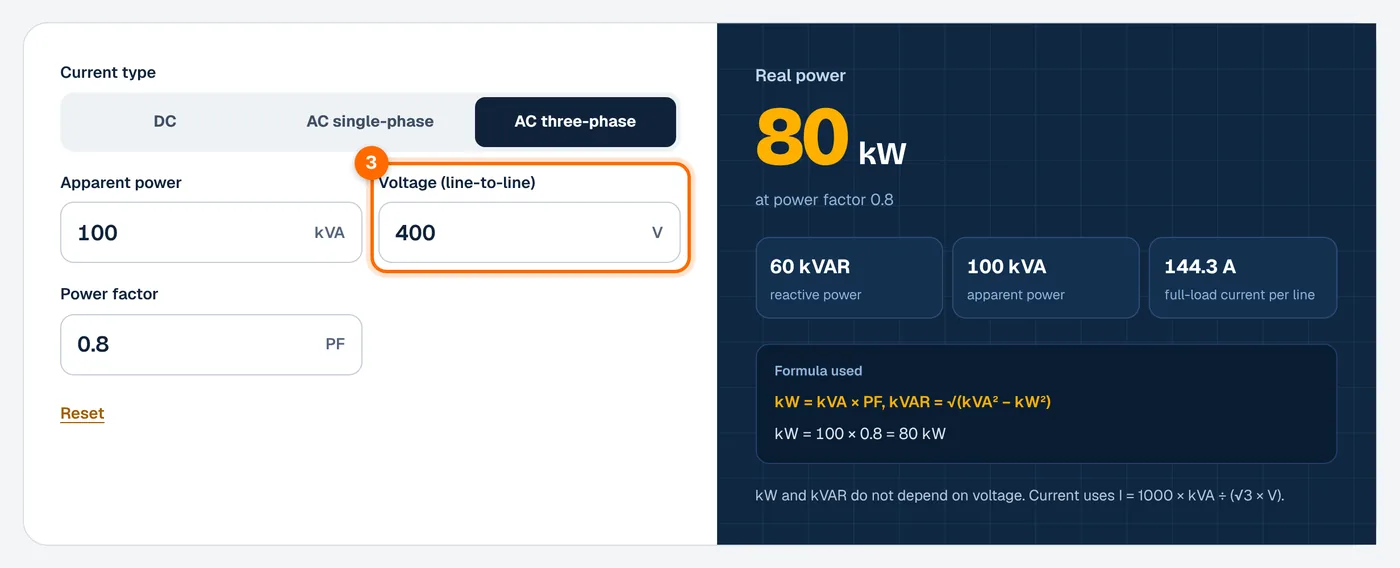
- Enter the power factor. Use the rated PF on the nameplate. Many industrial generators are rated at 0.8. Use your load’s PF if you want to know the real power that load will draw.
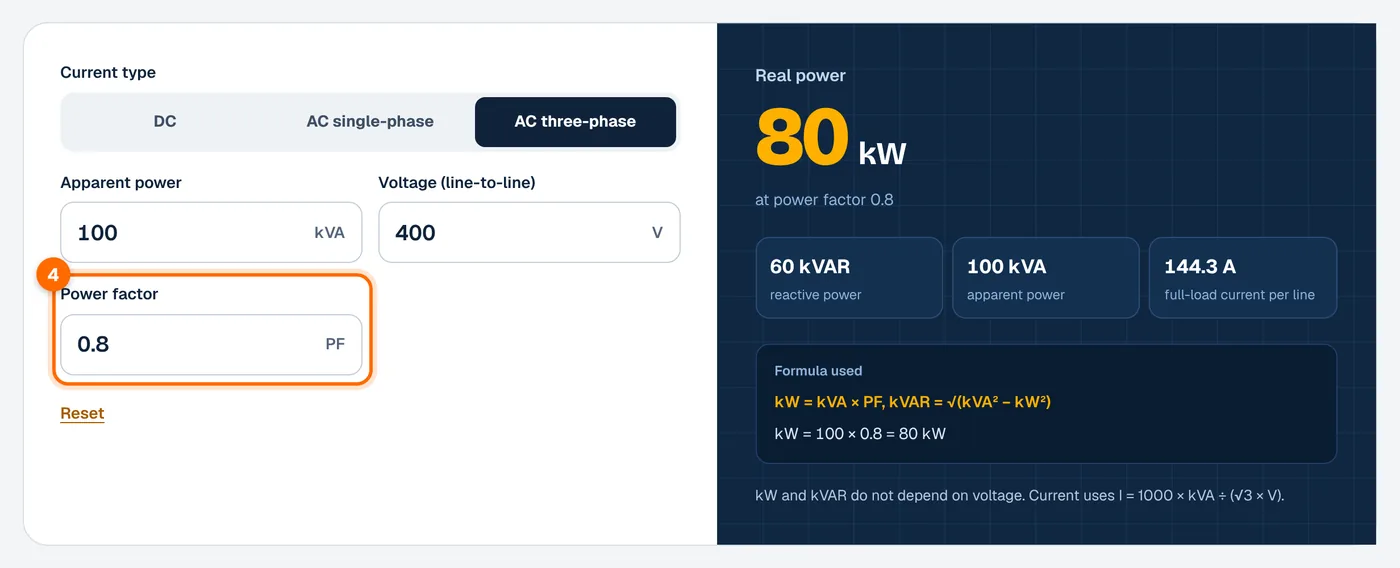
- Read kW and kVAR. kW is the real power that does work. kVAR is the reactive power that flows back and forth to magnetize motors and transformers.
kVA to kW formula
Real power, reactive power and apparent power form a right triangle, often called the power triangle. kW and kVAR are the two shorter sides, and kVA is the longest side.
Real power
Reactive power
Reverse: kW to kVA
Where:
- kVA is apparent power in kilovolt-amperes: voltage times current, divided by 1,000 (times √3 for three-phase).
- kW is real power in kilowatts. It is the power that runs equipment and that energy meters record.
- kVAR is reactive power in kilovolt-amperes reactive. It supports magnetic fields in motors and transformers but does no useful work.
- PF is the power factor, from 0 to 1. It equals kW / kVA, which is also the cosine of the angle between kW and kVA in the power triangle.
Worked examples
Example 1: 100 kVA generator at PF 0.8
The generator can supply 80 kW of real power and 60 kVAR of reactive power at its rated 100 kVA.
Example 2: 750 kVA standby generator at PF 0.8
A 750 kVA nameplate rating at 0.8 PF means 600 kW of usable real power.
Example 3: 5 kVA UPS at PF 0.9
The UPS can power up to 4.5 kW of real load. Check both ratings: the load must stay within the kW limit and the kVA limit.
kVA to kW chart for common sizes
Real power at three common power factors, plus reactive power at PF 0.8 (which equals 0.6 × kVA).
| Rating (kVA) | kW at PF 0.8 | kW at PF 0.9 | kW at PF 1.0 | kVAR at PF 0.8 |
|---|---|---|---|---|
| 2 | 1.6 | 1.8 | 2 | 1.2 |
| 3.5 | 2.8 | 3.15 | 3.5 | 2.1 |
| 5 | 4 | 4.5 | 5 | 3 |
| 7.5 | 6 | 6.75 | 7.5 | 4.5 |
| 10 | 8 | 9 | 10 | 6 |
| 20 | 16 | 18 | 20 | 12 |
| 30 | 24 | 27 | 30 | 18 |
| 50 | 40 | 45 | 50 | 30 |
| 100 | 80 | 90 | 100 | 60 |
| 250 | 200 | 225 | 250 | 150 |
| 500 | 400 | 450 | 500 | 300 |
What affects the result
Power factor rating
Industrial generators are commonly rated at 0.8 PF lagging, so their kW rating is 80% of the kVA rating. Single-phase portable generators that feed mostly resistive loads are often rated at PF 1.0, where kW and kVA are equal. Always read which PF the nameplate uses.
Type of load
Your actual kW depends on the load, not only the source. Incandescent and resistive heating loads run at about 0.98 to 1.0. Three-phase induction motors often run at 0.75 to 0.85 lagging. Magnetic-ballast fluorescent lighting can be as low as 0.40 to 0.50. UPS units with active power factor correction run at about 0.95 to 0.99.
Motor loading
Induction motors that run lightly loaded have a lower power factor than at full load. A plant with many underloaded motors draws more kVA, and more current, for the same kW.
Utility power factor charges
Many utilities add a charge when a customer’s power factor drops below a set level, often 0.95. Capacitors can supply some of the kVAR locally, raising PF and cutting the kVA the utility must deliver.
Frequently asked questions
What is the difference between kVA and kW?
kW is real power, the part that does work such as turning a motor or heating an element. kVA is apparent power, the product of voltage and current. kVA includes both real power and reactive power. The two are equal only when the power factor is 1.
Why are generators rated in kVA?
A generator’s heating limit depends on the current through its windings, and current is set by kVA, not kW. The same kVA can carry different kW depending on the load’s power factor. Many industrial generators state kVA at 0.8 PF, so the kW rating is 80% of the kVA.
How many kW is 1 kVA?
It depends on the power factor. At PF 0.8, 1 kVA equals 0.8 kW. At PF 0.9 it equals 0.9 kW, and at PF 1.0 it equals 1 kW. There is no single fixed conversion, which is why the calculator asks for the power factor.
How do I convert kW back to kVA?
Divide kW by the power factor: kVA = kW / PF. A 40 kW load at PF 0.8 needs 50 kVA of supply capacity. Use this when sizing a generator, UPS or transformer for a known real-power load, then add a margin for future loads.
What is kVAR used for?
Reactive power (kVAR) builds the magnetic fields that motors, transformers and inductors need. It does no useful work, but it still flows through cables and generator windings. Power factor correction capacitors supply kVAR close to the load, which lowers the current on the rest of the system.