Amps to Watts Calculator
Convert amps to watts for DC, single-phase and three-phase AC loads using voltage and power factor.
Quick answer
To convert amps to watts, multiply the current by the voltage. For DC, P = V × I, so 15 A at 120 V equals 1,800 W. For single-phase AC, multiply by the power factor as well: P = PF × V × I. For three-phase AC, use P = √3 × PF × VLL × I.
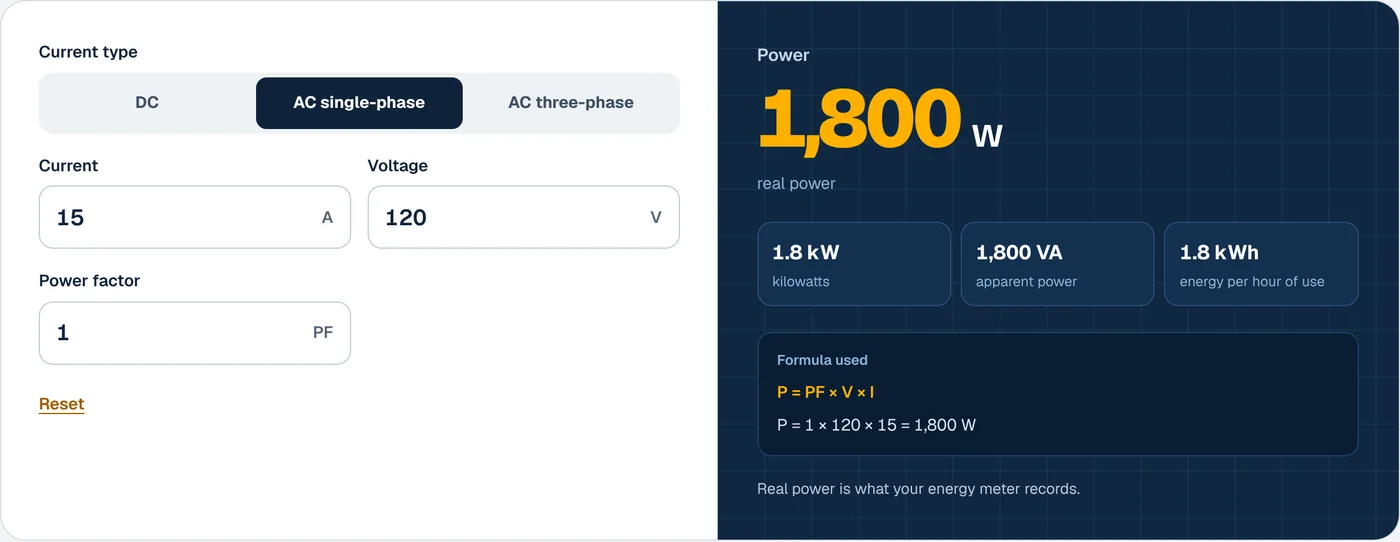
How to use the amps to watts calculator
- Choose the current type. Select DC for batteries, solar strings and vehicle systems. Select single-phase AC for standard outlets and household circuits. Select three-phase AC for motors, workshops and commercial supplies.
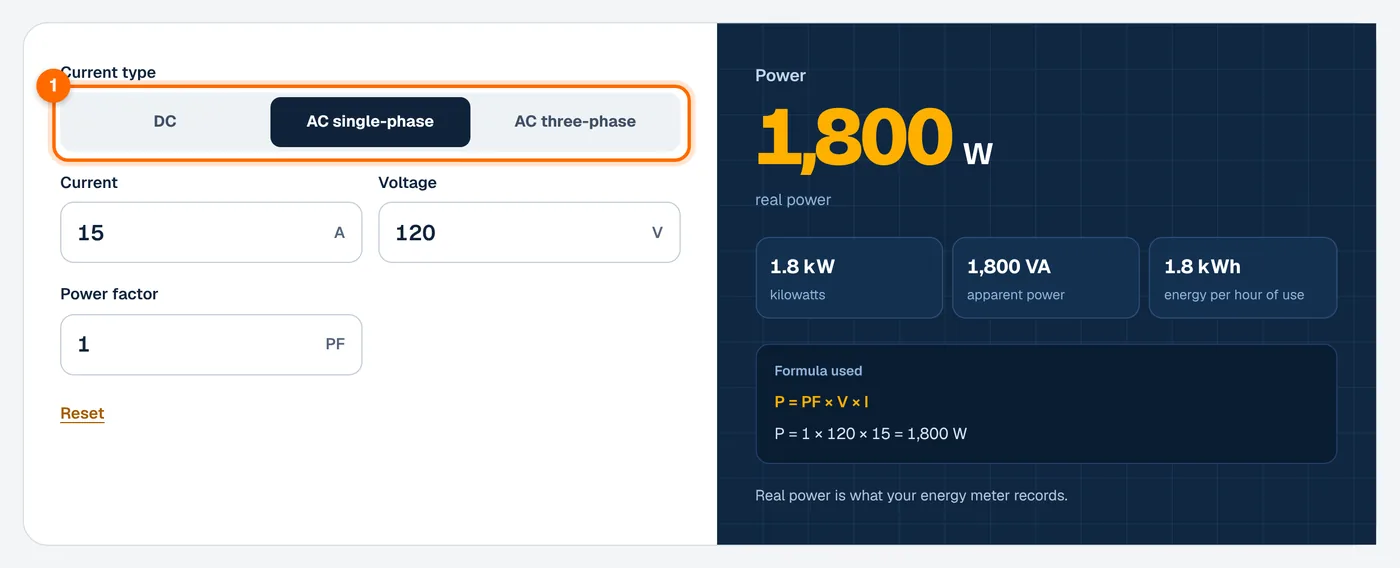
- Enter the current in amps. Use the measured current, the nameplate current or the breaker rating you want to check.
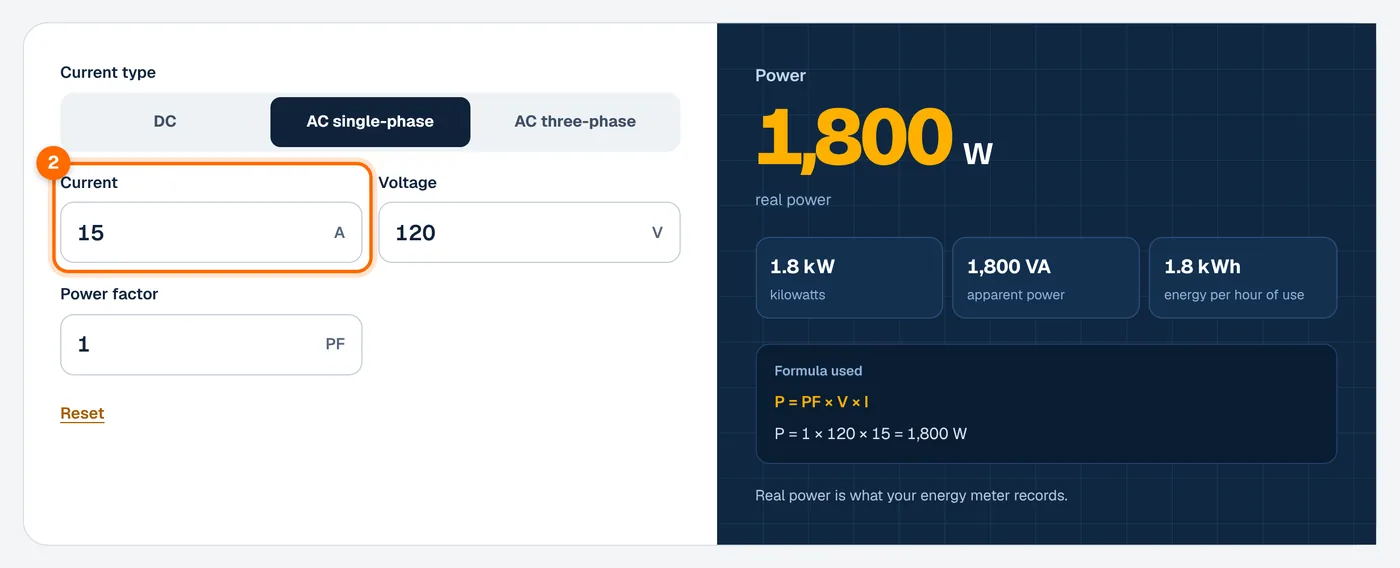
- Enter the voltage. For single-phase, enter the voltage across the load, such as 120 V, 230 V or 240 V. For three-phase, enter the line-to-line voltage, such as 208 V, 400 V or 480 V.
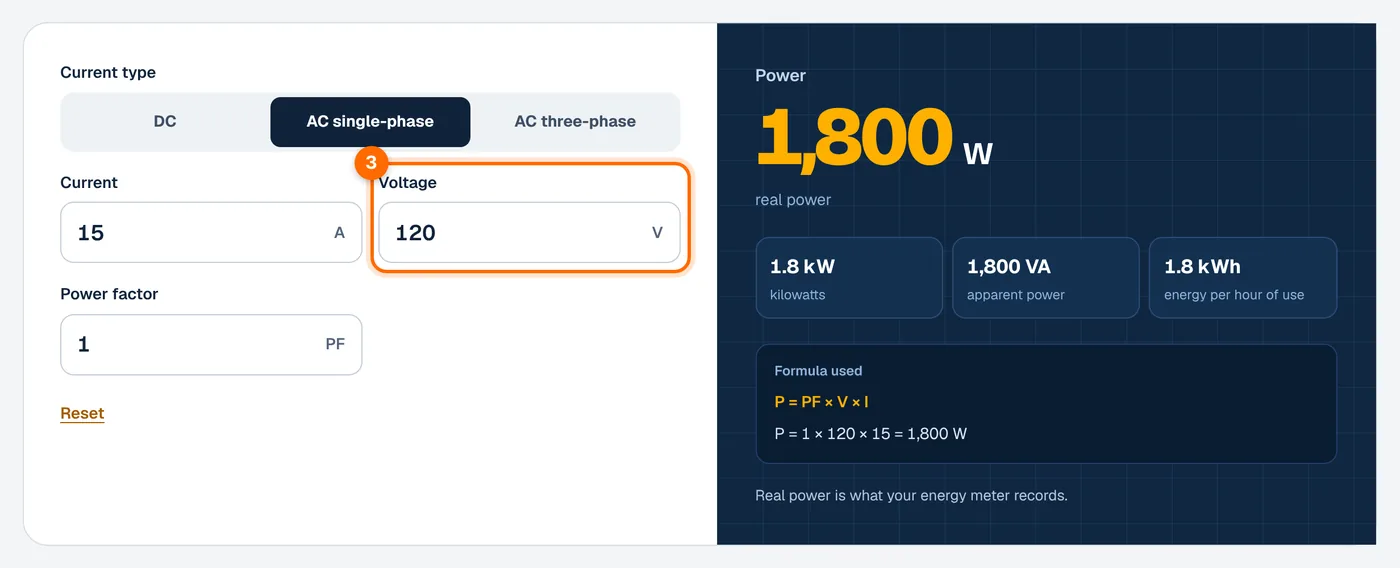
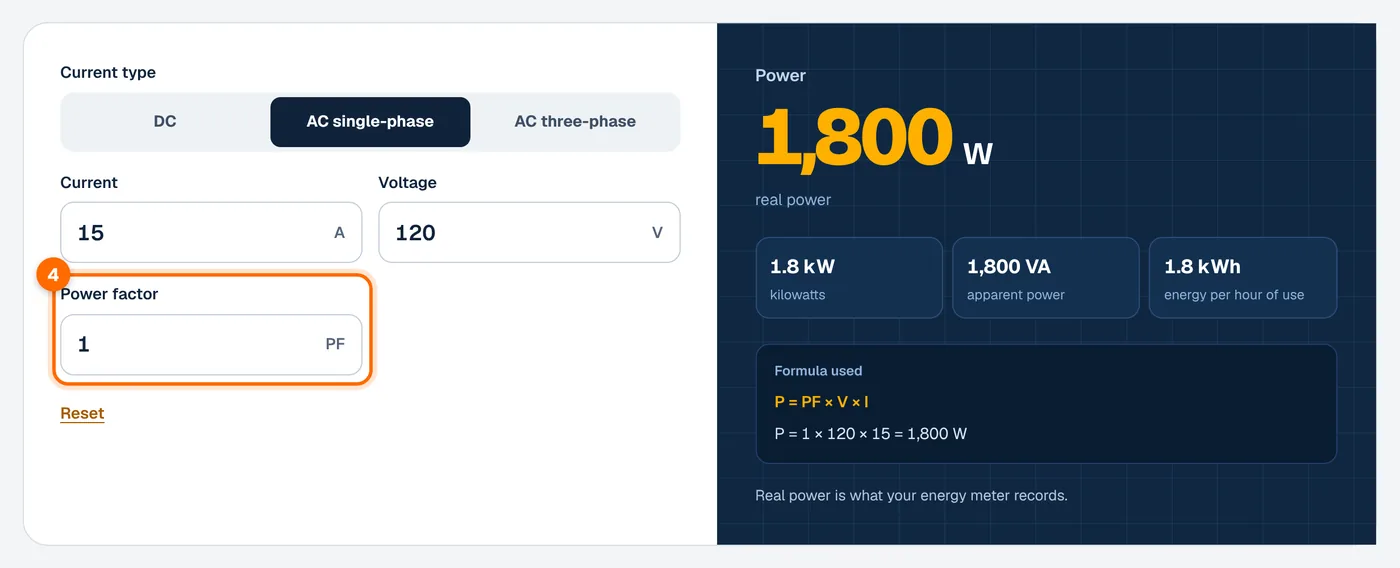
- Enter the power factor. Keep it at 1 for DC and resistive loads. Enter the nameplate value for motors and other inductive equipment.
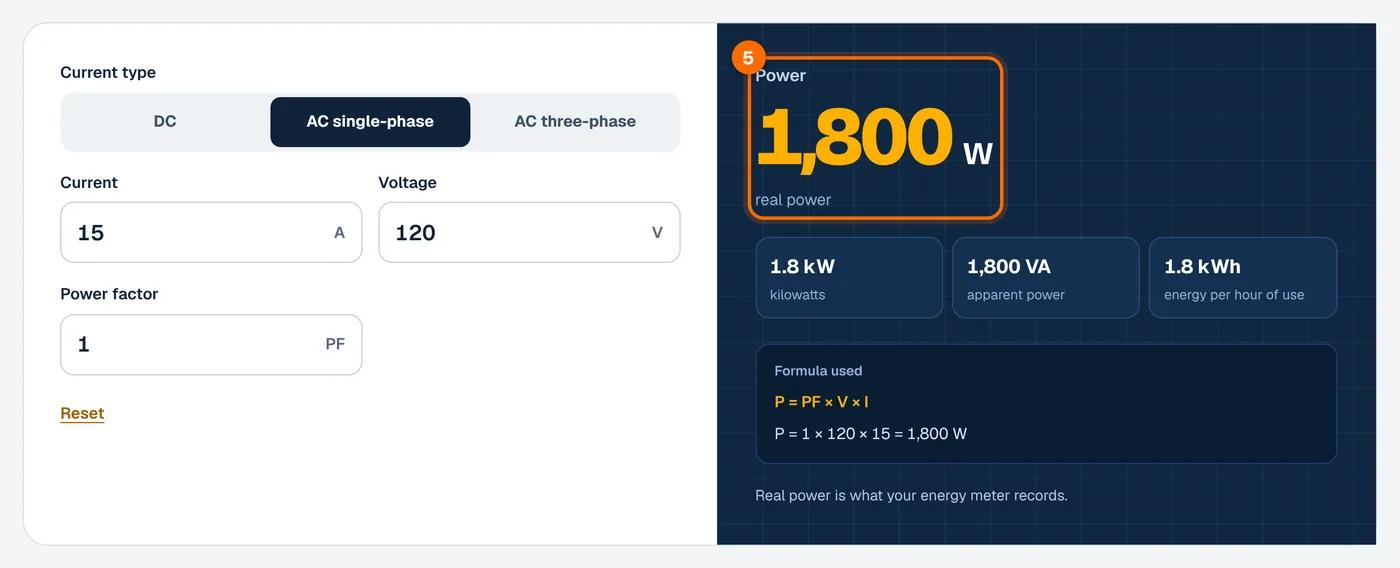
- Read the power in watts. The result is real power, the part that does useful work and shows up on an energy meter.
Amps to watts formula
The calculator picks the formula that matches the current type.
DC
Single-phase AC
Three-phase AC
Where:
- P is the real power in watts (W).
- I is the current in amps (A). In three-phase, it is the current in each line.
- V is the voltage across the load in volts (V).
- VLL is the line-to-line voltage of a three-phase supply.
- PF is the power factor, from 0 to 1. It equals real power divided by apparent power.
- √3 is about 1.732.
Without the power factor, V × I gives volt-amperes (VA), not watts. For resistive loads the two are equal. For motors and many electronic loads, watts are lower than VA.
Worked examples
Example 1: 15 A circuit at 120 V
For a resistive load, PF = 1.
A 15 A, 120 V circuit carries up to 1,800 W of resistive load at its full rating.
Example 2: 13 A UK plug at 230 V
The largest standard UK plug fuse is 13 A, and the nominal supply is 230 V.
That is about 3 kW, which is why a 3 kW kettle is close to the limit of a single UK socket.
Example 3: 32 A three-phase load at 400 V, PF 0.9
The load uses about 20.0 kW of real power. With PF = 1, the same current would deliver about 22.2 kW.
Example 4: 10 A on a 12 V DC system
A 12 V DC load drawing 10 A uses 120 W.
Amps to watts chart by breaker size
This table shows the power at the full breaker rating with PF = 1. It is the upper limit of the rating, not a safe continuous load. Your local electrical code sets how much of a breaker’s rating a continuous load may use.
| Current (A) | Watts at 120 V | Watts at 230 V | Watts at 240 V |
|---|---|---|---|
| 10 | 1,200 | 2,300 | 2,400 |
| 15 | 1,800 | 3,450 | 3,600 |
| 16 | 1,920 | 3,680 | 3,840 |
| 20 | 2,400 | 4,600 | 4,800 |
| 30 | 3,600 | 6,900 | 7,200 |
| 32 | 3,840 | 7,360 | 7,680 |
| 40 | 4,800 | 9,200 | 9,600 |
| 50 | 6,000 | 11,500 | 12,000 |
US homes use 120 V for most outlets and 240 V for large appliances such as dryers, ranges and EV chargers. UK and EU homes use 230 V.
What affects the result
Supply voltage
The same current carries more power at a higher voltage. 20 A at 240 V is 4,800 W, twice the 2,400 W at 120 V. Use the actual system voltage. In the US, common nominal systems include 120/240 V single-phase and 208Y/120 V and 480Y/277 V three-phase. In the UK and Western Europe, supplies were harmonized to 230 V single-phase and 400 V three-phase.
Power factor
For resistive loads, PF is close to 1 and watts equal VA. Three-phase induction motors often run at about 0.75 to 0.85, so real power is lower than V × I. Leaving PF at 1 for an inductive load will overstate the watts.
Line vs phase values
In three-phase mode, enter the line current and the line-to-line voltage. If you enter a line-to-neutral voltage (such as 277 V or 230 V) with the √3 formula, the result will be too low by a factor of √3.
Measured vs rated current
A clamp meter reading shows the current at that moment. Appliance current changes with thermostat cycling, motor load and charging stage. For energy use over time, multiply the watts by the hours of use with a kWh calculator.
Frequently asked questions
How many watts is 20 amps?
At 120 V and a power factor of 1, 20 A equals 2,400 W. At 230 V it equals 4,600 W, and at 240 V it equals 4,800 W. On a 12 V DC system, 20 A equals only 240 W. The voltage always decides the answer.
Are watts and VA the same thing?
Only when the power factor is 1. Volt-amperes (VA) are voltage times current. Watts are VA times the power factor. A load drawing 10 A at 230 V with PF 0.8 uses 2,300 VA but only 1,840 W of real power. Generators and UPS units are often rated in both.
How do I convert amp-hours to watt-hours?
Multiply amp-hours by the battery voltage. A 100 Ah battery at 12 V stores 1,200 Wh, and a 100 Ah battery at 48 V stores 4,800 Wh. This is the same P = V × I relationship applied over time. Usable energy depends on the battery’s depth of discharge.
Can I use this for three-phase motors?
Yes. Choose three-phase AC, enter the line current, the line-to-line voltage and the motor’s power factor. The result is the electrical input power. The shaft output is lower because of motor losses, so it will not match the motor’s kW or hp rating exactly.
Why does my reading differ from the label?
Labels show rated or maximum values. Real current varies with voltage, load and temperature. A heater thermostat switches on and off, and a fridge compressor cycles. Measure over time or use a plug-in energy meter if you need actual consumption.