Watts to Amps Calculator
Convert watts to amps for DC, single-phase and three-phase AC circuits, with power factor and line-to-line voltage built in.
Quick answer
To convert watts to amps, divide the power by the voltage. For DC, I = P / V, so a 1,500 W heater on 120 V draws 12.5 A. For single-phase AC, divide by power factor times voltage. For three-phase AC, divide by √3 × power factor × line-to-line voltage.
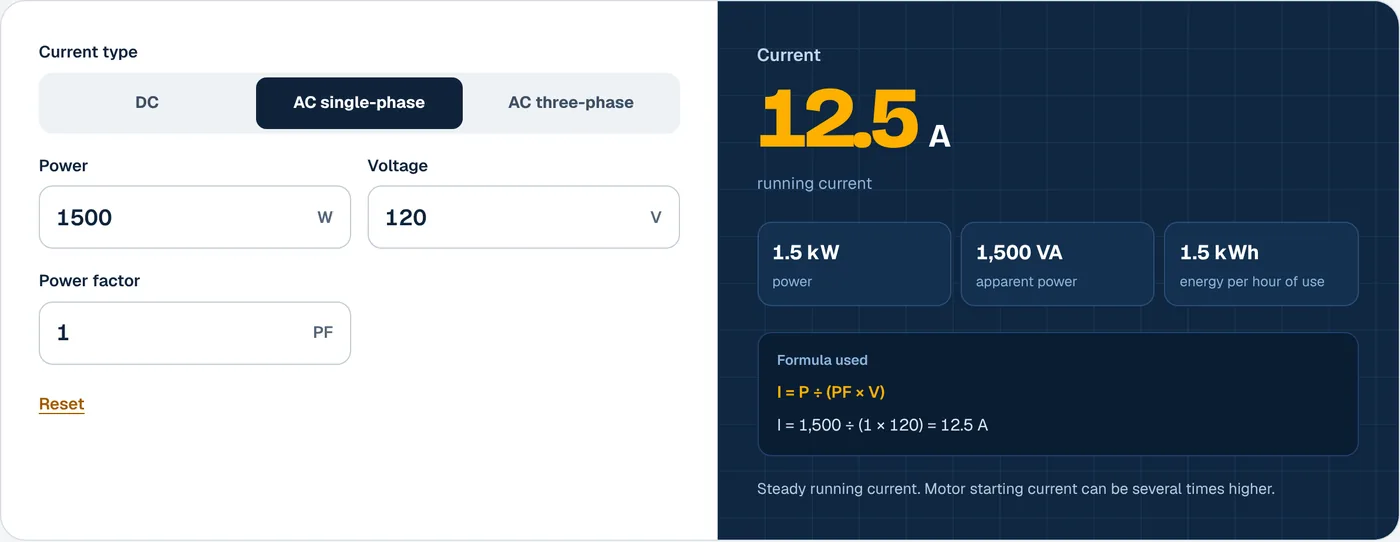
How to use the watts to amps calculator
- Choose the current type. Pick DC for batteries, solar panels and 12 V, 24 V or 48 V systems. Pick single-phase AC for household outlets and most home appliances. Pick three-phase AC for motors, commercial equipment and large chargers.
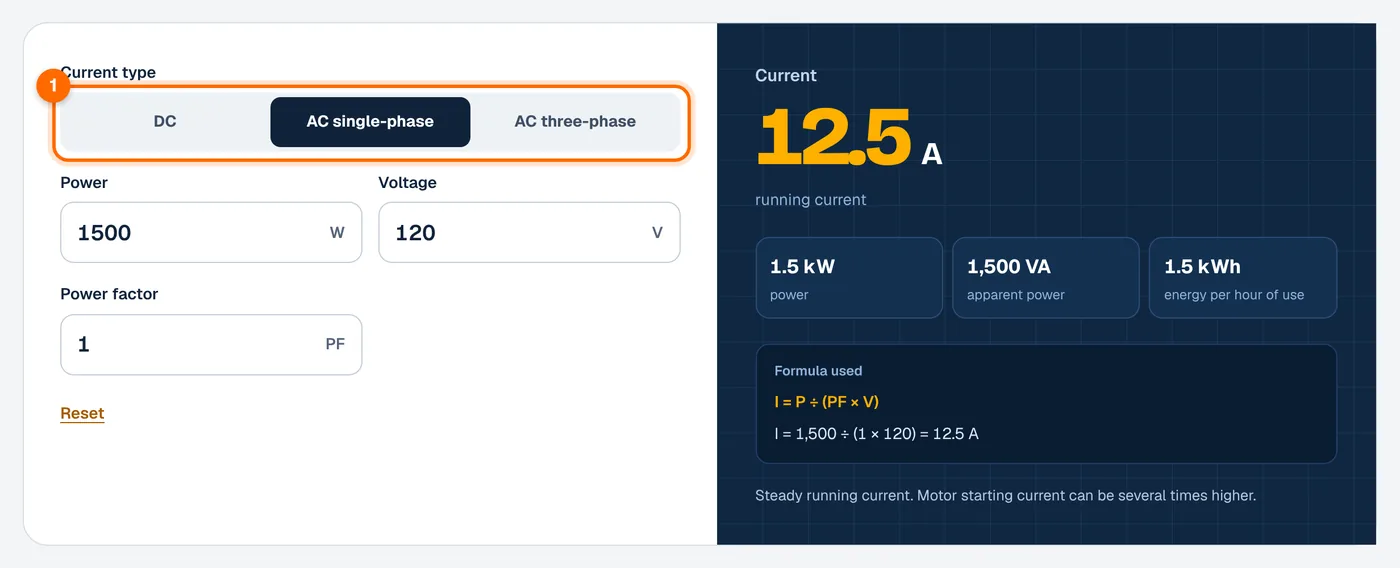
- Enter the power in watts. Use the rated input power from the nameplate or the spec sheet, not the output or heat rating.
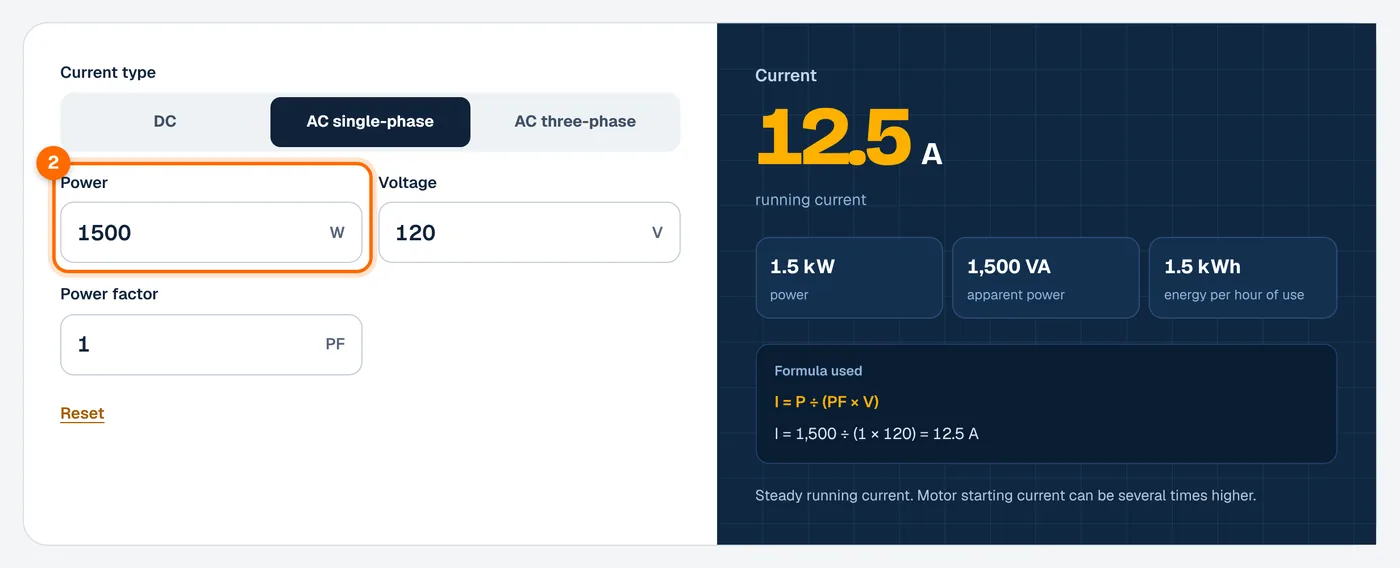
- Enter the voltage. For single-phase, use the voltage across the load, such as 120 V, 230 V or 240 V. For three-phase, use the line-to-line voltage, such as 208 V, 400 V or 480 V.
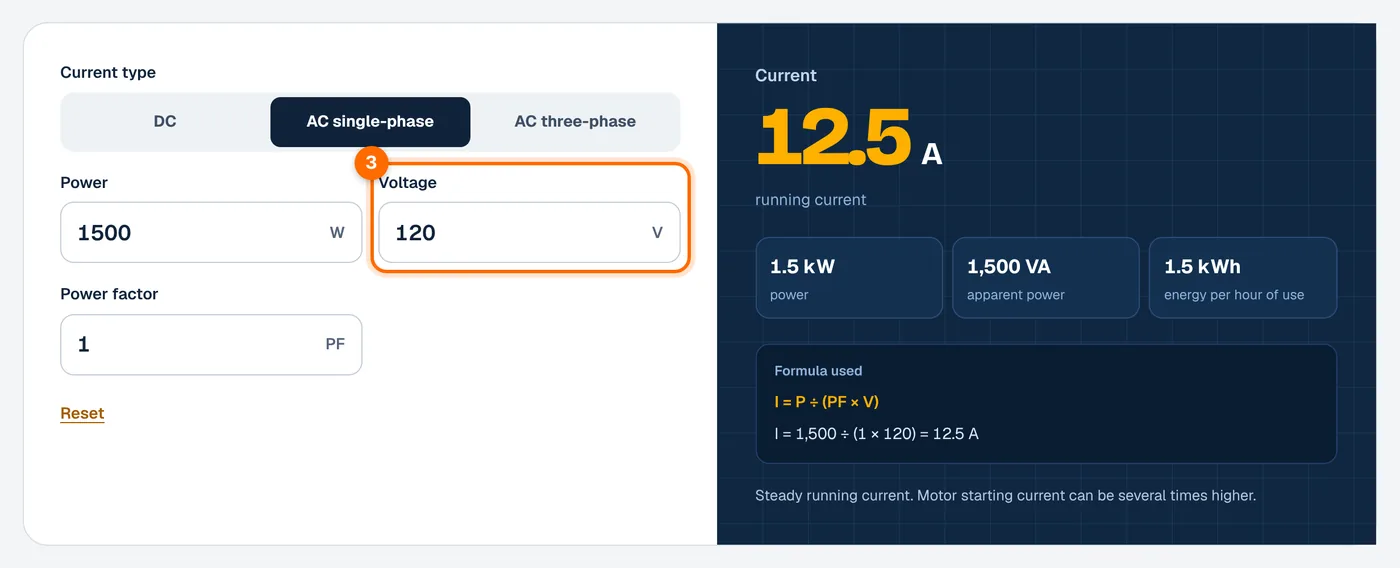
- Enter the power factor. Leave it at 1 for DC and for resistive loads such as heaters, kettles and incandescent lamps. Use the nameplate value for motors and other inductive loads.
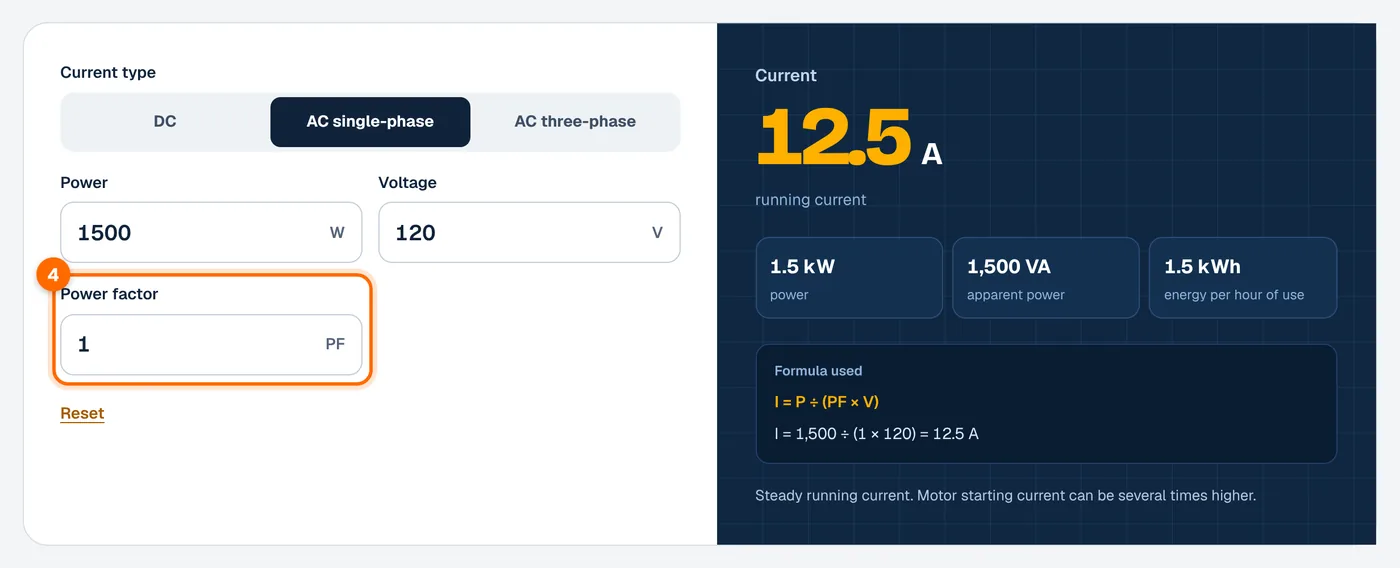
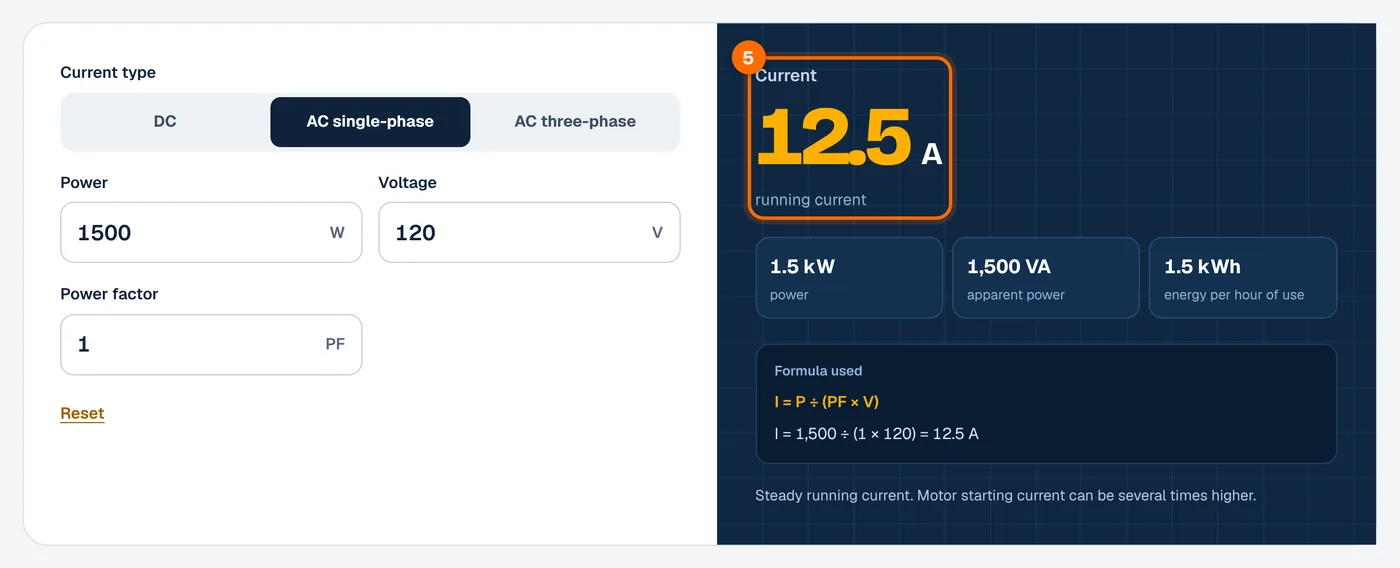
- Read the current in amps. The result is the steady running current. It does not include motor starting current.
Watts to amps formula
The calculator uses one of three formulas, depending on the current type you choose.
DC
Single-phase AC
Three-phase AC
Where:
- I is the current in amps (A).
- P is the real power in watts (W).
- V is the voltage in volts (V) across the load.
- VLL is the line-to-line voltage of a three-phase system.
- PF is the power factor, a number from 0 to 1. It is the ratio of real power (kW) to apparent power (kVA).
- √3 is about 1.732. It links line-to-line voltage to the total power of a balanced three-phase load.
A lower power factor means more current for the same watts. That is why a motor draws more amps than a heater of the same wattage on the same circuit.
Worked examples
Example 1: 1,500 W space heater on 120 V
A heater is a resistive load, so PF = 1. Use the DC or single-phase formula.
The heater draws 12.5 A.
Example 2: 3 kW kettle on 230 V
A kettle is also resistive, so PF = 1.
The kettle draws about 13.0 A on a 230 V supply in the UK or EU.
Example 3: 10 kW three-phase motor at 400 V, PF 0.85
Assume 10 kW is the electrical input power and the motor runs on a 400 V line-to-line supply.
Each line carries about 17.0 A. Note that motor nameplates usually list shaft output power. The electrical input is higher because of motor losses, so use the input figure or the nameplate full-load current when you have it.
Watts to amps chart at 120 V and 230 V
These rows assume a power factor of 1. The wattages are example ratings only. Check the nameplate on your own device.
| Power (W) | Example load | Amps at 120 V | Amps at 230 V |
|---|---|---|---|
| 10 | LED bulb | 0.08 | 0.04 |
| 65 | Laptop charger | 0.54 | 0.28 |
| 150 | Television | 1.25 | 0.65 |
| 1,000 | Microwave oven | 8.33 | 4.35 |
| 1,500 | Space heater | 12.50 | 6.52 |
| 1,800 | Hair dryer | 15.00 | 7.83 |
| 3,000 | Kettle | 25.00 | 13.04 |
For other voltages, divide the watts by the voltage. At 240 V, the values are half the 120 V column.
What affects the result
Voltage
Current falls as voltage rises for the same power. A 1,500 W load draws 12.5 A at 120 V but only 6.25 A at 240 V. US homes use 120 V and 240 V split-phase service. The UK and most of Europe use 230 V single-phase and 400 V three-phase.
Power factor
Resistive loads such as heaters and incandescent lamps run close to a PF of 1. Three-phase induction motors often run at about 0.75 to 0.85 lagging, and lightly loaded motors run lower. If you do not know the PF of an inductive load, the result will understate the current when you leave PF at 1.
Single-phase vs three-phase
Spreading power across three phases lowers the current in each wire. The √3 factor only applies when you enter the line-to-line voltage. If you enter the line-to-neutral voltage (such as 120 V or 230 V) in three-phase mode, the answer will be wrong.
Rated vs actual power
The calculator works with the watts you enter. Many devices draw less than their rated power most of the time, and motors draw several times their running current for a moment at start-up. Size circuits from the nameplate rating and the electrical code, not from a single reading.
Frequently asked questions
How many amps is 1,000 watts?
At 120 V and a power factor of 1, 1,000 W draws 8.33 A. At 230 V it draws 4.35 A, and at 240 V it draws 4.17 A. For a 12 V DC system, 1,000 W draws 83.3 A, which is why low-voltage systems need much thicker cable.
Can I convert watts to amps without knowing the voltage?
No. Watts equal volts times amps, so you need the voltage to find the current. The same 1,200 W appliance draws 10 A at 120 V and about 5.2 A at 230 V. If the voltage is unknown, check the device label or the supply type.
What power factor should I use?
Use 1 for DC and for resistive loads such as heaters, kettles and toasters. For motors, compressors and pumps, use the power factor on the nameplate. Three-phase induction motors often fall between 0.75 and 0.85 at full load. A lower power factor gives a higher current.
Why does three-phase use √3?
In a balanced three-phase system, the three line currents are 120 degrees apart. The total power equals √3 × line-to-line voltage × line current × power factor. Rearranging that equation gives the current per line. The √3 term only applies when you use the line-to-line voltage.
How many amps does a solar panel produce?
Divide the panel’s power by its operating voltage. A 400 W panel with a maximum power voltage of 40 V produces about 10 A at its maximum power point. Real output varies with sunlight and temperature, so use the datasheet values for Vmp and Imp when sizing wire.