kW to Amps Calculator
Convert kilowatts to amps for DC, single-phase and three-phase AC systems at any voltage and power factor.
Quick answer
To convert kW to amps, multiply kilowatts by 1,000 and divide by the voltage. For DC, I = 1,000 × P / V. For single-phase AC, I = 1,000 × P / (PF × V). For three-phase AC, I = 1,000 × P / (√3 × PF × VLL). A 7.2 kW load on 240 V draws 30 A.
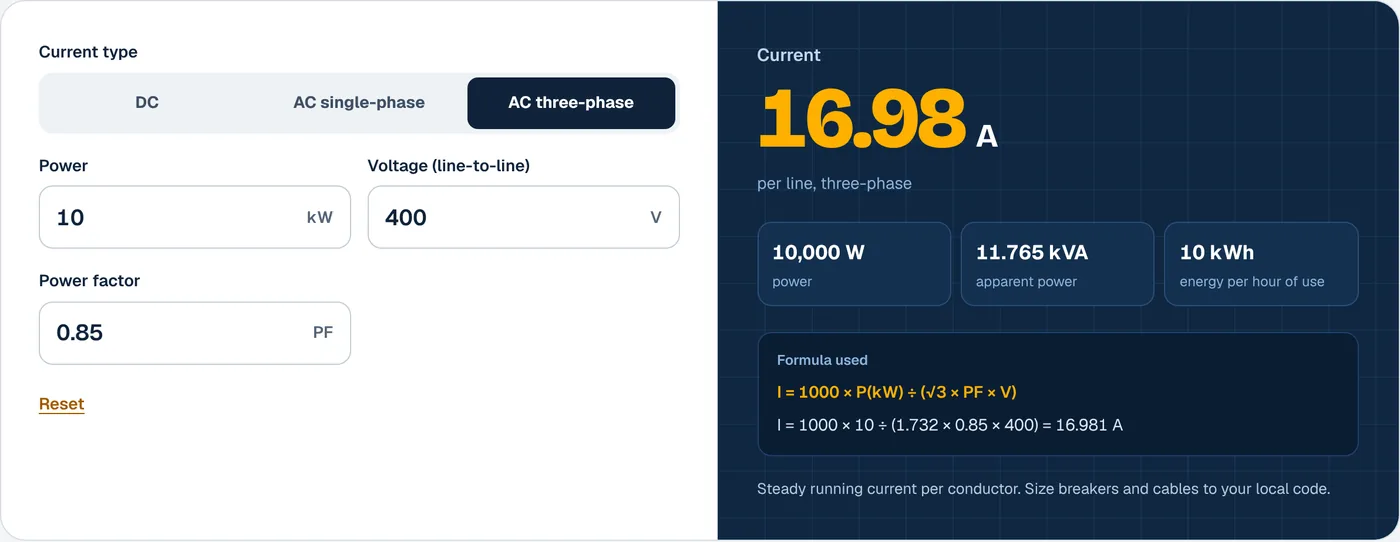
How to use the kW to amps calculator
- Choose the current type. Select DC for battery banks, solar arrays and the DC side of an inverter. Select single-phase AC for household and light commercial circuits. Select three-phase AC for motors, large chargers and commercial supplies.
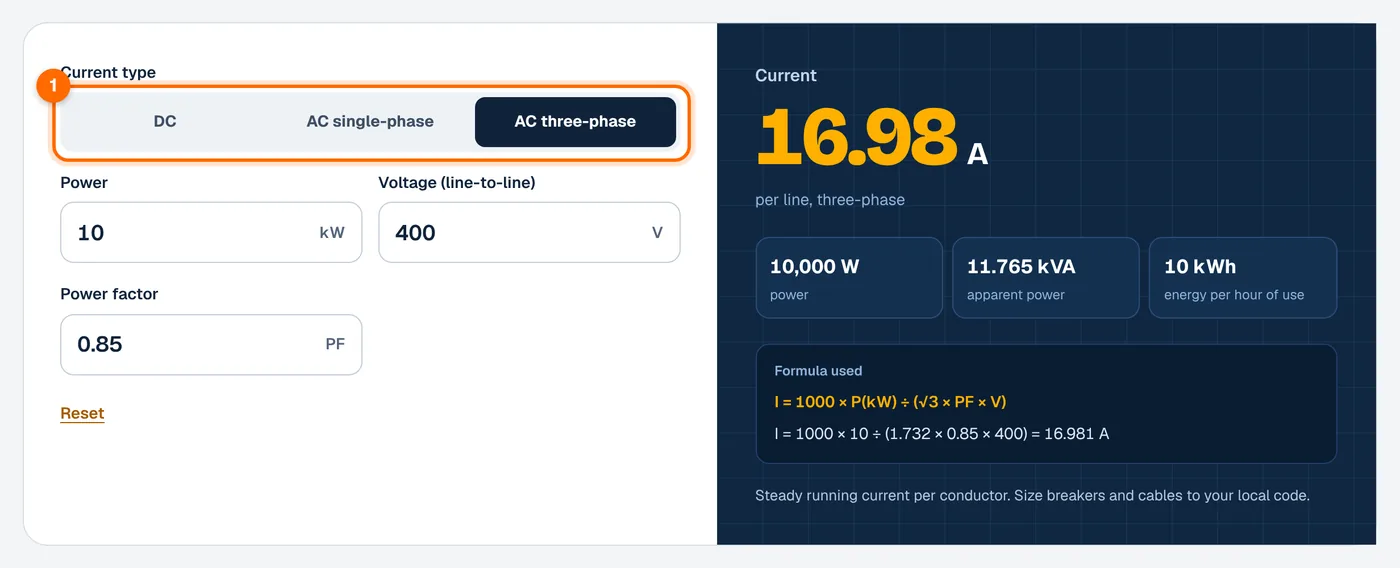
- Enter the power in kilowatts. Use the real power rating in kW. If you only have a kVA rating, convert it to kW first.
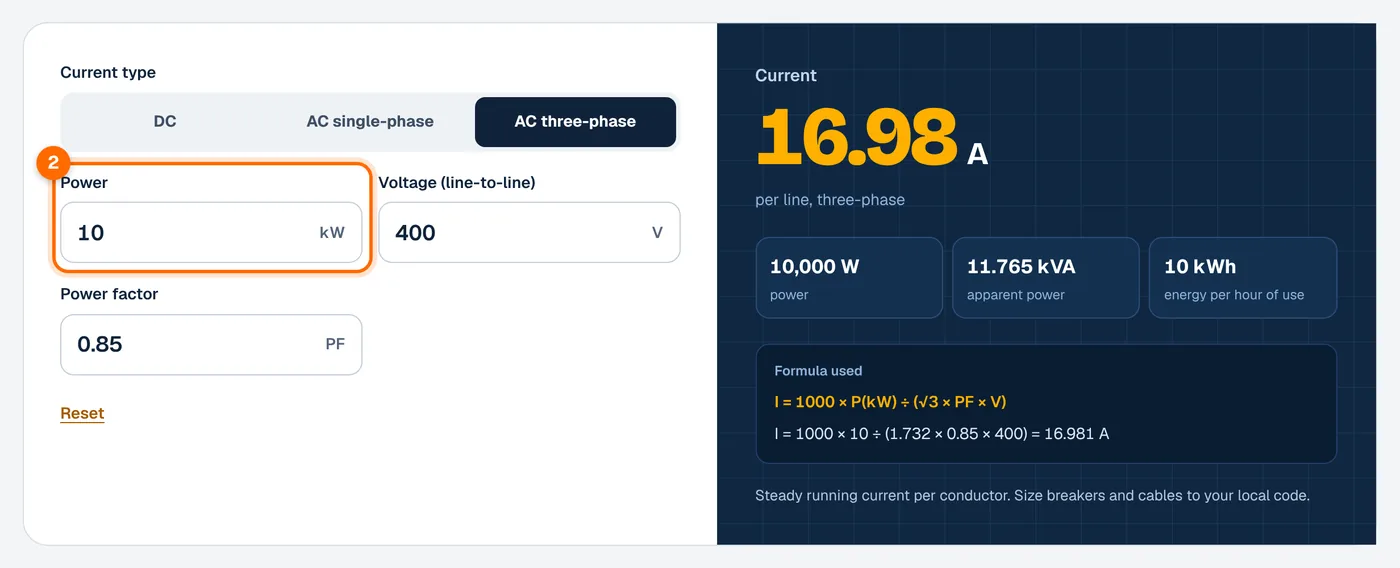
- Enter the voltage. Use the load voltage for single-phase, such as 120 V, 230 V or 240 V. Use the line-to-line voltage for three-phase, such as 208 V, 400 V or 480 V.
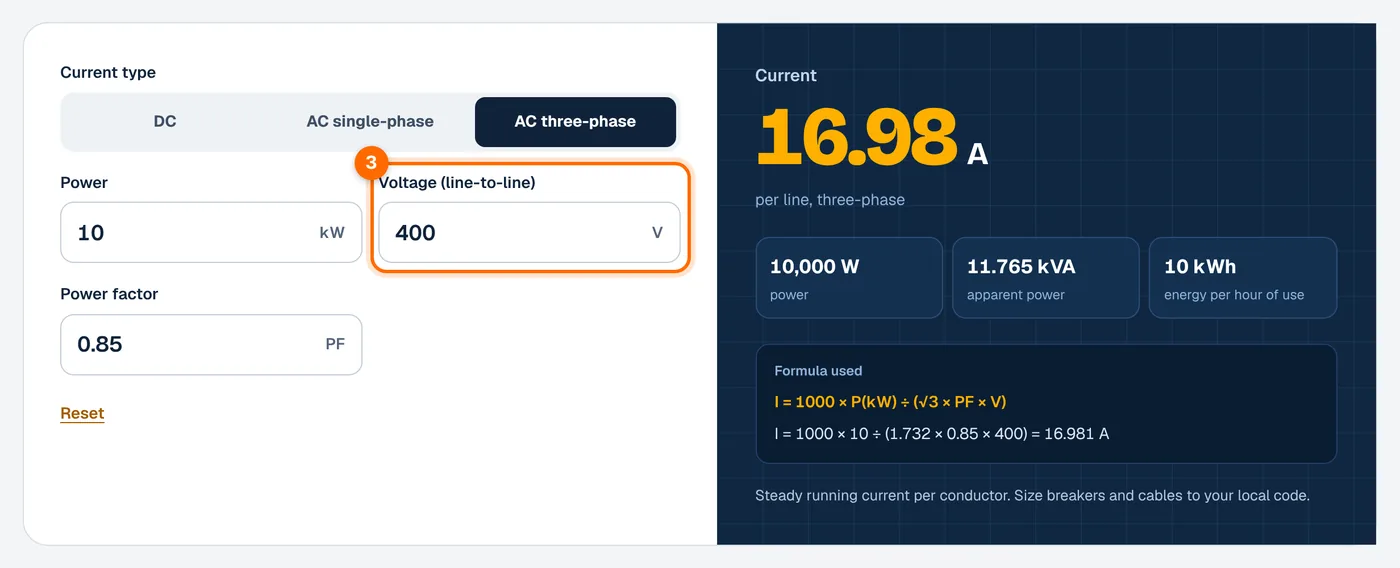
- Enter the power factor. Leave it at 1 for DC and resistive loads. Use the nameplate PF for motors, compressors and drives.
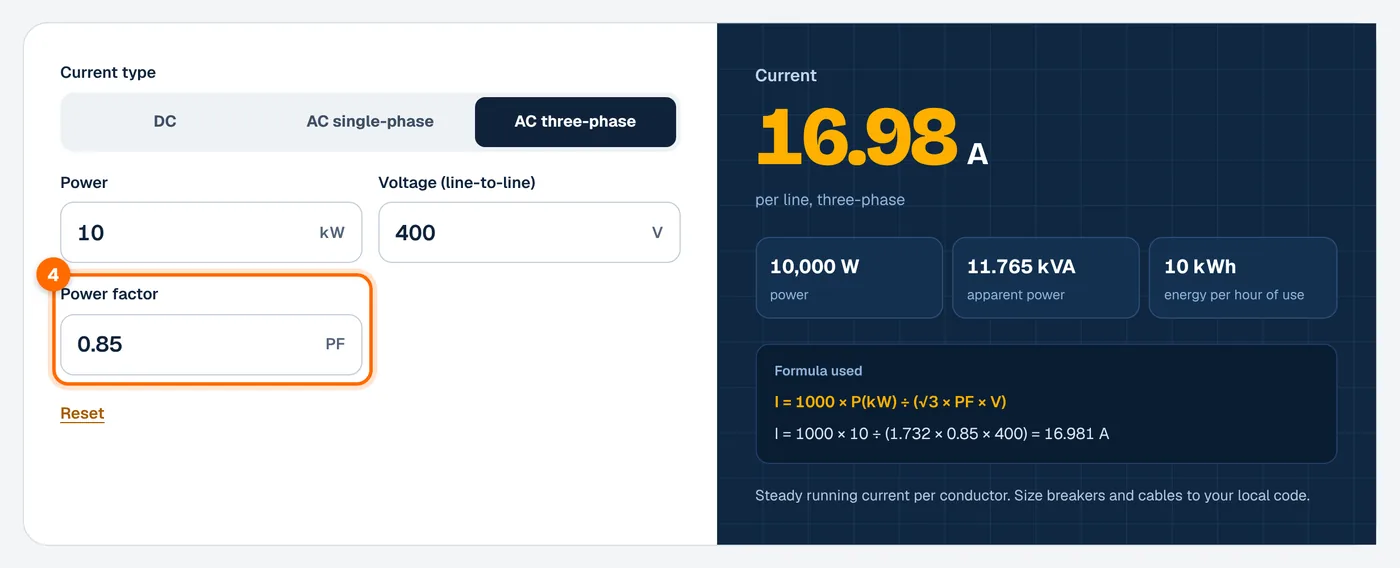
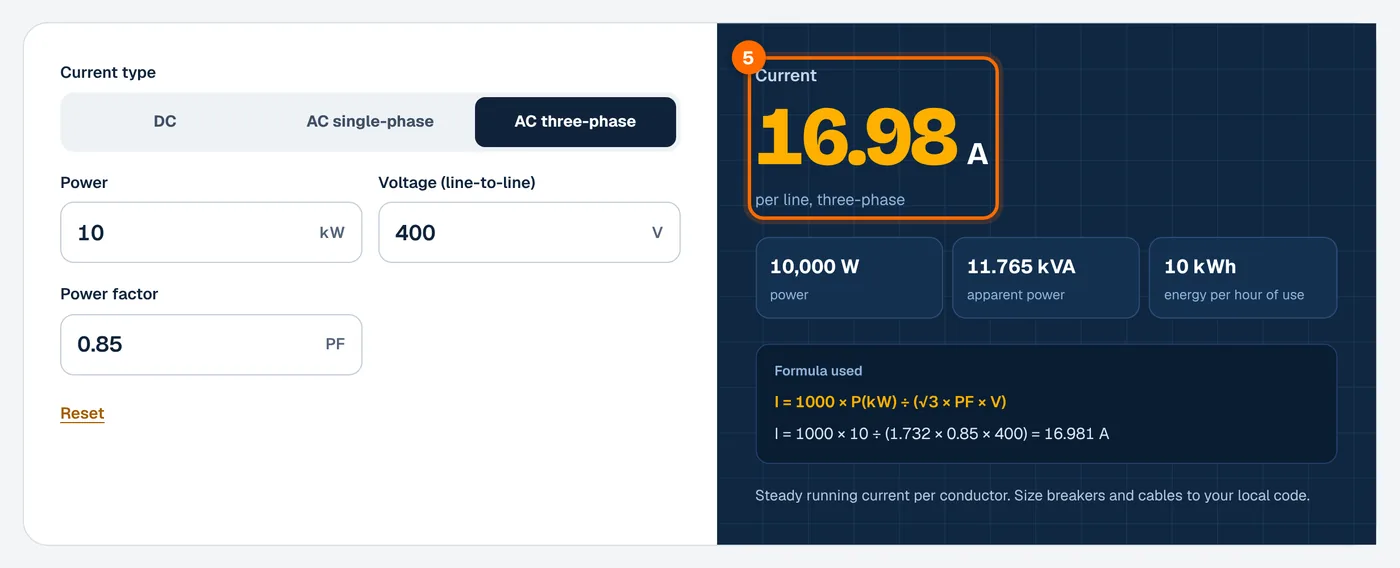
- Read the current. The result is the running current per conductor (per line in three-phase).
kW to amps formula
The calculator converts kilowatts to watts by multiplying by 1,000, then applies the formula for the current type.
DC
Single-phase AC
Three-phase AC
Where:
- I is the current in amps (A).
- PkW is the real power in kilowatts (kW). One kW is 1,000 W.
- V is the voltage across the load in volts (V).
- VLL is the line-to-line voltage in a three-phase system.
- PF is the power factor (0 to 1), the ratio of kW to kVA.
- √3 is about 1.732.
Worked examples
Example 1: 7.2 kW EV charger on 240 V single-phase
Assume PF = 1.
The charger draws 30 A.
Example 2: 5 kW from a 48 V battery bank
This is the DC side of an off-grid inverter delivering 5 kW. The example ignores inverter losses, so real battery current will be a little higher.
The battery supplies about 104 A. The same 5 kW on a 12 V system would need about 417 A, which shows why larger systems use higher battery voltages.
Example 3: 50 kW three-phase load at 480 V, PF 0.9
Each line carries about 66.8 A.
Example 4: 22 kW EV charger at 400 V three-phase
Assume PF = 1.
That is about 32 A per phase.
kW to amps chart
Three-phase columns use PF 0.9. The single-phase 240 V column uses PF 1. Values are rounded to one decimal place.
| Power (kW) | 1-phase 240 V, PF 1 | 3-phase 208 V | 3-phase 400 V | 3-phase 480 V |
|---|---|---|---|---|
| 1 | 4.2 A | 3.1 A | 1.6 A | 1.3 A |
| 5 | 20.8 A | 15.4 A | 8.0 A | 6.7 A |
| 10 | 41.7 A | 30.8 A | 16.0 A | 13.4 A |
| 15 | 62.5 A | 46.3 A | 24.1 A | 20.0 A |
| 22 | 91.7 A | 67.9 A | 35.3 A | 29.4 A |
| 30 | 125.0 A | 92.5 A | 48.1 A | 40.1 A |
| 50 | 208.3 A | 154.2 A | 80.2 A | 66.8 A |
| 75 | 312.5 A | 231.3 A | 120.3 A | 100.2 A |
| 100 | 416.7 A | 308.4 A | 160.4 A | 133.6 A |
For 230 V single-phase at PF 1, divide watts by 230. For example, 10 kW draws about 43.5 A.
What affects the result
System voltage
Higher voltage means lower current for the same kW. US three-phase systems commonly run at 208Y/120 V or 480Y/277 V. UK and EU three-phase supplies run at 400 V, with 230 V between each phase and neutral. Enter the line-to-line value in three-phase mode.
Power factor
A lower PF raises the current. Three-phase induction motors often run at about 0.75 to 0.85 lagging. Resistive heating runs near 1. If the PF is unknown, using 1 gives the lowest possible current, so treat that result as a minimum for inductive loads.
kW vs kVA ratings
Generators, UPS units and transformers are often rated in kVA. The formula here needs real power in kW. Convert first with kW = kVA × PF, or work out current directly from kVA by setting PF to 1 in this calculator and entering the kVA value as if it were kW.
Efficiency losses
Motors, inverters and chargers lose some power as heat. If your kW figure is output power, the input current is higher than the result. Use the input rating or nameplate current for wire and breaker sizing.
Frequently asked questions
How many amps is 1 kW?
At PF 1, 1 kW draws 8.33 A at 120 V, 4.35 A at 230 V and 4.17 A at 240 V. On three-phase at PF 0.9, 1 kW draws about 1.6 A at 400 V and 1.3 A at 480 V. The voltage and phase type set the answer.
How many amps is 10 kW three-phase?
At 400 V and PF 0.9, 10 kW draws about 16.0 A per line. At 480 V it draws about 13.4 A, and at 208 V about 30.8 A. At PF 1 the current at 400 V drops to about 14.4 A.
Do I need the power factor for DC?
No. DC has no phase shift between voltage and current, so the power factor is always 1. The calculator uses I = 1,000 × P / V for DC. This applies to batteries, solar strings and the DC input of an inverter.
What voltage should I enter for three-phase?
Enter the line-to-line voltage, measured between two phase conductors. In the US that is often 208 V or 480 V. In the UK and EU it is 400 V. Entering the line-to-neutral value, such as 230 V or 277 V, gives a current that is too high.
Is the result the breaker size I need?
No. The result is the running current. Breaker and wire sizing depend on your electrical code, continuous load rules, motor starting current, ambient temperature and installation method. Use the result as the starting point, then follow the code that applies where you live.