What Size Wire for a 40 Amp Breaker?
Short answer
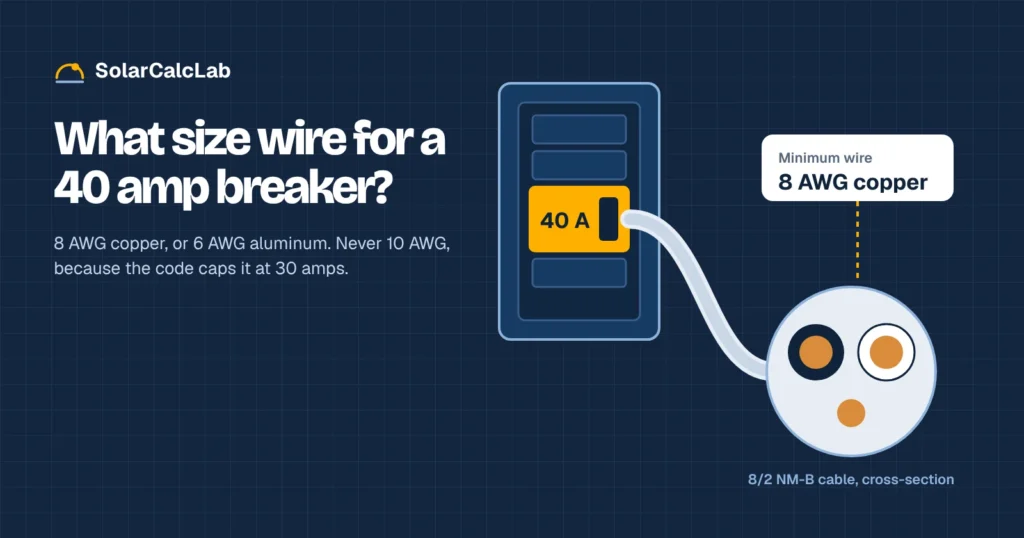
A 40 amp breaker needs 8 AWG copper wire, either 8 AWG NM-B cable or 8 AWG THHN in conduit. With aluminum, use 6 AWG. Never put 10 AWG copper on a 40 amp breaker, because the code caps 10 AWG at 30 amps. Size up to 6 AWG copper on long runs to control voltage drop.
Getting the 40 amp wire size right is not a matter of taste. The breaker protects the wire, so the wire must be able to carry the full 40 amps the breaker allows without overheating. Pick a conductor that is too small and the breaker can let it run hot for hours without ever tripping.
This guide gives the answer for copper and aluminum, explains why the cable type and its temperature rating change the result, and shows when a long run or a continuous load should push you one size up. The rules quoted here come from the 2023 edition of NFPA 70, the National Electrical Code, which most US states adopt with local amendments.
What size wire for a 40 amp breaker?
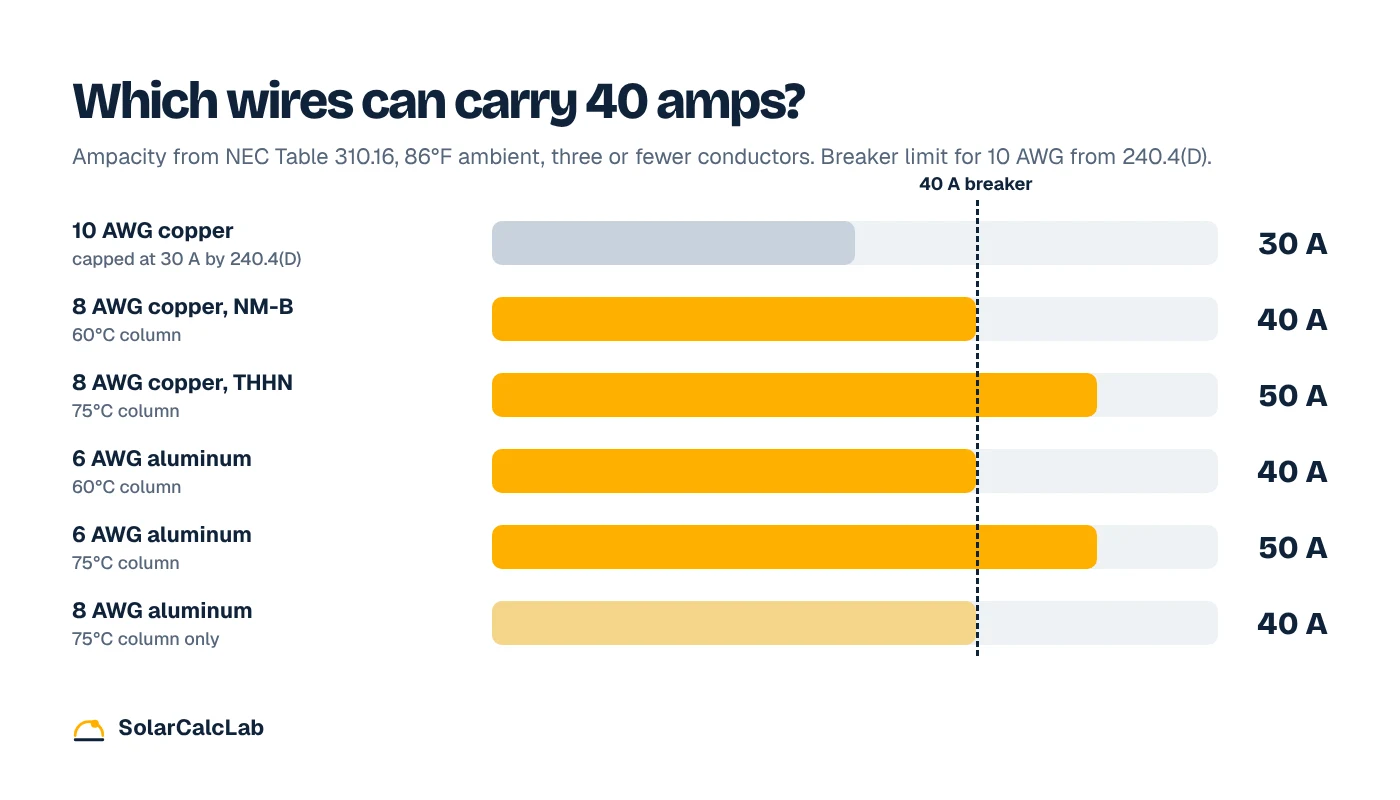
For most homes the answer is 8 AWG copper. The table below covers the common cable types. The ampacity column is what the wire can carry under normal conditions, and it must be at least 40 amps.
| Wire or cable | Minimum size for 40 A | Ampacity at that size | Notes |
|---|---|---|---|
| NM-B copper (Romex), indoors | 8 AWG (8/2 or 8/3) | 40 A (60°C column) | NM cable is always rated from the 60°C column |
| UF-B copper, buried or wet locations | 8 AWG | 40 A (60°C column) | Same limit as NM-B |
| THHN or THWN-2 copper in conduit | 8 AWG | 50 A (75°C column) | Extra headroom if terminals are rated 75°C |
| Aluminum (XHHW-2, SER), 60°C terminals | 6 AWG | 40 A (60°C column) | The safe default for aluminum |
| Aluminum, 75°C rated terminals | 8 AWG | 40 A (75°C column) | Only when the breaker and the equipment are both marked 75°C and AL |
Values follow NEC Table 310.16 for three or fewer current-carrying conductors at an ambient temperature of 86°F (30°C). You can check the same numbers on the Cerrowire ampacity chart, a wire maker’s published copy of the table.
Why 10 gauge wire is not allowed on a 40 amp breaker
The NEC table gives 10 AWG copper 30 A at 60°C, 35 A at 75°C and 40 A at 90°C. That last number tempts people, but it does not apply here. Section 240.4(D), the small conductor rule, limits the breaker on 10 AWG copper to 30 amps no matter which column you read.
The 90°C column exists for a different job. It is the starting point when you must reduce ampacity for heat or for many wires in one conduit, a process called derating. It never lets you put a bigger breaker on a small wire.
How temperature ratings change the answer
Every conductor has an insulation rating of 60°C, 75°C or 90°C, and every breaker and lug has a temperature rating of its own. The circuit is only as good as its weakest part.
- NM-B cable must be sized from the 60°C column even though the individual wires inside are rated 90°C. Section 334.80 sets that limit, which is why 8/2 NM-B is a 40 amp cable.
- Terminations on circuits of 100 amps or less use the 60°C column unless the equipment is marked for 75°C, under Section 110.14(C). Most modern breakers carry a 60/75°C marking, but check yours.
- Aluminum has lower ampacity than copper at the same gauge, so it usually needs one size larger. Its terminals must also be rated for aluminum, marked AL or CU/AL.
Continuous loads: what a 40 amp breaker can really run
A continuous load is one that runs at full current for three hours or more, such as an EV charger or an electric water heater. The NEC sizes the breaker at 125% of a continuous load, which means a 40 amp circuit can carry no more than 32 amps continuously.
At 240 volts, 32 amps equals 7,680 watts. That is why a 32 A Level 2 EV charger, often sold as a 7.7 kW unit, sits on a 40 amp breaker and 8 AWG copper. A load that draws 32 A for only short periods can use the full 40 A, but most fixed appliances list their required breaker on the nameplate, and that marking always wins. You can convert any load with the amps to watts calculator.
Example: a solar inverter on a 40 amp breaker
Inverter output is treated as continuous. Take an illustrative 7.6 kW grid-tied inverter at 240 volts:
31.7 A × 1.25 = 39.6 A, so the next standard breaker is 40 A
That circuit needs at least 8 AWG copper. Always use the maximum continuous output current and the breaker size printed in the inverter’s installation manual, since those figures can differ slightly from a watts-divided-by-volts estimate.
When to use 6 AWG instead of 8 AWG
Ampacity tells you the wire will not overheat. It does not tell you how much voltage you lose along the way. On long runs, resistance in the wire wastes power and lets motors and chargers see a lower voltage than they need.
The NEC includes an informational note that suggests keeping branch circuit voltage drop to about 3%. It is a recommendation, not a requirement, but it is a sensible target. Using typical resistance values from NEC Chapter 9, Table 8 (about 0.78 ohms per 1,000 feet for stranded 8 AWG copper and 0.49 ohms for 6 AWG), a 32 A load at 240 V works out like this:
| One-way distance | 8 AWG copper drop | 6 AWG copper drop |
|---|---|---|
| 50 ft | 2.5 V (1.0%) | 1.6 V (0.7%) |
| 100 ft | 5.0 V (2.1%) | 3.1 V (1.3%) |
| 150 ft | 7.5 V (3.1%) | 4.7 V (2.0%) |
| 200 ft | 10.0 V (4.2%) | 6.3 V (2.6%) |
The formula is voltage drop = 2 × one-way length × current × resistance per foot. Past roughly 140 feet, 8 AWG copper passes the 3% mark at a 32 A load, so 6 AWG copper is the better choice. For your exact run, enter the length and load in the voltage drop calculator, or let the wire size calculator pick the gauge for both ampacity and voltage drop.
Common 40 amp circuits
- Electric ranges and cooktops. Many smaller ranges and most cooktops call for a 40 amp circuit. Check the nameplate, because full-size ranges often need 50 amps.
- Level 2 EV chargers. A charger set to 32 amps needs a 40 amp breaker and 8 AWG copper.
- Air conditioners and heat pumps. Size these from the nameplate, which lists the minimum circuit ampacity (MCA) for the wire and the maximum overcurrent protection (MOP) for the breaker. A unit can legally use a 40 A breaker with a smaller wire when the nameplate allows it, so follow the label, not this table.
- Solar inverters and battery systems. A 7.6 kW inverter is a common example, as worked out above.
- Subpanels for a shed or workshop. A 40 amp feeder works for light loads. Long runs to outbuildings are where voltage drop often pushes the wire to 6 AWG.
Does voltage change the wire size?
No. Wire size depends on current, not voltage. A 40 amp circuit needs 8 AWG copper at 120 V or 240 V. Voltage changes how much power the circuit delivers: 40 amps at 240 V is 9,600 watts, while 40 amps at 120 V is 4,800 watts. Higher voltage does help with voltage drop, because the same lost volts are a smaller share of the total.
What size ground wire does a 40 amp circuit need?
NEC Table 250.122 sizes the equipment grounding conductor from the breaker rating. For any breaker up to 60 amps, the minimum ground is 10 AWG copper or 8 AWG aluminum. That is why 8/2 NM-B cable carries a 10 AWG bare ground. If you upsize the hot wires for voltage drop, Section 250.122(B) requires the ground to grow in proportion.
Mistakes to avoid
- Reusing 10 AWG wire when upgrading a 30 amp circuit to 40 amps. The wire has to be replaced as well.
- Reading the 90°C column to justify a smaller wire. That column is for derating only.
- Ignoring heat and bundling. Wire in a hot attic, or more than three current-carrying conductors in one conduit, must be derated and may need a larger size.
- Putting aluminum on copper-only terminals. Use lugs and breakers marked AL or CU/AL, with the torque the manufacturer specifies.
- Skipping the nameplate. Appliance and equipment instructions override general tables.
Local codes can add rules of their own, and most jurisdictions require a permit for new circuits. If you are not certain about any step, have a licensed electrician size and install the circuit.
Frequently asked questions
Can I use 10 gauge wire on a 40 amp breaker?
No. NEC Section 240.4(D) limits 10 AWG copper to a 30 amp breaker, even though the 90°C column lists 40 amps. A 40 amp breaker would let the wire carry more current than it is allowed, so it could overheat without tripping. Use 8 AWG copper instead.
Is 8 gauge wire good for 40 amps?
Yes. 8 AWG copper is rated 40 amps in the 60°C column, which covers NM-B cable, and 50 amps in the 75°C column for THHN in conduit. Either way it meets a 40 amp breaker. On runs longer than about 140 feet at a heavy load, consider 6 AWG for voltage drop.
What size aluminum wire do I need for 40 amps?
Use 6 AWG aluminum, which carries 40 amps even in the 60°C column. 8 AWG aluminum is rated 40 amps only in the 75°C column, so it is allowed only when the breaker, the equipment and the wire are all rated 75°C. All terminals must be listed for aluminum.
How far can I run 8 gauge wire on a 40 amp circuit?
For a 32 amp continuous load at 240 volts, 8 AWG copper stays within a 3% voltage drop up to about 140 feet one way. At lighter loads the distance grows. For longer runs, move up to 6 AWG copper or check your exact numbers with a voltage drop calculator.
What size ground wire do I need for a 40 amp circuit?
NEC Table 250.122 calls for at least 10 AWG copper or 8 AWG aluminum as the equipment ground on circuits protected at 40 amps. Standard 8/2 and 8/3 NM-B cable already includes a 10 AWG ground. If you upsize the hot conductors, the ground must be increased proportionally.