Amp Hour Calculator
Size a battery in amp-hours for a DC load and runtime, or find how long a battery of known Ah will last.
Quick answer
To size a battery in amp-hours, multiply the load current by the hours it must run, then divide by the share of the battery you plan to use. Ah = A × h ÷ usable fraction. A 10 A load for 8 hours at 80% usable capacity needs 10 × 8 ÷ 0.8 = 100 Ah.

How to use the amp hour calculator
- Choose what you want to find. Pick Battery Ah needed to size a battery for a load and runtime. Pick Runtime from Ah to see how long a battery you already own will last.

- Enter the load current. Type the DC current the load draws from the battery in amps. If you only know watts, divide by the battery voltage, or use the watts to amps calculator.
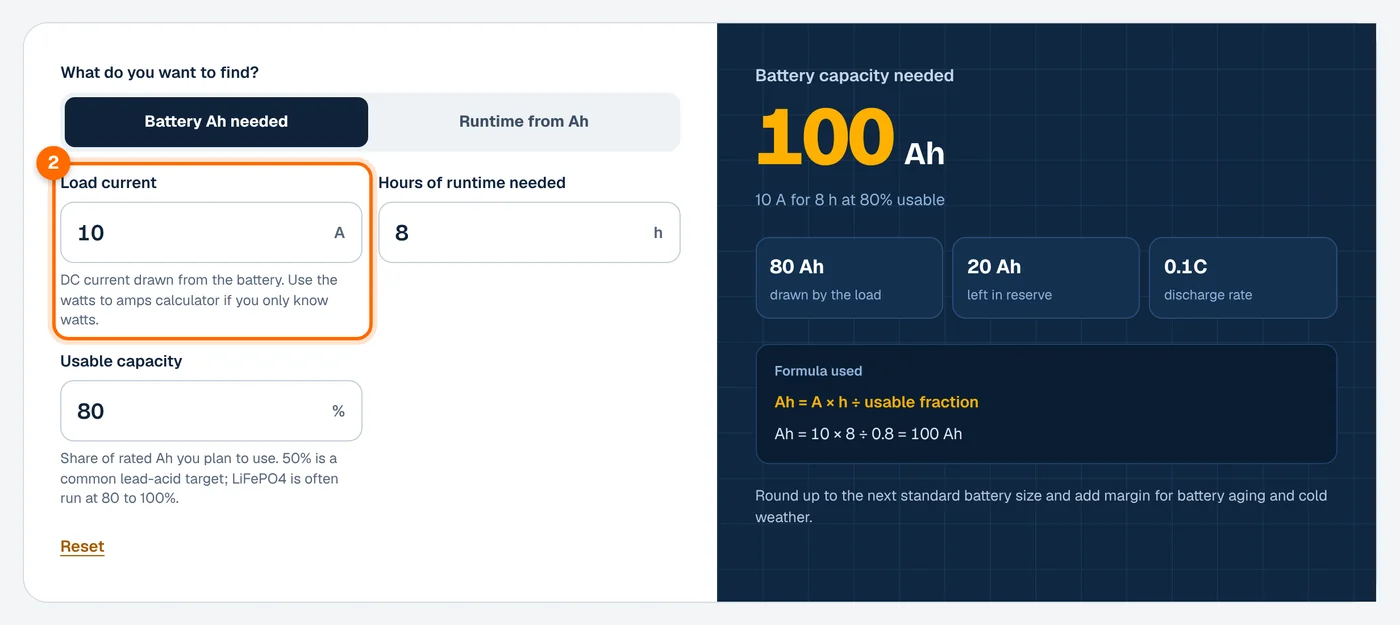
- Enter the hours of runtime needed. Type how long the load must run between charges. In Runtime from Ah mode this field becomes the battery capacity, so enter the battery’s rated Ah instead.
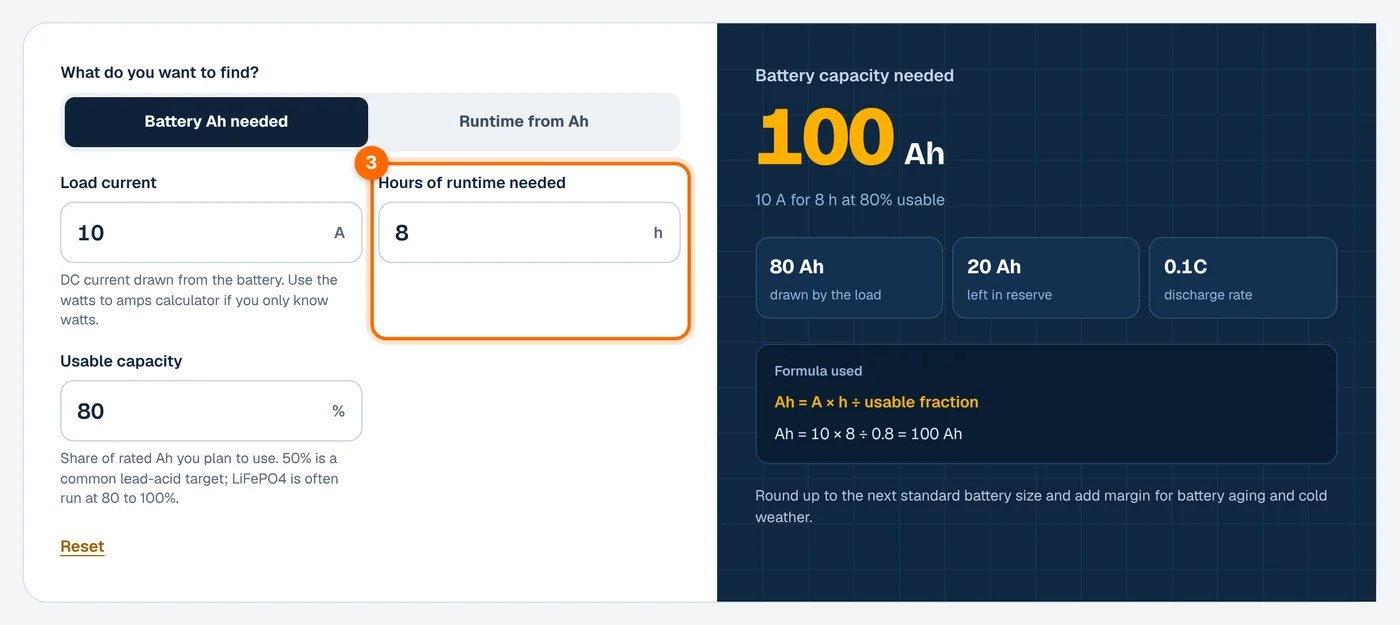
- Enter the usable capacity. This is the share of the rated Ah you plan to draw before recharging. A common target is 50% for lead-acid, while LiFePO4 is often run at 80% to 100%.

- Read the result. The large number is the battery size in Ah, or the runtime in hours. The cards show the amp-hours the load draws, the reserve left in the battery and the discharge rate.

Amp hour formula
An amp-hour is one amp of current flowing for one hour. The load uses A × h amp-hours, and the battery must be big enough that this amount is only the usable part of its capacity.
Where:
- Ahbattery is the rated battery capacity in amp-hours.
- I is the load current in amps (A), measured at the battery.
- t is the runtime in hours.
- u is the usable fraction of capacity, such as 0.5 for 50% or 0.8 for 80%.
The discharge rate card shows the load as a fraction of capacity, called the C-rate. A 10 A load on a 100 Ah battery is 0.1C.
Worked examples
Example 1: 10 A camping load for 8 hours, LiFePO4
The load draws 80 Ah, and the remaining 20 Ah stays in the battery as reserve. A 100 Ah LiFePO4 battery fits.
Example 2: 5 A load for 12 hours, lead-acid
Planning to use only 50% of a lead-acid battery:
The load uses 60 Ah, so the battery needs twice that rating. Round up to the next standard size.
Example 3: runtime of a 100 Ah AGM battery at 7 A
Choose Runtime from Ah mode, enter 7 A, 100 Ah and 50% usable.
That is about 7 hours 9 minutes before the battery reaches half charge.
Battery Ah needed by load and runtime
Rated Ah needed for each load at three usable fractions. Values do not include any extra margin for aging or cold.
| Load (A) | Runtime (h) | Ah drawn | At 50% usable | At 80% usable | At 100% usable |
|---|---|---|---|---|---|
| 1 | 24 | 24 | 48 | 30 | 24 |
| 5 | 8 | 40 | 80 | 50 | 40 |
| 5 | 24 | 120 | 240 | 150 | 120 |
| 10 | 8 | 80 | 160 | 100 | 80 |
| 20 | 5 | 100 | 200 | 125 | 100 |
| 50 | 2 | 100 | 200 | 125 | 100 |
What affects the result
Usable capacity and chemistry
Deep discharges shorten battery life. For flooded lead-acid batteries, Trojan Battery’s maintenance guide recommends discharges of 50% or less and treats 80% as the maximum safe discharge. LiFePO4 batteries tolerate deeper cycles, so 80% to 100% is common. Check your battery’s datasheet.
Discharge rate
Lead-acid batteries are often rated at the 20-hour rate. Draw current faster and they deliver fewer amp-hours, an effect described by Peukert’s law. If the C-rate card shows well above 0.05C for a lead-acid battery, expect less runtime than the formula gives.
Current at the battery, not the device
Enter the current drawn from the battery. An inverter running a 120 V appliance pulls far more amps from a 12 V battery than the appliance draws from the outlet, plus its own losses. For AC loads, the battery life calculator handles watts and inverter efficiency for you.
Temperature and age
Cold reduces available capacity, especially for lead-acid, and all batteries lose capacity as they age. Round the result up to the next standard battery size and allow some margin for this, based on your climate and how long you expect to keep the battery.
Frequently asked questions
How do I calculate amp-hours?
Multiply the current in amps by the time in hours. A 4 A load running for 5 hours uses 4 × 5 = 20 Ah. To size a battery, divide that by the usable fraction, so 20 Ah at 50% usable needs a 40 Ah battery.
How long will a 100 Ah battery last?
Divide the usable amp-hours by the load current. At 80% usable, a 100 Ah battery gives 80 Ah, so it runs a 10 A load for 8 hours and a 20 A load for 4 hours. At 50% usable for lead-acid, the same loads run 5 and 2.5 hours.
How do I convert watts to amps for a battery?
Divide the watts by the battery voltage. A 120 W DC load on a 12 V battery draws 10 A. For AC loads through an inverter, divide by the inverter efficiency too: 300 W ÷ 0.9 ÷ 12 V is about 27.8 A from the battery.
Why should I not use 100% of a lead-acid battery?
Deep discharges wear lead-acid batteries quickly. Trojan Battery recommends keeping discharges to 50% or less and warns that fully discharging a flooded battery can damage it. Sizing for 50% usable capacity doubles the battery size but gives a much longer service life.
What does C-rate mean?
C-rate is the load current divided by the battery’s Ah rating. A 20 A load on a 100 Ah battery is 0.2C. A 1C load would empty the battery in about an hour. Lower C-rates generally give more usable capacity and less stress on the battery.