Watts to kWh Calculator
Convert an appliance's watts into kilowatt-hours per day, month and year from the hours it runs.
Quick answer
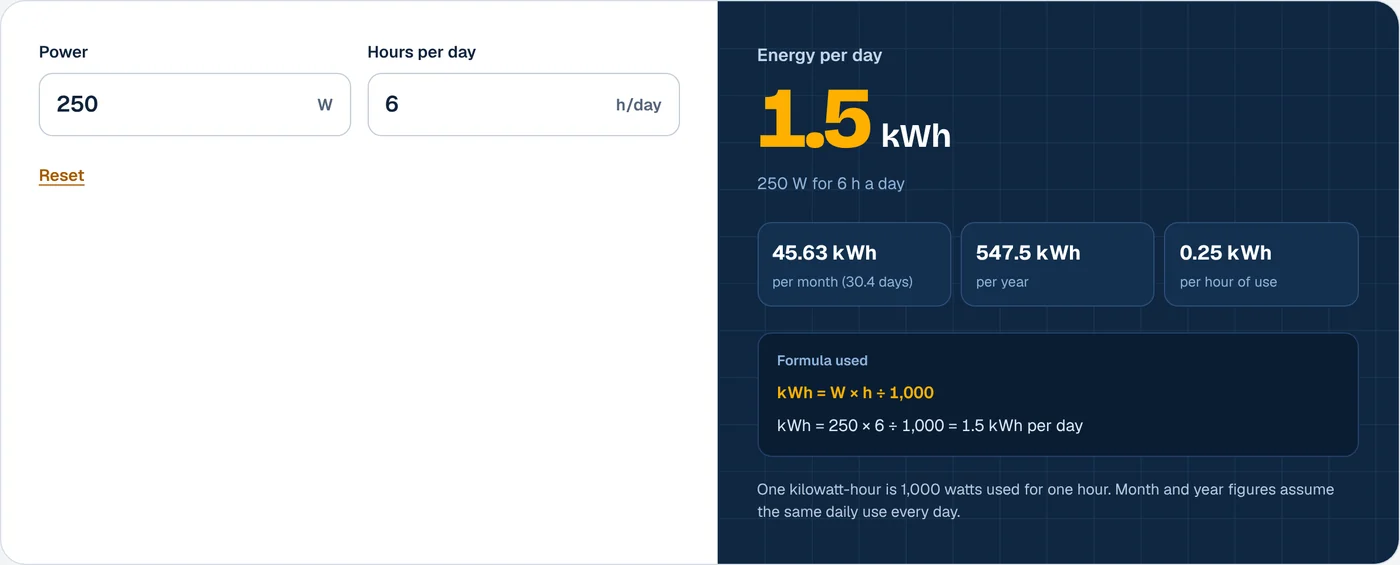
To convert watts to kWh, multiply the watts by the hours of use and divide by 1,000. kWh = W × h ÷ 1,000. A 250 W device running 6 hours a day uses 250 × 6 ÷ 1,000 = 1.5 kWh per day, about 45.6 kWh per month and 547.5 kWh per year.
How to use the watts to kWh calculator
- Enter the power in watts. Use the input wattage from the label or manual. For devices that cycle, such as a fridge, enter the average watts measured with a plug-in energy meter.
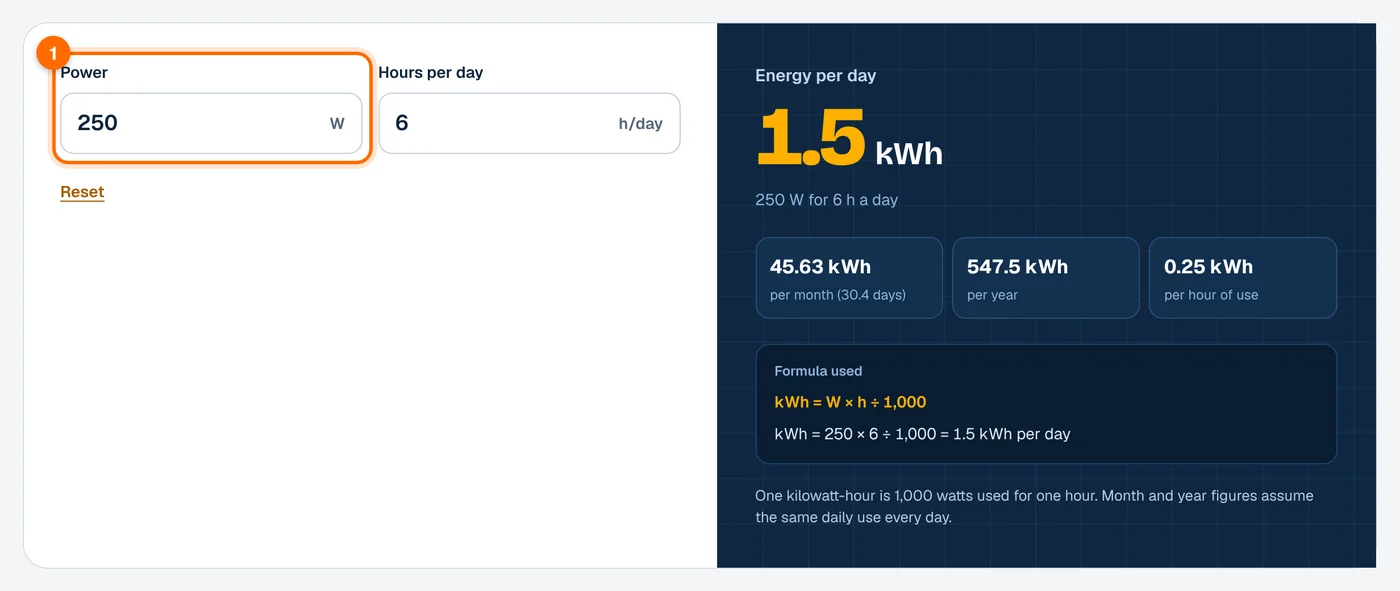
- Enter the hours per day. Type how many hours a day the device runs at that power. Use decimals for part hours, so 30 minutes is 0.5 and 15 minutes is 0.25.

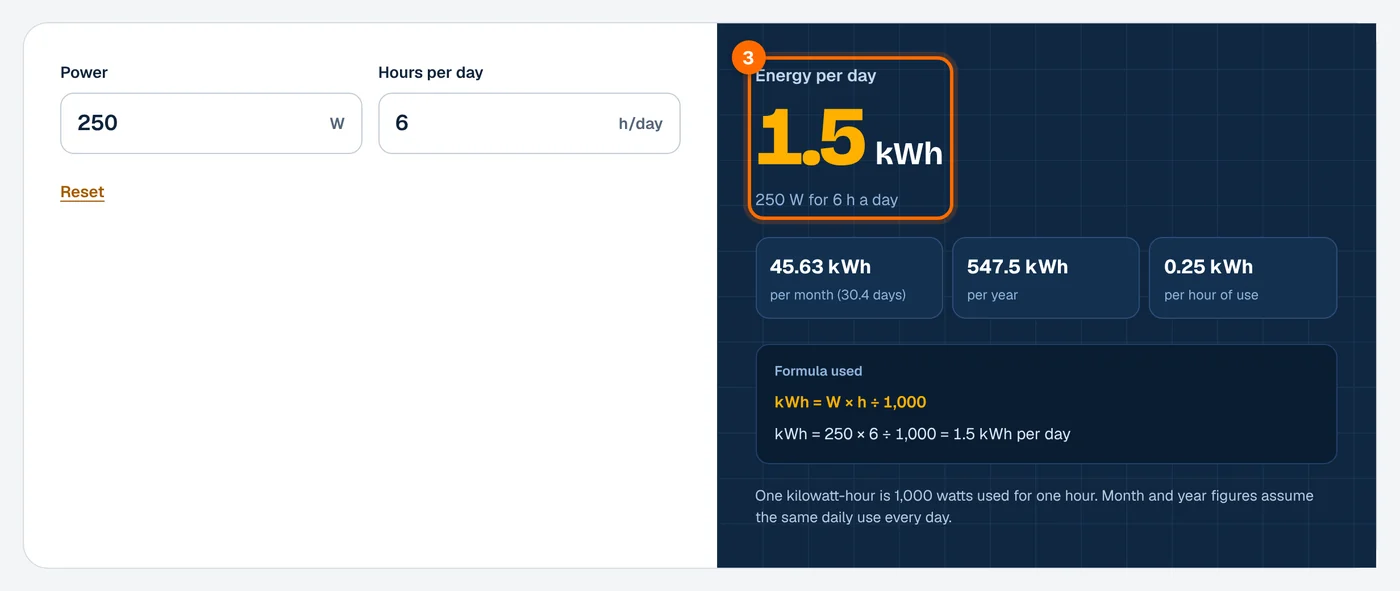
- Read the kWh per day. The large number is the daily energy use. The cards convert it to kWh per month and per year, and show the kWh for each hour of use.
Watts to kWh formula
Watts measure power, the rate of energy use. Kilowatt-hours measure energy, the total used over time. To go from one to the other, you need the time.
Where:
- Eday is the energy per day in kilowatt-hours (kWh).
- P is the power in watts (W).
- h is the hours of use per day.
- 1,000 converts watt-hours (Wh) to kilowatt-hours, since 1 kWh = 1,000 Wh.
- 30.42 is the average number of days in a month (365 ÷ 12).
If you only need watt-hours, skip the division: a 250 W load for 6 hours is 1,500 Wh.
Worked examples
Example 1: 60 W light for 5 hours a day
Per month: 0.3 × 30.42 = 9.13 kWh. Per year: 0.3 × 365 = 109.5 kWh. Swapping it for a 10 W LED with the same hours drops the daily figure to 10 × 5 ÷ 1,000 = 0.05 kWh.
Example 2: 1,500 W window air conditioner
Say the compressor runs 3 hours a day in total on a hot day. This is an example run time, not a measured one.
Over a 30.42 day month at the same use, that is 4.5 × 30.42 = 136.9 kWh.
Example 3: 100 W device running all day
A small server or network cabinet that draws a steady 100 W around the clock:
Per year: 2.4 × 365 = 876 kWh. Loads that never switch off add up quickly, so they are worth measuring.
Watts to kWh conversion chart
The wattages and hours below are examples only. Check the label or measure your own device.
| Power (W) | Example load | Hours per day | kWh per day | kWh per month | kWh per year |
|---|---|---|---|---|---|
| 10 | LED bulb | 5 | 0.05 | 1.52 | 18.25 |
| 60 | Ceiling fan | 5 | 0.3 | 9.13 | 109.5 |
| 100 | Desktop computer | 8 | 0.8 | 24.33 | 292 |
| 150 | Television | 4 | 0.6 | 18.25 | 219 |
| 500 | Gaming PC under load | 8 | 4 | 121.67 | 1,460 |
| 1,000 | Microwave oven | 1 | 1 | 30.42 | 365 |
| 1,500 | Space heater | 3 | 4.5 | 136.88 | 1,642.5 |
| 3,000 | Electric water heater element | 2 | 6 | 182.5 | 2,190 |
To scale a row, change the hours: kWh rises in direct proportion. Twice the hours means twice the kWh.
What affects the result
Hours at full power
The formula assumes the device draws its full wattage for every hour you enter. Thermostats, compressors and power-saving modes mean many appliances spend part of the time at lower power or off. Enter only the hours at that wattage, or the average watts over the whole day.
Label wattage vs real draw
Labels often show the maximum input. A TV, computer or games console usually draws less in normal use, while a heater or kettle draws close to its rating. A plug-in meter gives the most accurate figure.
Standby and idle loads
Chargers, set-top boxes and smart devices draw small amounts of power all day. Even 3 W adds 3 × 24 ÷ 1,000 = 0.072 kWh a day, or 26.3 kWh a year. Add these as separate rows with 24 hours of use.
Seasonal use
The monthly and yearly cards assume the same daily use every day. A heater used only in winter or an air conditioner used only in summer needs a separate estimate for each season.
Frequently asked questions
How many kWh is 1,000 watts?
1,000 watts running for one hour uses 1 kWh. Watts alone are not energy, so you always need the time. The same 1,000 W microwave uses 0.25 kWh in 15 minutes and 2 kWh over 2 hours. Multiply watts by hours and divide by 1,000.
How do I convert kWh back to watts?
Multiply the kWh by 1,000 and divide by the hours. If a device used 3 kWh over 6 hours, its average power was 3 × 1,000 ÷ 6 = 500 W. This gives the average draw, which can be lower than the peak rating on the label.
Is a watt-hour the same as a watt?
No. A watt is a rate of energy use, like speed. A watt-hour is an amount of energy, like distance. One watt-hour is one watt used for one hour. A kilowatt-hour is 1,000 watt-hours, the unit used on electricity bills.
How many kWh does a 100 W device use per month?
At 100 W for 24 hours a day, it uses 2.4 kWh a day and about 73 kWh in an average month (2.4 × 30.42). At 8 hours a day it uses 0.8 kWh a day and about 24.3 kWh a month. The hours you enter make the biggest difference.
How do I find the cost from kWh?
Multiply the kWh by your electricity rate per kWh. For example, 45.6 kWh at an example rate of $0.18 per kWh costs about $8.21. The electricity cost calculator does this for you and shows the cost per hour, day, month and year.