Net Metering Calculator
Compare your monthly electric bill under net metering and net billing from imported and exported kWh, retail and export rates.
Quick answer
Under net metering, exports cancel imports kWh for kWh: bill = (import − export) × retail rate. Under net billing, you pay retail for imports and earn a lower export rate: bill = import × retail − export × export rate. With 450 kWh imported, 250 exported, $0.20 retail and $0.06 export, the bills are $40 and $75.

How to use the net metering calculator
- Choose your currency. This changes only the symbol on the results. The math is the same in any currency.

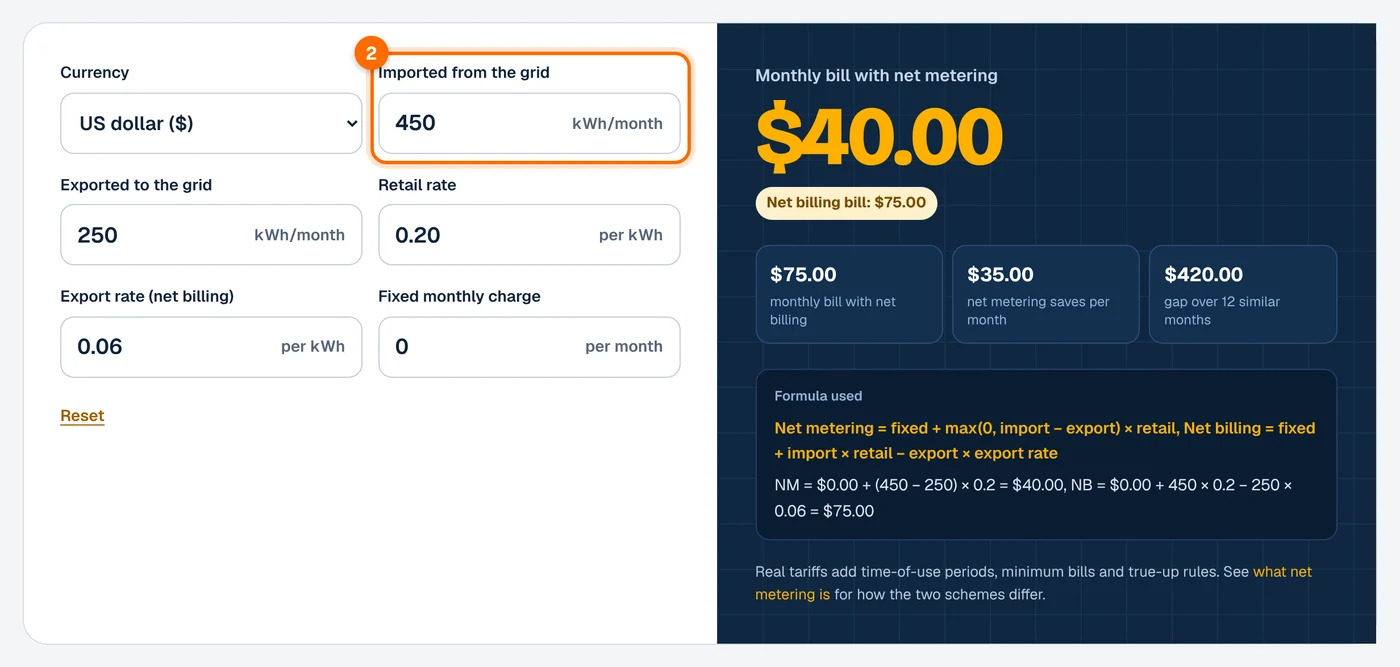
- Enter the kWh imported from the grid. This is the energy your meter recorded coming into your home during the month. Your bill or utility app usually lists it as delivered or imported energy.
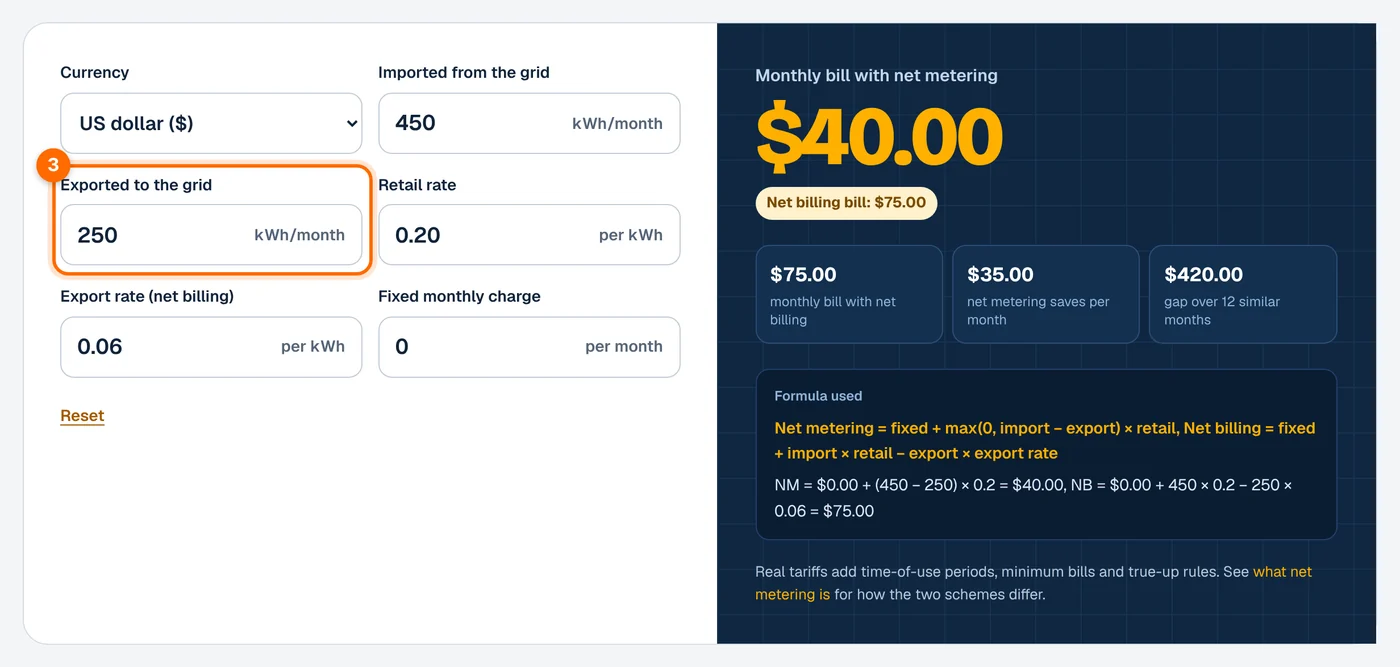
- Enter the kWh exported to the grid. This is the solar energy your home sent out because you were not using it at the time. It may be listed as received or exported energy.
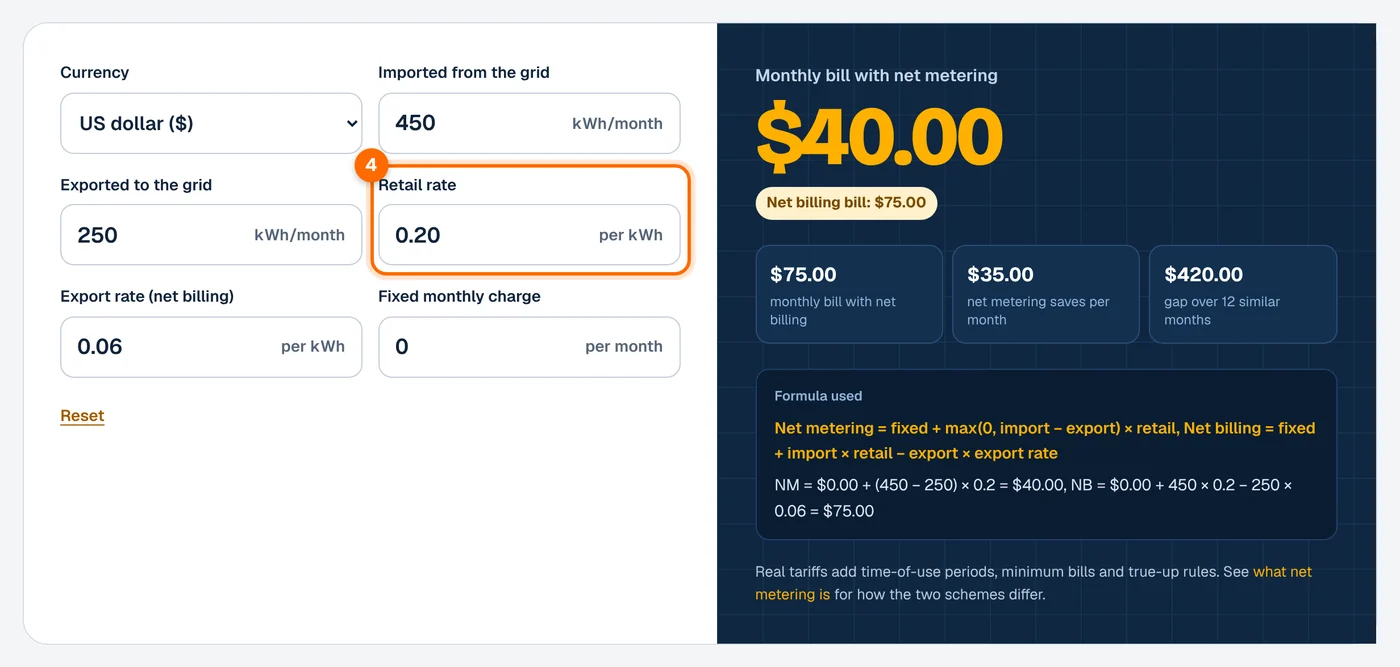
- Enter the retail rate. Use the full price per kWh you pay for imports, including per-kWh delivery charges. If you have time-of-use rates, use a weighted average.
- Enter the export rate. This is the credit per kWh under net billing, often based on the utility’s avoided cost. Check your tariff sheet or interconnection agreement.

- Enter the fixed monthly charge. Add any customer or connection charge that you pay regardless of usage. Solar does not reduce it under either scheme.

- Read the monthly bill under each scheme. The big number is the net metering bill. The cards show the net billing bill, the monthly gap and that gap over 12 similar months.

Net metering formula
The calculator works out the same month two ways.
Net metering (1:1 credit)
Net billing (separate export rate)
Where:
- F is the fixed monthly charge.
- I is imported energy in kWh and X is exported energy in kWh.
- r is the retail rate per kWh and e is the export rate per kWh.
- max(0, …) means the energy charge cannot go below zero. If you export more than you import, the extra kWh are usually carried forward as a credit.
For a full explanation of the two schemes, read our guide to what net metering is and how it differs from net billing.
Worked examples
Example 1: the standard comparison
Illustrative inputs: 450 kWh imported, 250 kWh exported, $0.20 retail, $0.06 export, no fixed charge.
Net metering saves $35.00 this month, or $420 over 12 similar months.
Example 2: exporting more than you import
A sunny month: 200 kWh imported, 600 kWh exported, $0.20 retail, $0.06 export and a $12 fixed charge.
Under net metering you pay only the fixed charge and carry 400 kWh of credit to the next month. That credit is worth $80 at the retail rate.
Example 3: finding your break-even export rate
The two bills match when the export rate equals the retail rate. Any gap between the rates costs you that gap on every exported kWh: in example 1, (0.20 − 0.06) × 250 = $35.
Bills at different export levels
All rows use 450 kWh imported, $0.20 retail, $0.06 export and no fixed charge. The numbers are illustrative, not a real tariff.
| Exported (kWh) | Net metering bill | Net billing bill | Monthly difference |
|---|---|---|---|
| 0 | $90.00 | $90.00 | $0.00 |
| 100 | $70.00 | $84.00 | $14.00 |
| 200 | $50.00 | $78.00 | $28.00 |
| 250 | $40.00 | $75.00 | $35.00 |
| 350 | $20.00 | $69.00 | $49.00 |
| 450 | $0.00 | $63.00 | $63.00 |
The difference grows by $0.14 for every extra kWh exported, which is the retail rate minus the export rate.
What affects the result
The gap between retail and export rates
This is the single biggest factor. Under net billing, each exported kWh is worth only the export rate, so a wide gap makes exports far less valuable than self-use.
How much you export
Homes that are empty during the day export more and feel the switch to net billing most. Shifting laundry, dishwashing, pool pumps or car charging into sunny hours turns exports into self-use, which saves the full retail rate.
Fixed and minimum charges
Many utilities charge a fixed monthly fee, and some set a minimum bill. Solar cannot reduce these, so they set a floor under both schemes.
Time-of-use rates and true-up
Real tariffs may price kWh by time of day and settle credits once a year in a true-up. A single average rate is a simplification. Retail prices also vary a lot by state: the EIA’s state price table showed a US average of 18.31¢ per kWh for residential customers in July 2026.
Frequently asked questions
What is the difference between net metering and net billing?
Net metering credits each exported kWh at about the retail rate, so exports cancel imports one for one. Net billing charges imports at the retail rate and pays a separate, usually lower, rate for exports. The same solar system can save much less under net billing.
What happens if I export more than I import?
Under net metering, the extra kWh usually roll forward as a credit to later months, often settled once a year. Under net billing, any surplus credit is usually carried forward as a dollar amount. Unused credits at the end of a settlement period may be paid out at a low rate or lost.
Does net metering remove my whole electric bill?
Rarely. Fixed customer charges and any minimum bill remain, so check your tariff for both. In example 2, the home exported more than it imported and still paid the $12 fixed charge. Taxes and other per-bill fees may also stay on the bill.
How do I find my import and export kWh?
Most bills for solar homes show two meter readings, often called delivered and received. Delivered is your import and received is your export. Your utility’s online account or your inverter app may also show both. Use the same billing period for each.
Is a battery worth it under net billing?
A battery stores midday surplus for the evening, turning low-value exports into self-use at the retail rate. The saving per kWh is roughly retail minus export rate. Whether that covers the battery’s cost depends on how many kWh you shift each day and on the battery price.