Ohm’s Law Calculator
Solve voltage, current, resistance and power from any two known values, with the full Ohm's law wheel of formulas.
Quick answer
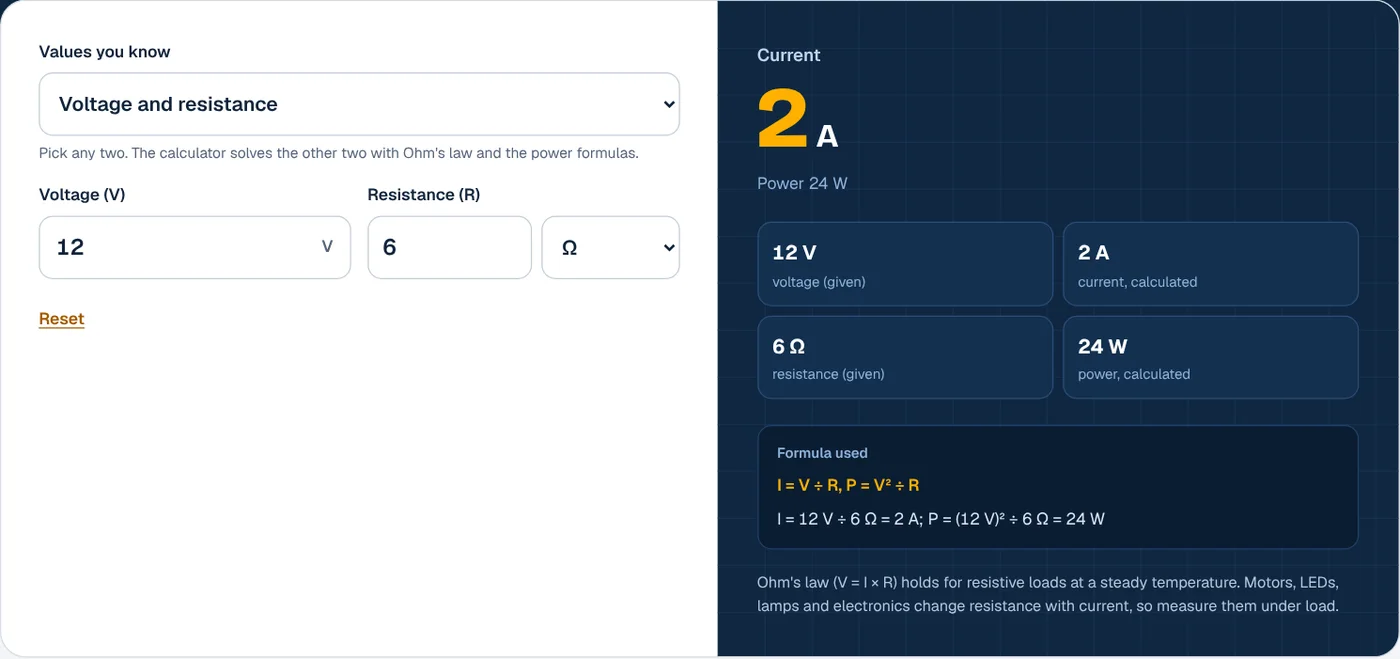
Ohm’s law says voltage equals current times resistance: V = I × R. A 12 V supply across a 6 Ω resistor drives I = 12 ÷ 6 = 2 A, and the resistor turns P = V × I = 24 W into heat. Know any two of voltage, current, resistance and power, and the other two follow.
How to use the Ohm’s law calculator
- Pick the two values you know. Choose a pair from the list: voltage and resistance, voltage and current, current and resistance, or power with any one of the other three. Only the two matching input boxes stay visible.

- Enter the first known value. Type the voltage in volts, or the power in watts, depending on the pair. For a battery or bench supply, use the voltage measured across the load, not the label value.
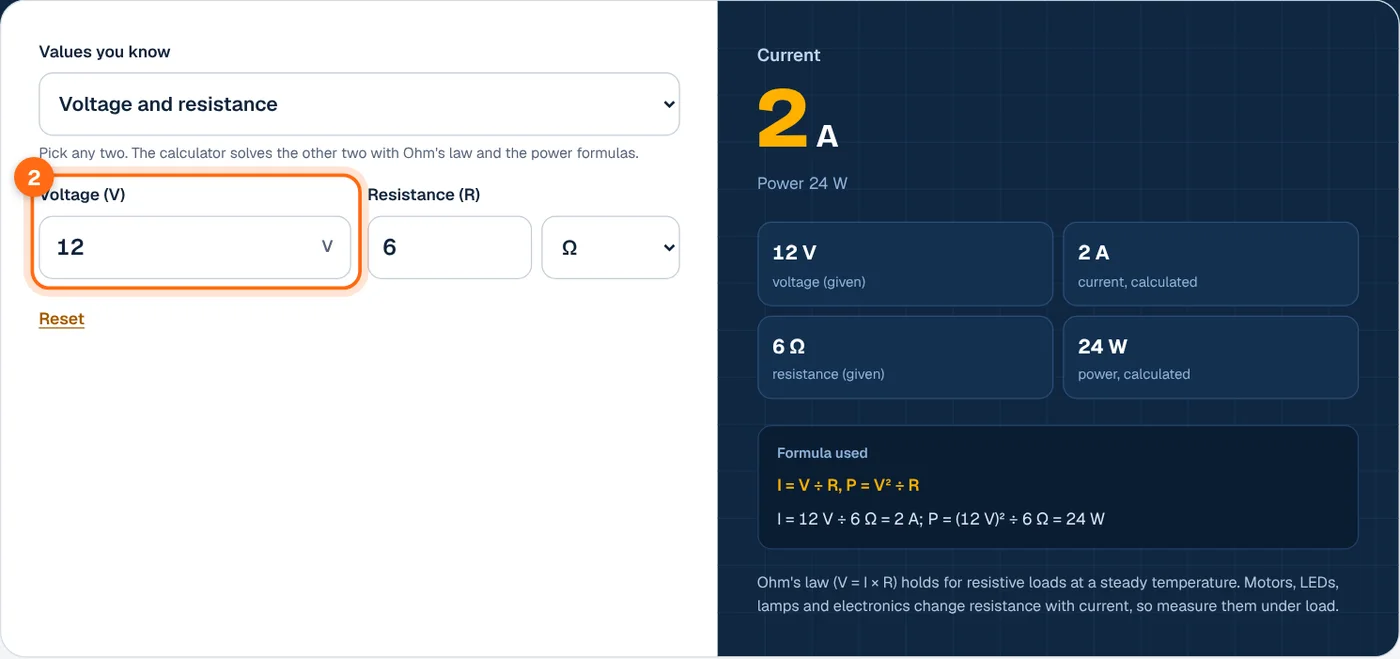
- Enter the second known value. Type the current or resistance and set its unit. Current accepts A or mA, and resistance accepts Ω, kΩ or MΩ, so you can enter 220 Ω or 4.7 kΩ exactly as printed on a part.

- Read the result. The large number is the first unknown, the line below it is the second, and the four cards show V, I, R and P together with the formula and your numbers substituted in.

Ohm’s law formula and the Ohm’s law wheel
Ohm’s law links three quantities. Combine it with the power law P = V × I and you get 12 formulas, usually drawn as a wheel with V, I, R and P in the middle. The calculator picks the right two for the pair you entered.
Voltage
Current
Resistance
Power
Where:
- V is voltage in volts, the electrical pressure across the component.
- I is current in amperes, the rate of charge flowing through it. 1 A = 1,000 mA.
- R is resistance in ohms (Ω). 1 kΩ = 1,000 Ω and 1 MΩ = 1,000,000 Ω.
- P is power in watts, the rate at which electrical energy turns into heat, light or motion.
Worked examples
Example 1: 12 V across a 6 Ω resistor
This is the calculator’s default. A 24 W load on 12 V needs wiring and a fuse rated for at least 2 A, and a resistor this size must be a power resistor, not a small through-hole part.
Example 2: LED series resistor on 5 V with 220 Ω
Choose voltage and resistance, enter 5 V and 220 Ω. Ignoring the LED’s own forward voltage, the worst case is the full 5 V across the resistor.
A standard 1/4 W (250 mW) resistor handles this comfortably. Subtract the LED forward voltage from 5 V first if you want the actual LED current.
Example 3: 60 W lamp drawing 500 mA
Choose power and current, enter 60 W and 500 mA.
240 Ω is the hot resistance. A tungsten filament reads far lower when cold, which is why lamps draw a surge at switch-on.
Ohm’s law reference table
Current and power for common resistor values at three supply voltages, computed with I = V ÷ R and P = V² ÷ R.
| Resistance | Current at 5 V | Power at 5 V | Current at 12 V | Power at 12 V | Current at 24 V | Power at 24 V |
|---|---|---|---|---|---|---|
| 1 Ω | 5 A | 25 W | 12 A | 144 W | 24 A | 576 W |
| 10 Ω | 500 mA | 2.5 W | 1.2 A | 14.4 W | 2.4 A | 57.6 W |
| 100 Ω | 50 mA | 250 mW | 120 mA | 1.44 W | 240 mA | 5.76 W |
| 220 Ω | 22.7 mA | 114 mW | 54.5 mA | 655 mW | 109 mA | 2.62 W |
| 470 Ω | 10.6 mA | 53.2 mW | 25.5 mA | 306 mW | 51.1 mA | 1.23 W |
| 1 kΩ | 5 mA | 25 mW | 12 mA | 144 mW | 24 mA | 576 mW |
| 4.7 kΩ | 1.06 mA | 5.32 mW | 2.55 mA | 30.6 mW | 5.11 mA | 123 mW |
| 10 kΩ | 0.5 mA | 2.5 mW | 1.2 mA | 14.4 mW | 2.4 mA | 57.6 mW |
| 100 kΩ | 50 µA | 0.25 mW | 120 µA | 1.44 mW | 240 µA | 5.76 mW |
What affects the result
Temperature
Resistance changes with temperature. Copper rises about 0.39% per °C, so a motor winding or long cable run reads several percent higher when hot. Lamp filaments and heating elements change much more. For live circuits, measure voltage and current under load and let the calculator find resistance.
Non-ohmic loads
Diodes, LEDs, transistors, switch-mode power supplies and motors do not follow V = I × R with a fixed R. Their current depends on voltage in a non-linear way. Ohm’s law still holds at any instant, but the resistance you calculate only applies to that operating point.
AC circuits
For AC, use RMS voltage and current. With purely resistive loads such as heaters and kettles the formulas work unchanged. With motors or transformers, current and voltage shift out of phase and you also need the power factor. Use the volts to watts calculator for AC loads with a known power factor.
Wire resistance
Every cable adds resistance in series with the load. At low voltage and high current this can cost a noticeable share of the supply. A 0.05 Ω round trip at 20 A drops 1 V, which is over 8% of a 12 V system. Check long runs with the voltage drop calculator.
Component ratings
The power result tells you what wattage a resistor needs. Choose a part rated for at least twice the calculated dissipation so it runs cool and lasts.
Frequently asked questions
What is Ohm’s law in simple terms?
Ohm’s law says the current through a conductor is proportional to the voltage across it. Double the voltage and the current doubles, as long as resistance stays the same. Written as a formula, V = I × R. It lets you find any one of voltage, current or resistance when you know the other two.
How do I remember the Ohm’s law formulas?
Use the triangle: V on top, I and R side by side underneath. Cover the value you want and the other two show the operation. Cover V and you see I × R. Cover I and you see V over R. The wheel adds power, giving 12 formulas that all come from V = I × R and P = V × I.
Can Ohm’s law find power?
Yes, when combined with P = V × I. Substituting Ohm’s law gives P = I² × R and P = V² ÷ R. So 12 V across 6 Ω gives 144 ÷ 6 = 24 W. The calculator shows power on every result, which helps you pick a resistor wattage or a fuse.
Does Ohm’s law work for AC?
It works for AC when you use RMS values and the load is resistive. For loads with inductance or capacitance, the opposition to current is impedance (Z), not just resistance, and current shifts out of phase with voltage. Real power then needs the power factor: P = V × I × PF.
Why does my measured resistance not match the calculation?
Most often because the load is hot when running and cold when measured with a meter. Filaments, heaters and motor windings all change resistance with temperature. Meter lead resistance, poor contact and parallel paths in the circuit also skew readings. Measure with power off and the part isolated for a true value.