Electric Heater Running Cost Calculator
Work out what an oil-filled, fan, convector or infrared heater costs per hour, day, week and month at UK electricity prices.
Quick answer
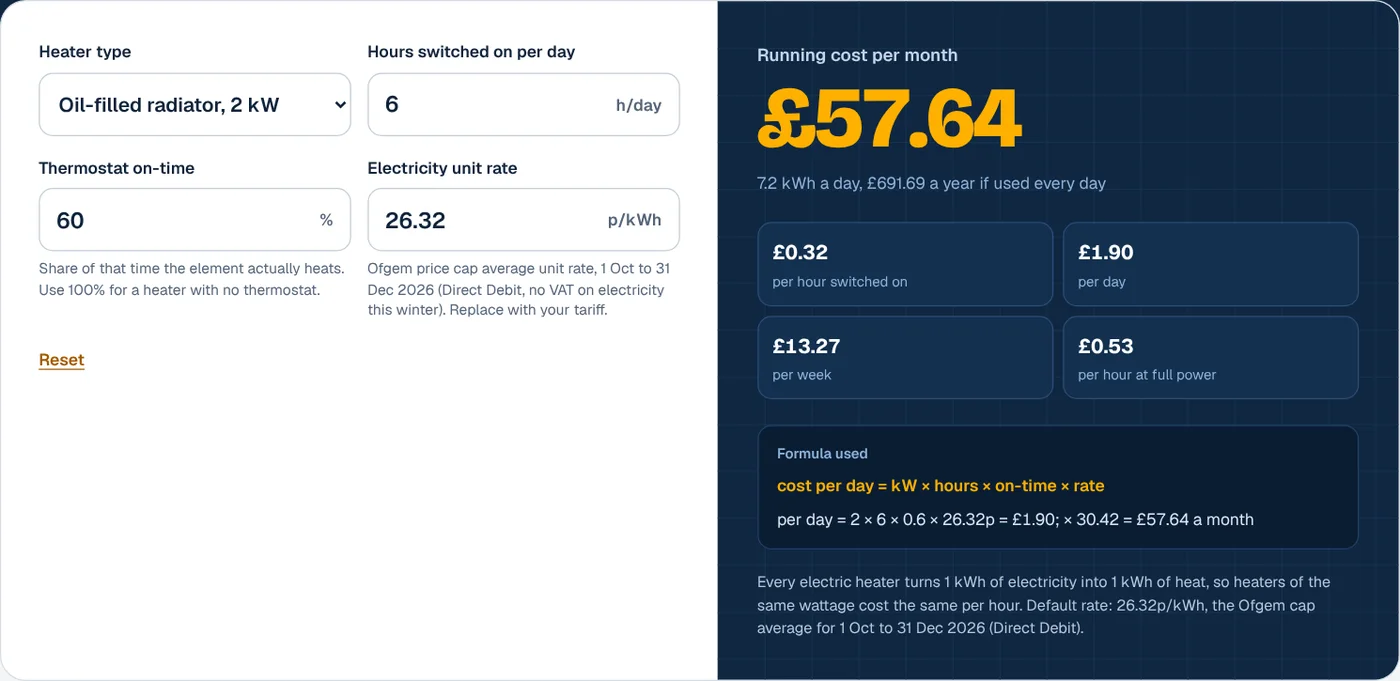
An electric heater costs its power in kW multiplied by your unit rate for every hour the element is on. At the Ofgem cap rate of 26.32p/kWh, a 2 kW oil-filled radiator costs 53p an hour at full power. Switched on 6 hours a day with the thermostat heating 60% of the time, it costs about £1.90 a day, or £57.64 a month.
How to use the electric heater running cost calculator
- Choose the heater type. Pick a preset for a common oil-filled radiator, fan heater, convector, infrared panel or halogen heater, or choose Enter my own wattage to type the rating from the label.
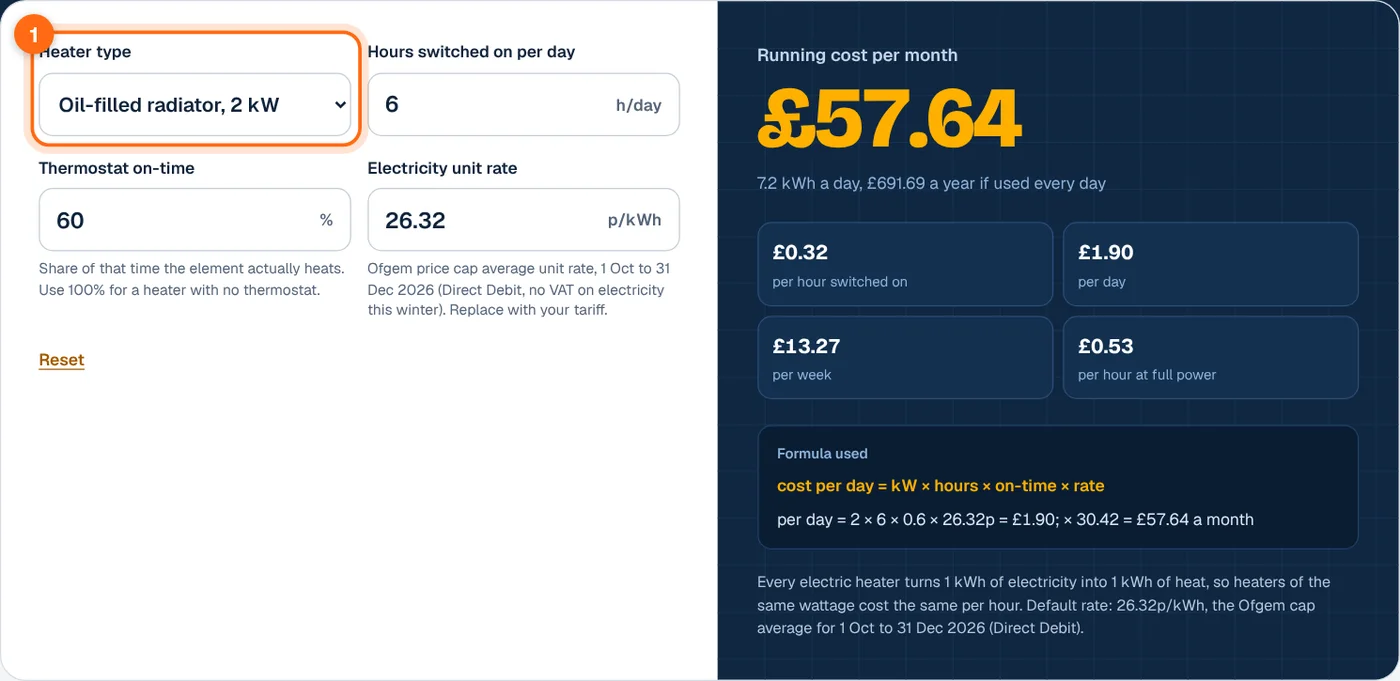
- Enter the hours switched on per day. Count the time the heater is plugged in and set to heat, for example 6 hours for an evening in the living room.
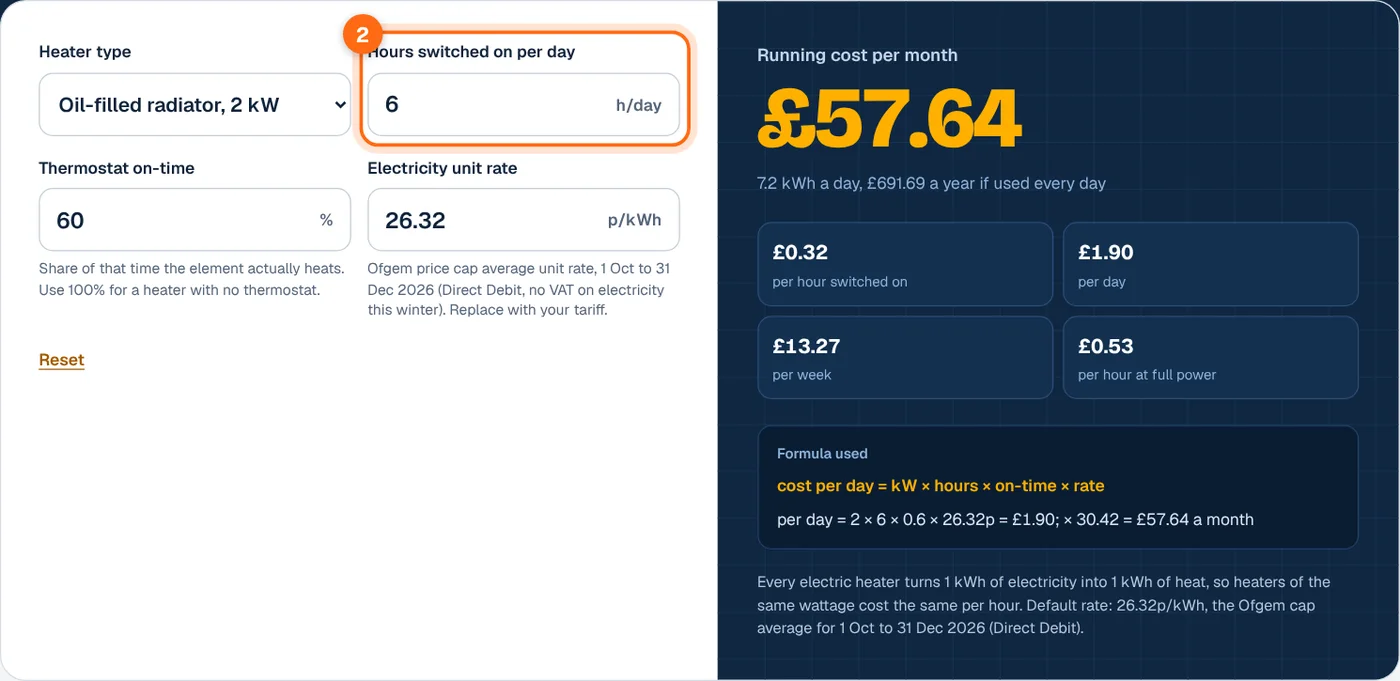
- Set the thermostat on-time. Once the room is warm, the thermostat switches the element on and off. 60% is a reasonable starting point. Use 100% for a heater with no thermostat or a cold, draughty room.
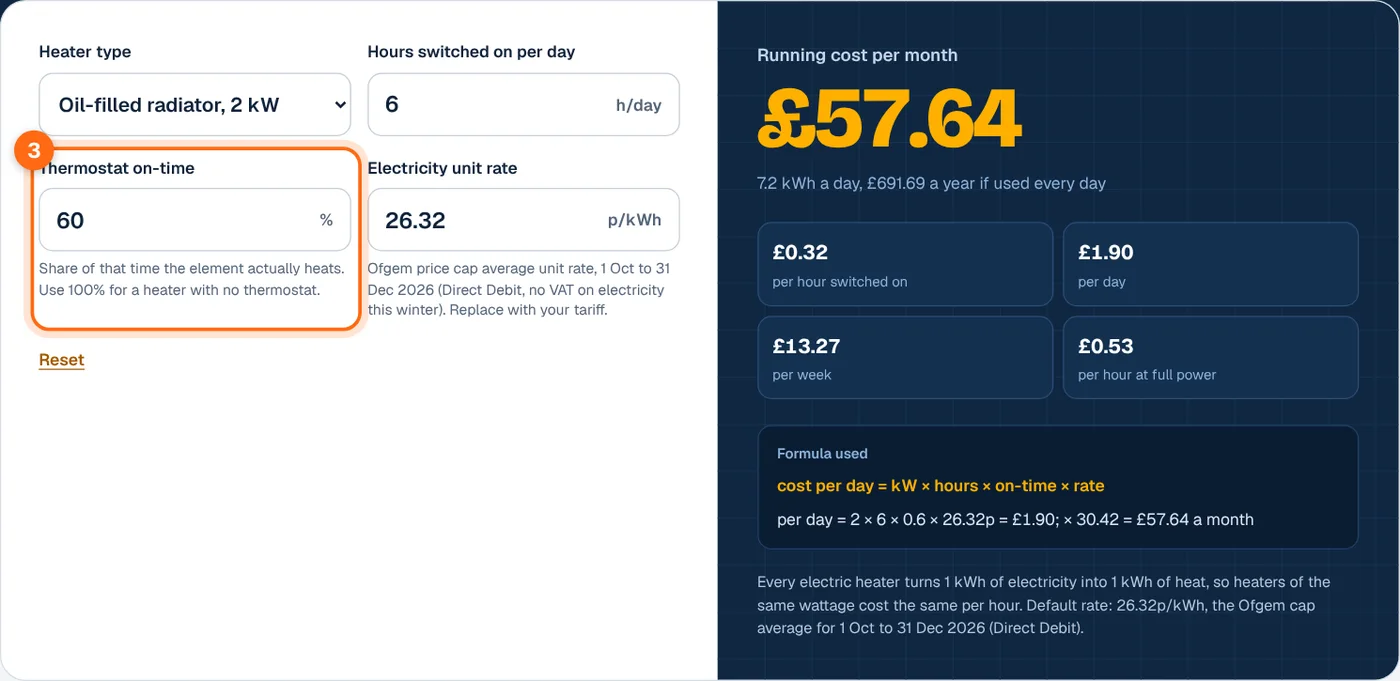
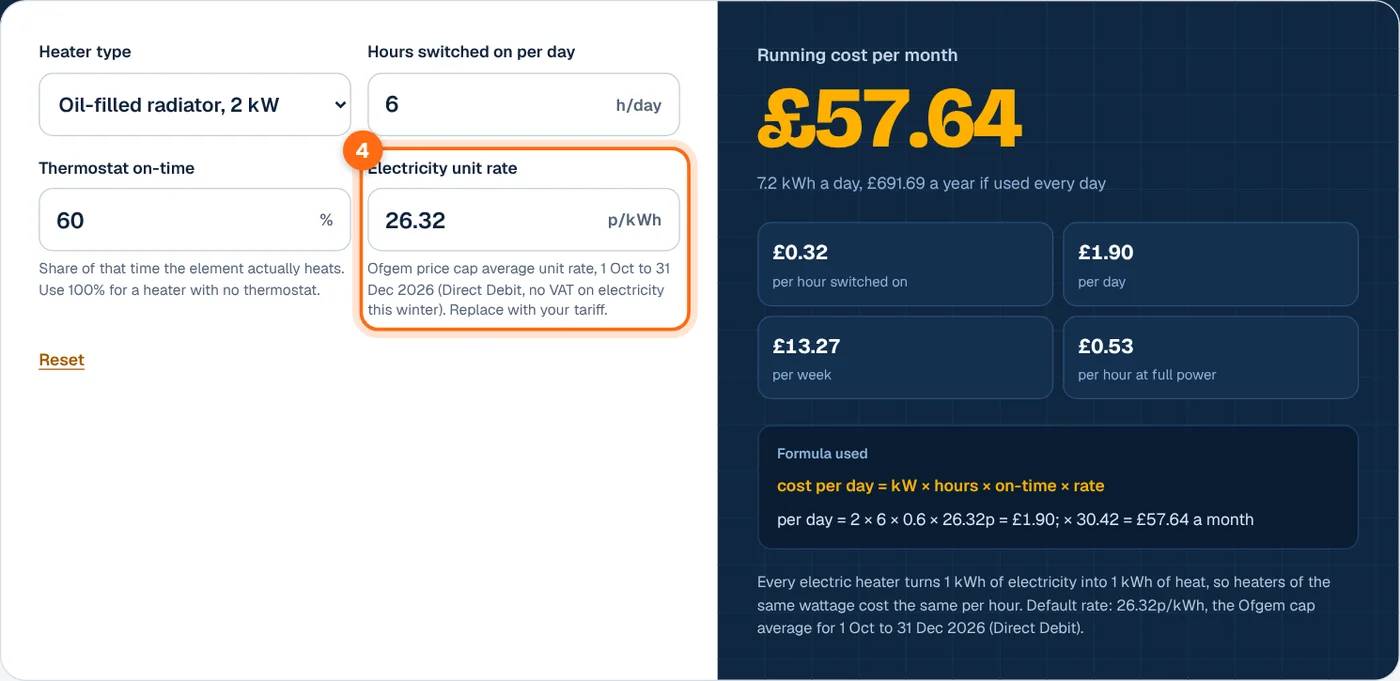
- Check the electricity unit rate. The default is the Ofgem price cap average for October to December 2026. Replace it with the rate on your bill.
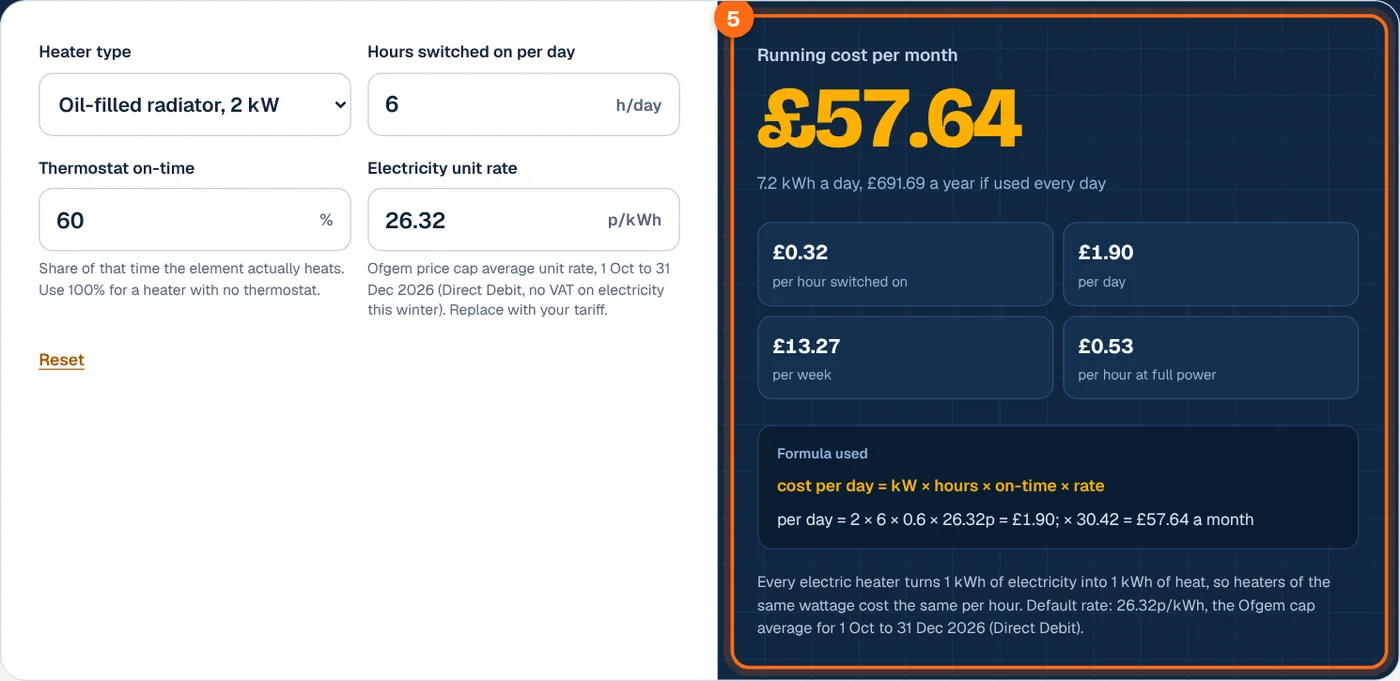
- Read the result. The large number is the cost per month if you use the heater every day. The cards show the cost per hour switched on, per day, per week and per hour at full power.
Electric heater running cost formula
Electric heaters convert all the electricity they draw into heat, so the cost depends only on the energy used and its price.
Where:
- P is the heater power in kilowatts (watts ÷ 1,000).
- h is the hours switched on per day.
- d is the thermostat on-time as a decimal, such as 0.6 for 60%.
- R is the electricity unit rate in pounds per kWh, such as £0.2632.
- 30.42 is the average number of days in a month (365 ÷ 12).
Worked examples
Example 1: 2 kW oil-filled radiator in the evening
The radiator is on for 6 hours a day and the thermostat keeps the element heating 60% of that time.
That is 7.2 kWh a day. Per week: £13.27. Per month: £57.64. Each hour switched on costs about 32p, and an hour at full power costs about 53p.
Example 2: 3 kW fan heater in a cold garage
A fan heater with no thermostat runs flat out for 2 hours a day, so the on-time is 100%.
Per week that is £11.05, and per month about £48.03. Fan heaters warm air fast but lose the heat quickly once switched off.
Example 3: 600 W infrared panel in a home office
The panel is on for 8 hours a day and its thermostat runs it about half the time.
About £19.21 a month. Its lower power keeps the cost down, though it will only heat a small room or the person sitting in front of it.
Electric heater running costs by wattage
Cost per hour at full power and monthly cost at 60% thermostat on-time, used every day, at 26.32p/kWh.
| Heater power | Per hour (full power) | 4 h/day, per month | 6 h/day, per month | 8 h/day, per month |
|---|---|---|---|---|
| 600 W (infrared panel) | 16p | £11.53 | £17.29 | £23.06 |
| 1,200 W (halogen) | 32p | £23.06 | £34.58 | £46.11 |
| 1,500 W (small oil-filled) | 39p | £28.82 | £43.23 | £57.64 |
| 2,000 W (oil-filled, fan, convector) | 53p | £38.43 | £57.64 | £76.85 |
| 2,500 W (large oil-filled) | 66p | £48.03 | £72.05 | £96.07 |
| 3,000 W (large fan heater) | 79p | £57.64 | £86.46 | £115.28 |
What affects the result
Thermostat on-time
The label wattage is the maximum. Once a room reaches the set temperature, the thermostat cycles the element, so the average draw falls. In a well insulated room on a mild day, on-time may be 30 to 50%. In a cold, draughty room, the heater may never switch off. A plug-in energy monitor shows your real kWh, which you can turn into an average for the kWh calculator.
Heater type
Every plug-in electric heater is effectively 100% efficient at turning electricity into heat. An oil-filled radiator, a fan heater and a convector of the same wattage cost exactly the same per hour at full power. What differs is how they deliver the heat. Oil-filled radiators hold heat and cycle gently. Fan heaters warm a room quickly. Infrared panels and halogen heaters warm people and surfaces directly, which can let you heat less of the room.
Your unit rate
The default of 26.32p/kWh is the average Direct Debit unit rate under the Ofgem price cap for 1 October to 31 December 2026, with no VAT on electricity from October 2026 to March 2027. Regional rates differ, and fixed tariffs can be higher or lower. On Economy 7, daytime heater use is charged at the more expensive day rate.
Room size and insulation
A heater that is too small for the room runs at 100% and still never gets it warm. A rough guide is about 1 kW for every 10 to 15 m² of floor area in an average UK room. For whole-house heating, a heat pump uses far less electricity for the same warmth. Compare the two with the heat pump running cost calculator.
Frequently asked questions
How much does a 2 kW heater cost per hour?
At the October to December 2026 Ofgem cap rate of 26.32p/kWh, a 2 kW heater costs about 53p for each hour it runs at full power. With a thermostat cycling the element 60% of the time, the cost per hour switched on falls to about 32p.
Are oil-filled radiators cheaper to run than fan heaters?
Not per kilowatt. Both turn all their electricity into heat, so a 2 kW oil-filled radiator and a 2 kW fan heater cost the same per hour at full power. Oil-filled radiators hold heat and cycle more gently, which can mean less on-time for steady background warmth. Fan heaters suit quick, short bursts.
Is an infrared heater more efficient?
Infrared heaters are not more efficient at converting electricity to heat, since all electric heaters are close to 100%. They can feel cheaper because they warm people and surfaces directly rather than all the air in the room. Lower wattage panels used near where you sit can therefore use fewer kWh overall.
What thermostat on-time should I enter?
Start with 60% for a heater with a thermostat in a reasonably insulated room. Use 100% if the heater has no thermostat, or the room never reaches the set temperature. For the most accurate figure, measure the kWh used over a day with a plug-in energy monitor and compare it with the full-power figure.
Is it cheaper to use an electric heater than central heating?
Heating one room with an electric heater for a few hours can cost less than running gas central heating for the whole house. For heating the full home, gas at 7.97p/kWh or a heat pump is far cheaper per unit of heat than direct electric heating at 26.32p/kWh.