Home Battery Savings Calculator
Estimate yearly savings and payback from adding a battery to home solar, from export and import rates, time-of-use and battery cost.
Quick answer
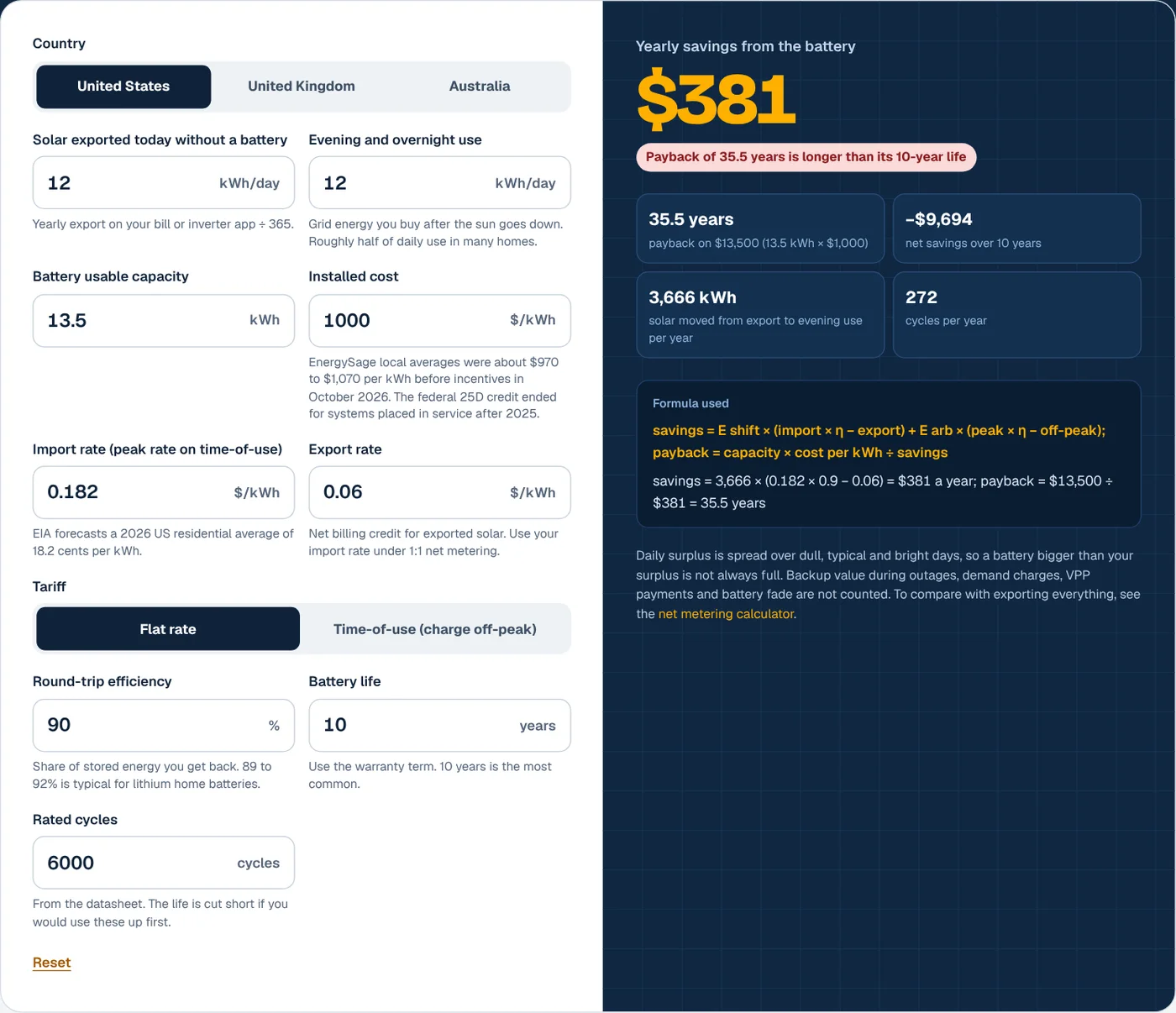
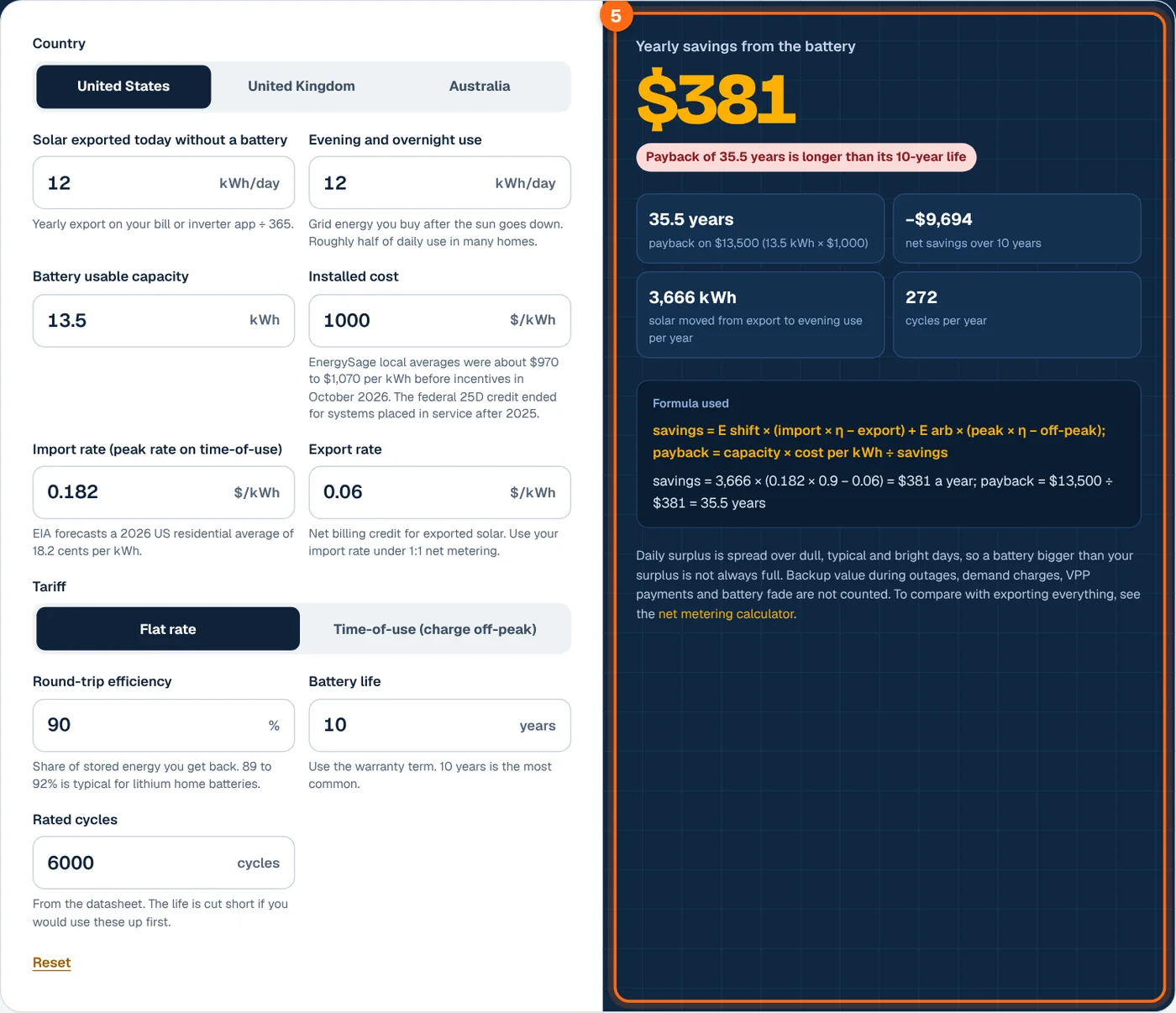
A solar battery saves (import rate × efficiency − export rate) on every kWh of solar it moves from export to evening use, plus the peak and off-peak gap on any grid energy it shifts. A 13.5 kWh battery that shifts 3,666 kWh a year saves about $381 at 18.2 cents import and 6 cents export. At $1,000 per kWh installed it takes 35 years to pay back, so in the US a battery is worth it mainly where export rates are low and import or peak rates are high.
How to use the home battery savings calculator
- Choose your country. United States, United Kingdom or Australia. Each sets the currency and typical 2026 rates and battery prices as defaults.
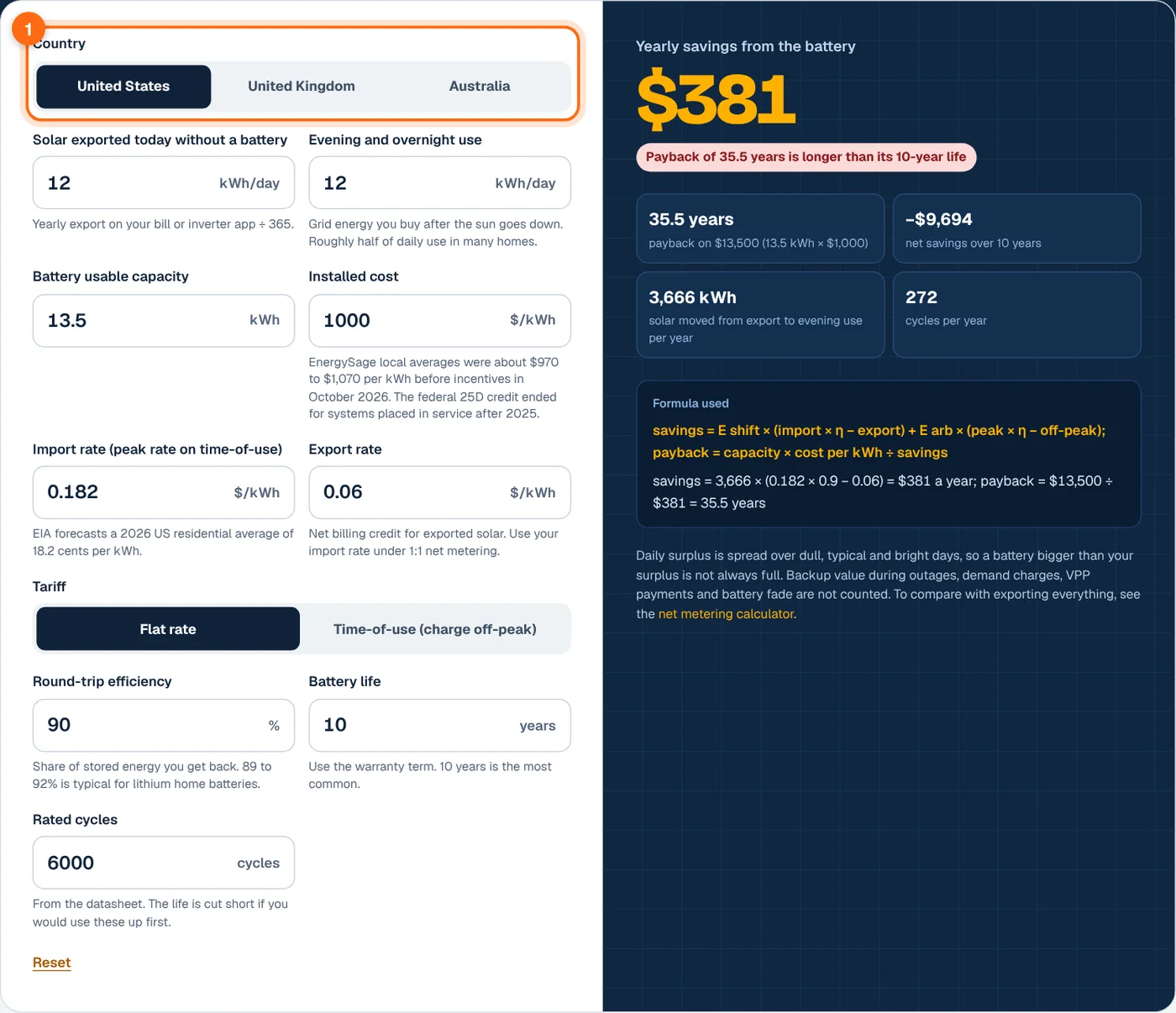
- Enter your solar surplus and evening use. Use the daily export from your inverter app or bill, and the grid energy you buy after sunset. The battery can only save on the smaller of the two.

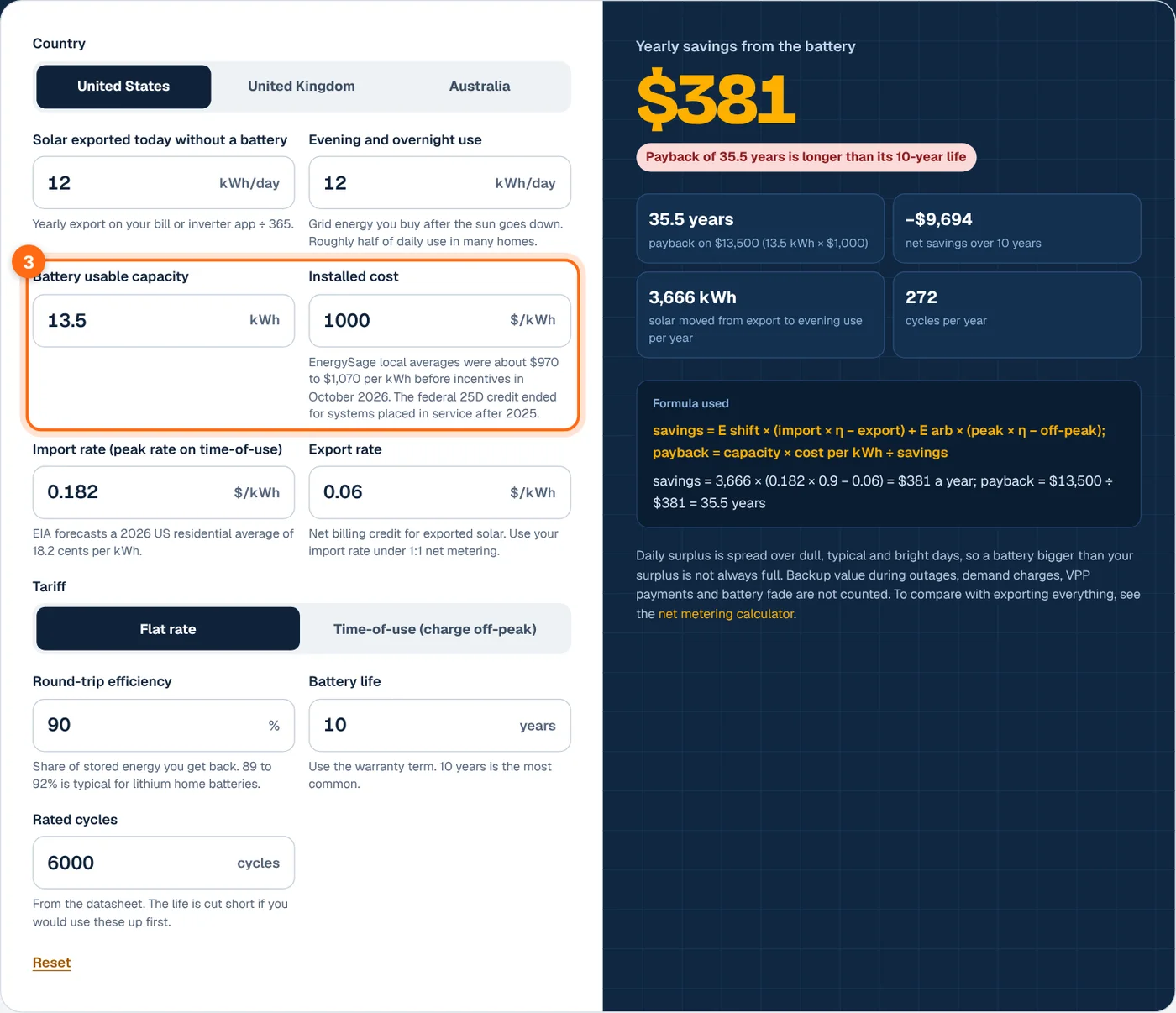
- Enter the battery and its cost. Add the usable capacity in kWh and the installed cost per kWh after any rebates.
- Enter your rates and tariff. Add your import and export rates. Choose Time-of-use if you have a cheap off-peak rate the battery can charge from, and enter it.
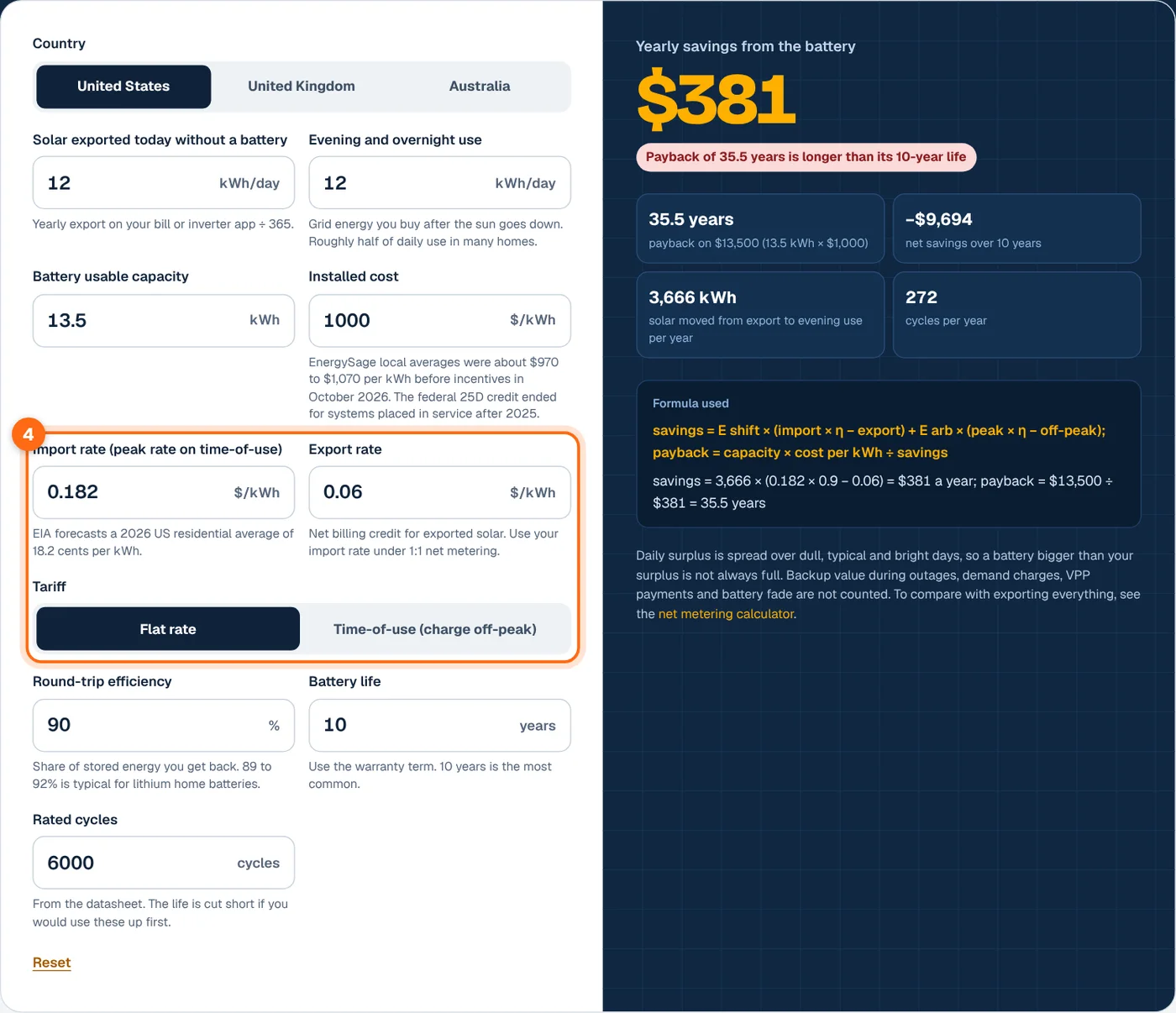
- Read the savings. The big number is yearly savings, and the chip compares payback with the battery’s life. The cards show payback, net lifetime savings, the solar shifted and the cycles used each year.
Home battery savings formula
Each day, the calculator charges the battery from solar surplus first. On a time-of-use plan it tops up any room left from the off-peak rate, as long as the evening needs it. Surplus is spread over dull, typical and bright days.
Where:
- Eshift is solar stored instead of exported, in kWh per year, and Earb is off-peak grid energy stored for the peak.
- η is round-trip efficiency, typically 0.89 to 0.92 for lithium home batteries.
- rimp is the import (or peak) rate, rexp the export credit and roff the off-peak rate.
- Life is the shorter of the warranty years and rated cycles ÷ cycles per year.
The key term is rimp × η − rexp. Under 1:1 net metering, exports already earn the full import rate, so the term turns negative and a battery loses money on energy alone.
Worked examples
Example 1: US home on net billing, flat rate
The home exports 12 kWh a day, buys 12 kWh after dark, and adds a 13.5 kWh battery at $1,000 per kWh ($13,500). Import is 18.2 cents, the 2026 US average forecast in the EIA’s October 2026 Short-Term Energy Outlook, and export earns 6 cents.
The battery averages 272 cycles a year and does not pay back within a 10-year warranty. With a 35-cent peak rate, 5-cent export and a 15-cent off-peak rate on time-of-use, savings rise to $1,170 and payback to 11.5 years.
Example 2: UK home on a time-of-use tariff
The same home in the UK pays the October 2026 price cap of 26.32p, earns 12p export and charges overnight at 8p. A 10 kWh battery costs £6,000.
Payback is 13.3 years. The 0% VAT rate on batteries runs until 31 March 2027.
Example 3: Australia after the rebate
At 32c import, 6c feed-in and A$900 per kWh after the federal discount, a 10 kWh battery shifts 3,017 kWh and saves A$688 a year, paying back in 13.1 years. Low feed-in tariffs make batteries pay faster in Australia than in most of the US.
Value of each stored kWh
Savings per kWh shifted, rimp × 0.9 − rexp, in your currency. Multiply by the kWh shifted per year.
| Import rate | Export 0 | Export 0.05 | Export 0.10 | Export 0.15 |
|---|---|---|---|---|
| 0.15 | 0.135 | 0.085 | 0.035 | −0.015 |
| 0.20 | 0.180 | 0.130 | 0.080 | 0.030 |
| 0.25 | 0.225 | 0.175 | 0.125 | 0.075 |
| 0.30 | 0.270 | 0.220 | 0.170 | 0.120 |
| 0.35 | 0.315 | 0.265 | 0.215 | 0.165 |
A battery cycling about 300 times a year shifts roughly 3,000 kWh per 10 kWh of capacity, so 0.10 per kWh is worth about 300 a year.
What affects the result
Export rate
The wider the gap between import and export, the more a battery earns. California’s net billing, UK export rates of 4 to 15p and Australian feed-in tariffs of 5 to 8c all favor batteries. Classic 1:1 net metering does not; check yours with the net metering calculator.
Battery price and incentives
EnergySage local data put US installed prices at about $970 to $1,070 per kWh in October 2026. The federal Residential Clean Energy Credit does not apply to property placed in service after December 31, 2025, so state and utility programs are now the main US incentives.
Time-of-use plans
Charging from a cheap off-peak rate lets the battery work in winter when solar surplus is small. In the UK, an 8p overnight rate against a 26p day rate is worth more than most export tariffs.
Surplus and evening use
A battery larger than your daily surplus or evening use cycles only partly. Size it near the smaller of the two. The solar self-consumption calculator helps estimate both.
Frequently asked questions
Is a solar battery worth it?
It depends on the gap between your import and export rates and the battery’s price. In the US at 18 cents import, 6 cents export and $1,000 per kWh, a battery rarely pays back on savings alone. With high peak rates, low export credits or rebates, payback can fall to 8 to 12 years. Backup power is a separate benefit.
How much does a home battery save per year?
Roughly the kWh it shifts times the value per kWh. A 13.5 kWh battery shifting about 3,700 kWh a year saves $381 at a 10.4-cent margin, or around $1,170 with a 35-cent peak rate on time-of-use. In the UK, a 10 kWh battery on an overnight tariff saves about £450.
Does a battery make sense with net metering?
Not for savings. Under 1:1 net metering each exported kWh already earns the full retail rate, and a battery loses about 10% in storage. Batteries make sense there only for backup during outages, or where time-of-use rates make evening power much more expensive than the credit earned at midday.
How long do home batteries last?
Most lithium home batteries carry a 10-year warranty and a cycle or energy throughput limit, often around 6,000 cycles or 70% capacity at the end. At one cycle a day, that is about 16 years of cycles, so the warranty years usually set the life used in the payback.
Can a battery save money without solar?
Yes, on a time-of-use tariff with a large gap between off-peak and peak rates. The battery charges cheaply overnight and supplies the home at peak times. Set the solar export to 0 and choose Time-of-use to see the result; the margin must beat the round-trip loss to save anything.