kWh to mAh Calculator
Convert kilowatt-hours to milliamp-hours and amp-hours for power stations, e-bike packs and home batteries.
Quick answer
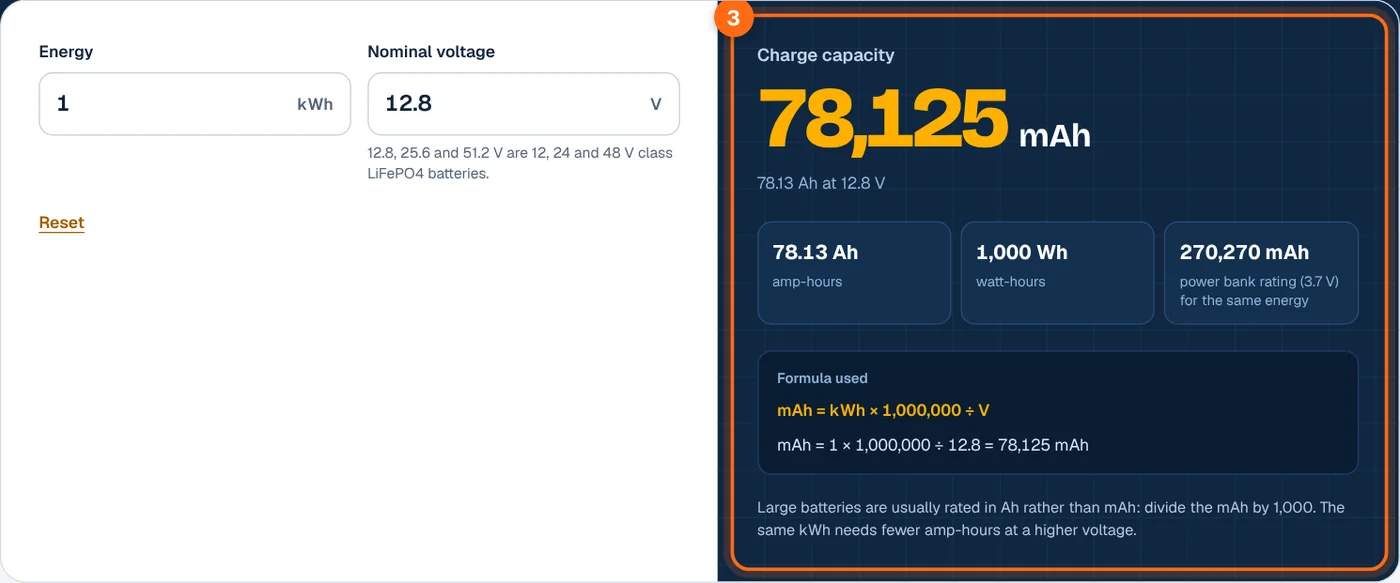
To convert kWh to mAh, multiply the kilowatt-hours by 1,000,000 and divide by the voltage. mAh = kWh × 1,000,000 ÷ V. A 1 kWh battery at 12.8 V holds 1,000,000 ÷ 12.8 = 78,125 mAh, or 78.1 Ah. At 48 V the same 1 kWh is only 20,833 mAh, so the voltage decides the answer.

How to use the kWh to mAh calculator
- Enter the energy in kWh. Type the kilowatt-hour rating of the battery, such as 0.5 kWh for an e-bike pack, 1 kWh for a portable power station or 13.5 kWh for a home battery. For a Wh figure, divide by 1,000: 720 Wh is 0.72 kWh.

- Enter the nominal voltage. Use the battery’s rated voltage: 12.8 V, 25.6 V or 51.2 V for 12, 24 and 48 V class LiFePO4 batteries, 36 V or 48 V for e-bikes, and 3.7 V if you want the equivalent power bank rating.
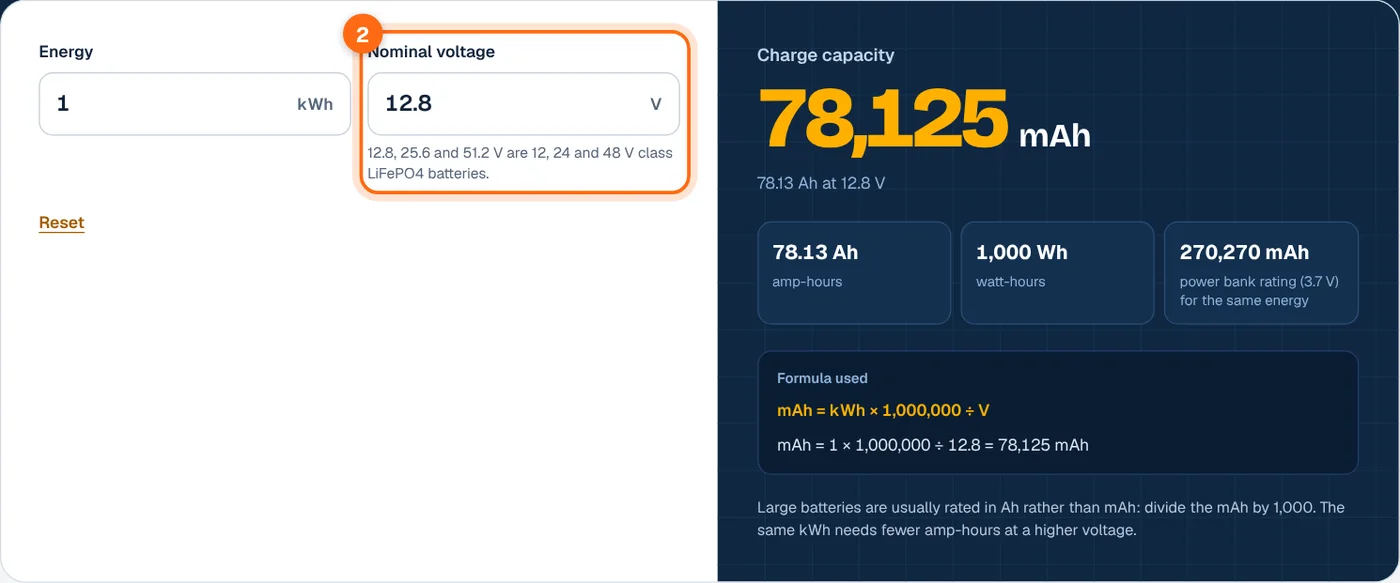
- Read the charge in mAh. The large number is the capacity in milliamp-hours. The cards give the same value in Ah, the energy in Wh, and the mAh a 3.7 V power bank would need to match it.
kWh to mAh formula
One kWh is 1,000,000 mWh. Dividing milliwatt-hours by volts leaves milliamp-hours, so the conversion is a single line.
Where:
- mAh is the charge capacity in milliamp-hours.
- kWh is the energy in kilowatt-hours. 1 kWh = 1,000 Wh = 1,000,000 mWh.
- V is the nominal battery voltage.
- Ah is the charge capacity in amp-hours. 1 Ah = 1,000 mAh.
The reverse, from milliamp-hours to energy and charging cost, is on the mAh to kWh calculator.
Worked examples
Example 1: 1 kWh portable power station
A power station advertises 1,024 Wh from a 12.8 V LiFePO4 battery. Treating it as roughly 1 kWh:
That is 78.1 Ah at 12.8 V. Some brands quote the same unit as 270,270 mAh, which is the 3.7 V cell equivalent. Both describe 1 kWh, but the bigger number is only meaningful if you compare it with other 3.7 V ratings. With the full 1.024 kWh the 12.8 V figure is 80,000 mAh (80 Ah).
Example 2: e-bike battery by Wh rating
An e-bike lists a 720 Wh battery at 36 V, and you want the Ah to compare it with another listing.
So the pack is 36 V 20 Ah. A 48 V pack with the same 720 Wh would be 15,000 mAh.
Example 3: home battery
A 10 kWh home battery runs at 51.2 V nominal.
That is about 195.3 Ah. Home batteries are sized in kWh because the number lines up with household use: a house using 30 kWh a day would get about eight hours from it at an even load. The battery backup calculator turns that into hours for your own loads.
kWh to mAh conversion table
Values in mAh, calculated as kWh × 1,000,000 ÷ V and rounded to the nearest whole number.
| Energy (kWh) | 3.7 V | 12.8 V | 25.6 V | 36 V | 48 V | 51.2 V |
|---|---|---|---|---|---|---|
| 0.1 | 27,027 | 7,813 | 3,906 | 2,778 | 2,083 | 1,953 |
| 0.25 | 67,568 | 19,531 | 9,766 | 6,944 | 5,208 | 4,883 |
| 0.5 | 135,135 | 39,063 | 19,531 | 13,889 | 10,417 | 9,766 |
| 1 | 270,270 | 78,125 | 39,063 | 27,778 | 20,833 | 19,531 |
| 2 | 540,541 | 156,250 | 78,125 | 55,556 | 41,667 | 39,063 |
| 5 | 1,351,351 | 390,625 | 195,313 | 138,889 | 104,167 | 97,656 |
| 10 | 2,702,703 | 781,250 | 390,625 | 277,778 | 208,333 | 195,313 |
| 13.5 | 3,648,649 | 1,054,688 | 527,344 | 375,000 | 281,250 | 263,672 |
The 0.1 kWh row, 27,027 mAh at 3.7 V, is the largest power bank you can carry on a plane. The 13.5 kWh row matches the usable energy of a Tesla Powerwall 3.
What affects the result
Which voltage the rating refers to
Large packs are built from many cells in series, so the pack voltage, not the cell voltage, belongs in the formula. A 51.2 V home battery is sixteen 3.2 V LiFePO4 cells. Dividing by 3.2 V would give the cell level mAh, sixteen times larger than the pack rating.
Usable versus total kWh
Some makers quote total energy, others usable energy after the battery management system holds back a reserve. Tesla, for example, lists the Powerwall 3 at 13.5 kWh usable on its product datasheet. Check which one you are converting, as the gap can be 5% to 10%.
Rounding in Wh ratings
Marketing often rounds 1,024 Wh to “1 kWh” or 1,280 Wh to “1.3 kWh”. A 2.4% difference in kWh becomes a 2.4% difference in mAh, which matters if you are matching a replacement pack or a charge controller to the Ah rating.
mAh is the wrong scale for big batteries
Past about 50,000 mAh, Ah is clearer. The calculator shows both, and for sizing a battery bank in Ah from your daily use, the battery bank calculator starts from kWh directly.
Frequently asked questions
How many mAh is 1 kWh?
1 kWh equals 270,270 mAh at 3.7 V, 78,125 mAh at 12.8 V, 39,063 mAh at 25.6 V and 20,833 mAh at 48 V. Use the voltage of the battery you are describing. Without a voltage, kWh cannot be turned into mAh, because one measures energy and the other measures charge.
How many 20,000 mAh power banks equal 1 kWh?
A 20,000 mAh bank at 3.7 V holds 74 Wh. 1 kWh divided by 74 Wh is about 13.5, so you would need 13 to 14 such power banks to store 1 kWh. A single 1 kWh power station is far lighter and cheaper per kWh than that stack.
Why do power stations list mAh numbers like 270,000 mAh?
They quote the capacity at a 3.7 V cell level, which gives a large, eye-catching mAh figure that matches power bank marketing. It is not wrong, but only the Wh or kWh rating lets you compare a power station with a battery of any other voltage fairly.
Is 1 kWh the same as 1,000 Ah?
Only at exactly 1 V, which no practical battery uses. At 12.8 V, 1 kWh is 78.1 Ah, and at 48 V it is 20.8 Ah. Divide watt-hours by volts to get amp-hours, then multiply by 1,000 for milliamp-hours. The Ah to Wh calculator covers that step.
How many Ah is a 5 kWh battery?
At 51.2 V, a 5 kWh battery is about 97.7 Ah. At 48 V it is 104.2 Ah, and at 25.6 V it is 195.3 Ah. For a 12.8 V system, 5 kWh would need 390.6 Ah, which is why larger home systems move to 48 V class batteries.