Ah to kWh Calculator
Convert amp-hours to kilowatt-hours for home batteries, golf cart packs and RV banks, including batteries in parallel.
Quick answer
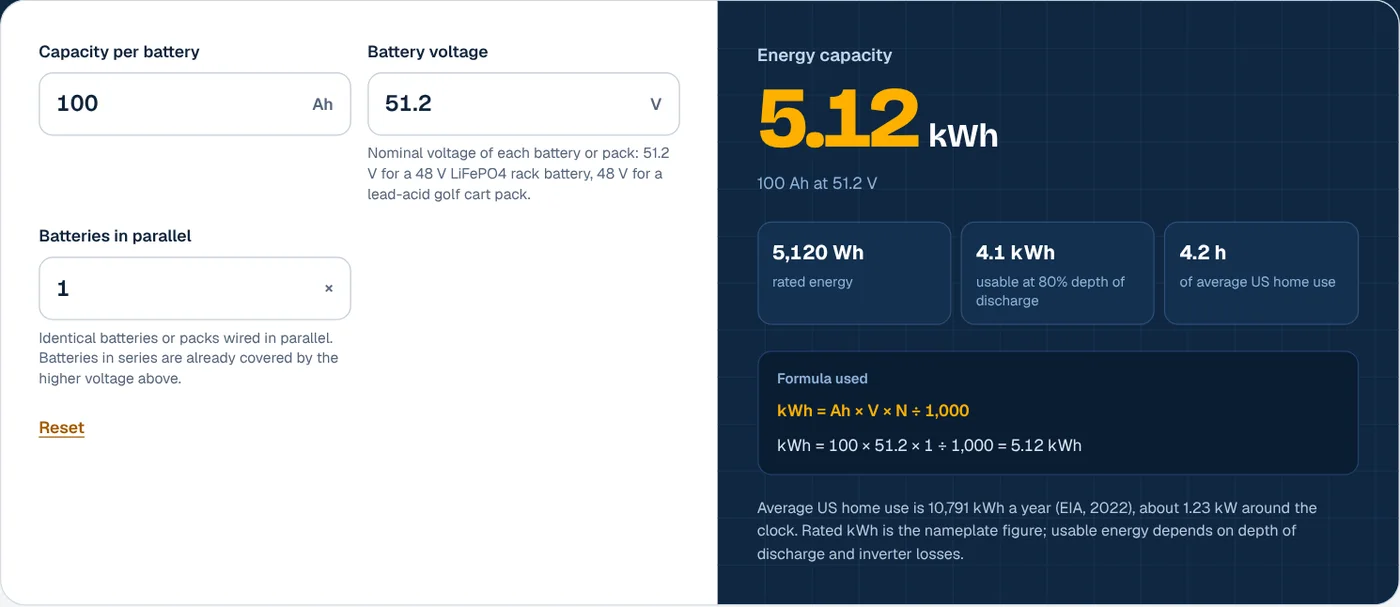
To convert Ah to kWh, multiply amp-hours by the battery voltage and divide by 1,000: kWh = Ah × V ÷ 1,000. A 100 Ah, 51.2 V server rack battery holds 100 × 51.2 ÷ 1,000 = 5.12 kWh. A 48 V golf cart pack of 170 Ah holds 8.16 kWh.
How to use the Ah to kWh calculator
- Enter the capacity per battery. Type the amp-hour rating of one battery or pack, from the label or datasheet.

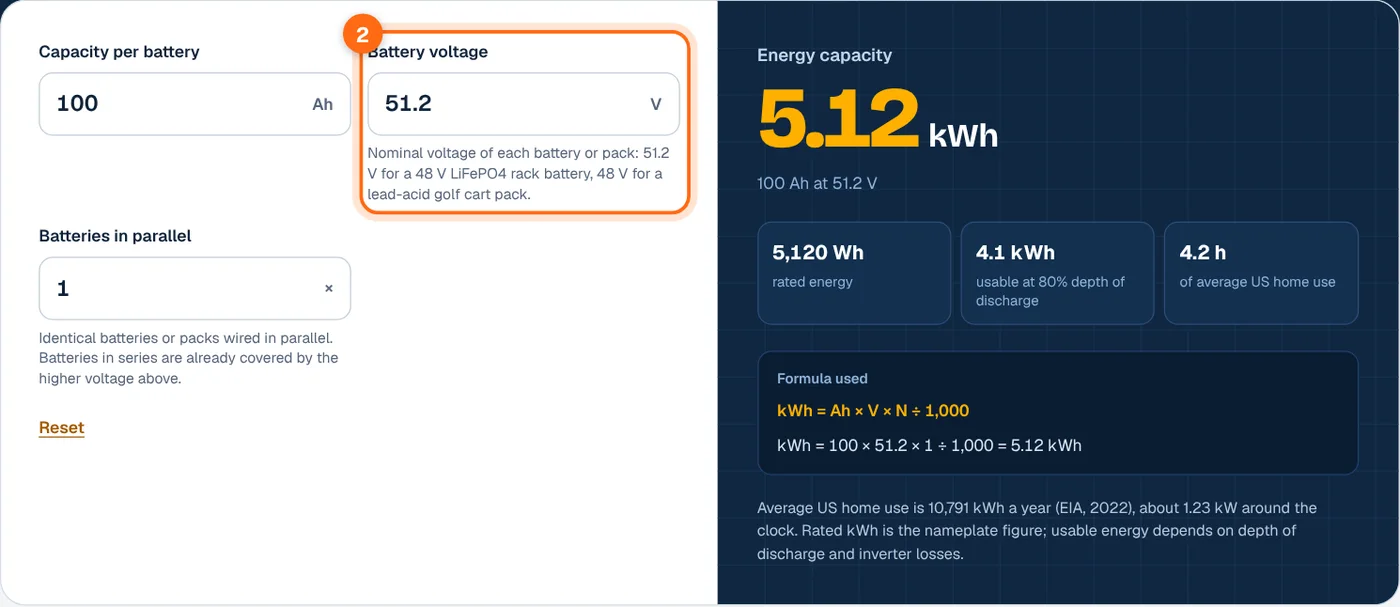
- Enter the battery voltage. Use the nominal voltage of that battery or of the series string: 51.2 V for a 48 V LiFePO4 rack battery, 48 V for six 8 V lead-acid golf cart batteries in series, 76.8 V for a 72 V lithium cart.
- Enter the number in parallel. If you have several identical batteries or strings wired in parallel, enter how many. Leave it at 1 for a single battery or pack.

- Read the result. The large number is the rated energy in kWh. The cards show the same figure in Wh, the usable energy at 80% depth of discharge and how many hours it would run an average US home.

Ah to kWh formula
Amp-hours count charge. Multiply by voltage to get watt-hours of energy, then divide by 1,000 for kilowatt-hours, the unit used on electric bills, home battery spec sheets and EV packs.
Where:
- kWh is the rated energy in kilowatt-hours.
- Ah is the capacity of one battery or one series string in amp-hours.
- V is the nominal voltage of that battery or string.
- N is the number of identical batteries or strings in parallel.
Series wiring adds voltage and keeps the Ah of a single battery. Parallel wiring adds Ah and keeps the voltage. Either way the total kWh is the sum of every battery in the bank.
Worked examples
Example 1: a 48 V server rack battery
A typical 48 V LiFePO4 rack battery, such as the EG4 LifePower4 48 V 100 Ah, is rated at 51.2 V nominal.
Four of them in parallel give 4 × 5.12 = 20.48 kWh. At 80% depth of discharge that is about 16.4 kWh of usable energy.
Example 2: a lead-acid golf cart pack
Many 48 V golf carts use six 8 V flooded batteries in series, each rated around 170 Ah at the 20-hour rate.
Only about half of that is used per charge if you want the batteries to last, so plan on roughly 4 kWh of driving energy. A lithium replacement of 105 Ah at 51.2 V holds 5.38 kWh, and most of it can be used.
Example 3: a 12 V RV bank
Three 12.8 V LiFePO4 batteries of 200 Ah each, wired in parallel:
That matches the energy of one and a half 5.12 kWh rack batteries, even though the bank is rated 600 Ah. High Ah numbers at 12 V look big, but kWh is the fair comparison.
Ah to kWh chart
Rated energy in kWh for common capacities and nominal voltages.
| Capacity (Ah) | 12 V | 12.8 V | 24 V | 25.6 V | 48 V | 51.2 V |
|---|---|---|---|---|---|---|
| 50 | 0.6 | 0.64 | 1.2 | 1.28 | 2.4 | 2.56 |
| 100 | 1.2 | 1.28 | 2.4 | 2.56 | 4.8 | 5.12 |
| 150 | 1.8 | 1.92 | 3.6 | 3.84 | 7.2 | 7.68 |
| 200 | 2.4 | 2.56 | 4.8 | 5.12 | 9.6 | 10.24 |
| 280 | 3.36 | 3.58 | 6.72 | 7.17 | 13.44 | 14.34 |
| 314 | 3.77 | 4.02 | 7.54 | 8.04 | 15.07 | 16.08 |
The 280 Ah and 314 Ah rows match the large prismatic LiFePO4 cells now common in DIY home batteries. Sixteen of them in series make a 51.2 V pack of 14.34 kWh or 16.08 kWh.
What affects the result
Nominal voltage
Use the nominal figure from the datasheet, not the charging voltage. A 48 V LiFePO4 pack of 16 cells is 51.2 V nominal, while a 48 V lead-acid pack is 48 V. Using 48 V for a lithium pack understates its energy by about 6%.
Rated versus usable energy
The result is nameplate energy. Lead-acid is normally cycled to about 50%, LiFePO4 to 80 to 100%. Inverters lose another 5 to 10% turning DC into AC. The battery backup calculator turns usable kWh into hours of backup for your loads.
Home energy use
The home-hours card uses the EIA average of 10,791 kWh a year per US household (2022 data), which is about 1.23 kW around the clock. Homes with electric heating, air conditioning or an EV use much more, so treat the figure as a rough guide.
Lead-acid rating time
Lead-acid Ah ratings are usually at the 20-hour rate. A golf cart pulls far more current than that while climbing a hill, so the pack delivers fewer kWh in real driving than the label suggests.
Frequently asked questions
How many kWh is 100 Ah?
It depends on the voltage. 100 Ah is 1.2 kWh at 12 V, 1.28 kWh at 12.8 V, 2.56 kWh at 25.6 V, 4.8 kWh at 48 V and 5.12 kWh at 51.2 V. Multiply the amp-hours by the nominal voltage and divide by 1,000.
How many kWh is a 200 Ah battery?
A 200 Ah 12.8 V LiFePO4 battery holds 2.56 kWh. A 200 Ah 12 V lead-acid battery holds 2.4 kWh, of which about 1.2 kWh is usable at 50% depth of discharge. A 200 Ah pack at 51.2 V holds 10.24 kWh.
How do I convert amp-hours to kWh for a golf cart?
Multiply the Ah of one battery by the pack voltage and divide by 1,000. Six 8 V batteries in series make 48 V, so 170 Ah batteries give 170 × 48 ÷ 1,000 = 8.16 kWh. For a lithium pack, use its nominal voltage, often 51.2 V for 48 V carts.
How many kWh do I need to power a house?
An average US home uses about 30 kWh a day based on EIA data, but backup systems rarely run the whole house. Many backup setups use 10 to 20 kWh to cover a fridge, lights, internet and a few circuits overnight. Add up the loads you want to keep running and size from there.
Do batteries in series or parallel change the kWh?
No. Series wiring doubles the voltage, parallel wiring doubles the Ah, and either way two batteries store twice the energy of one. Enter the string voltage and the number of parallel strings, and the calculator gives the total kWh of the bank.