Appliance Solar Panel Calculator
Find how many solar panels you need to run a refrigerator, air conditioner or any appliance, with its surge and battery needs.
Quick answer
To find how many solar panels an appliance needs, divide its daily energy by what one panel makes per day after losses. A full-size refrigerator uses about 1,260 Wh a day, so at 5 peak sun hours and 25% losses it needs 336 W of solar: two 200 W panels or one 400 W panel. A 10,000 BTU window AC running 8 hours needs about 1,150 W, or three 400 W panels.

How to use the appliance solar panel calculator
- Pick the appliance. Choose a preset such as a refrigerator, window AC, mini-split, central AC, freezer or well pump, or choose Custom appliance to enter your own running watts.

- Set how long it runs. For fridges and freezers, set the compressor run time as a share of 24 hours. For air conditioners, set the hours of cooling and the average compressor load. For other appliances, enter the hours of use per day.
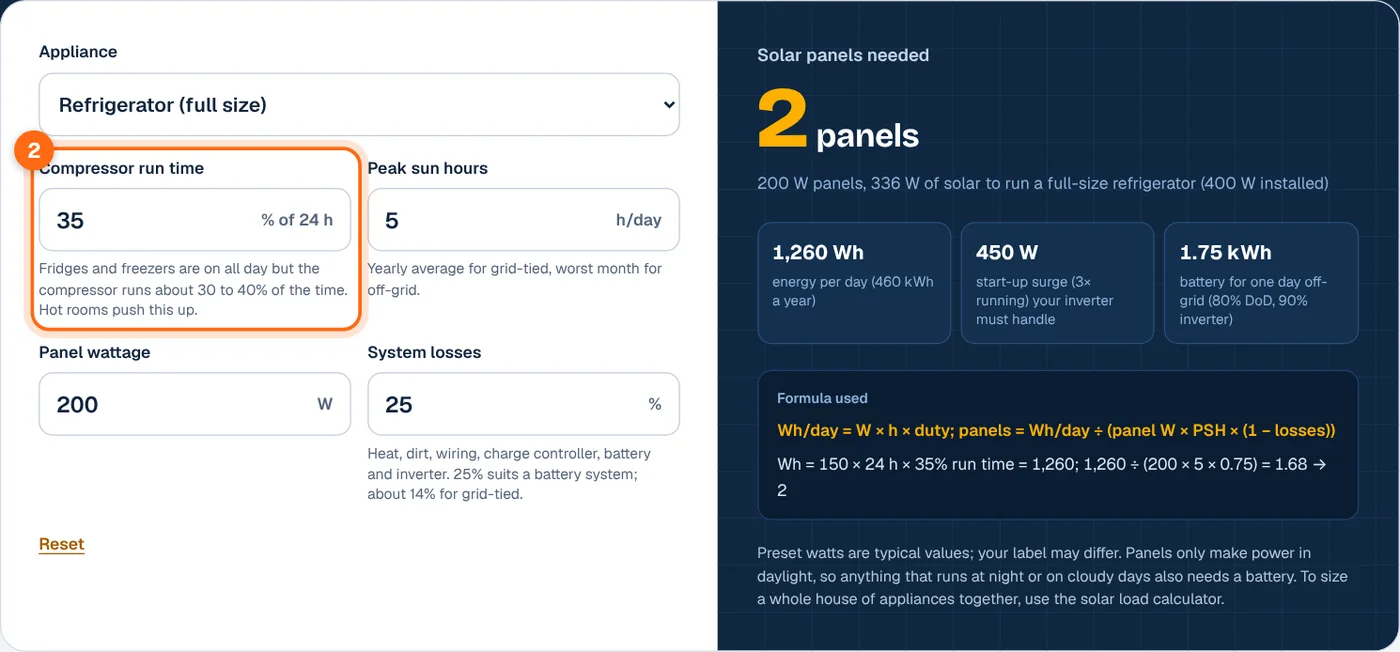
- Enter your peak sun hours. Use the yearly average for a grid-tied system, or the worst month if the appliance runs off-grid all year.
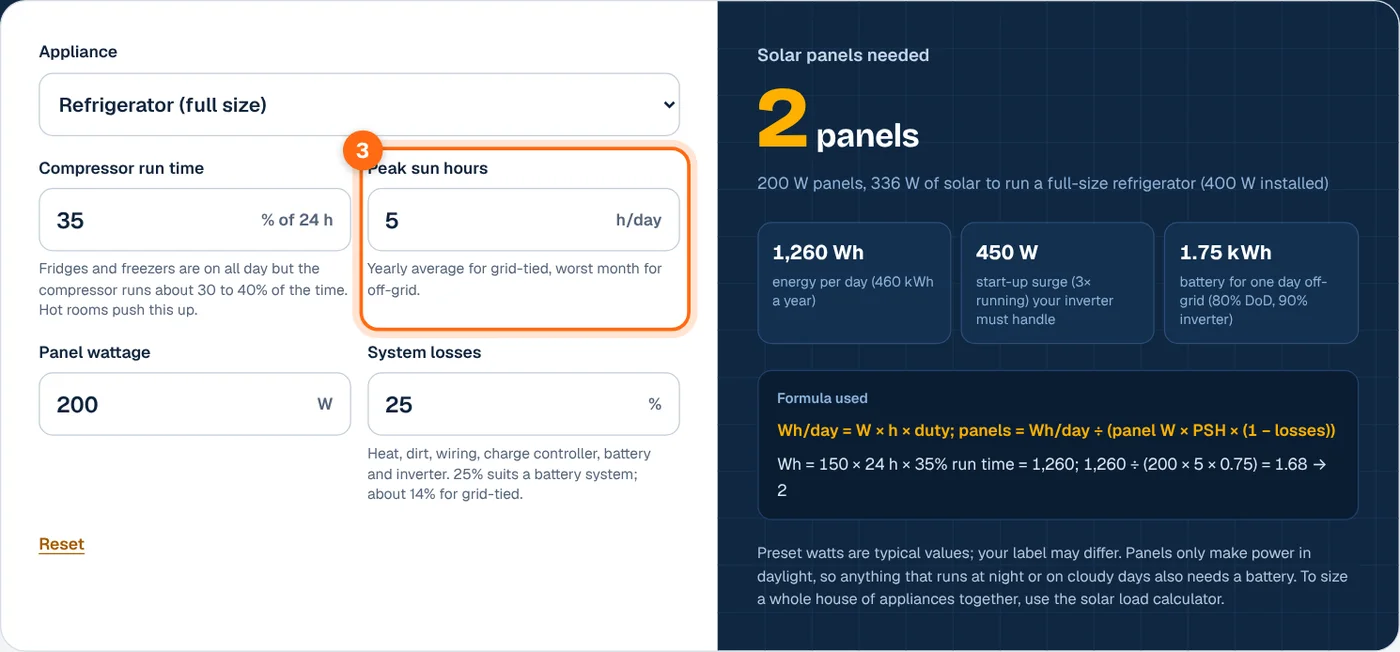
- Enter the panel wattage and losses. Use the rating of the panels you plan to buy. Keep 25% losses for a battery system, or use about 14% for grid-tied panels.

- Read the number of panels. The big number is how many panels you need, rounded up. The cards show the daily energy, the start-up surge your inverter must handle and the battery needed to run the appliance for a day off-grid.

Appliance solar panel formula
Where:
- W is the appliance’s running watts and h the hours it is switched on per day.
- Duty is the share of that time it actually draws full power: about 35% for a fridge compressor and 60% for an AC on a warm day.
- Ppanel is one panel’s rated watts and PSH is peak sun hours per day.
- Losses cover heat, dirt, wiring, the charge controller, the battery and the inverter.
- The battery figure assumes a LiFePO4 bank at 80% depth of discharge and a 90% efficient inverter.
The preset watts are typical values. A modern full-size fridge draws about 150 W while the compressor runs, and an older one more: ENERGY STAR notes that an average old refrigerator uses about 20% more energy than a certified model. For a custom appliance, multiply the volts and amps on the label if only those are given.
Worked examples
Example 1: How many solar panels to run a refrigerator
A 150 W fridge whose compressor runs 35% of the day, 5 peak sun hours, 200 W panels, 25% losses.
One 200 W panel makes 750 Wh a day after losses, so two are needed. The fridge also needs about 1.75 kWh of battery to run through the night, and an inverter that can handle a 450 W start-up surge.
Example 2: How many solar panels to run a window air conditioner
A 10,000 BTU window AC drawing 900 W, cooling for 8 hours at 60% average load, with 400 W panels and 5 peak sun hours.
Three 400 W panels (1,200 W) cover it on an average day. Its compressor can surge to about 2,700 W at start-up.
Example 3: A 3 ton central AC
A 3,000 W central AC cooling for 8 hours at 60% load, at 4 peak sun hours with 400 W panels.
Twelve 400 W panels, or 4.8 kW of solar. Running it off-grid would also need about 20 kWh of battery, so central AC is normally run on a grid-tied system. An inverter-driven mini-split with the same hours needs only four panels.
Solar panels needed by appliance
Computed with this calculator: number of 400 W panels, 25% losses and the default run times shown. Solar watts are the exact array size before rounding.
| Appliance | Running watts | Daily use | Wh per day | 4 sun hours | 5 sun hours | 6 sun hours |
|---|---|---|---|---|---|---|
| Refrigerator, full size | 150 W | 24 h × 35% | 1,260 | 2 (420 W) | 1 (336 W) | 1 (280 W) |
| Mini fridge | 80 W | 24 h × 35% | 672 | 1 (224 W) | 1 (179 W) | 1 (149 W) |
| Chest freezer | 90 W | 24 h × 35% | 756 | 1 (252 W) | 1 (202 W) | 1 (168 W) |
| Window AC, 10,000 BTU | 900 W | 8 h × 60% | 4,320 | 4 (1,440 W) | 3 (1,152 W) | 3 (960 W) |
| Mini-split, 12,000 BTU | 1,000 W | 8 h × 60% | 4,800 | 4 (1,600 W) | 4 (1,280 W) | 3 (1,067 W) |
| Central AC, 3 ton | 3,000 W | 8 h × 60% | 14,400 | 12 (4,800 W) | 10 (3,840 W) | 8 (3,200 W) |
| TV, 50-inch LED | 100 W | 6 h | 600 | 1 (200 W) | 1 (160 W) | 1 (133 W) |
| CPAP machine | 40 W | 6 h | 240 | 1 (80 W) | 1 (64 W) | 1 (53 W) |
| Well pump, 1 hp | 1,000 W | 1 h | 1,000 | 1 (333 W) | 1 (267 W) | 1 (222 W) |
What affects the result
Run time and duty cycle
Fridges and air conditioners do not draw full power all the time. A fridge in a hot garage may run 50% of the day instead of 35%, which raises the panel count by about 40%.
Peak sun hours
Fewer sun hours mean more panels. The central AC drops from 12 panels at 4 sun hours to 8 at 6. To size several appliances together, use the solar load calculator. Find your local sun hours with the peak sun hours calculator.
Start-up surge
Compressor and pump motors draw three to four times their running watts for a moment. Panels do not need to cover this, but the inverter and battery do. Inverter-driven mini-splits start softly, which is one reason they suit solar well. The inverter size calculator helps choose a unit.
Battery or grid
Panels only produce in daylight. A fridge or CPAP that runs at night needs a battery, while a grid-tied system simply offsets the appliance’s energy over the day.
Frequently asked questions
How many solar panels do I need to run a refrigerator?
Usually one 400 W panel or two 200 W panels for a modern full-size fridge using about 1.2 to 1.3 kWh a day at 5 peak sun hours. You also need a battery of about 1.5 to 2 kWh to keep it cold overnight, and an inverter rated for a start-up surge of around 450 W.
How many solar panels to run an air conditioner?
A 10,000 BTU window unit cooling 8 hours a day needs about three 400 W panels at 5 sun hours. A 12,000 BTU mini-split needs about four. A 3 ton central AC needs 10 to 12 panels, which is why most people run central AC from a grid-tied system rather than batteries.
Can a solar panel run an appliance directly without a battery?
Only DC loads designed for it, such as some fans and pumps, and only while the sun shines. Household AC appliances need an inverter, and output drops whenever a cloud passes. For steady power, use a battery with a charge controller and inverter, or a grid-tied system.
How do I find my appliance’s running watts?
Check the rating plate or manual. If it gives only volts and amps, multiply them: 120 V × 1.5 A = 180 W. The nameplate is a maximum, so real average power is often lower. A plug-in energy meter shows the actual kWh per day, which you can divide by 24 for average watts.
Why does the calculator round up the number of panels?
You cannot buy part of a panel, and a slightly undersized array will drain the battery over a run of average days. Rounding up adds a small margin.