kWh to Ah Calculator
Convert kilowatt-hours to amp-hours for home batteries and EV packs, and count the battery modules you need.
Quick answer
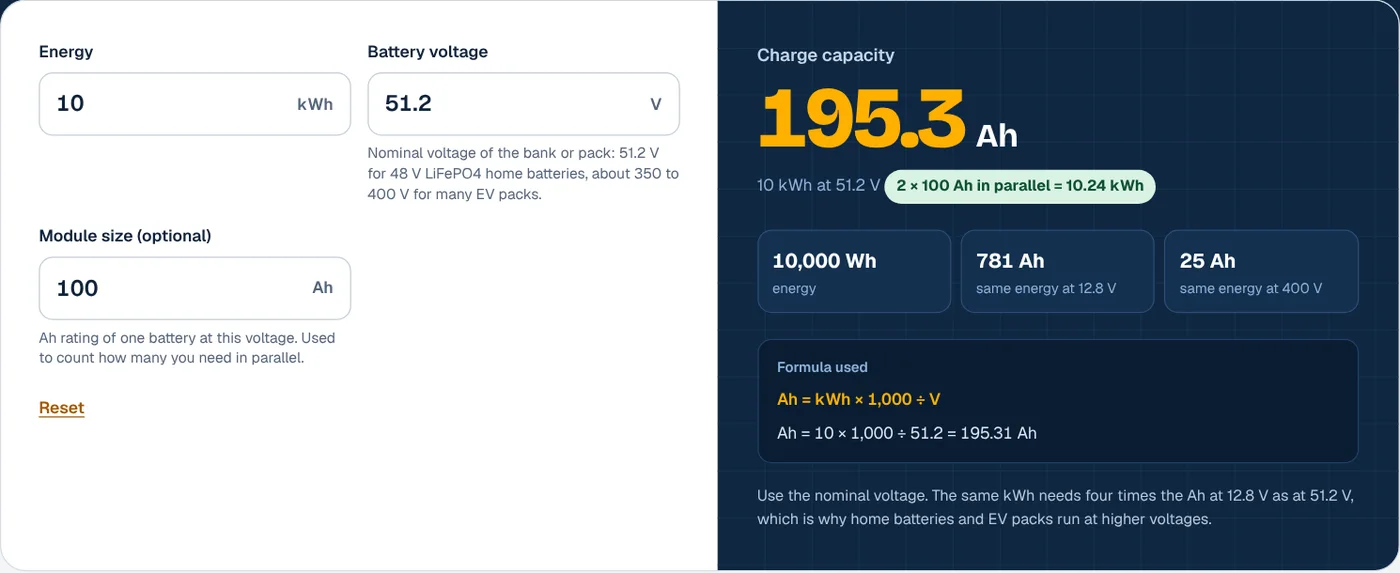
To convert kWh to Ah, multiply the kilowatt-hours by 1,000 and divide by the battery voltage: Ah = kWh × 1,000 ÷ V. A 10 kWh home battery at 51.2 V is 10,000 ÷ 51.2 = 195.3 Ah, so two 100 Ah rack batteries (10.24 kWh) cover it. A 75 kWh EV pack at 400 V is 187.5 Ah.
How to use the kWh to Ah calculator
- Enter the energy in kWh. Type the capacity you need or the rating you want to convert, such as a home battery spec, an EV pack size or a backup target.

- Enter the battery voltage. Use the nominal voltage of the bank or pack: 51.2 V for a 48 V LiFePO4 home battery, 12.8 V for an RV bank or about 350 to 400 V for a typical EV pack.
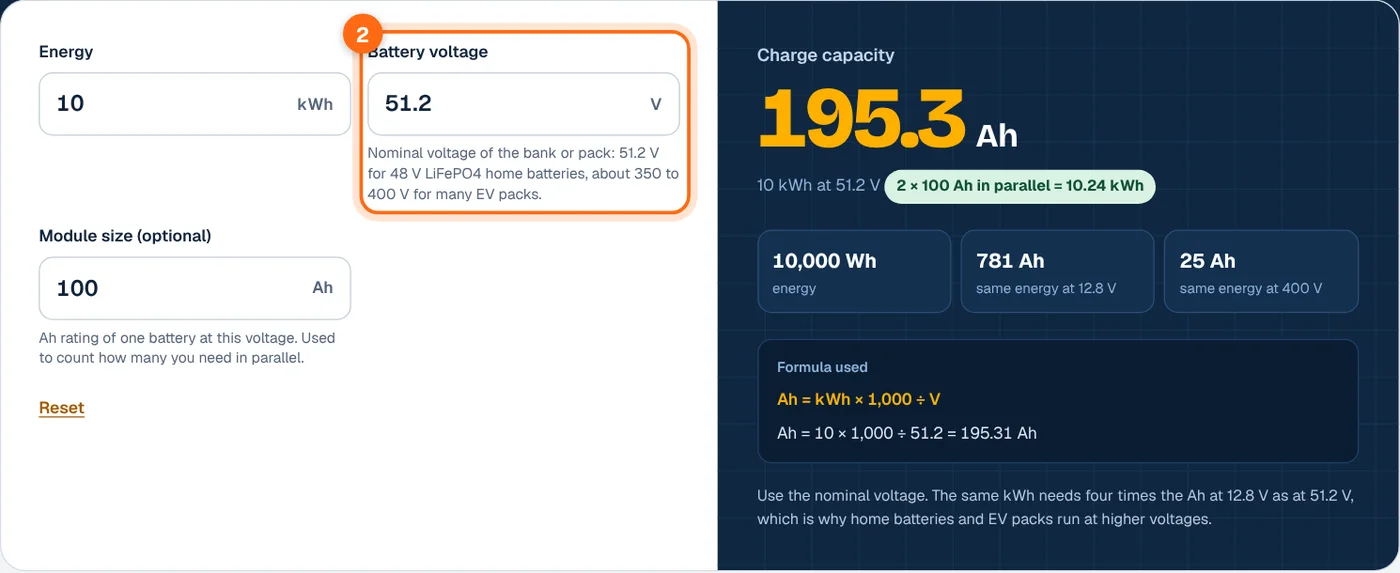
- Enter a module size. Optional. Type the Ah rating of one battery at that voltage, and the chip shows how many you need in parallel and the kWh they add up to.

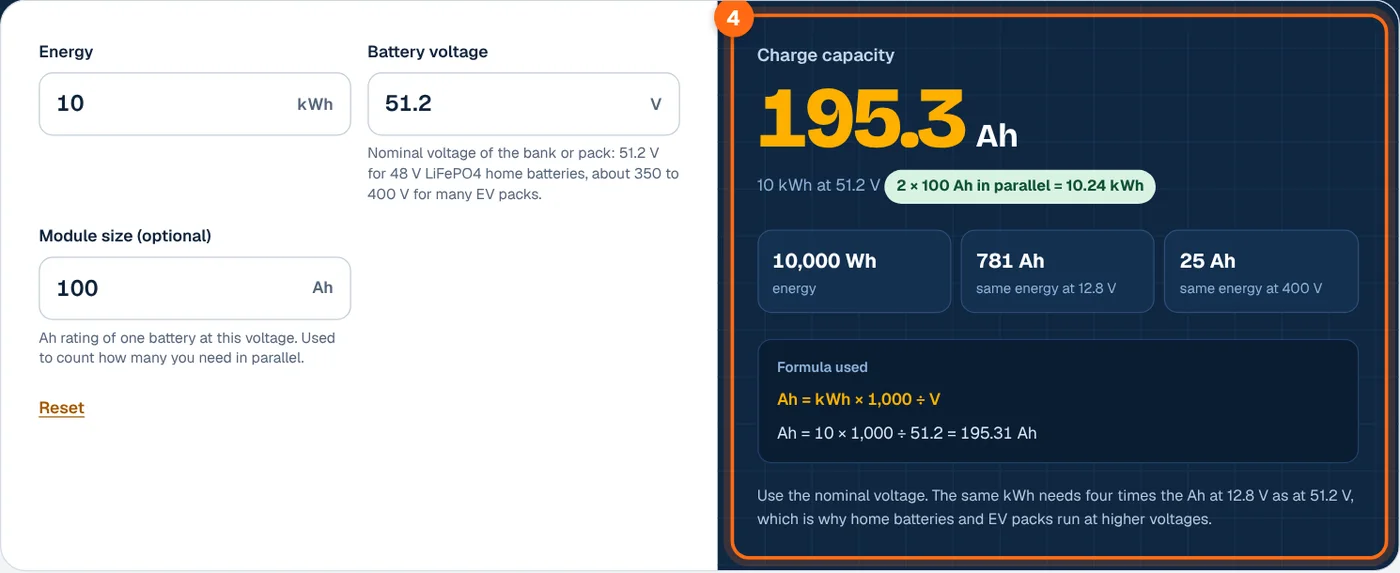
- Read the result. The large number is the charge capacity in Ah. The cards give the same energy in Wh and the amp-hours it would take at 12.8 V and at 400 V.
kWh to Ah formula
A kilowatt-hour is 1,000 watt-hours of energy. Dividing energy by voltage gives charge in amp-hours.
Where:
- Ah is the charge capacity in amp-hours at voltage V.
- kWh is the energy in kilowatt-hours.
- V is the nominal battery or pack voltage.
- Ah per battery is the rating of one battery or module at the same voltage.
The voltage changes the answer dramatically. The same 10 kWh is 781 Ah at 12.8 V and only 25 Ah at 400 V. Higher voltage means lower current for the same power, which allows thinner cables and smaller losses. For smaller figures in watt-hours, the Wh to Ah calculator works the same way.
Worked examples
Example 1: building a 10 kWh home battery from rack modules
With 100 Ah, 51.2 V rack batteries you need 195.31 ÷ 100 = 1.95, rounded up to 2 modules. Two in parallel give 200 Ah, or 10.24 kWh. This is the default example in the calculator.
Example 2: matching a 13.5 kWh home battery
Many all-in-one home batteries are sold at around 13.5 kWh. To match that with 51.2 V modules:
Three 100 Ah modules (15.36 kWh) clear the target. At 12.8 V the same energy would take 1,055 Ah of batteries, which shows why whole-home storage is built at 48 V class voltages.
Example 3: an EV pack
A 75 kWh EV pack with a nominal voltage of 400 V:
The pack’s cells are wired in series strings to reach 400 V, so its Ah is close to the Ah of the cells in one string group. An 800 V pack of the same energy would be rated at 93.75 Ah.
kWh to Ah chart
Amp-hours for common energy capacities at standard nominal voltages.
| Energy (kWh) | 12.8 V | 25.6 V | 51.2 V | 400 V |
|---|---|---|---|---|
| 1 | 78.1 | 39.1 | 19.5 | 2.5 |
| 2.5 | 195.3 | 97.7 | 48.8 | 6.3 |
| 5 | 390.6 | 195.3 | 97.7 | 12.5 |
| 10 | 781.3 | 390.6 | 195.3 | 25 |
| 13.5 | 1,054.7 | 527.3 | 263.7 | 33.8 |
| 15 | 1,171.9 | 585.9 | 293 | 37.5 |
| 20 | 1,562.5 | 781.3 | 390.6 | 50 |
| 30 | 2,343.8 | 1,171.9 | 585.9 | 75 |
For a usable-capacity target, divide the kWh by your depth of discharge first. A 10 kWh usable target at 90% depth of discharge needs 11.1 kWh of rated capacity, or 217 Ah at 51.2 V.
What affects the result
Nominal pack voltage
Use the nominal voltage on the datasheet. A 16-cell LiFePO4 pack is 51.2 V nominal and charges to about 56 to 58 V. EV packs vary with chemistry and cell count, so check the manufacturer figure rather than guessing.
Rated versus usable kWh
Home battery makers often quote usable kWh, while DIY modules quote rated kWh. Make sure you are converting like for like. The battery bank calculator sizes from your loads and depth of discharge.
Depth of discharge and cycle life
Draining a battery less deeply each day makes it last longer. The Victron LiFePO4 Smart datasheet lists 2,500 cycles at 80% depth of discharge and 5,000 at 50%. Oversizing the Ah slightly can pay for itself in battery life.
Module matching
Only parallel batteries of the same voltage and chemistry, ideally the same model. Mixed modules share current unevenly, which reduces usable capacity and can stress the weaker battery.
Frequently asked questions
How many Ah is 1 kWh?
It depends on the voltage. 1 kWh is 83.3 Ah at 12 V, 78.1 Ah at 12.8 V, 39.1 Ah at 25.6 V, 19.5 Ah at 51.2 V and 2.5 Ah at 400 V. Multiply the kWh by 1,000 and divide by the nominal voltage of the battery.
How many Ah is a 10 kWh battery?
At 51.2 V, a 10 kWh battery is 195.3 Ah. At 48 V it is 208.3 Ah, and at 12.8 V it is 781.3 Ah. Home batteries usually run at 48 V class voltages, so you will most often see figures near 200 Ah for 10 kWh.
How many 100 Ah batteries make 10 kWh?
At 12.8 V, one 100 Ah battery holds 1.28 kWh, so you need 8 batteries for 10.24 kWh. At 51.2 V, one 100 Ah module holds 5.12 kWh, so 2 modules give 10.24 kWh. Wire them in parallel at the same voltage, or in series to reach a higher voltage.
Why are EV batteries rated in kWh and not Ah?
kWh tells you energy, which relates directly to driving range. Ah alone is meaningless without the voltage, and EV packs run at very different voltages, from about 350 V to over 800 V. Converting kWh to Ah is still useful when comparing pack designs or cell counts.
Should I use usable or total kWh?
Use the figure that matches your goal. To find the Ah of a battery you are buying, convert its rated kWh. To size a battery for your loads, divide the energy you need by your depth of discharge first, then convert. Mixing the two leads to an undersized bank.