Boat Solar Calculator
Size marine solar for a 12 V or 24 V house bank from your daily amp-hours, with losses for flexible panels and rigging shade.
Quick answer
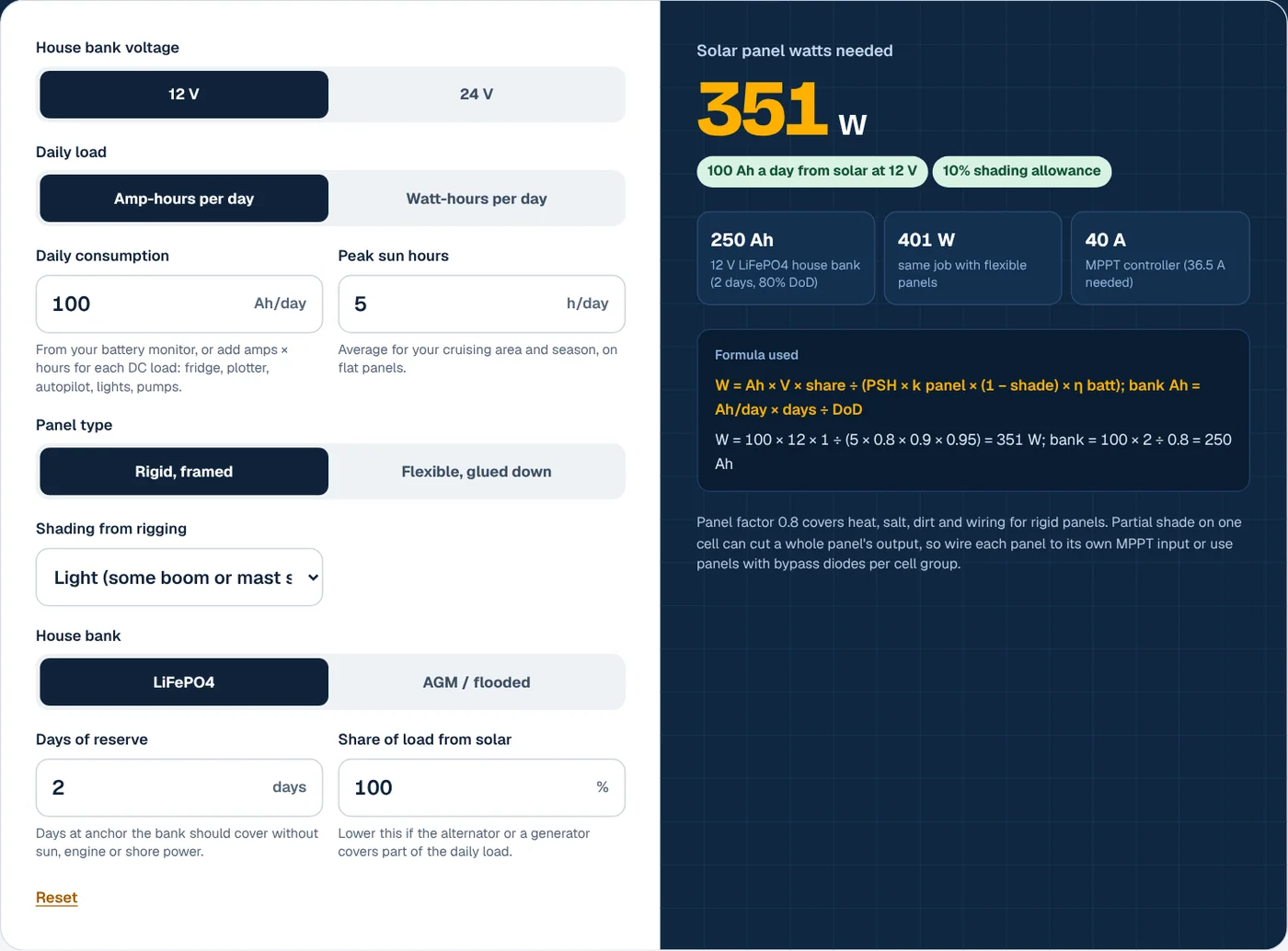
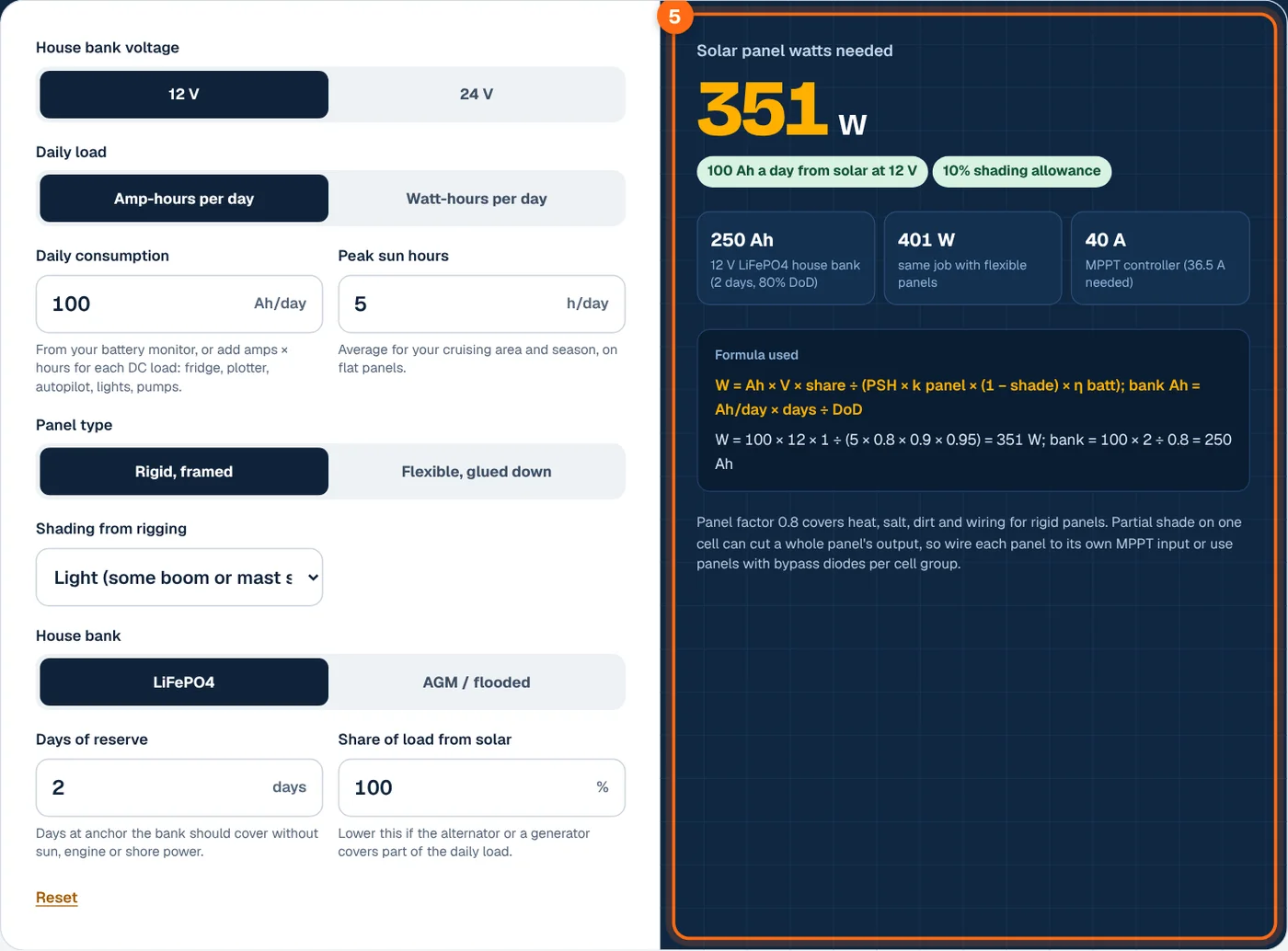
For a boat, panel watts = daily Ah × bank voltage ÷ (peak sun hours × panel factor × (1 − shading) × battery efficiency). A 12 V boat using 100 Ah a day at 5 peak sun hours, with light rigging shade, needs about 351 W of rigid panels or 401 W of flexible panels, plus a 250 Ah LiFePO4 house bank for 2 days at anchor.
How to use the boat solar calculator
- Choose the house bank voltage and enter your daily load. Pick 12 V or 24 V, then enter amp-hours per day from your battery monitor, or switch to watt-hours if you added up your loads that way.
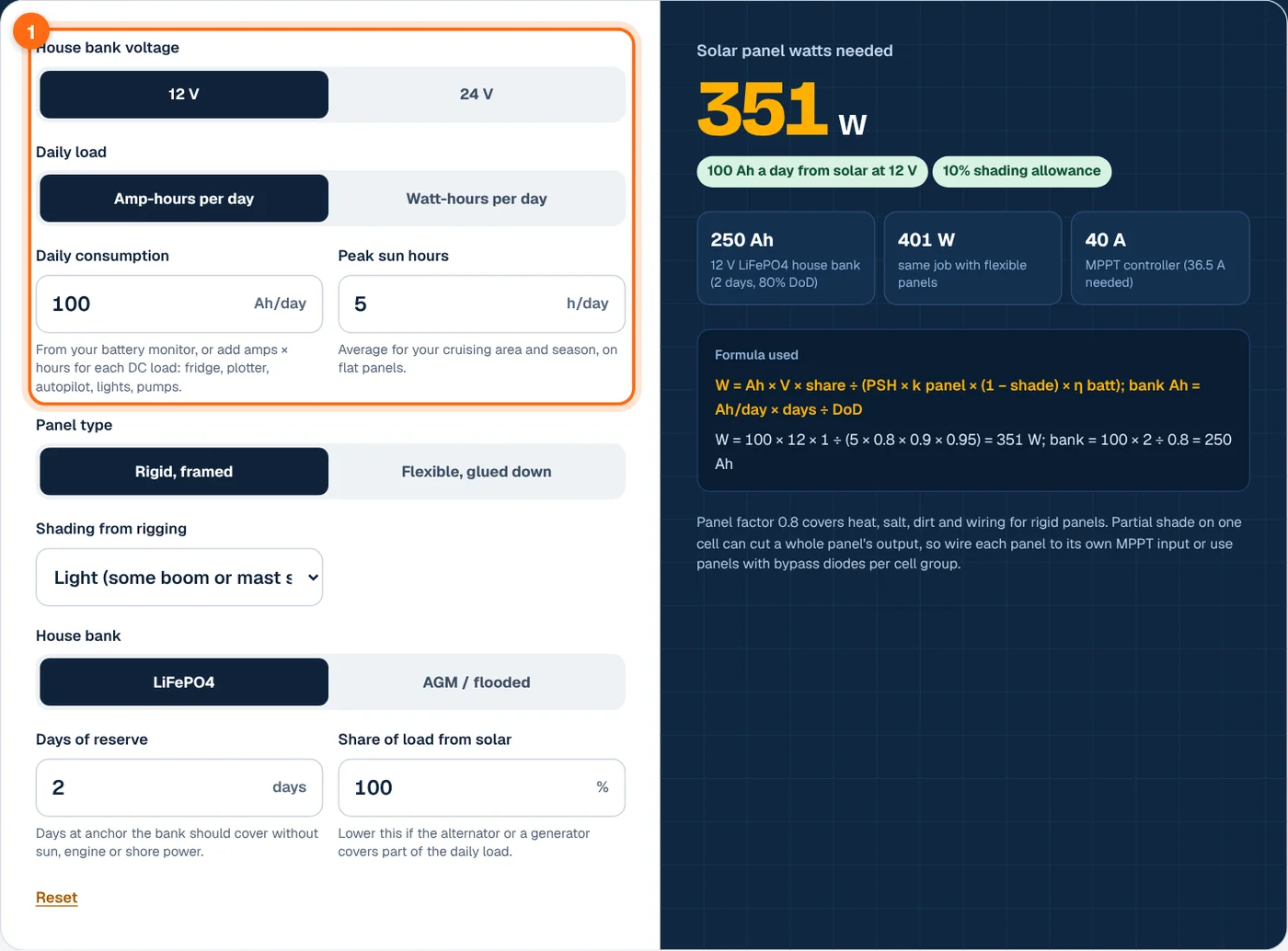
- Enter your peak sun hours. Use the average for your cruising ground and season on flat panels. The peak sun hours calculator gives monthly figures for any port.
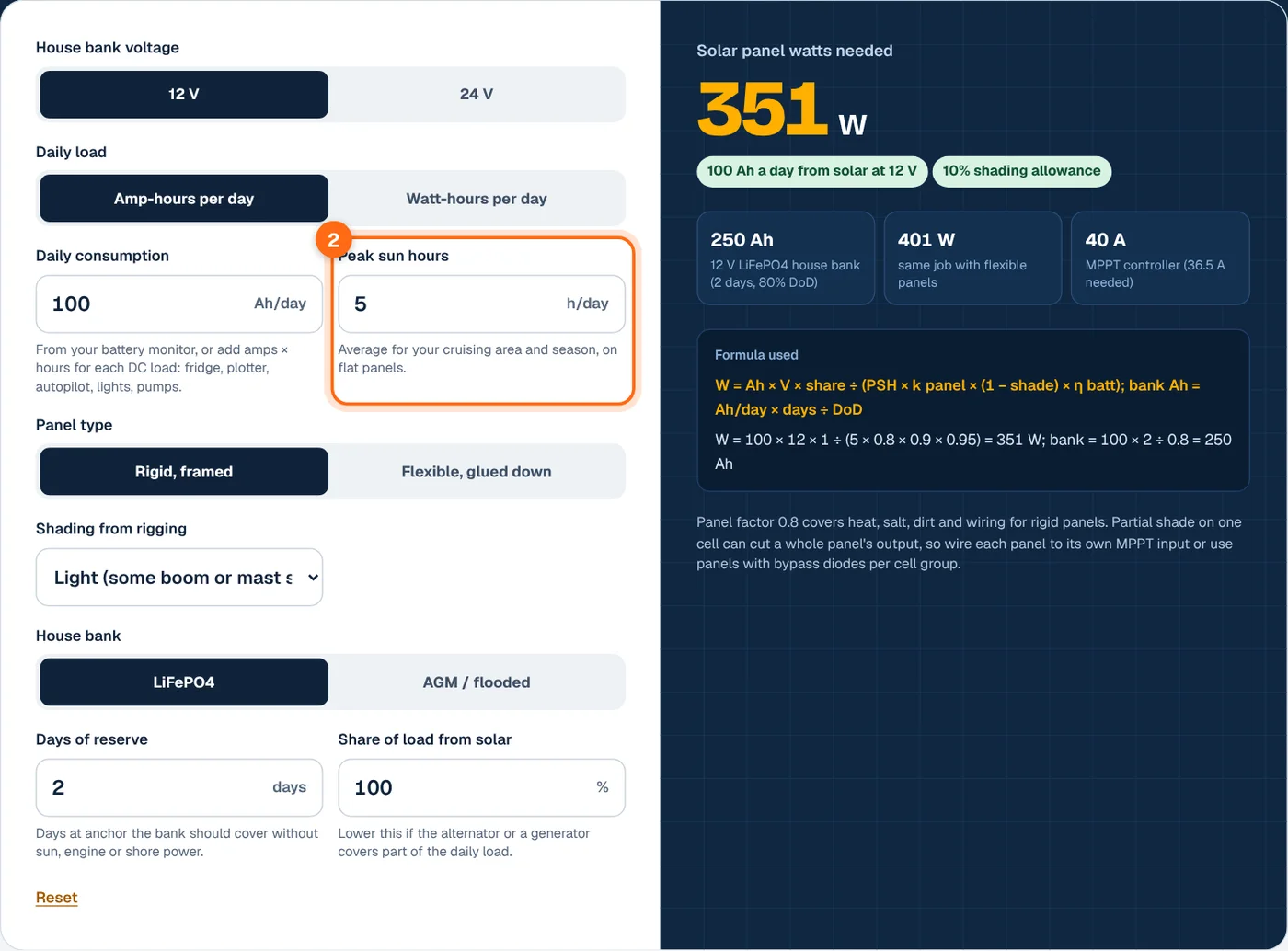
- Describe the panels and the shade. Pick rigid framed panels or flexible glued-down panels, then choose how much the boom, mast, bimini and rigging shade them.
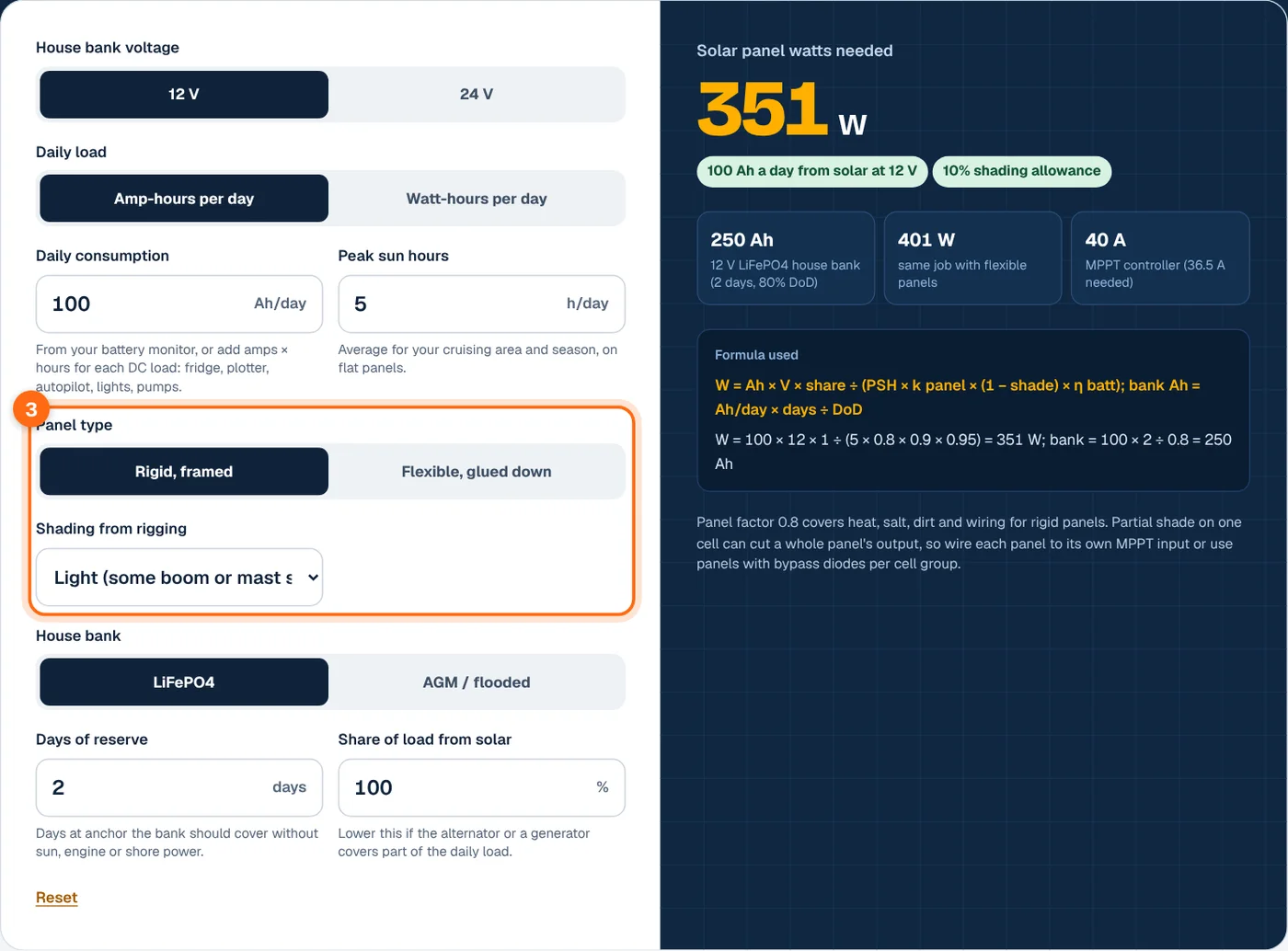
- Set the house bank. Choose LiFePO4 or AGM, the days at anchor the bank should cover, and the share of the daily load solar should supply if an alternator or generator covers the rest.
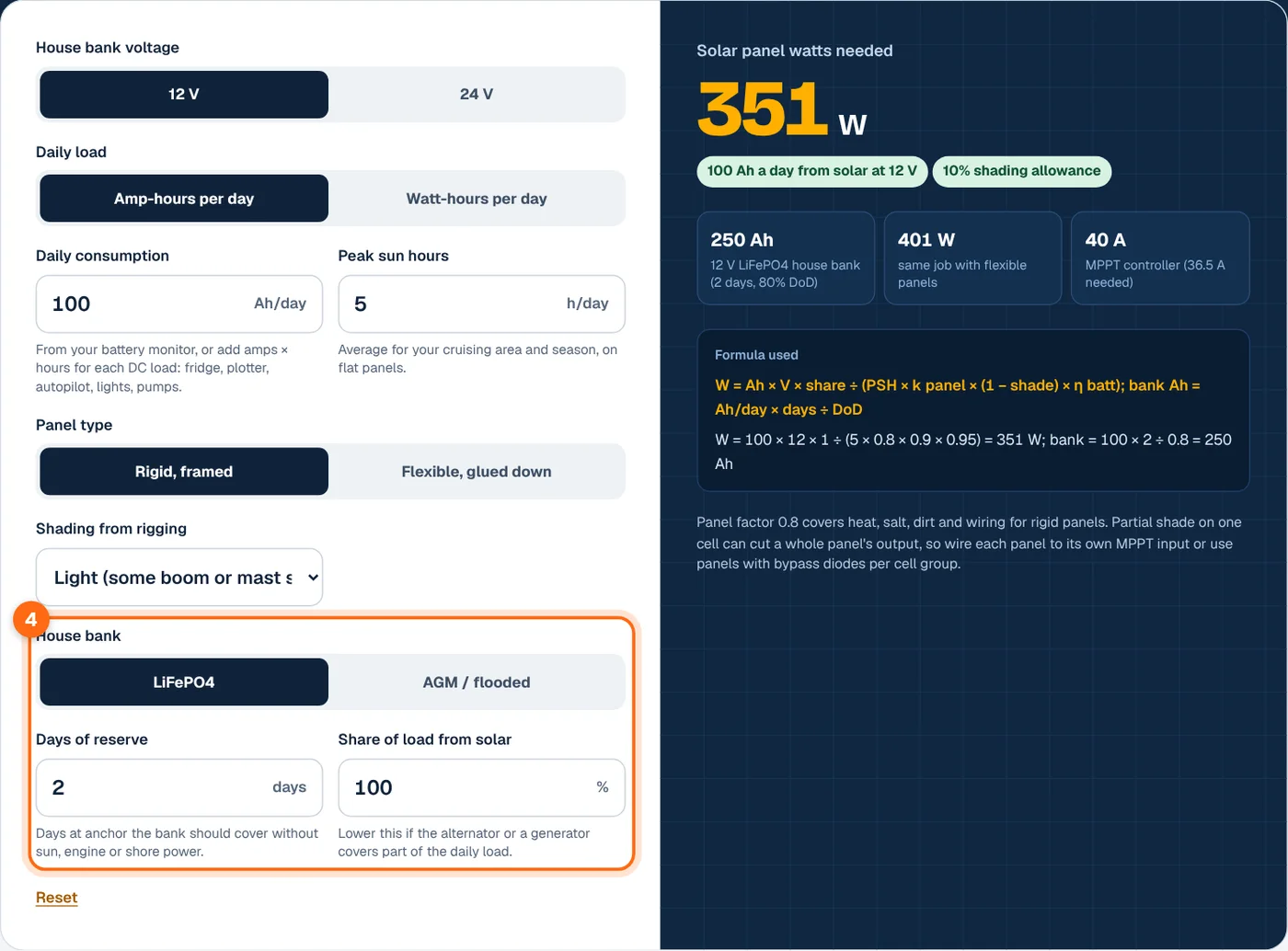
- Read the result. The big number is the panel watts needed. The cards show the house bank in Ah, the watts the other panel type would need and the MPPT controller current.
Boat solar formula
Marine loads are almost all DC and logged in amp-hours, so the calculator works in Ah at the house bank voltage.
Where:
- Ahday is the daily consumption at the bank voltage V.
- s is the share of the load solar must supply.
- PSH is peak sun hours per day on the panels.
- k is the panel factor: 0.80 for rigid framed panels with an air gap and 0.70 for flexible panels bonded to the deck. It covers heat, salt film, dirt and wiring.
- fshade is the shading allowance: 0, 10, 25 or 40%.
- ηbatt is charge efficiency: 0.95 for LiFePO4 and 0.85 for AGM. DoD is 0.8 and 0.5 respectively.
The flexible panel factor is lower because panels lose power as they heat. Victron’s PWM or MPPT white paper gives a typical power coefficient of −0.45% per °C, so a flexible panel running 20 °C hotter than a ventilated rigid panel loses about 9% more.
Worked examples
Example 1: 12 V cruising sailboat
The boat uses 100 Ah a day: fridge, plotter, autopilot, lights and pumps. Rigid panels on an arch get light boom shadow (10%), there are 5 peak sun hours, and the house bank is LiFePO4.
Two 180 to 200 W rigid panels cover it. The controller needs 351 ÷ 12 × 1.25 = 36.5 A, so a 40 A MPPT unit. The same job with flexible panels needs 401 W.
Example 2: 24 V catamaran with bimini shade
A 24 V boat uses 80 Ah a day (1,920 Wh), with rigid panels on a bimini that see moderate shade (25%).
Flexible panels in the same spot would need 770 W. The controller needs 35.1 A at 24 V, so a 40 A unit.
Example 3: weekend boat with alternator help
A 12 V AGM boat uses 60 Ah a day, gets 4 peak sun hours and lets the engine alternator cover 30% of the load. Solar needs 60 × 12 × 0.7 ÷ (4 × 0.8 × 0.9 × 0.85) = 206 W, and 2 days on AGM at 50% DoD need a 240 Ah bank.
Panel watts per 10 Ah of daily use
Watts needed for each 10 Ah a day at 12 V on LiFePO4 with 10% shading. Multiply by your daily Ah ÷ 10. At 24 V, use the same figure per 5 Ah.
| Peak sun hours | Rigid panels | Flexible panels |
|---|---|---|
| 3 h | 58 W | 67 W |
| 4 h | 44 W | 50 W |
| 5 h | 35 W | 40 W |
| 6 h | 29 W | 33 W |
| 7 h | 25 W | 29 W |
A 12 V fridge drawing 40 to 60 Ah a day is usually the single largest load and alone needs 140 to 210 W of rigid panels at 5 peak sun hours.
What affects the result
Shading from rigging
Shade hurts solar on boats more than on roofs. A thin shadow across one cell row can cut a panel’s output by a third or more, because the cells are wired in series. Wiring each panel to its own MPPT controller, or using panels with several bypass diodes, limits the loss to the shaded panel.
Flexible versus rigid panels
Flexible panels are light and walkable, but glued directly to the deck they have no cooling air behind them, run hot and tend to age faster. Rigid panels on an arch, davits or a bimini frame produce more per watt and usually last longer.
House bank chemistry
LiFePO4 gives 80% usable capacity and accepts charge with little loss, so it needs less panel and a smaller bank. AGM and flooded batteries should stay above 50% and need a long absorption charge, which solar alone often cannot finish in a short winter day.
Season and latitude
Flat panels on a boat in the tropics may see 6 peak sun hours, while the same panels in New England or the UK in October may see 2. Size for the season you cruise, and check the bank size with the battery calculator.
Frequently asked questions
What size solar panel do I need for my boat?
Multiply your daily amp-hours by the bank voltage and divide by peak sun hours times about 0.68 for rigid panels with light shade. A 12 V boat using 100 Ah a day at 5 peak sun hours needs about 351 W rigid or 401 W flexible. Small daysailers using 20 Ah need only 70 to 80 W.
How many amp-hours does a sailboat use per day?
A small coastal cruiser with LED lights and instruments may use 30 to 50 Ah a day at 12 V. Adding a 12 V fridge brings it to 80 to 120 Ah. Autopilots, watermakers and radar push liveaboard boats to 150 to 250 Ah. A battery monitor with a shunt gives the real figure.
Are flexible solar panels good for boats?
They work where nothing else fits, such as on a curved deck or a canvas bimini. Bonded flat to the deck they run hot, so they produce less, about 13% less in this calculator, and tend to age faster. Mounting them with an air gap or choosing rigid panels on a frame gives more energy per watt.
Do I need an MPPT controller on a boat?
MPPT is the better choice for most boats. It harvests more energy from panels in cool weather and handles partial shade better. It also lets you wire panels in series and run thinner cable to the bank. A separate MPPT controller per panel is the best defense against shadows from the mast and boom.
How big should a boat house bank be?
Multiply daily amp-hours by the days you want to stay at anchor without charging, then divide by the depth of discharge. For 100 Ah a day and 2 days, that is 250 Ah of LiFePO4 at 80% DoD or 400 Ah of AGM at 50%. Many cruisers size for 2 to 3 days.