Solar Panel Size Calculator
Find solar panel dimensions, area and weight for any wattage and cell count, plus how many panels a system needs.
Quick answer
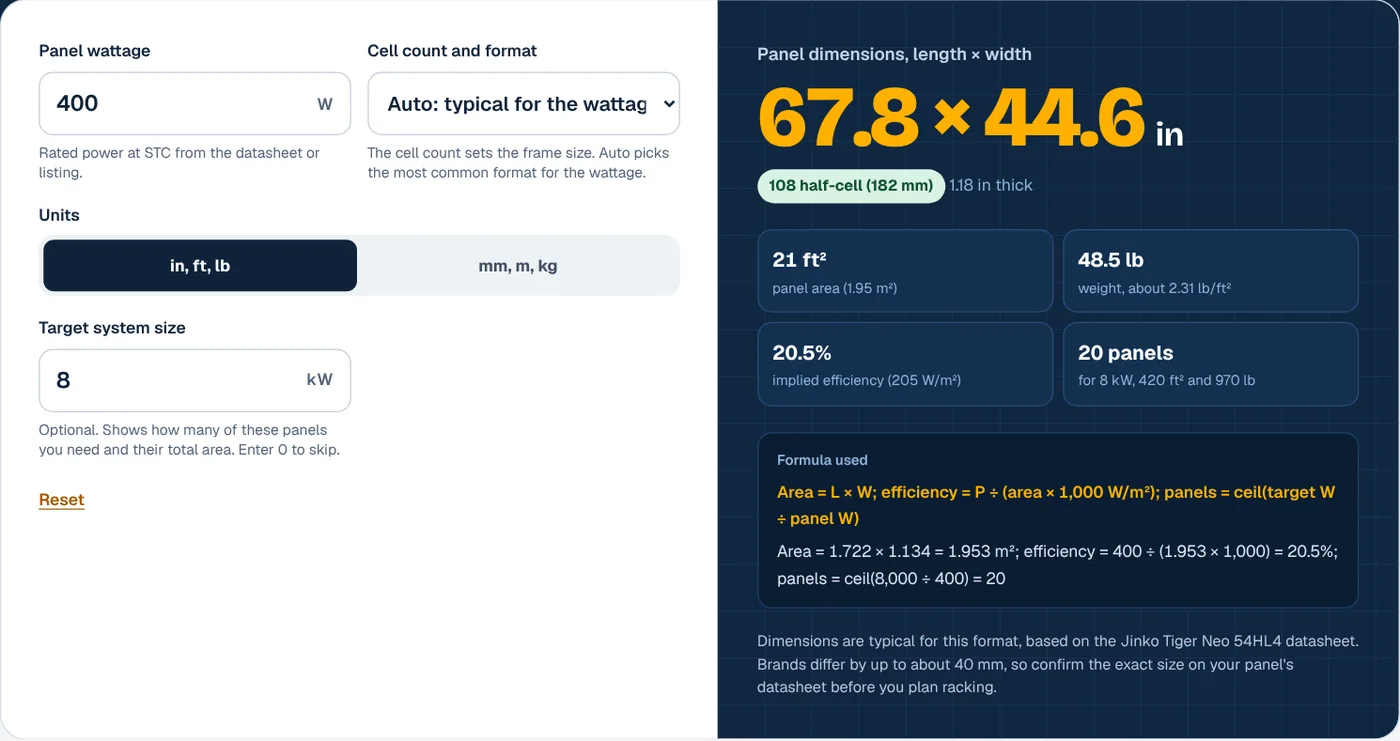
A typical 400 W residential solar panel measures about 67.8 × 44.6 in (1,722 × 1,134 mm), covers 21 ft² (1.95 m²) and weighs about 48.5 lb (22 kg). A 100 W 12 V panel is about 42 × 21 in, and a 580 W commercial panel is about 89.7 × 44.6 in. Panel size depends mainly on cell count and cell format, not on wattage alone.
How to use the solar panel size calculator
- Enter the panel wattage. Use the rated power at standard test conditions (STC) from the listing or datasheet, anywhere from 100 W to 700 W.
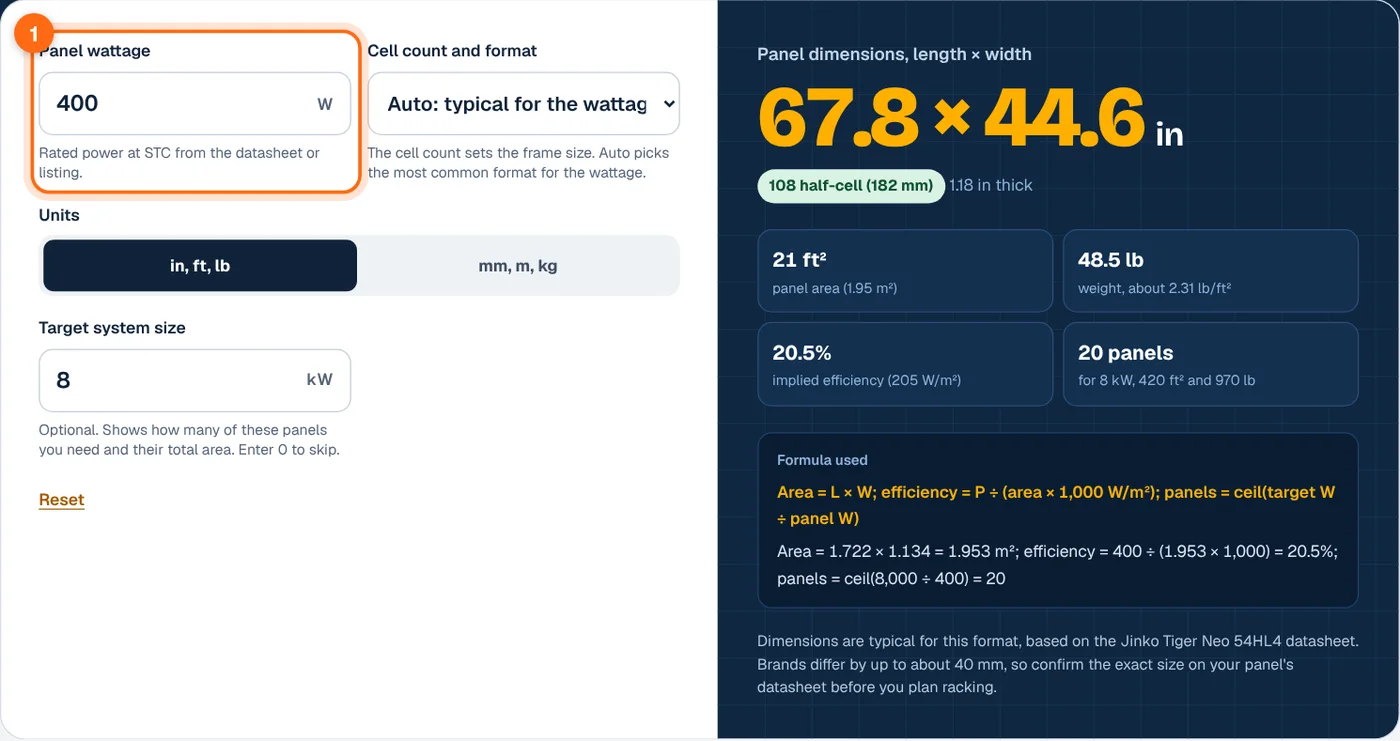
- Choose the cell count and format. Leave it on Auto to get the most common frame for that wattage, or pick the cell count printed on the datasheet, such as 108 half cells or 144 half cells.

- Pick your units. Inches, feet and pounds suit US roof plans. Millimeters, meters and kilograms match most datasheets.

- Enter a target system size. Type the kW you want, for example 8 kW, to see how many of these panels you need and their total area and weight. Enter 0 to skip it.

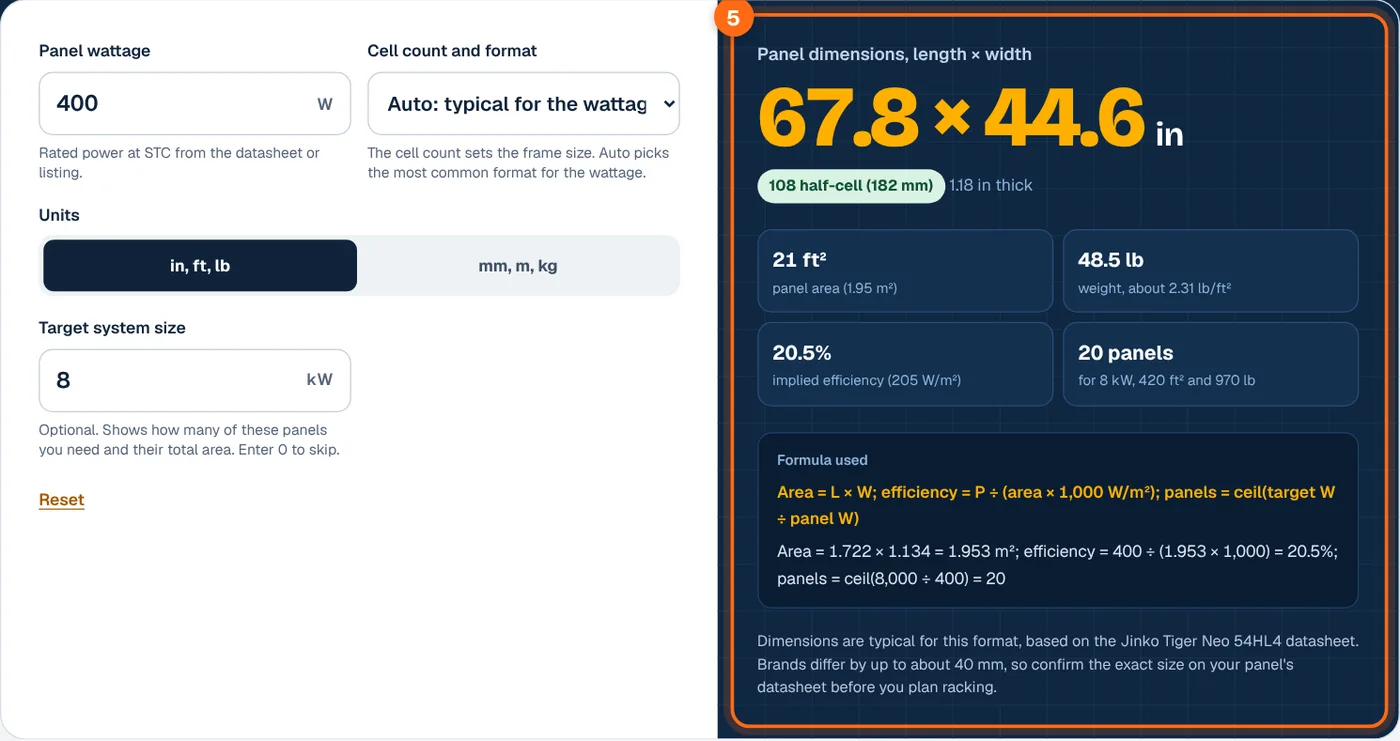
- Read the panel dimensions. The big number is length × width. The cards show the area, weight, implied efficiency and the panel count for your target size.
Solar panel size formula
Each format in the calculator uses the frame size of a real panel from a manufacturer datasheet. From that frame, the calculator works out the area, the power density and how many panels a system needs.
Where:
- L and W are the outer frame length and width in meters.
- P is the panel’s rated power in watts at STC.
- 1,000 W/m² is the STC irradiance used to rate every panel.
- ceil rounds up to the next whole panel.
For 12 V panels the frame grows with power, so the calculator scales the size between two datasheets: 17.8% efficiency at 100 W and 19.2% at 200 W, at about 11.4 kg per square meter.
Worked examples
Example 1: a 400 W panel for an 8 kW roof
Auto picks a 108 half-cell panel at 1,722 × 1,134 mm, which is 67.8 × 44.6 in.
Twenty panels cover 420 ft² and weigh about 970 lb before racking.
Example 2: a 100 W 12 V panel
The scaled 36-cell frame is 41.8 × 20.8 in (1,061 × 529 mm), close to the 1,062 × 530 mm listed on the Renogy 100 W datasheet.
It weighs about 14.1 lb. Four of them for a 400 W van or cabin array take up 24 ft² and weigh 56 lb.
Example 3: 585 W commercial panels for 10 kW
A 144 half-cell panel measures 2,278 × 1,134 mm, or 89.7 × 44.6 in.
Eighteen panels cover 501 ft² and weigh 1,111 lb. You need fewer panels than with 400 W modules, but each one is longer and heavier: 61.7 lb, which is a two-person lift on a roof.
Solar panel dimensions chart
Frame sizes and weights from manufacturer datasheets, checked October 2026. Area and efficiency are computed from the frame.
| Format (example model) | Power | Size (mm) | Size (in) | Area | Weight | Efficiency |
|---|---|---|---|---|---|---|
| 36-cell 12 V (Renogy RNG-100D-SS) | 100 W | 1,062 × 530 | 41.8 × 20.9 | 6.1 ft² | 14.1 lb | 17.8% |
| 12 V, 68 cells (Renogy RSP200D) | 200 W | 1,491 × 699 | 58.7 × 27.5 | 11.2 ft² | 26.5 lb | 19.2% |
| 60-cell full cell (Canadian Solar CS6K) | 300 W | 1,650 × 992 | 65.0 × 39.1 | 17.6 ft² | 40.1 lb | 18.3% |
| 72-cell full cell (Canadian Solar CS6U) | 330 W | 1,960 × 992 | 77.2 × 39.1 | 20.9 ft² | 49.4 lb | 17.0% |
| 120 half cell, 166 mm (Qcells Q.PEAK DUO BLK-G10+) | 365 W | 1,717 × 1,045 | 67.6 × 41.1 | 19.3 ft² | 43.9 lb | 20.3% |
| 132 half cell, 166 mm (Qcells Q.PEAK DUO ML-G10+) | 400 W | 1,879 × 1,045 | 74.0 × 41.1 | 21.1 ft² | 48.5 lb | 20.4% |
| 108 half cell, 182 mm (Jinko Tiger Neo 54HL4) | 430 W | 1,722 × 1,134 | 67.8 × 44.6 | 21.0 ft² | 48.5 lb | 22.0% |
| 120 half cell, 182 mm (Jinko Tiger Neo 60HL4) | 470 W | 1,903 × 1,134 | 74.9 × 44.6 | 23.2 ft² | 53.4 lb | 21.8% |
| 144 half cell, 182 mm (Jinko Tiger Neo 72HL4) | 585 W | 2,278 × 1,134 | 89.7 × 44.6 | 27.8 ft² | 61.7 lb | 22.6% |
| 132 half cell, 210 mm (Trina Vertex N NEG21C.20) | 700 W | 2,384 × 1,303 | 93.9 × 51.3 | 33.4 ft² | 84.4 lb | 22.5% |
The 60 and 72 full-cell formats are now mostly found on older roofs and in the used market. New residential panels in 2026 are almost all 108 or 120 half-cell modules around 1,134 mm wide.
What affects solar panel size
Cell count and wafer size
The frame is built around the cells, so cell count and wafer size set the dimensions. A 108 half-cell panel is just 54 cut cells in six columns. Larger 182 mm and 210 mm wafers made panels wider, which is why newer modules are 1,134 mm or 1,303 mm wide instead of the old 992 mm.
Efficiency
Two panels of the same size can differ by 50 W or more. A 20.5% panel and a 22% panel in the same 1.95 m² frame give 400 W and 430 W. If roof space is tight, compare watts per square foot with the solar panel efficiency calculator.
Frame depth and glass
Most residential frames are 30 to 35 mm deep, and older ones are 40 mm. Glass-glass bifacial panels are heavier for their size: the 700 W Trina weighs 12.3 kg per square meter against about 11.3 kg for a glass-backsheet panel.
Brand tolerances
Two brands using the same cell count can differ by 20 to 40 mm in length. Racking rails, clamp zones and the roof layout should always use the exact datasheet of the panel you buy. To see how many fit a roof face after fire setbacks, use the solar panel roof area calculator.
Frequently asked questions
What is the standard size of a solar panel?
There is no single standard, but most new home panels in 2026 are 108 or 120 half-cell modules about 1,722 to 1,903 mm long and 1,134 mm wide, or roughly 68 to 75 in by 44.6 in. Older 60-cell panels were 65 × 39 in. Commercial 144-cell panels are about 90 in long.
How big is a 400 watt solar panel?
Most 400 W panels are about 67.8 × 44.6 in (1,722 × 1,134 mm) with 108 half cells, or 74 × 41 in with 132 smaller half cells. Either way the area is about 21 ft² and the weight is around 48 lb. A 400 W 12 V panel for RVs is narrower and longer.
How much roof space do I need for 8 kW?
With 400 W panels you need 20 panels covering about 420 ft² of panel area. Real roofs need more because of ridge setbacks, fire pathways and edge clearance, so plan on 500 to 600 ft² of usable roof face. Higher-wattage panels reduce the count but not the area by much.
How much does a solar panel weigh?
A 100 W 12 V panel weighs about 14 lb. A 400 to 440 W residential panel weighs 44 to 49 lb, and a 585 W commercial panel about 62 lb. Glass-glass 700 W panels reach 84 lb. On a roof, panels plus racking usually add 2.5 to 4 lb per square foot.
Are bigger solar panels better?
Not always. Larger panels mean fewer clamps and less wiring per kW, which lowers install cost on big flat roofs and ground mounts. On a home roof, the 1,722 × 1,134 mm size fits more layouts, is easier to carry on a ladder and leaves less wasted space around vents and edges.