EV Range Calculator
Estimate real electric car range from battery size, efficiency and charge, adjusted for outside temperature and highway speed.
Quick answer
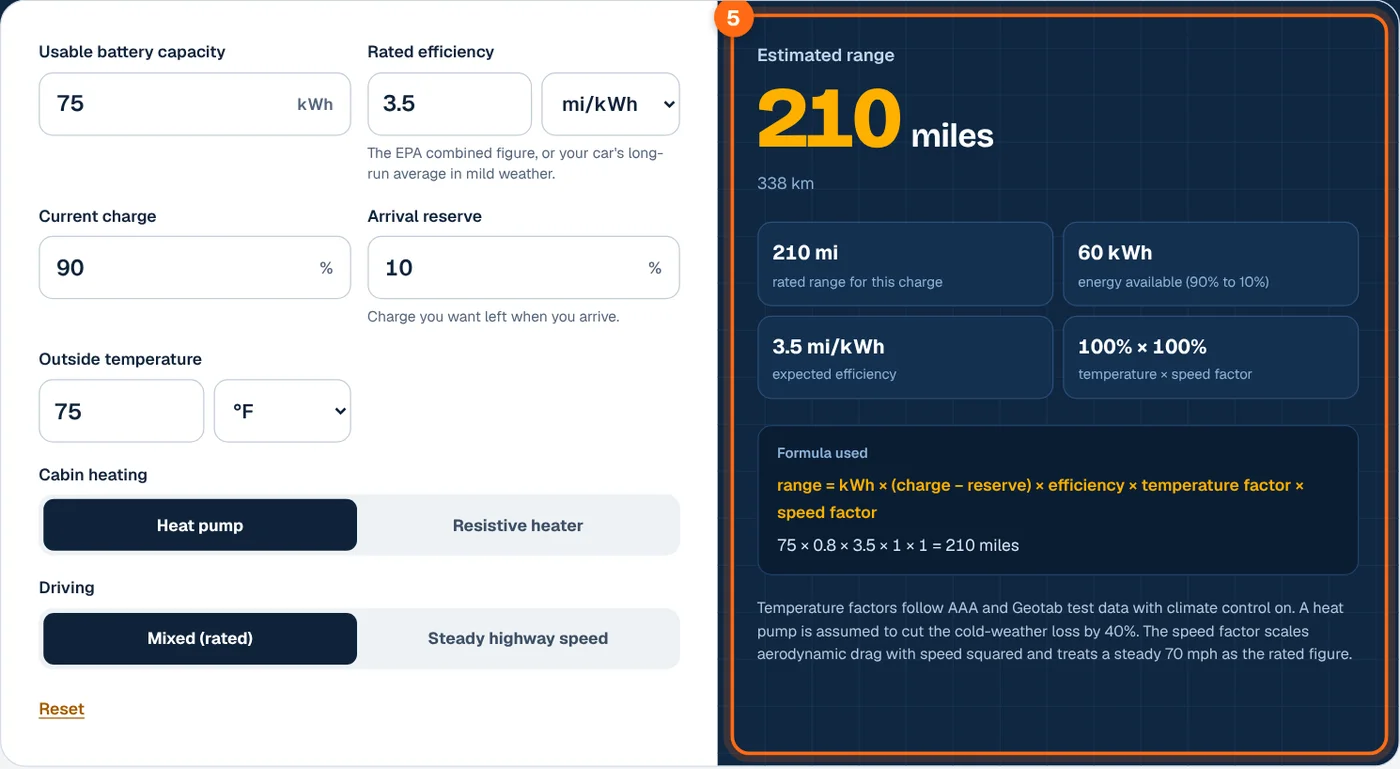
EV range = usable kWh × (charge − reserve) × efficiency × temperature factor × speed factor. A 75 kWh battery at 90%, keeping a 10% reserve, holds 60 kWh, which gives 210 miles at 3.5 mi/kWh in mild weather. At 20 °F with a resistive heater, AAA testing points to about 41% less, around 124 miles. A heat pump keeps it nearer 158 miles.
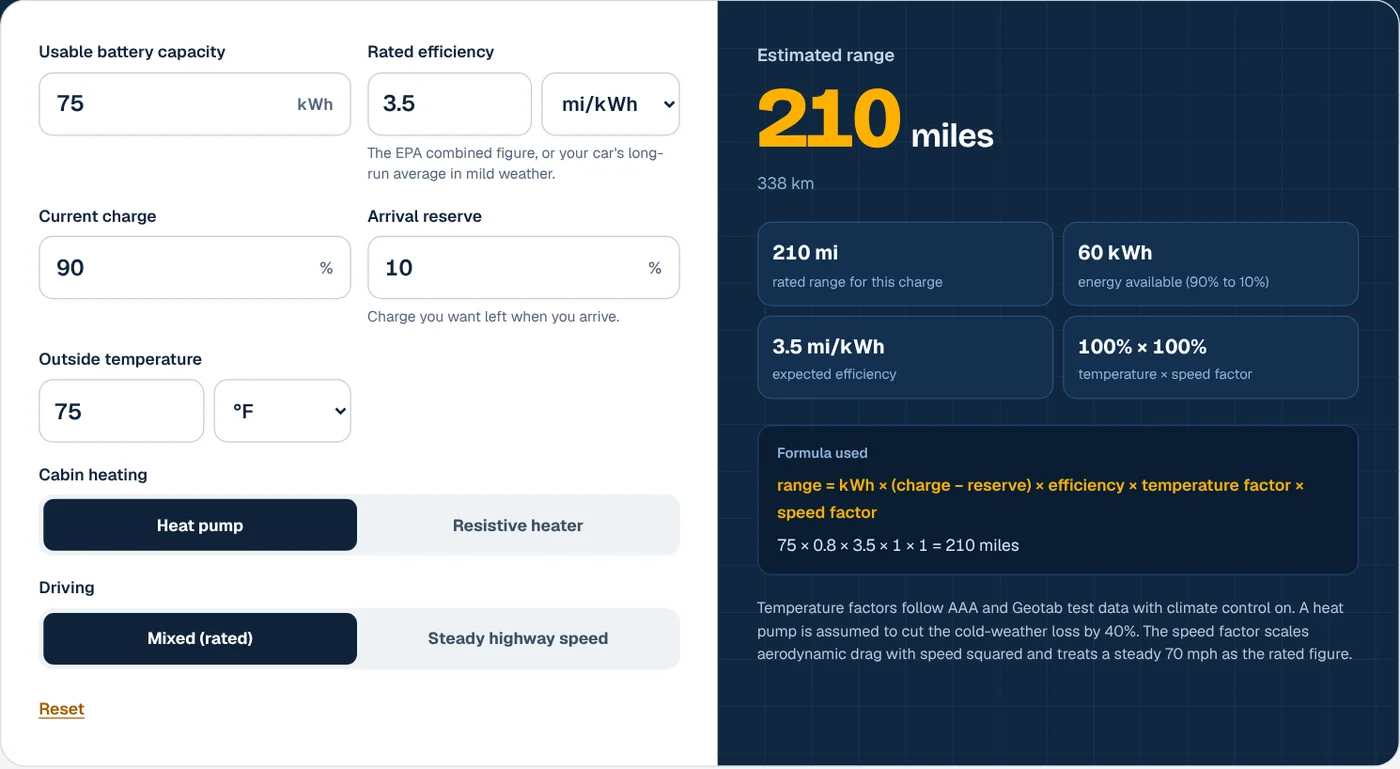
How to use the EV range calculator
- Enter the battery and rated efficiency. Use the usable kWh and the EPA combined efficiency, or your own long-run average in mild weather, in mi/kWh, kWh/100 mi or kWh/100 km.
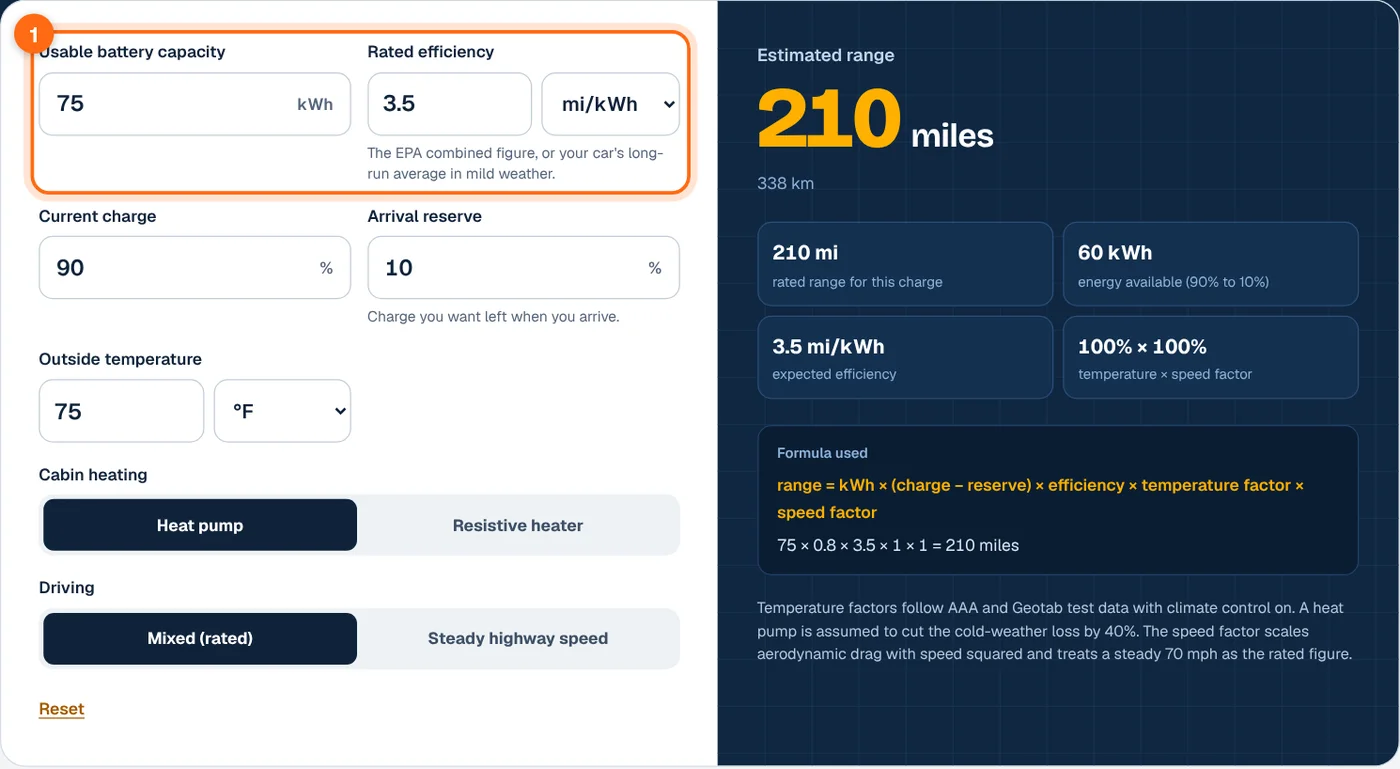
- Set your current charge and arrival reserve. The reserve is the charge you want left at the end, usually 10 to 20%.
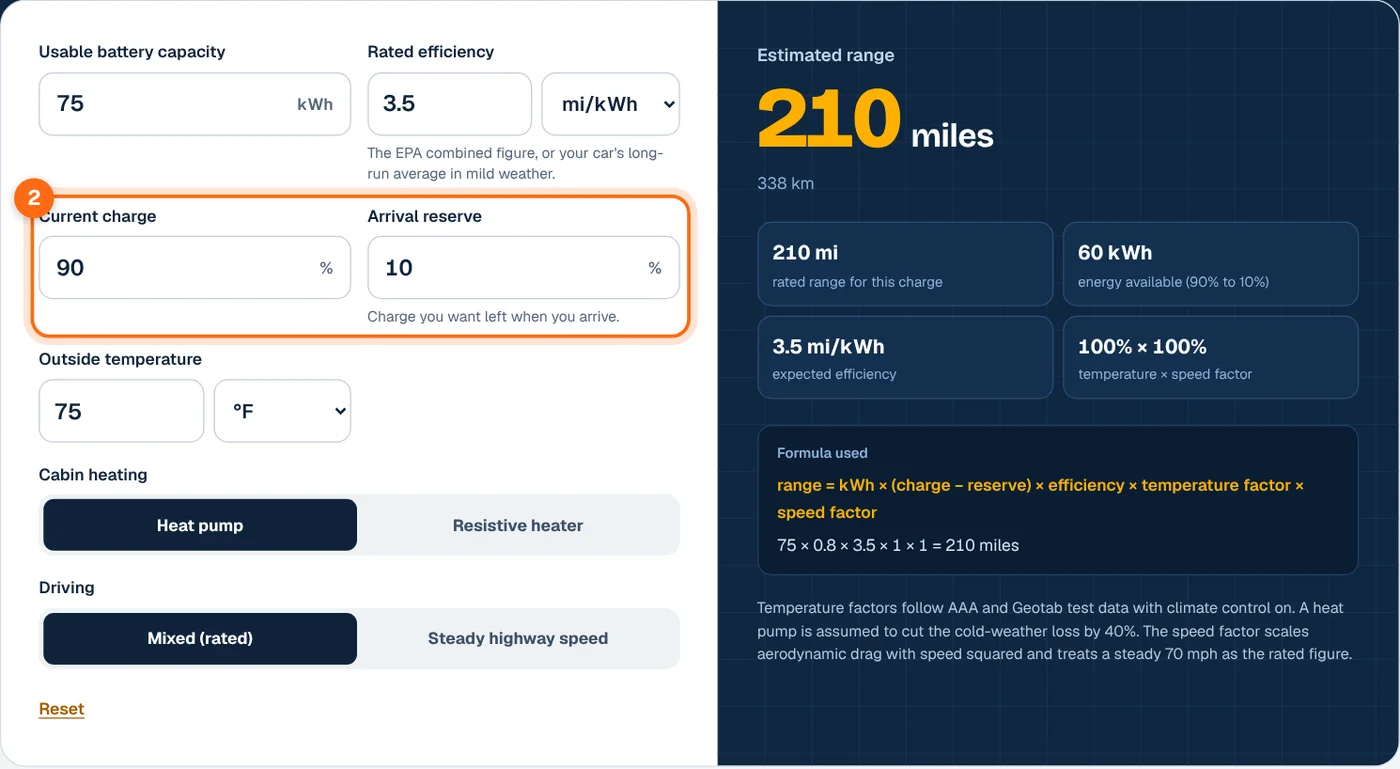
- Enter the outside temperature and cabin heating. Choose °F or °C. Pick Heat pump if your car has one, or Resistive heater if it does not.
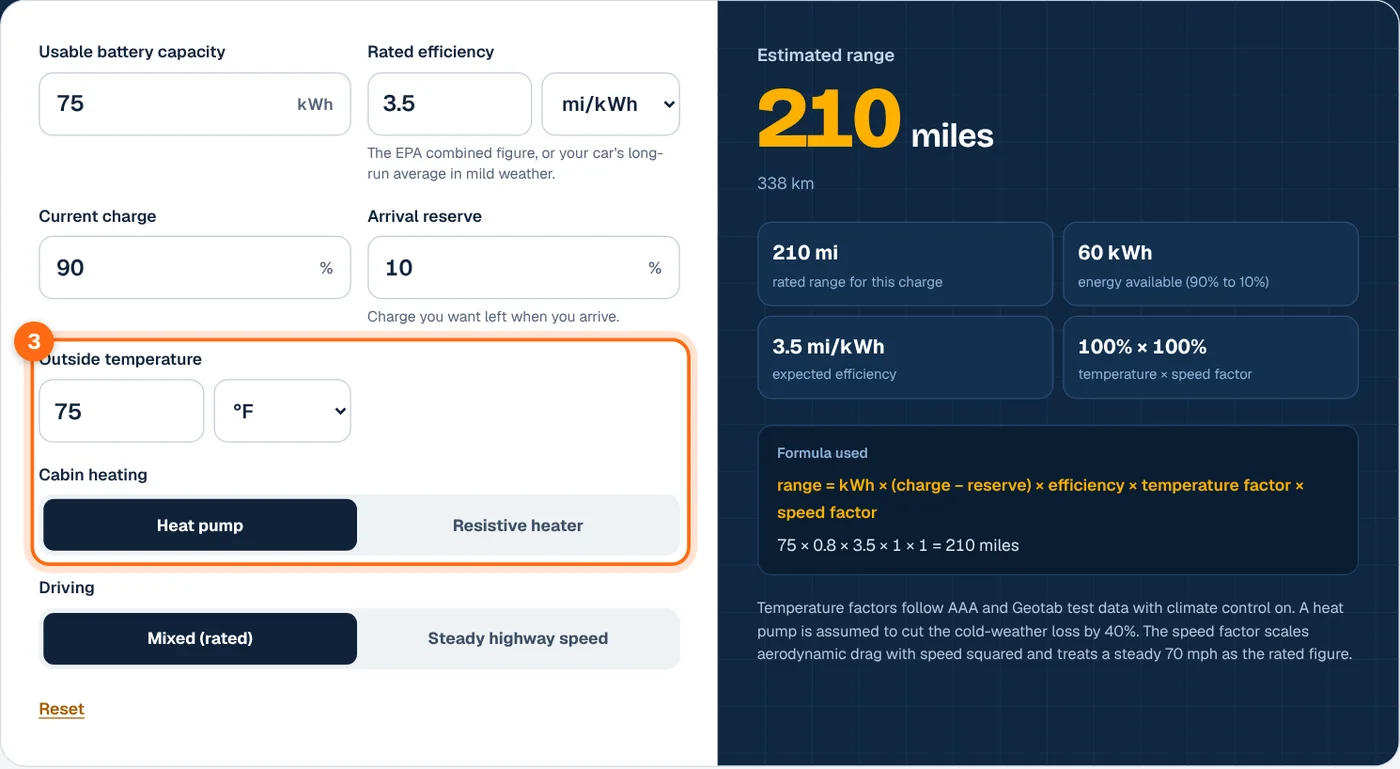
- Choose how you drive. Mixed uses the rated figure. Steady highway speed adjusts for aerodynamic drag at the speed you enter.
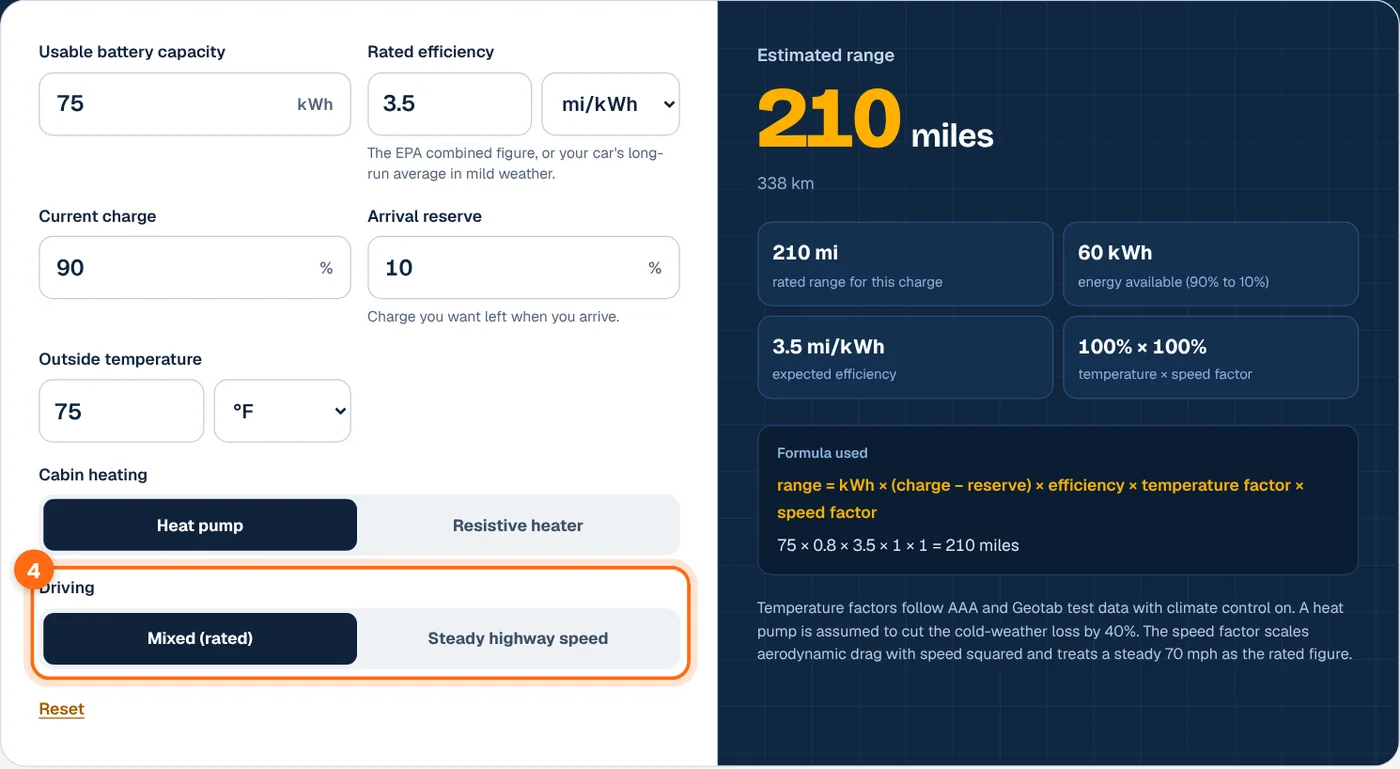
- Read the result. The large number is the estimated range in miles, with kilometers below. The cards show rated range, energy available, expected efficiency and the factors applied.
EV range formula
Where:
- C is usable battery capacity in kWh and E is the energy you can use on this trip.
- η is rated efficiency in miles per kWh.
- fT is the temperature factor, 1.00 between 68 °F and 77 °F. It follows AAA testing, which measured 41% less range at 20 °F with the heater on and 17% less at 95 °F with air conditioning, both against 75 °F. Below 20 °F the curve follows Geotab fleet data, which found EVs at 54% of rated range at 5 °F. A heat pump cuts the cold-weather loss by 40% in the model.
- fv is the speed factor. Aerodynamic drag accounts for about 47% of highway energy use in Department of Energy figures and grows with speed squared. The highway test cycle averages about 48 mph. The model treats a steady 70 mph as the rated figure, in line with highway range tests run at 70 mph.
Worked examples
Example 1: mild day, mixed driving
A 75 kWh battery is at 90% and you want 10% left.
Example 2: 20 °F, heater on
With a resistive heater the temperature factor is 0.59, so range = 60 × 3.5 × 0.59 = 124 miles and efficiency falls to 2.07 mi/kWh. With a heat pump the loss shrinks to 41% × 0.6 = 24.6%, so fT = 0.754 and range is about 158 miles. Recurrent data on 18,000 US vehicles found that heat pumps were the biggest single factor in keeping winter range.
Example 3: -10 °C on the motorway at 120 km/h
-10 °C is 14 °F. With a heat pump fT = 0.732. 120 km/h is 74.6 mph, giving fv = 0.919.
Range by temperature and speed
Values for the default car: 60 kWh available, rated 3.5 mi/kWh, 210 miles in mild weather.
| Outside temperature | Factor, resistive heat | Range, resistive heat | Factor, heat pump | Range, heat pump |
|---|---|---|---|---|
| 0 °F (-18 °C) | 47% | 99 mi | 68% | 144 mi |
| 20 °F (-7 °C) | 59% | 124 mi | 75% | 158 mi |
| 32 °F (0 °C) | 70% | 147 mi | 82% | 172 mi |
| 50 °F (10 °C) | 86% | 181 mi | 92% | 192 mi |
| 75 °F (24 °C) | 100% | 210 mi | 100% | 210 mi |
| 95 °F (35 °C) | 83% | 174 mi | 83% | 174 mi |
| 104 °F (40 °C) | 74% | 155 mi | 74% | 155 mi |
| Steady speed | 55 mph | 60 mph | 65 mph | 70 mph | 75 mph | 80 mph | 85 mph |
|---|---|---|---|---|---|---|---|
| Speed factor | 133% | 121% | 110% | 100% | 91% | 83% | 76% |
| Range at 75 °F | 280 mi | 254 mi | 231 mi | 210 mi | 191 mi | 175 mi | 160 mi |
What affects the result
Cabin and battery heating
In cold weather the car heats both the cabin and the battery with electricity. On short trips this fixed load takes a big share of the energy, so winter losses are worst for short, cold commutes. Preheating while plugged in draws that energy from the grid instead.
Speed and aerodynamics
Drag rises with the square of speed, so going from 70 to 80 mph cuts range by about 17% in the model. Wind, roof boxes and bike racks add drag too.
Battery health and usable capacity
Batteries lose a little capacity with age. Use the usable figure your car reports today, or apply a few percent less for an older pack. The battery cycle life calculator covers how capacity fades with use.
Terrain, load and tires
Climbing costs energy that regenerative braking only partly recovers on the way down. Towing can cut range in half. Underinflated or winter tires also add rolling resistance.
Frequently asked questions
How do I calculate my EV’s range?
Multiply usable battery kWh by the share of charge you will use, then by your efficiency in mi/kWh. A 75 kWh battery used from 90% to 10% holds 60 kWh, which gives 210 miles at 3.5 mi/kWh. Then reduce it for cold, heat and high speed using the factors in this calculator.
How much range does an EV lose in winter?
AAA measured 41% less range at 20 °F with the heater running, compared with 75 °F. Recurrent’s data from over 18,000 US cars found an average loss of about 20% in freezing conditions, with heat-pump models losing the least. Expect 20 to 40% depending on the car and trip length.
Does driving faster reduce EV range?
Yes. Aerodynamic drag grows with the square of speed, and EVs have no gearbox to soften the effect. In this model, 80 mph gives about 17% less range than 70 mph, while 60 mph gives about 21% more. Geotab found peak efficiency at much lower city speeds.
Does air conditioning reduce EV range?
Yes, but less than heating. AAA found a 17% range loss at 95 °F with the air conditioning on. Heat also makes the car run its battery cooling system, which draws extra power. Parking in the shade and pre-cooling the cabin while still plugged in both help on hot days.
Is EPA range realistic?
EPA range is a combined city and highway figure in mild weather. Some cars beat it in steady 70 mph testing, others fall short. Use it for mixed driving in mild conditions, then apply temperature and speed factors for winter road trips.