Solar Fuse Size Calculator
Size PV string, charge controller and battery fuses with the 1.56 × Isc rule and standard fuse ratings.
Quick answer
A PV string fuse must be at least Isc × 1.56 and no larger than the module’s maximum series fuse rating. For a panel with 11.14 A Isc and a 20 A rating, 11.14 × 1.56 = 17.38 A, so use a 20 A fuse. String fuses are needed with three or more strings in parallel. Battery and charge controller fuses are sized at 1.25 times the continuous current.
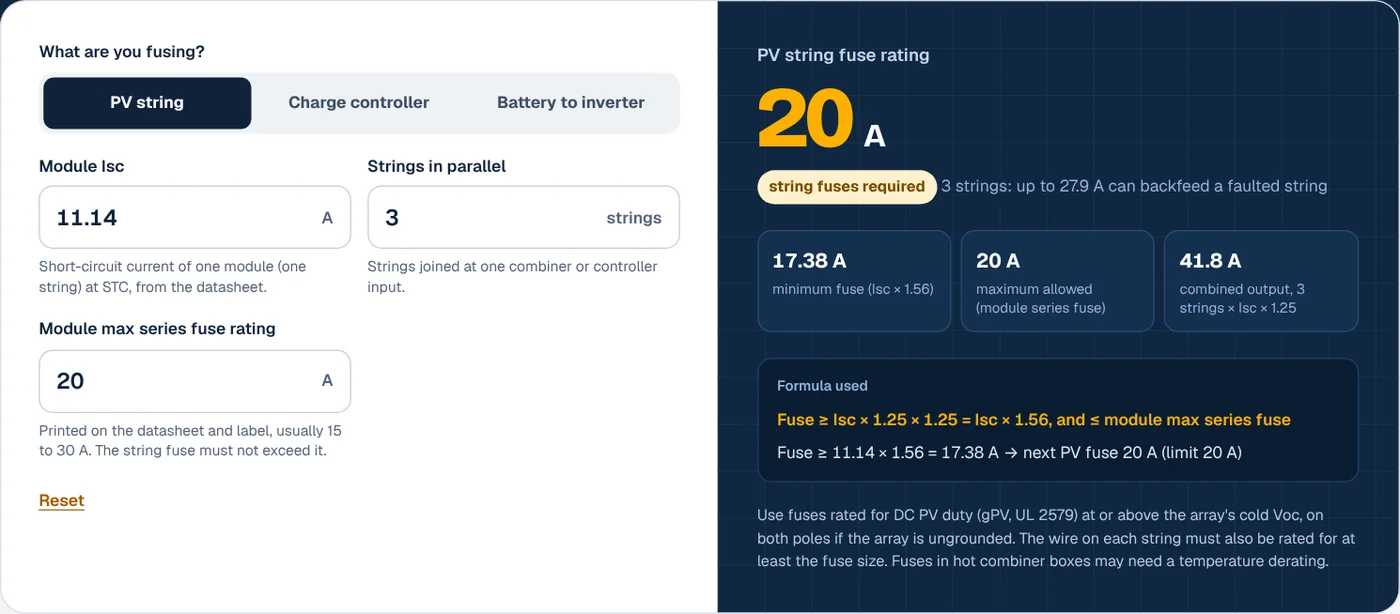
How to use the solar fuse size calculator
- Choose what you are fusing. PV string covers fuses in a combiner box. Charge controller covers the fuse between controller and battery. Battery to inverter covers the main battery fuse.
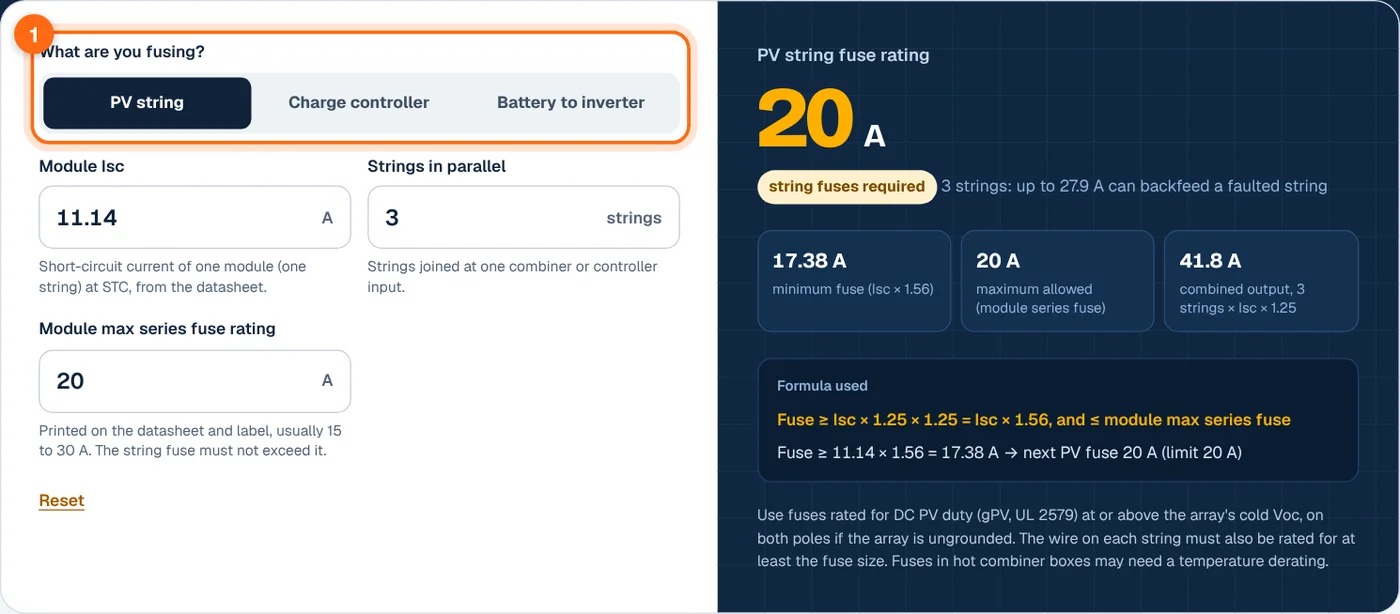
- Enter the module data for a PV string. Type the module Isc, the number of strings in parallel and the maximum series fuse rating from the datasheet.

- Enter the controller or inverter data. For a controller, enter its rated output current. For an inverter, enter its continuous watts, the battery voltage and the efficiency.
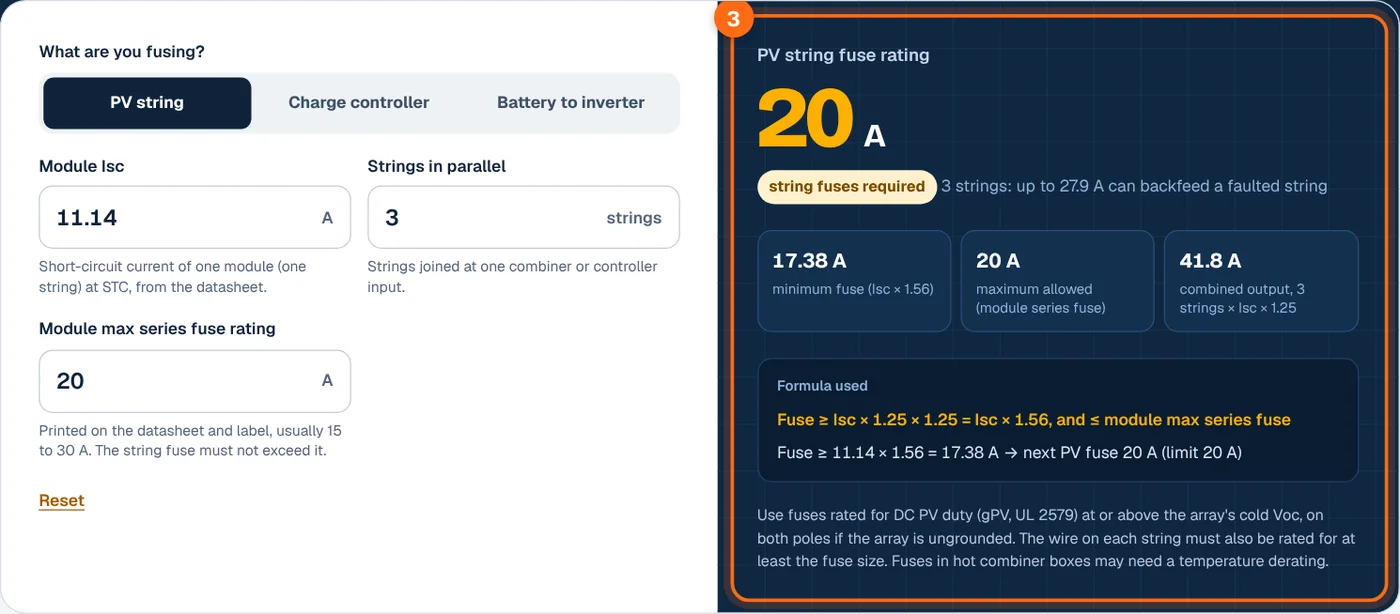
- Read the fuse size. The big number is the standard fuse rating to use. The line below it tells you whether string fuses are required, and the cards show the minimum and maximum limits.
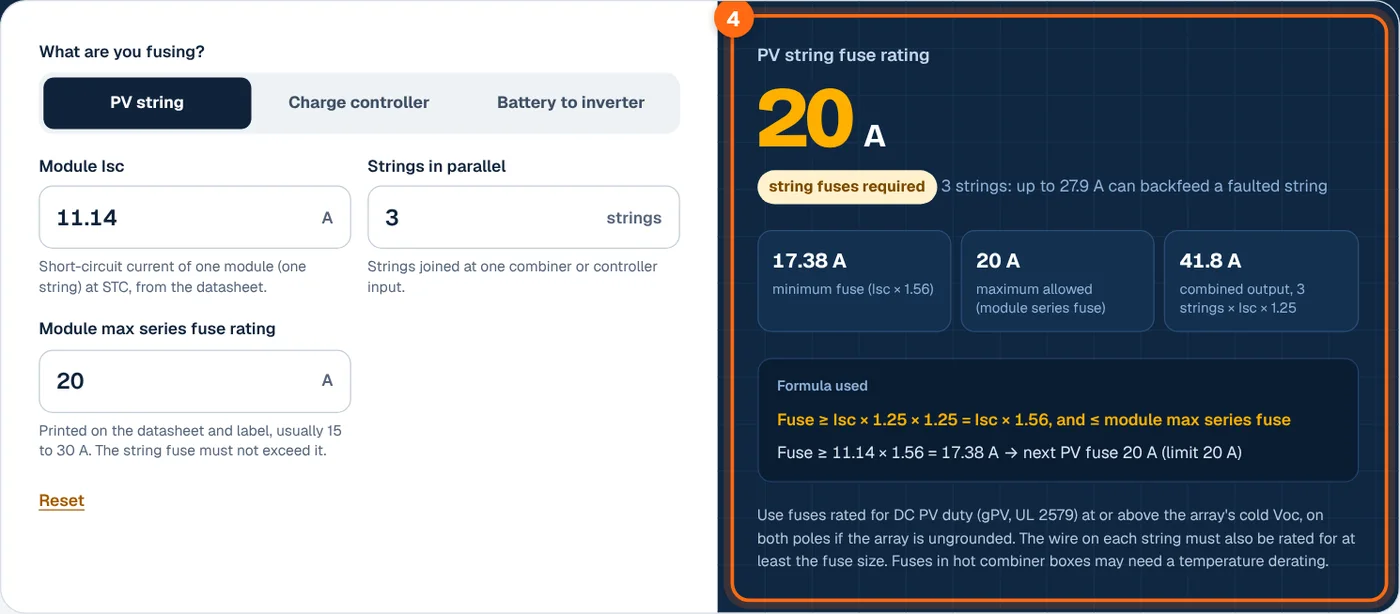
Solar fuse size formulas
1. PV string fuse
2. Charge controller fuse
3. Battery to inverter fuse
Where:
- Isc is the module short-circuit current at STC.
- The first 1.25 covers sunlight above 1,000 W/m² (NEC 690.8(A)); the second is the continuous-duty factor for overcurrent devices (NEC 690.9(B)).
- Np is the number of strings in parallel.
- P is inverter continuous power, η its efficiency and Vlow the low battery voltage: 10.5 V per 12 V nominal.
- The result rounds up to the next standard fuse rating.
Mersen’s guide to sizing PV fuses under the NEC sets out the same rule: one or two strings usually need no fuse, three or more do, and the fuse must not exceed the module rating.
Worked examples
Example 1: three strings of 400 W panels
Module Isc 11.14 A, max series fuse 20 A, 3 strings in parallel.
Two healthy strings could push 27.9 A into a shorted one, more than the 20 A the module can take, so each string needs a 20 A fuse. 20 A is also the maximum allowed, so it fits exactly.
Example 2: two strings with a 25 A module rating
Module Isc 13.96 A, max series fuse 25 A.
No string fuses are needed. If you fit them anyway, use 25 A: 13.96 × 1.56 = 21.78 A, rounded up.
Example 3: a 2,000 W inverter on 12 V
The same inverter on 24 V needs a 150 A fuse and on 48 V a 70 A fuse. A 40 A MPPT charge controller needs 40 × 1.25 = 50 A.
Standard fuse ratings
PV string fuses (10 × 38 mm, 1,000 V DC, Littelfuse SPF range): 1, 2, 3, 3.5, 4, 5, 6, 8, 10, 12, 15, 20, 25 and 30 A, with larger gPV sizes of 32, 35, 40, 50 and 63 A. Battery and controller fuses use the NEC 240.6(A) steps: 15, 20, 25, 30, 35, 40, 45, 50, 60, 70, 80, 90, 100, 110, 125, 150, 175, 200, 225, 250, 300, 350, 400, 450, 500 and 600 A.
| Module Isc | Isc × 1.56 | String fuse |
|---|---|---|
| 5.21 A (100 W 12 V) | 8.13 A | 10 A |
| 9.92 A (300 W 60-cell) | 15.48 A | 20 A |
| 11.14 A (400 W) | 17.38 A | 20 A |
| 13.44 A (420 W) | 20.97 A | 25 A |
| 13.96 A (470 W) | 21.78 A | 25 A |
| 11.05 A (200 W 12 V) | 17.24 A | 20 A |
| Inverter power | 12 V fuse | 24 V fuse | 48 V fuse |
|---|---|---|---|
| 1,000 W | 150 A | 70 A | 35 A |
| 1,500 W | 200 A | 100 A | 50 A |
| 2,000 W | 300 A | 150 A | 70 A |
| 3,000 W | 400 A | 200 A | 100 A |
| 5,000 W | 700 A | 350 A | 175 A |
Inverter fuses assume 90% efficiency and a low battery voltage of 10.5 V per 12 V.
What affects fuse size
Number of parallel strings
With one string, nothing can backfeed it. With two, the one healthy string can supply at most 1.25 × Isc, which usually stays within the module rating. With three or more, the combined backfeed exceeds it, so each string needs a fuse. The solar panel series and parallel calculator shows how many strings a layout uses.
Module series fuse rating
This rating, usually 15 to 30 A, is the most current the module can survive flowing backward. If Isc × 1.56 is above it, the module cannot be fused correctly at that current and you should use fewer strings per input or a different panel.
Cable ampacity
A fuse protects the cable as well as the equipment, so it must not exceed the cable’s ampacity. Size the cable first with the solar cable size calculator, then confirm the fuse is no larger.
Voltage and interrupting rating
PV fuses must be DC rated at or above the cold-weather array Voc. Battery fuses must be able to interrupt the very high short-circuit current of a lithium bank, which is why Class T fuses are common on LiFePO4 systems.
Heat
Fuses in a sunny combiner box can run hot and open early. Manufacturers publish temperature derating factors; shade the box or step up one size within the module and cable limits.
Frequently asked questions
What size fuse do I need for my solar panel?
Multiply the panel’s Isc by 1.56 and round up to the next standard fuse, keeping it at or below the maximum series fuse rating on the label. A 100 W 12 V panel with 5.21 A Isc needs a 10 A fuse. A 400 W panel with 11.14 A Isc needs a 20 A fuse.
Do I need a fuse for every solar panel?
No. Fuses go on strings, not individual panels, and only when backfeed from other strings could exceed the module rating. In practice that means three or more strings in parallel. A single string or two parallel strings usually need no string fuse if the cables are rated for Isc × 1.56.
Why is the solar fuse 1.56 times Isc?
It is two 1.25 factors multiplied. The first allows for sunlight brighter than the 1,000 W/m² test level, which raises current. The second keeps the fuse from running above 80% of its rating continuously, because solar current lasts for hours. Together they give 1.25 × 1.25 = 1.5625.
What size fuse between charge controller and battery?
Use 1.25 times the controller’s rated output current, rounded up to a standard size, unless the manual specifies a value. A 40 A controller takes a 50 A fuse and a 60 A controller an 80 A fuse. Place it on the positive cable close to the battery.
Can I use a breaker instead of a fuse?
Yes, if the breaker is DC rated for the voltage and current, and for PV circuits listed for PV use. Breakers double as a disconnect, which is handy at the battery and controller. String protection in combiner boxes is still mostly done with 10 × 38 mm gPV fuses.