Solar Panel Efficiency Calculator
Calculate solar panel efficiency from rated watts and panel size, with output per square meter and per square foot.
Quick answer
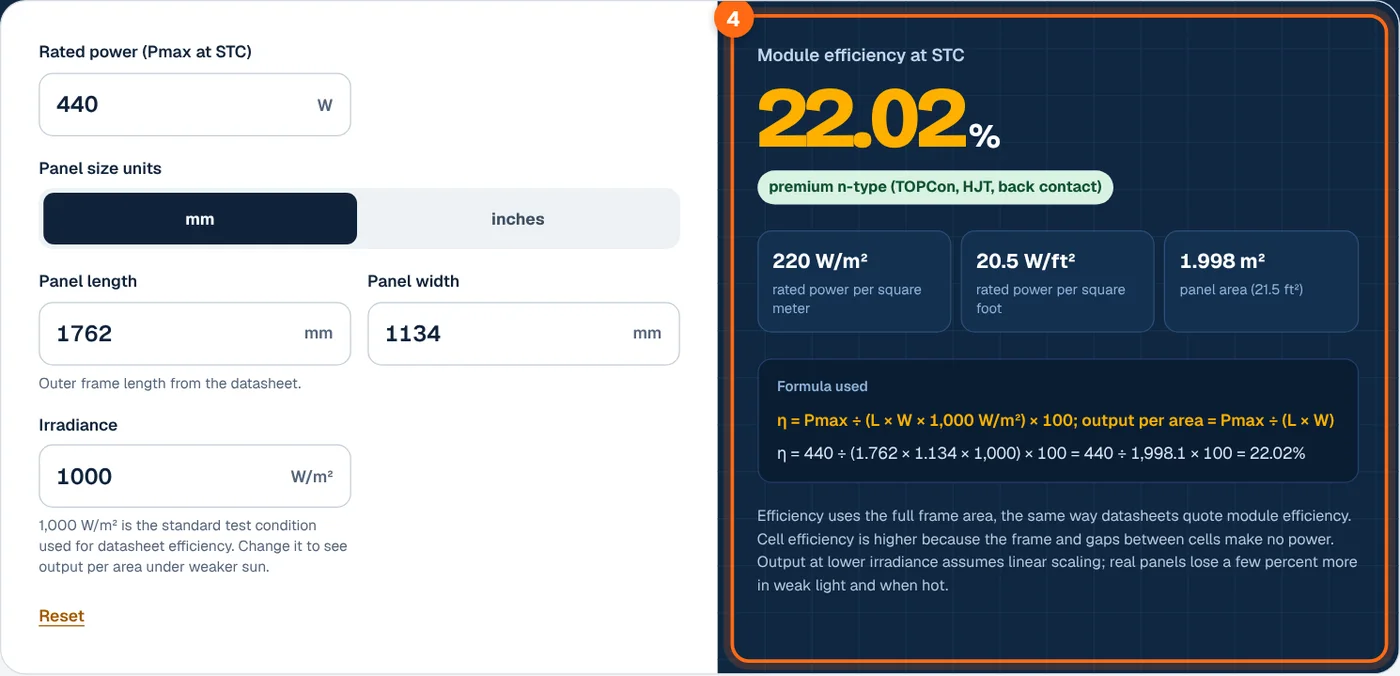
Solar panel efficiency is rated power divided by panel area times 1,000 W/m²: η = P ÷ (L × W × 1,000) × 100. A 440 W panel measuring 1,762 × 1,134 mm has an area of 1.998 m², so its efficiency is 22.02%, or 220 W per square meter (20.5 W/ft²). Most new residential panels in 2026 fall between 20.5% and 23%.

How to use the solar panel efficiency calculator
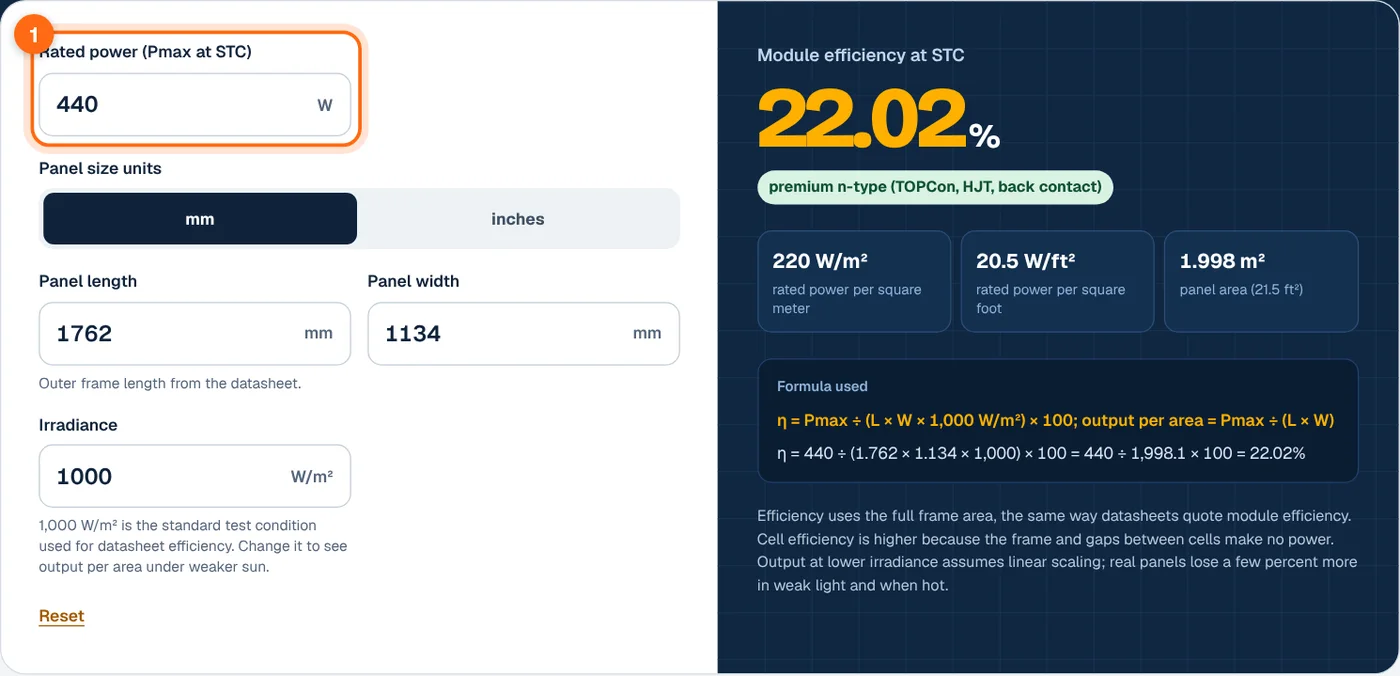
- Enter the rated power. Use Pmax at STC from the datasheet, for example 440 W.
- Enter the panel dimensions. Choose mm or inches, then type the outer frame length and width from the datasheet.
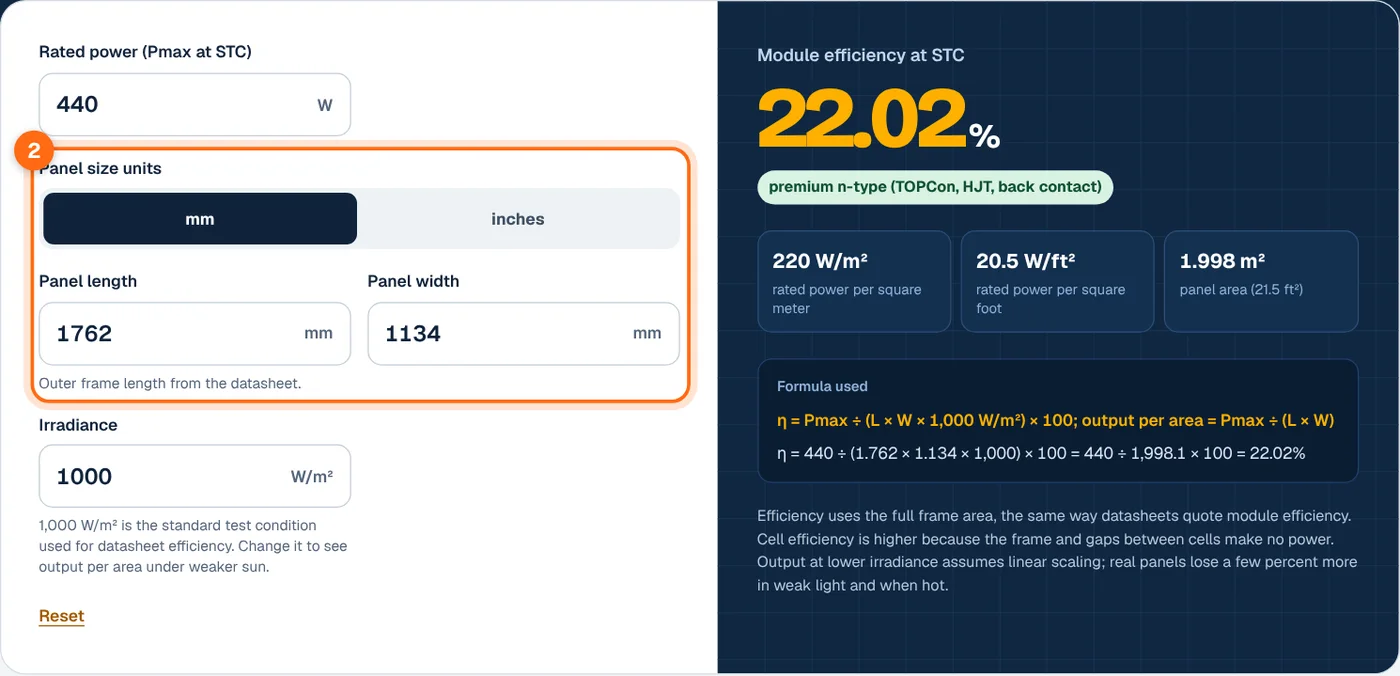
- Set the irradiance. Leave 1,000 W/m² to get the rated efficiency. Enter a lower value, such as 500 W/m², to see roughly what the panel makes in weaker sun.

- Read the efficiency. The big number is module efficiency at STC. The cards show watts per square meter, watts per square foot and the panel area.
Solar panel efficiency formula
Efficiency compares the electrical power out with the sunlight power falling on the panel. Panels are rated at standard test conditions (STC): 1,000 W/m² of sunlight, 25 °C cell temperature and an air mass of 1.5.
Where:
- η is module efficiency in percent.
- Pmax is rated power in watts at STC.
- L and W are the outer frame length and width in meters, so L × W is the full module area.
- 1,000 W/m² is the STC irradiance.
- To convert W/m² to W/ft², divide by 10.764.
Datasheets quote module efficiency over the full frame area. Cell efficiency is higher because the frame, the gaps between cells and the edge margins produce nothing.
Worked examples
Example 1: a 440 W TOPCon panel
The panel measures 1,762 × 1,134 mm.
That is 220 W/m² or 20.5 W/ft², matching the 22.02% printed on the datasheet. At 500 W/m² of sunlight the same panel makes about 220 W.
Example 2: a 100 W 12 V panel
The panel measures 1,062 × 530 mm.
Small 12 V panels are usually less efficient than roof modules: 178 W/m² against 220 W/m².
Example 3: a 700 W utility panel
The panel measures 2,384 × 1,303 mm.
The 700 W panel is no more efficient than the 440 W one. It is simply bigger.
Solar panel efficiency by panel
Computed from manufacturer datasheet power and frame size, checked October 2026.
| Panel | Power | Size (mm) | Area | Efficiency | W/m² | W/ft² |
|---|---|---|---|---|---|---|
| Renogy RNG-100D-SS (12 V) | 100 W | 1,062 × 530 | 0.563 m² | 17.77% | 178 | 16.5 |
| Canadian Solar CS6K (60-cell poly) | 300 W | 1,650 × 992 | 1.637 m² | 18.33% | 183 | 17.0 |
| Qcells Q.PEAK DUO BLK-G10+ | 365 W | 1,717 × 1,045 | 1.794 m² | 20.34% | 203 | 18.9 |
| Qcells Q.PEAK DUO ML-G10+ | 400 W | 1,879 × 1,045 | 1.964 m² | 20.37% | 204 | 18.9 |
| Jinko Tiger Neo 54HL4R | 440 W | 1,762 × 1,134 | 1.998 m² | 22.02% | 220 | 20.5 |
| Jinko Tiger Neo 60HL4 | 470 W | 1,903 × 1,134 | 2.158 m² | 21.78% | 218 | 20.2 |
| Jinko Tiger Neo 72HL4 | 585 W | 2,278 × 1,134 | 2.583 m² | 22.65% | 226 | 21.0 |
| Trina Vertex N NEG21C.20 | 700 W | 2,384 × 1,303 | 3.106 m² | 22.53% | 225 | 20.9 |
The best research cells are far more efficient than any commercial module. The NREL best research-cell efficiency chart tracks the confirmed records for each technology.
What affects solar panel efficiency
Cell technology
Older polycrystalline panels ran at 15% to 18%. Mono PERC raised that to about 20% to 21%. N-type TOPCon, heterojunction (HJT) and back-contact cells now reach 22% to 24% in production modules. The calculator labels the result by these bands.
Temperature
Rated efficiency assumes a 25 °C cell, but panels in sun usually run at 45 °C to 65 °C. At -0.30 %/°C, a cell at 65 °C loses 12% of its power. The solar panel temperature loss calculator works this out for your climate.
Light level
Efficiency stays fairly steady down to about 200 W/m², then falls. Datasheets often list relative efficiency at low irradiance; a typical figure is about 96% of the STC efficiency at 200 W/m².
Age
Panels lose a little power every year, so efficiency drops with it. A panel at 22% that has lost 10% of its output is effectively a 19.8% panel. The solar panel degradation calculator projects this over 25 to 30 years.
Frequently asked questions
How do you calculate solar panel efficiency?
Divide the rated power by the panel area in square meters, then divide by 1,000 and multiply by 100. A 440 W panel measuring 1.762 × 1.134 m covers 1.998 m², so 440 ÷ 1,998 × 100 = 22.02%. Use the outer frame dimensions from the datasheet, not the cell area.
What is a good solar panel efficiency in 2026?
For a new home panel, 21% to 23% is typical and anything above 22% is a premium n-type module. Budget and older PERC panels sit near 20%. Efficiency matters most when roof space is limited; on a large roof, price per watt and warranty matter more.
Does higher efficiency mean more power?
Only per square foot. A 22% panel and a 20% panel of the same wattage make the same energy in the same sun; the efficient one is just smaller. On a fixed roof area, though, higher efficiency lets you fit more watts and produce more kWh.
What is the difference between cell and module efficiency?
Cell efficiency is measured on the silicon cell alone. Module efficiency includes the whole panel area, with the frame, glass edges and gaps between cells. Module efficiency is always lower, by roughly 1 to 3 percentage points, and it is the number that matters for roof planning.
How much power does a solar panel make per square foot?
Modern residential panels make about 19 to 21 W per square foot at STC, or 200 to 226 W per square meter. Older 60-cell panels made about 17 W per square foot. Real output is lower most of the time because sunlight is rarely at the full 1,000 W/m².