Solar Panel Orientation Calculator
Compare the yearly solar yield of south, east, west and east-west panels against the best orientation for your location.
Quick answer
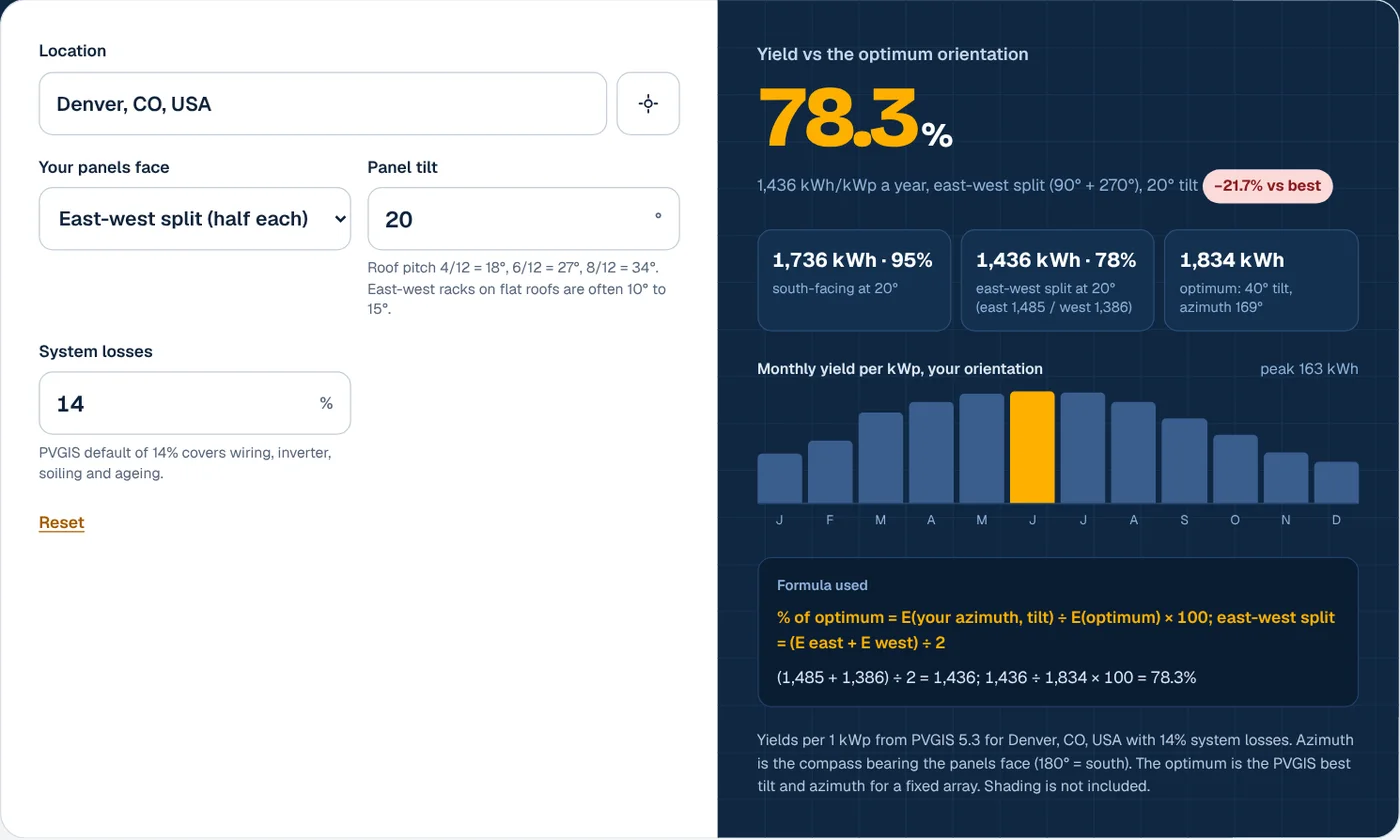
In the US and UK, south-facing panels (azimuth 180°) give the most energy, and east or west faces typically give 80 to 85% of the optimum. In Denver at a 20° tilt, south reaches 95% of the best possible yield, east 81%, west 76%, and an east-west split 78% (1,436 kWh per kWp a year). Southeast and southwest roofs typically lose 5 to 12%.
How to use the solar panel orientation calculator
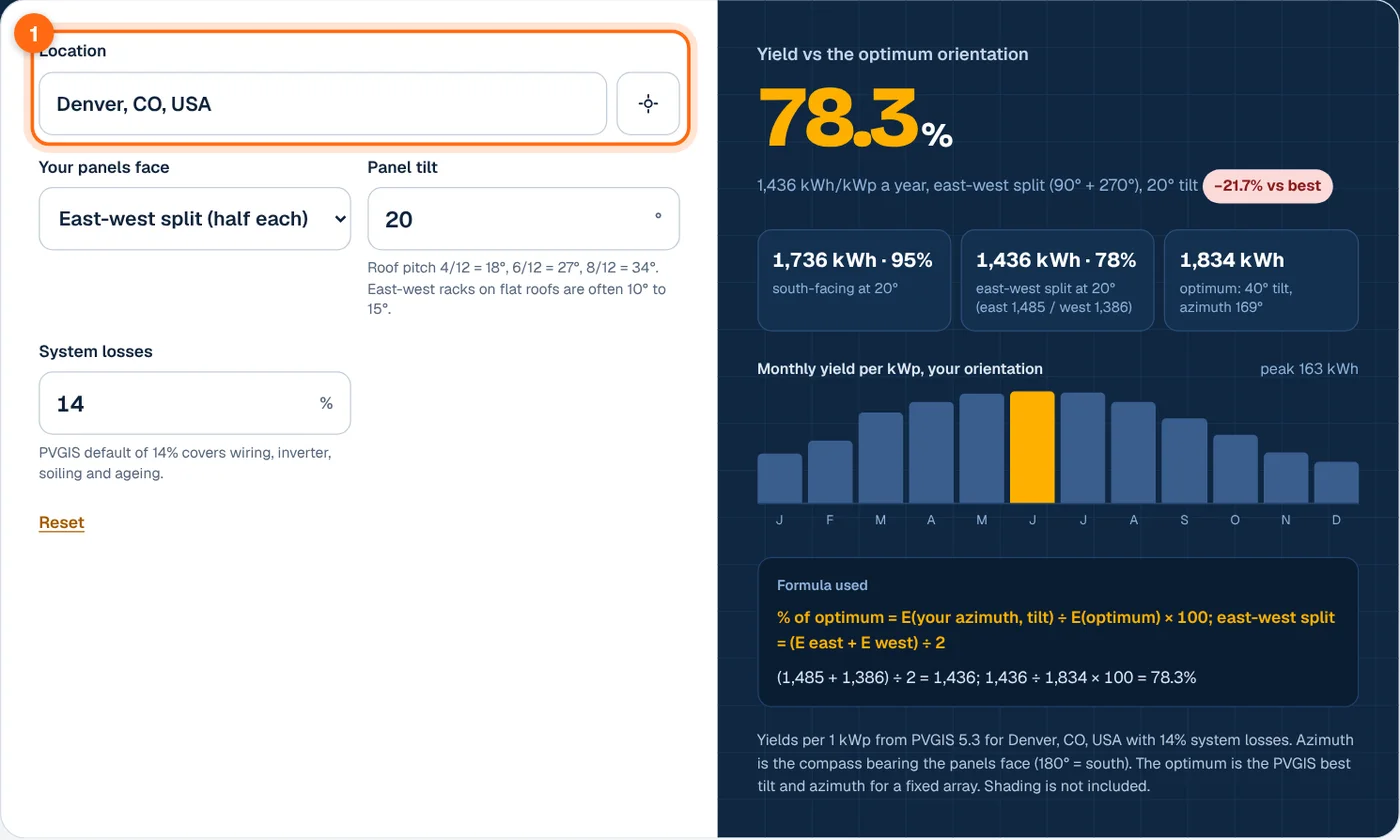
- Set your location. Search for a city, town or ZIP code, or use your device location. The calculator fetches yields for that spot from PVGIS, the European Commission’s solar database.
- Choose the direction your panels face. Pick south, southeast, southwest, east, west, an east-west split or north. Choose Custom to enter any compass azimuth from 0° to 360°.

- Enter the panel tilt. Use the roof pitch in degrees. A 6/12 roof is about 27°. East-west racks on flat roofs usually sit at 10° to 15°.

- Set the system losses. Keep the PVGIS default of 14% unless you know your wiring and inverter losses. Losses scale every option equally, so the percentages barely change.

- Read the result. The big number is your orientation’s yearly yield as a percentage of the optimum. The cards compare the equator-facing and east-west options at your tilt and show the optimum tilt and azimuth with its yield.

Solar panel orientation formula
For each direction, PVGIS simulates a typical year of hourly sunlight on a panel at your tilt and returns the yearly AC energy for 1 kWp of panels. The calculator then compares that with the PVGIS optimum, the best fixed tilt and azimuth for your location.
Where:
- E is the yearly yield in kWh per kWp of panels, after system losses.
- Eopt is the yield at the PVGIS optimal tilt and azimuth.
- Compass azimuth is the bearing the panels face, clockwise from north: 90° east, 180° south, 270° west.
- PVGIS aspect is the convention PVGIS uses, measured from due south. The PVGIS user manual defines −90° as east, 0° as south and 90° as west.
The east-west split assumes half of the panels face east and half face west at the same tilt, as on a ridge-mounted or tent-style flat roof rack.
Worked examples
All figures are PVGIS 5.3 yields per kWp with 14% losses, checked October 2026.
Example 1: Denver, east-west split at 20°
East gives 1,485 kWh and west 1,386 kWh per kWp. The optimum is 1,834 kWh at 40° tilt.
A south-facing roof at the same 20° would give 1,736 kWh, or 95% of the optimum. East beats west here because Denver’s summer afternoons are often cloudy.
Example 2: London, south vs east-west at 20°
The optimum is 1,023 kWh per kWp at 40°. A south-facing 20° roof gives 976 kWh.
On a 4 kWp system, that is 3,904 kWh against 3,320 kWh a year. East-west still makes sense when it fits many more panels on the roof.
Example 3: Sydney, a north-facing roof
In the southern hemisphere the best direction is north. At 20° tilt, north gives 1,523 kWh per kWp against an optimum of 1,560 kWh at 34°.
Pick North (0°) in the calculator for Australian roofs. The equator-facing card switches to north automatically.
Orientation losses by city
PVGIS 5.3 yearly yield at a 20° tilt as a percentage of each city’s optimum, 14% losses, checked October 2026. “Equator” means south in the northern hemisphere and north in Australia.
| City | Optimum (kWh/kWp) | Equator | SE / NE | SW / NW | East | West | East-west | Pole-facing |
|---|---|---|---|---|---|---|---|---|
| Miami, FL | 1,529 | 99% | 98% | 96% | 91% | 88% | 89% | 76% |
| Phoenix, AZ | 1,831 | 98% | 95% | 93% | 85% | 83% | 84% | 66% |
| Los Angeles, CA | 1,782 | 98% | 94% | 95% | 84% | 85% | 85% | 67% |
| Denver, CO | 1,834 | 95% | 92% | 88% | 81% | 76% | 78% | 58% |
| New York, NY | 1,405 | 96% | 92% | 91% | 81% | 79% | 80% | 61% |
| Chicago, IL | 1,392 | 94% | 95% | 85% | 86% | 73% | 80% | 63% |
| Seattle, WA | 1,166 | 96% | 90% | 92% | 78% | 81% | 80% | 61% |
| London, UK | 1,023 | 95% | 92% | 91% | 82% | 80% | 81% | 65% |
| Manchester, UK | 888 | 96% | 93% | 92% | 83% | 82% | 82% | 68% |
| Sydney, Australia | 1,560 | 98% | 94% | 93% | 84% | 82% | 83% | 66% |
| Perth, Australia | 1,692 | 99% | 96% | 95% | 88% | 86% | 87% | 71% |
Chicago’s southeast result beats due south at 20° because PVGIS finds the city’s optimum azimuth leaning east, likely from afternoon cloud and haze in its weather record.
What affects the result
Tilt
The flatter the panel, the less direction matters. At 0° every direction gives the same yield. Steep east, west or north roofs lose far more, so check tilt and direction together, and use the solar panel angle calculator to fine-tune the pitch.
Latitude
Close to the equator the sun passes high overhead, so direction costs little: Miami keeps 89% with an east-west split. At higher latitudes the sun stays low in the south, and the penalty for facing away grows.
Local weather patterns
Places with cloudy afternoons favor east, and places with foggy mornings favor west. That is why Denver and Chicago show a gap between east and west, while London and Seattle are nearly even.
Time-of-use rates and self-consumption
Yearly kWh is not the only goal. West panels produce more in the late afternoon, when time-of-use rates are high and homes use more power. An east-west split also flattens the daily curve, which can raise self-consumption. To see how this changes the bill, try the solar self-consumption calculator.
Frequently asked questions
What is the best direction for solar panels?
True south in the northern hemisphere and true north in the southern hemisphere. The exact optimum can lean a few degrees east or west because of local weather. In Denver PVGIS puts it at azimuth 169°, slightly east of south. Turning 20° either side of the optimum costs only about 2% in Denver and London.
Are east-west solar panels worth it?
Often, yes. They typically give 78 to 89% of the optimum yield per kWp, but a low east-west rack can fit more panels on a flat roof and spreads output across the day. If panels are cheap and roof space is the limit, more east-west panels can beat fewer south-facing ones.
Is east or west better for solar panels?
They are usually within a few percent of each other. East wins where afternoons are cloudy, as in Denver and Chicago, and west wins in places like Seattle. West can be worth more money if your utility has expensive late-afternoon time-of-use rates, even when it makes slightly fewer kWh.
Can solar panels face north in the US or UK?
They can, but they lose a lot: about 35 to 42% at a 20° tilt in the cities above. On a very low pitch the loss shrinks, because a flat panel does not care about direction. North-facing panels rarely pay back unless the roof is nearly flat and electricity is expensive.
What is solar panel azimuth?
Azimuth is the compass bearing a panel faces, measured clockwise from true north: 90° east, 180° south, 270° west. Some tools, including PVGIS, measure from south instead, with east negative. This calculator takes compass azimuth and converts it for PVGIS automatically.