kVA to Amps Calculator
Find the full-load current of a transformer, generator or UPS from its kVA rating, single-phase or three-phase.
Quick answer
To convert kVA to amps, multiply kVA by 1,000 and divide by the voltage. For three-phase, also divide by √3 (1.732). A 75 kVA transformer at 208 V three-phase delivers 75,000 ÷ (1.732 × 208) = 208.2 A per line. A 25 kVA single-phase transformer at 240 V delivers 104.2 A.

How to use the kVA to amps calculator
- Choose the phase. Pick single-phase for pole-mounted residential transformers and small UPS units. Pick three-phase for commercial transformers, standby generators and industrial supplies.

- Enter the kVA rating. Read it from the nameplate of the transformer, generator or UPS. The list offers common transformer sizes from 10 kVA to 1,000 kVA.
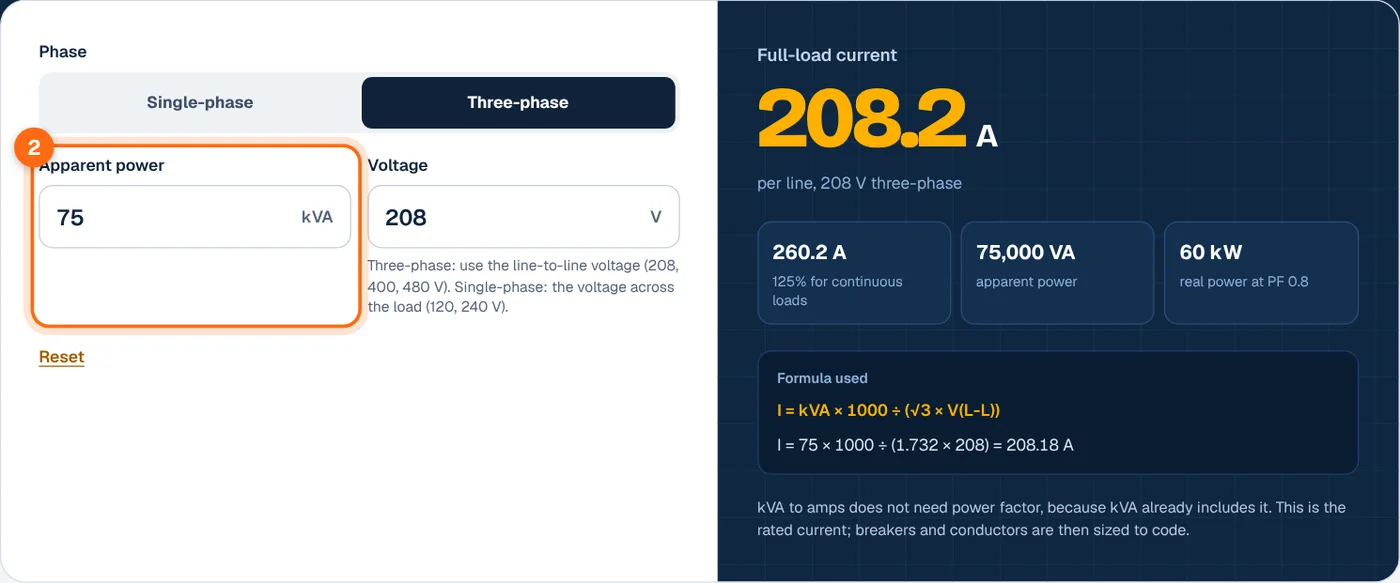
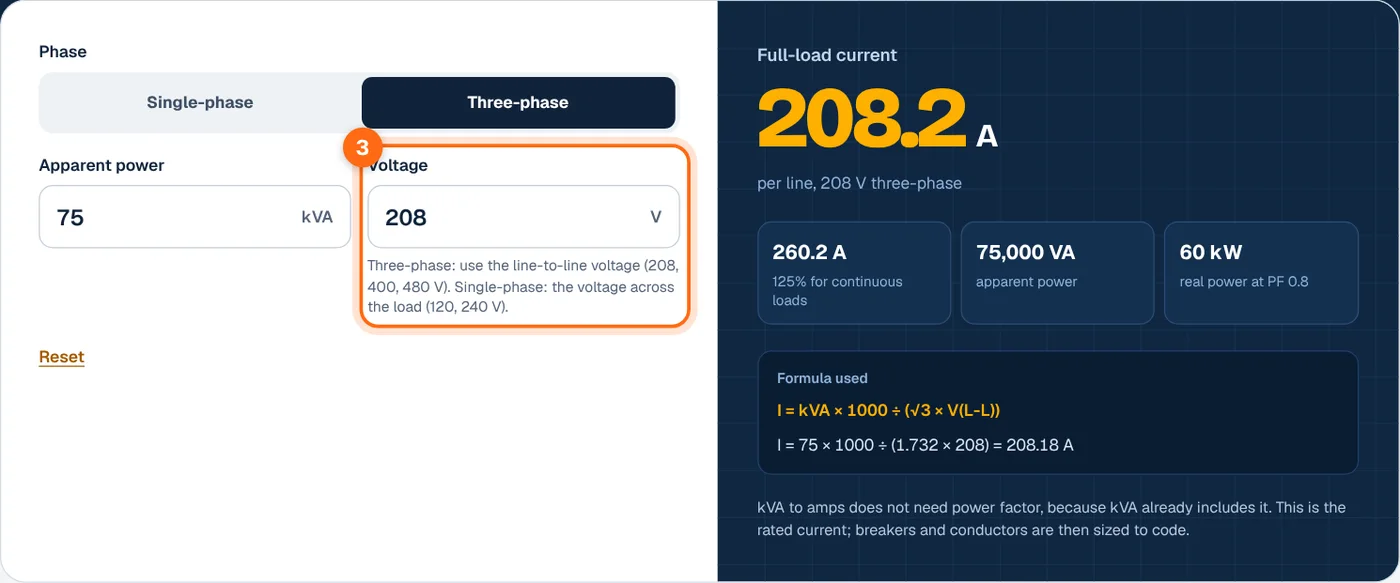
- Enter the voltage. For three-phase, use the line-to-line voltage, such as 208 V, 400 V or 480 V. For single-phase, use the voltage across the load, usually 120 V or 240 V.
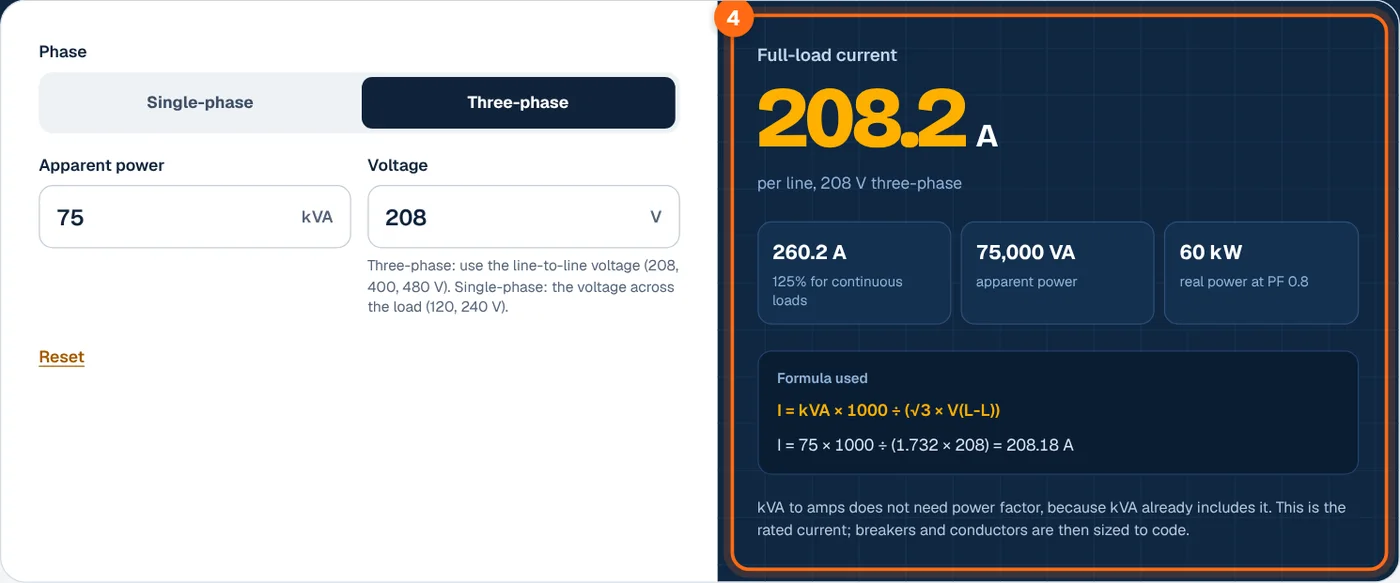
- Read the result. The large number is the full-load current per line. The cards show 125% of that current, the rating in VA and the real power at a typical 0.8 power factor.
kVA to amps formula
kVA is already voltage times current, so converting back to amps needs no power factor. That makes it the standard way to find the rated current of a transformer winding or generator.
Single-phase
Three-phase
Where:
- I is the full-load current in amps. For three-phase it is the current in each line.
- kVA is the apparent power rating in kilovolt-amperes.
- V is the voltage. Three-phase uses line-to-line voltage.
- √3 is about 1.732, the ratio of line-to-line to line-to-neutral voltage in a balanced system.
Worked examples
Example 1: 75 kVA transformer at 208 V three-phase
This is the default. The secondary of a 75 kVA 480 V to 208Y/120 V transformer can supply about 208 A per phase. The primary side at 480 V carries only 90.2 A.
Example 2: 25 kVA single-phase at 240 V
A 25 kVA utility transformer can serve roughly one large home or a few smaller ones at 104 A each side of the 120/240 V split.
Example 3: 500 kVA generator at 480 V three-phase
A 500 kVA standby generator at 480 V delivers about 601 A per line at full rating. Size the output breaker and feeder cable from this figure using the wire size calculator.
kVA to amps chart for standard transformer sizes
Full-load current per line for common kVA ratings. Single-phase columns use I = kVA × 1,000 ÷ V; three-phase columns divide by √3 as well.
| kVA | 120 V 1-phase | 240 V 1-phase | 208 V 3-phase | 400 V 3-phase | 480 V 3-phase |
|---|---|---|---|---|---|
| 10 | 83.3 A | 41.7 A | 27.8 A | 14.4 A | 12 A |
| 15 | 125 A | 62.5 A | 41.6 A | 21.7 A | 18 A |
| 25 | 208.3 A | 104.2 A | 69.4 A | 36.1 A | 30.1 A |
| 37.5 | 312.5 A | 156.3 A | 104.1 A | 54.1 A | 45.1 A |
| 50 | 416.7 A | 208.3 A | 138.8 A | 72.2 A | 60.1 A |
| 75 | 625 A | 312.5 A | 208.2 A | 108.3 A | 90.2 A |
| 112.5 | 937.5 A | 468.8 A | 312.3 A | 162.4 A | 135.3 A |
| 150 | 1,250 A | 625 A | 416.4 A | 216.5 A | 180.4 A |
| 225 | 1,875 A | 937.5 A | 624.5 A | 324.8 A | 270.6 A |
| 300 | 2,500 A | 1,250 A | 832.7 A | 433 A | 360.8 A |
| 500 | 4,166.7 A | 2,083.3 A | 1,387.9 A | 721.7 A | 601.4 A |
| 750 | 6,250 A | 3,125 A | 2,081.8 A | 1,082.5 A | 902.1 A |
| 1,000 | 8,333.3 A | 4,166.7 A | 2,775.7 A | 1,443.4 A | 1,202.8 A |
What affects the result
Line-to-line versus line-to-neutral voltage
The three-phase formula needs line-to-line voltage. Using 277 V in place of 480 V makes the current look √3 times too high. If you only know line-to-neutral voltage, multiply it by 1.732 first, or use the 3 phase power calculator, which accepts either.
Continuous loads
The NEC requires overcurrent devices and conductors to be sized at 125% of continuous load current, meaning loads that run three hours or more. The calculator shows that 125% figure as a card so you can compare it against breaker sizes.
Transformer losses and regulation
Nameplate kVA is the output rating. Under full load, the secondary voltage sags by the transformer’s regulation, often 2% to 4%, which raises the current slightly for a constant-power load. The primary current is also a little higher than the output kVA suggests because of core and copper losses.
Power factor does not matter here
Because kVA already includes reactive power, a 75 kVA transformer has the same 208 A limit whether the load is a heater or a motor. Power factor only changes how many kW you get from those amps.
Frequently asked questions
How many amps is 1 kVA?
At 120 V single-phase, 1 kVA is 8.33 A. At 240 V single-phase it is 4.17 A. At 208 V three-phase it is 2.78 A per line, and at 480 V three-phase it is 1.20 A per line. Divide 1,000 by the voltage, and by 1.732 more for three-phase.
How many amps does a 75 kVA transformer supply?
On a 208 V three-phase secondary, 75 kVA gives 208.2 A per line. On the 480 V primary it is 90.2 A. A 75 kVA single-phase transformer at 240 V would give 312.5 A. Always use the voltage of the winding you are sizing conductors or breakers for.
Do I need power factor to convert kVA to amps?
No. kVA is apparent power, the product of voltage and current, so current follows directly. Power factor is only needed when you start from kW. In that case, divide kW by PF to get kVA first, or use the kW to amps calculator.
Why use √3 for three-phase?
In a balanced three-phase system the line-to-line voltage is √3 times the line-to-neutral voltage, because the phases are 120° apart. Total kVA equals three times the per-phase kVA, which simplifies to √3 × V(L-L) × I. Rearranging gives I = kVA × 1,000 ÷ (√3 × V).
What breaker size do I need for a transformer?
Start from the full-load current this calculator gives, then follow NEC 450.3 for transformer overcurrent protection. Secondary protection is commonly set at no more than 125% of rated secondary current, rounded up to the next standard breaker size where the code allows. Have a licensed electrician confirm the final design.