Balcony Solar Battery Calculator
See what a battery adds to a plug-in balcony solar kit: self-consumption, yearly savings and battery payback under the 800 W limit.
Quick answer
A battery helps a balcony solar kit by storing midday surplus for the evening, so more of the output saves money. In Berlin, a 1,800 Wp kit with an 800 W limit on a 35° stand makes about 1,582 kWh a year. A 2.7 kWh battery raises self-consumption from 35% to about 75%, lifting savings from €205 to €438 a year at 37 ct per kWh. The €999 battery pays back in about 4.3 years.

How to use the balcony solar battery calculator
- Set your location and the kit. Search for your town, then enter the total panel power, the inverter limit, the mounting angle and the direction. The calculator pulls monthly yield from PVGIS and applies the 800 W limit.

- Describe your household. Enter your yearly electricity use, the share used after dark and the share of the kit’s output you use directly without a battery. The defaults of 60% and 35% are assumptions; adjust them to your routine.
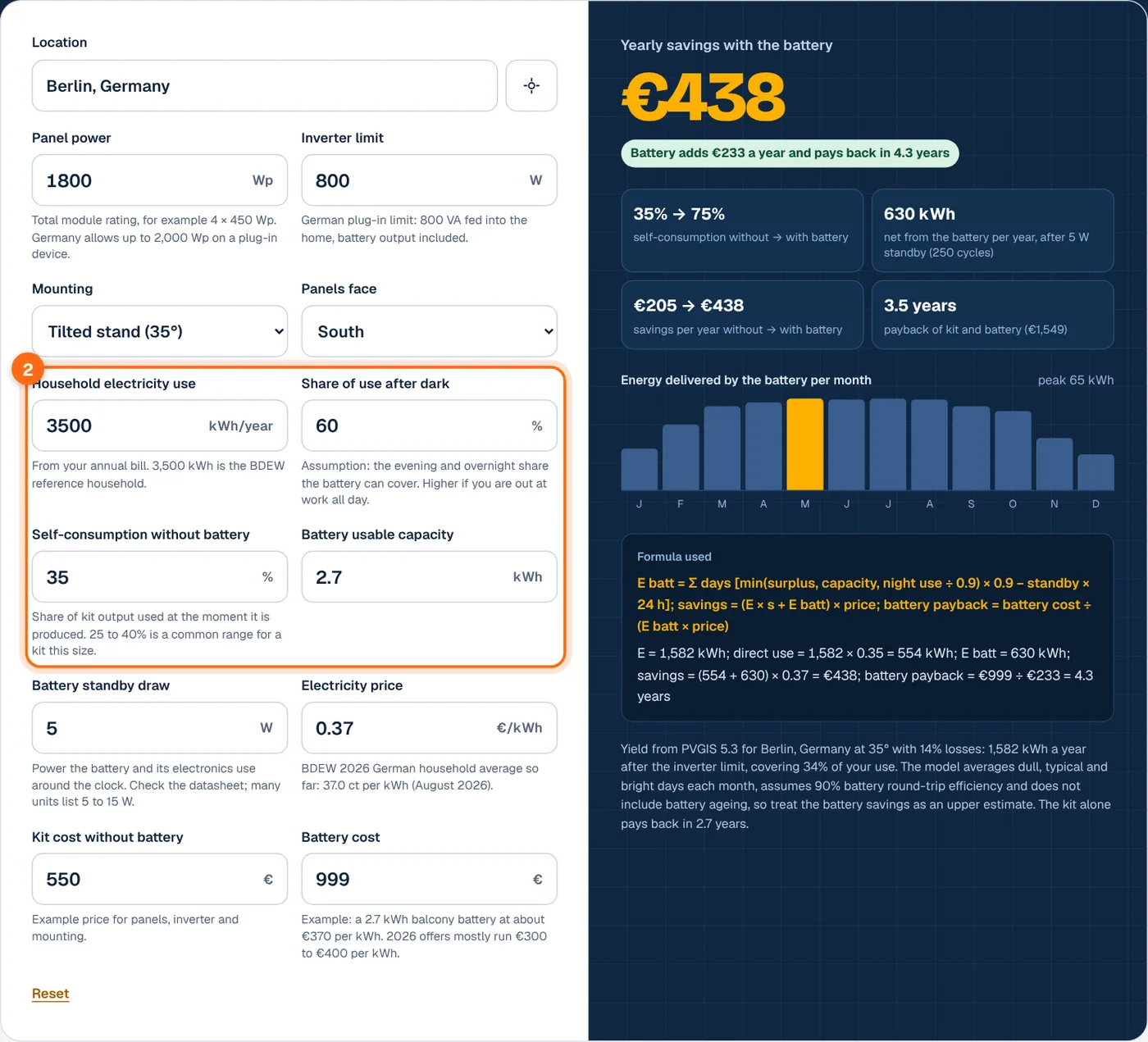
- Enter the battery. Use the usable capacity in kWh and the standby draw from the datasheet. Common balcony batteries hold 1.6 to 5 kWh.

- Enter prices. Add your electricity price per kWh, the kit cost without a battery and the battery cost.

- Read the savings. The big number is yearly savings with the battery, and the chip shows what the battery adds and its own payback. The cards compare self-consumption and savings with and without the battery, and the chart shows battery output by month.

Balcony solar battery formula
For each month the calculator models dull, typical and bright days. Each day, it takes what the household uses directly, then fills the battery with the rest, limited by the battery capacity and by evening demand.
Where:
- E is the kit’s yearly AC output after the inverter limit, from PVGIS 5.3 with 14% losses.
- s is self-consumption without a battery, and surplus is the daily output not used directly.
- night use is yearly use × after-dark share ÷ 365, the most a battery can usefully supply.
- 0.9 is the assumed battery round-trip efficiency.
- standby is the battery’s own draw in watts, which runs around the clock.
Only self-used energy counts, because German plug-in devices feed surplus into the grid unpaid. Section 8(5a) of the German Renewable Energy Sources Act (EEG) covers plug-in devices up to 2 kW of panels and 800 VA of inverter power assigned to unpaid feed-in.
German rules for balcony solar with a battery (October 2026)
- Limits: up to 2,000 Wp of panels and 800 VA fed into the home wiring. The 800 VA cap covers the kit and battery together, so a battery cannot be used to push more power into the socket.
- Standards: VDE-AR-N 4105:2026-03, published in March 2026, defines small plug-in and balcony storage units and keeps them in the simplified procedure while total feed-in stays at or below 800 VA. Grid operators may still apply the older rules until March 2027.
- Registration: register the kit in the Marktstammdatenregister within one month. Most guides say to enter the battery as a separate storage unit, and some grid operators still ask to be told about it, so check with yours.
Worked examples
Example 1: 1,800 Wp kit with a 2.7 kWh battery in Berlin
Four 450 Wp panels on a south-facing 35° stand make about 1,582 kWh a year after the 800 W limit. The household uses 3,500 kWh, 60% after dark, and uses 35% of the kit’s output directly.
The battery adds €233 a year, so a €999 battery pays back in 999 ÷ 233 = 4.3 years. Self-consumption rises to about 75%, and the battery runs about 250 cycles a year.
Example 2: vertical 900 Wp kit with a small battery
Two 450 Wp panels hung vertically on a south railing make 682 kWh a year. A 1.6 kWh battery costing €600 adds 304 kWh, raising savings from €88 to €201. The battery pays back in 5.3 years.
Example 3: bigger battery, same kit
With a 5.1 kWh battery at €1,100 on the kit from Example 1, the battery supplies 870 kWh, savings reach €527 and battery payback is 3.4 years. An 8 kWh battery adds almost nothing more (882 kWh), because the panels rarely produce enough surplus to fill it.
Battery size versus savings in Berlin
Results from this calculator for the 1,800 Wp kit in Example 1, with each battery priced at €370 per kWh and 5 W standby. PVGIS data retrieved October 2026.
| Usable capacity | Energy from battery | Self-consumption | Savings per year | Battery payback |
|---|---|---|---|---|
| No battery | 0 kWh | 35% | €205 | n/a |
| 1.0 kWh | 270 kWh | 52% | €305 | 3.7 years |
| 1.6 kWh | 428 kWh | 62% | €363 | 3.7 years |
| 2.7 kWh | 630 kWh | 75% | €438 | 4.3 years |
| 5.1 kWh | 870 kWh | 90% | €527 | 5.9 years |
| 8.0 kWh | 882 kWh | 91% | €531 | 9.1 years |
Past roughly 2 to 3 kWh per 1,000 Wp of panels, extra capacity sits mostly unused. These are model estimates: real savings are usually lower, since the model assumes the battery always discharges into evening use.
What affects the result
Battery price
Balcony batteries mostly sold for €300 to €400 per kWh in 2026, with some offers near €215. Payback scales directly with price, so a discount often matters more than an extra kWh.
Your daily routine
A household that is out during the day uses little solar directly and gains most from a battery. If someone is home and runs appliances at midday, self-consumption without a battery is already high and the battery adds less.
Standby draw and ageing
A battery that draws 10 W around the clock uses 88 kWh a year, worth €32 at 37 ct. Capacity also fades with cycles. Check both on the datasheet; the battery cycle life calculator estimates ageing.
Electricity price
The BDEW electricity price analysis puts the 2026 household average so far at 37.0 ct per kWh (August 2026). A cheaper dynamic or new-customer tariff lowers the savings. Compare the kit alone in the balcony solar calculator.
Frequently asked questions
Is a balcony solar battery worth it?
Often, if the kit has more than about 1,000 Wp and you use little power during the day. In the Berlin example, a 2.7 kWh battery adds about €233 a year and pays back in 4.3 years. For a vertical 800 to 900 Wp kit, the surplus is smaller and payback is longer.
Can a battery let my balcony kit feed in more than 800 W?
No. In Germany the 800 VA limit covers the whole plug-in system, panels and battery together, and storage units need a certificate proving the limit is set in hardware. A battery moves energy to the evening; it does not raise the power going into your socket.
What size battery do I need for a balcony power plant?
Roughly 1.5 to 3 kWh per 1,000 Wp of panels covers most of the summer surplus. In the calculator, going from 2.7 to 5.1 kWh on an 1,800 Wp kit adds 240 kWh a year, while going from 5.1 to 8 kWh adds only 12 kWh. Match the battery to your evening use too.
Do I have to register a balcony solar battery?
You must register the plug-in kit in the Marktstammdatenregister within a month of switching it on. Guides and manufacturers advise entering the battery there as well, with its capacity and output. Some grid operators also still want notice of storage, so check your operator’s current rules.
How much does a balcony solar battery cost in 2026?
Most balcony batteries sold for about €300 to €400 per kWh of usable capacity in 2026. For example, a 2.7 kWh unit sold for about €999, a 2.4 kWh unit from €1,099 and a 5.1 kWh unit for about €1,099. Larger units cost less per kWh but may not fill up.