Solar Load Calculator
Add up your appliances to get daily watt-hours, then size the solar array, battery bank and inverter for the load.
Quick answer
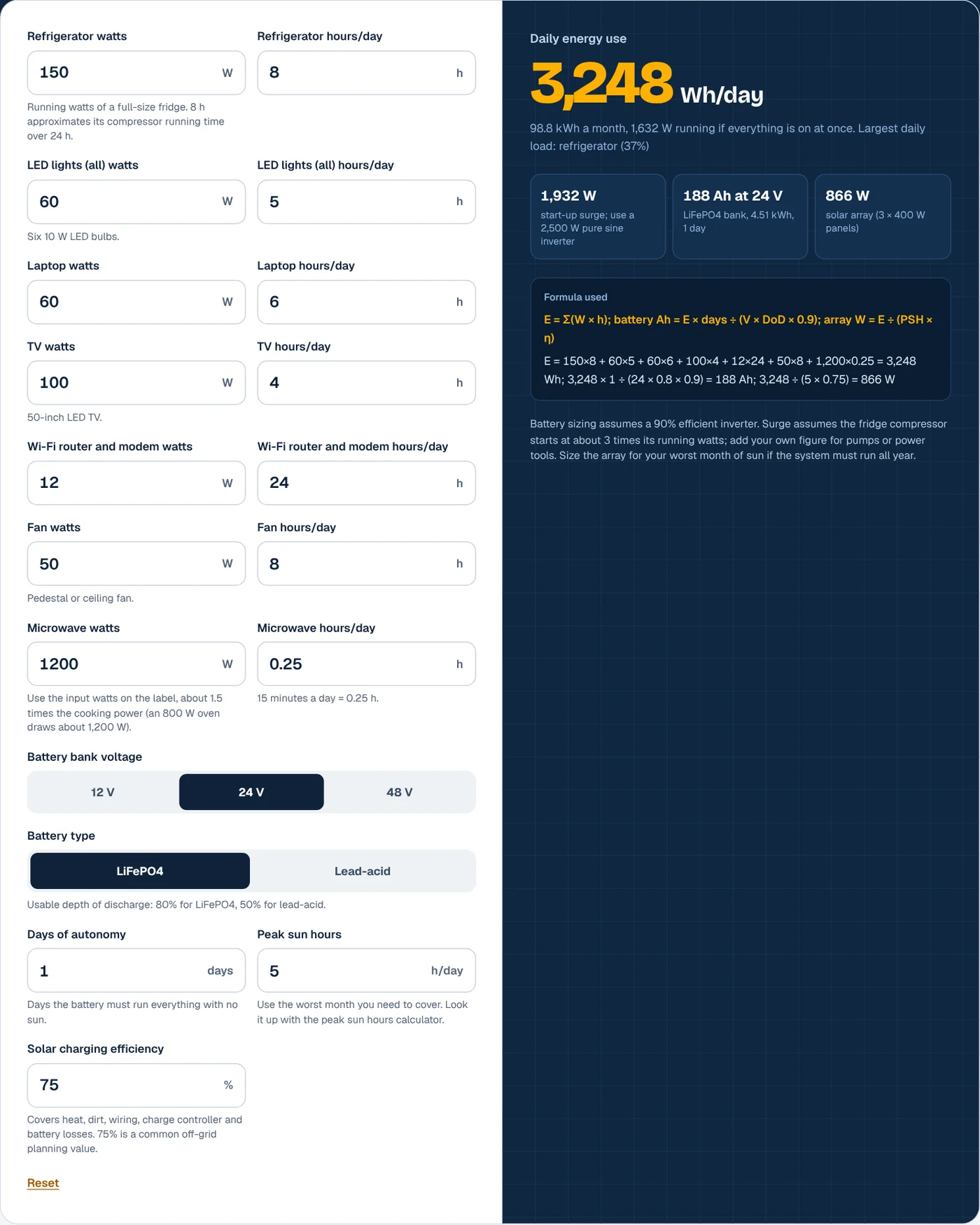
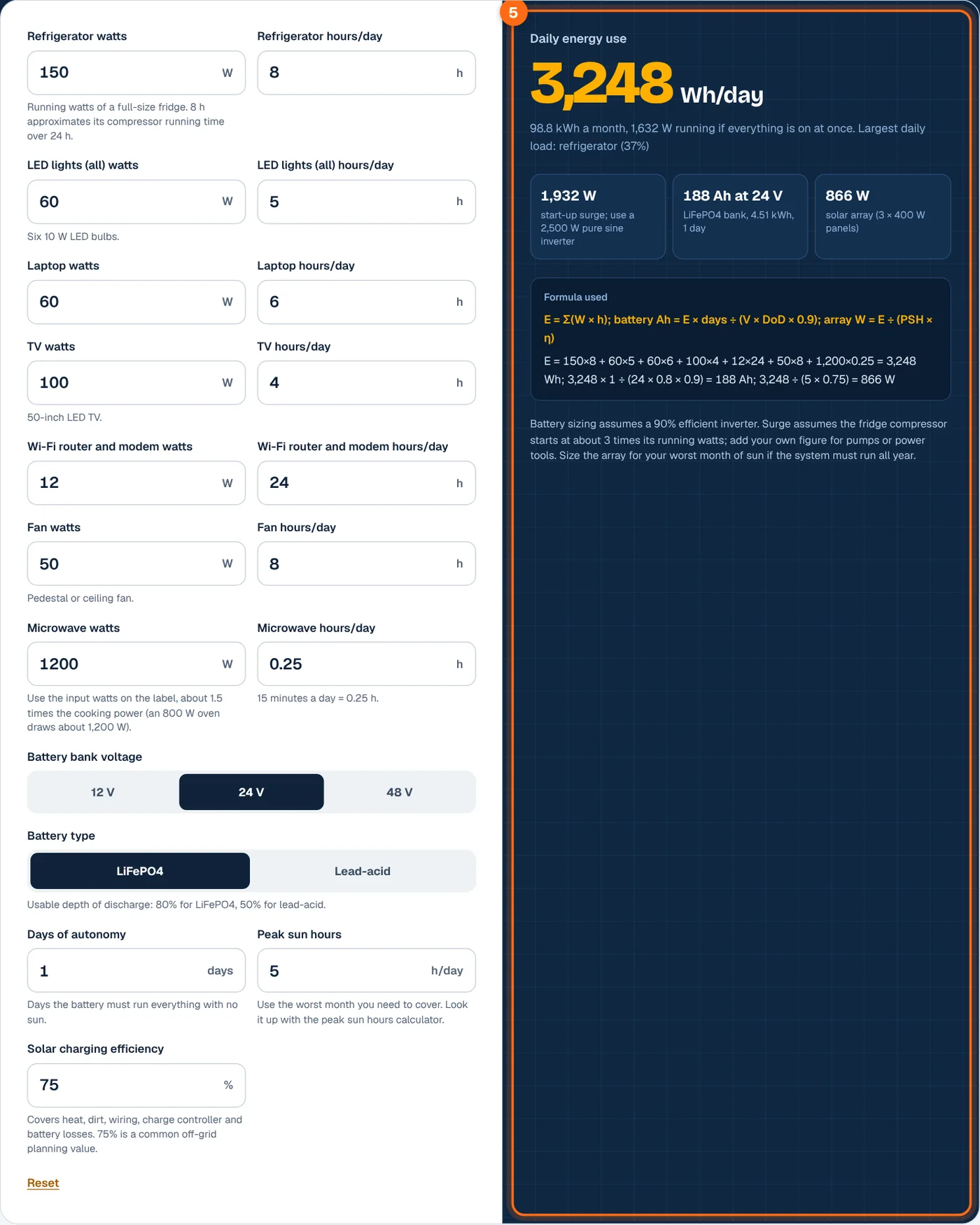
A solar load calculation adds up watts × hours for every appliance to get your daily energy in Wh. A typical off-grid cabin with a fridge, LED lights, a laptop, a TV, a router, a fan and a microwave uses about 3,248 Wh a day (98.8 kWh a month). At 5 peak sun hours that needs about 866 W of solar and a 188 Ah, 24 V LiFePO4 battery for one day of storage.
How to use the solar load calculator
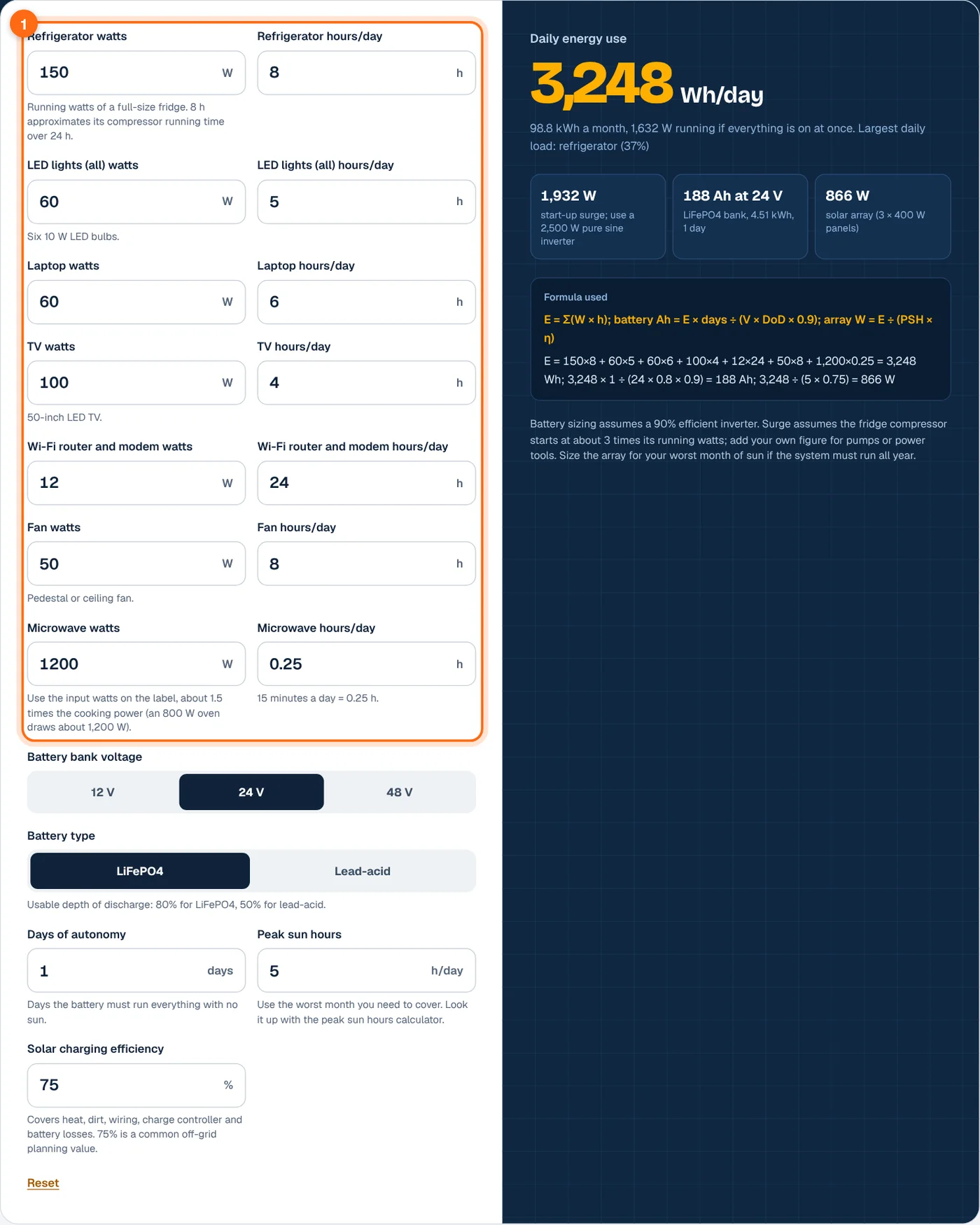
- Enter watts and hours for each appliance. Seven common loads are filled in with typical values. Replace them with the numbers from your appliance labels, and set any you do not have to 0 watts or 0 hours.
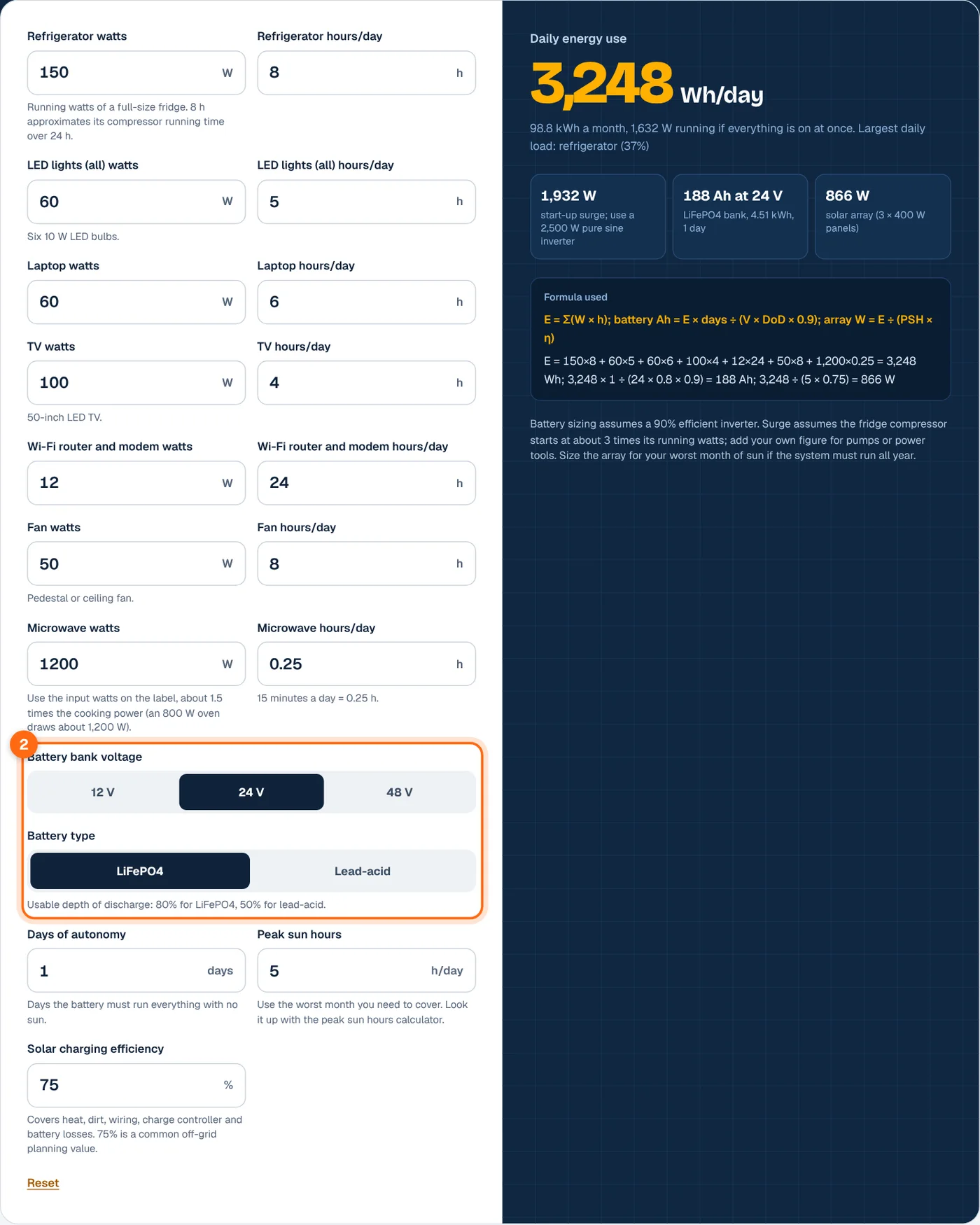
- Choose the battery voltage and type. Pick 12, 24 or 48 V, and LiFePO4 or lead-acid. LiFePO4 is sized at 80% depth of discharge and lead-acid at 50%.
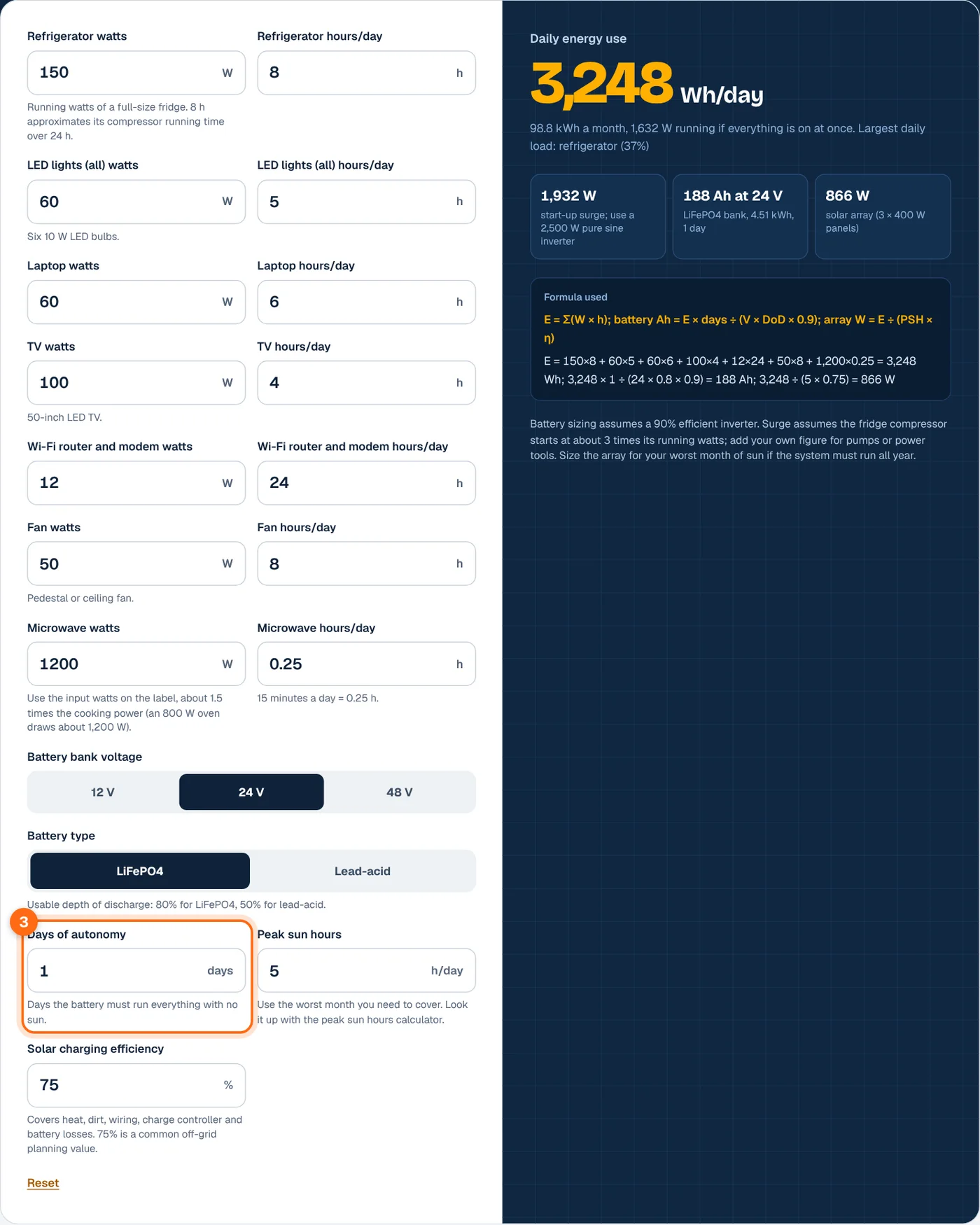
- Set the days of autonomy. This is how many days the battery must run everything without sun. One day suits most cabins with a backup generator; 2 to 3 days suits full-time off-grid homes.
- Enter your peak sun hours and charging efficiency. Use the peak sun hours for the worst month you need to cover. The 75% efficiency allows for heat, dirt, wiring and charging losses.
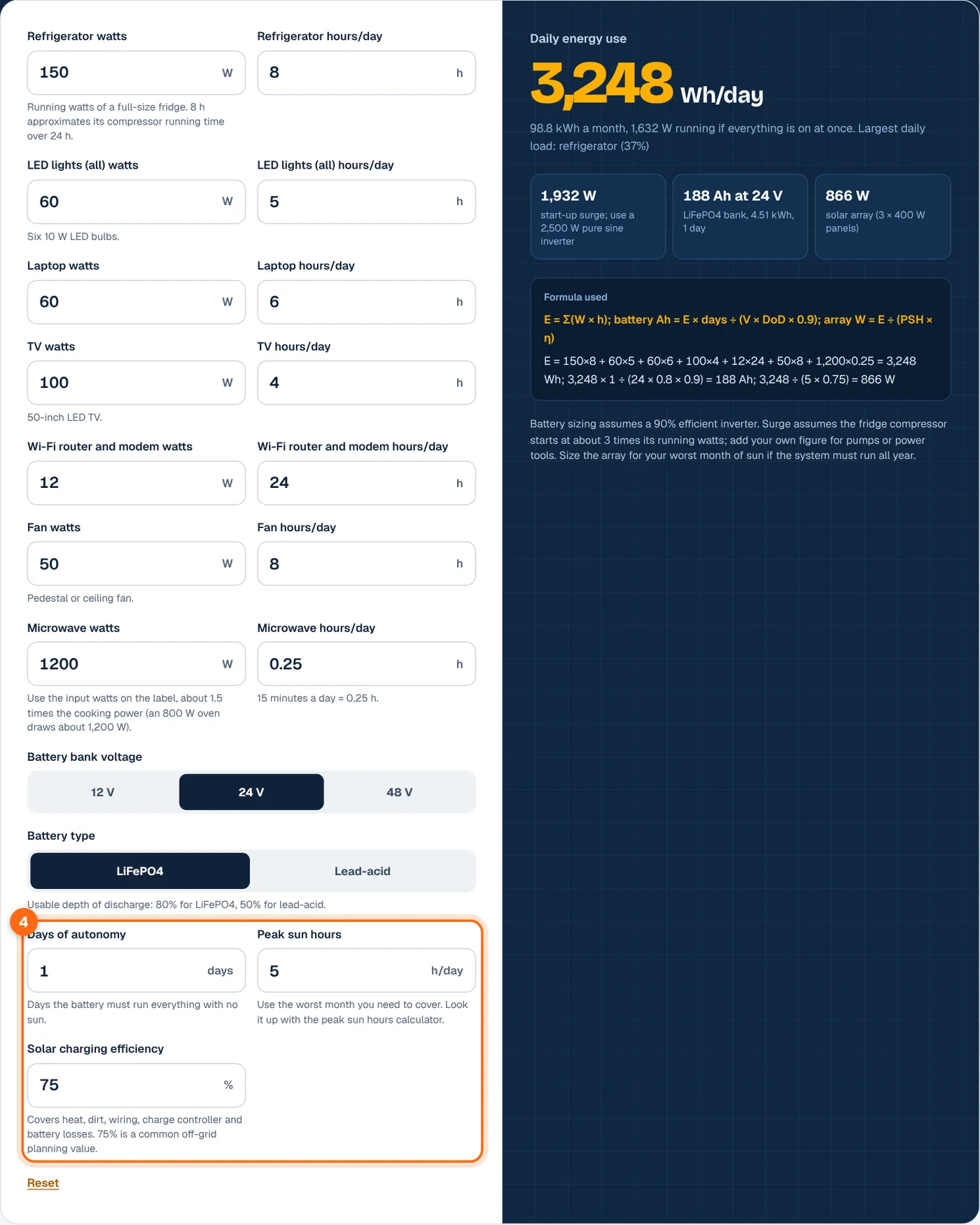
- Read the daily load. The big number is your daily energy use in Wh. The cards give the start-up surge with a suggested inverter size, the battery bank in Ah and kWh, and the solar array in watts.
Solar load formula
Where:
- E is daily energy in Wh; W is each appliance’s running watts and h its hours of use per day.
- V is the battery bank voltage and DoD the usable depth of discharge (0.8 for LiFePO4, 0.5 for lead-acid).
- 0.9 is an assumed inverter efficiency between battery and AC loads.
- PSH is peak sun hours per day and η is the solar charging efficiency.
- The surge adds twice the fridge’s running watts, because a compressor draws about three times its running power for a moment at start-up.
For appliances that cycle, such as a fridge, enter the hours the compressor actually runs, not 24. The Virginia Cooperative Extension guide to estimating appliance energy use explains this and lists typical wattages. The microwave default of 1,200 W is the input power, which is higher than the cooking power printed on the front.
Worked examples
Example 1: The default cabin load
Fridge 150 W × 8 h, lights 60 W × 5 h, laptop 60 W × 6 h, TV 100 W × 4 h, router 12 W × 24 h, fan 50 W × 8 h and microwave 1,200 W × 0.25 h.
That is three 400 W panels. Running everything at once draws 1,632 W, and the fridge start-up pushes the surge to 1,932 W, so a 2,500 W pure sine inverter fits.
Example 2: A minimal 12 V cabin
Only the fridge, lights and router, with 2 days of autonomy and 4 peak sun hours.
Two 400 W panels cover it, and a 500 W inverter handles the 522 W fridge start-up surge.
Example 3: The default load in winter on 48 V
Same 3,248 Wh, but sized for 3 peak sun hours and 2 days of storage at 48 V.
Winter sizing needs four 400 W panels instead of three. A 48 V bank keeps currents low, which saves on cable and charge controller size.
Typical appliance loads
Typical running watts and daily use for off-grid planning. Your appliance labels give the real figures.
| Appliance | Running watts | Typical hours/day | Wh per day | Start-up surge |
|---|---|---|---|---|
| Refrigerator, full size | 150 W | 8 (compressor time) | 1,200 | about 450 W |
| Chest freezer | 90 W | 8 (compressor time) | 720 | about 270 W |
| LED bulb | 10 W | 5 | 50 | none |
| Laptop | 60 W | 6 | 360 | none |
| TV, 50-inch LED | 100 W | 4 | 400 | none |
| Wi-Fi router and modem | 12 W | 24 | 288 | none |
| Fan | 50 W | 8 | 400 | small |
| Microwave (input power) | 1,200 W | 0.25 | 300 | small |
| CPAP machine | 40 W | 8 | 320 | none |
| Well pump, 1 hp | 1,000 W | 1 | 1,000 | about 4,000 W |
What affects the result
Hours of use
Daily energy scales directly with hours, so a heater or AC that runs for long periods dominates the budget. Check which load is the biggest: the calculator names it and its share under the main result. For a single big appliance, the appliance solar panel calculator goes into more detail.
Peak sun hours
The array size is inversely proportional to sun hours. Sizing for 3 hours instead of 5 needs two-thirds more panels. Look up your worst month with the peak sun hours calculator.
Battery type and autonomy
Lead-acid needs 60% more nominal capacity than LiFePO4 for the same load because it can only use half its rating. Each extra day of autonomy adds a full day’s energy to the bank. The battery calculator turns the result into a series and parallel layout.
Surge loads
Motors in fridges, pumps and power tools draw several times their running watts at start-up. The inverter must handle the combined surge, or it will shut down when a compressor kicks in.
Frequently asked questions
How do I calculate my solar load?
List every appliance, find its running watts on the label or in the manual, and estimate how many hours a day it runs. Multiply watts by hours for each, then add them up for watt-hours per day. Divide by 1,000 for kWh. This calculator does the sum and then sizes the battery and panels from it.
How many hours a day does a refrigerator run?
The compressor typically runs 30 to 40% of the time, about 7 to 10 hours a day, depending on room temperature, door openings and age. Enter those hours with the fridge’s running watts. A modern full-size fridge uses roughly 1 to 1.5 kWh a day, and older models use more.
What size inverter do I need for my solar load?
The inverter’s continuous rating must cover everything that can run at once, with some headroom, and its surge rating must cover motor start-up. The calculator suggests a size from the larger of 1.25 × running watts and half the surge, since most inverters can deliver about twice their rating for a moment.
Should I size solar for summer or winter?
For an off-grid home used all year, size for the worst month, usually December or January, because that is when the batteries run down. For a summer cabin, use the peak sun hours of the months you are there. Grid-tied systems can use the yearly average.
Why is my battery bigger than my daily use?
You cannot drain a battery to zero without shortening its life, so the bank is divided by the usable depth of discharge. The inverter also wastes about 10%. A 3,248 Wh daily load therefore needs a 4.51 kWh LiFePO4 bank for one day, or 7.22 kWh in lead-acid.