Amps to Ah Calculator
Convert a current in amps and a time in hours or minutes into amp-hours, with mAh and Wh shown alongside.
Quick answer
To convert amps to amp-hours, multiply the current by the time it flows in hours: Ah = A × h. A load drawing 5 A for 20 hours uses 5 × 20 = 100 Ah. For minutes, divide by 60 first, so 2 A for 90 minutes is 2 × 1.5 = 3 Ah.
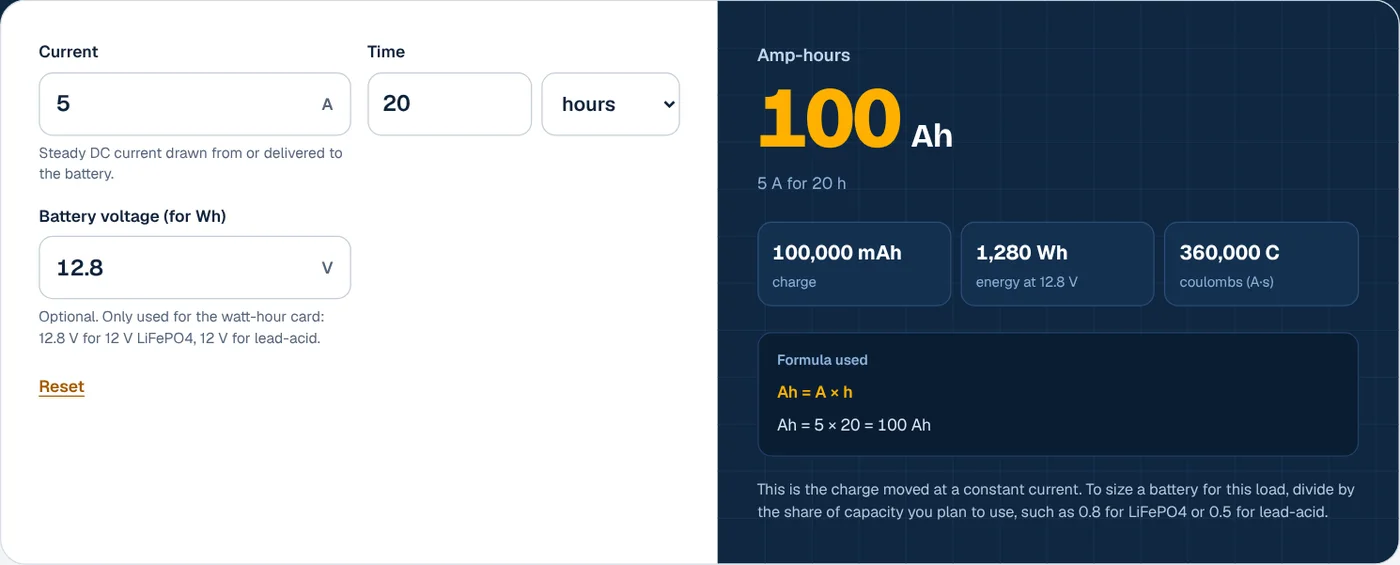
How to use the amps to Ah calculator
- Enter the current. Type the steady DC current in amps that flows out of or into the battery. Read it from a clamp meter, a battery monitor or the device label.

- Enter the time. Type how long that current flows and choose hours or minutes from the dropdown. The calculator converts minutes to hours for you.

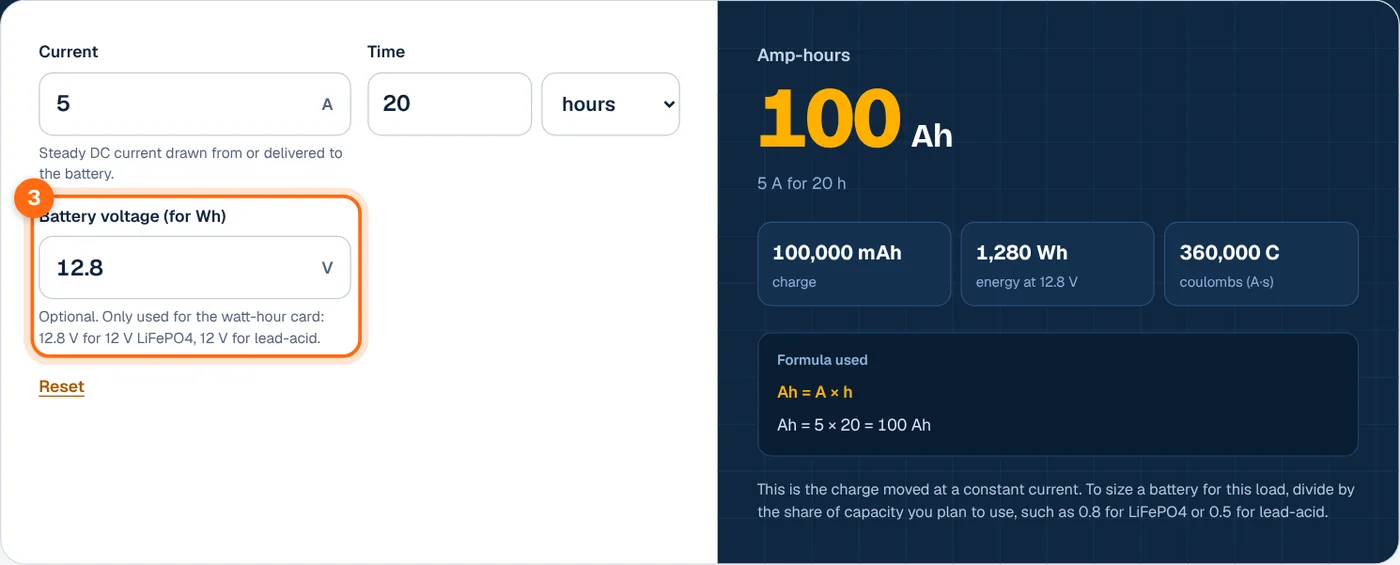
- Add the battery voltage. This is optional and only feeds the watt-hour card. Use 12.8 V for a 12 V LiFePO4 battery or 12 V for lead-acid.
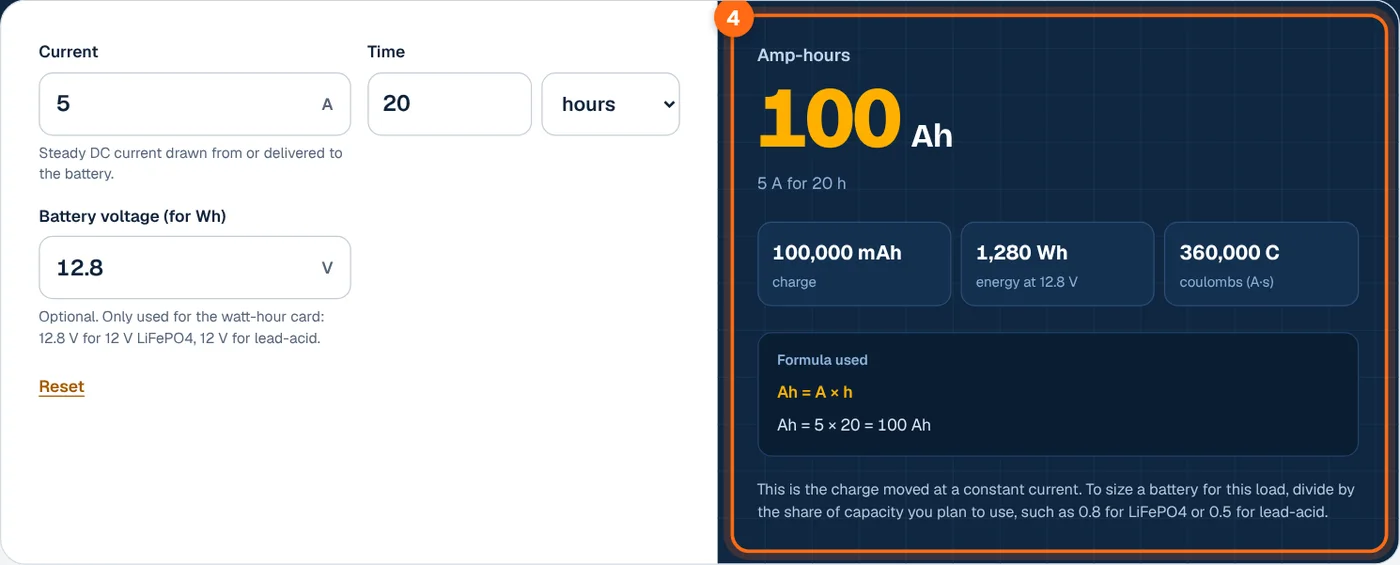
- Read the result. The large number is the charge in amp-hours. The cards show the same charge in mAh, the energy in Wh at your voltage and the charge in coulombs.
Amps to Ah formula
An amp is a rate of flow: one coulomb of charge per second. An amp-hour is a quantity: the charge moved by one amp in one hour. Converting from one to the other only needs the time.
Where:
- Ah is the charge in amp-hours. Multiply by 1,000 for milliamp-hours (mAh).
- A is the current in amps, held steady over the period.
- h is the time in hours.
- V is the nominal battery voltage, used only to turn amp-hours into watt-hours.
One amp-hour is 3,600 coulombs, because an hour has 3,600 seconds. That is why the calculator shows 360,000 C for the default 100 Ah.
If the current changes over time, split the period into blocks of steady current, convert each block and add them. A fridge that draws 6 A for 8 hours and 1 A for 16 hours uses 48 + 16 = 64 Ah a day.
Worked examples
Example 1: a 5 A load for 20 hours
On a 12.8 V LiFePO4 battery that is 100 × 12.8 = 1,280 Wh. Twenty hours is also the standard rating time for lead-acid batteries, so this is exactly what a 100 Ah lead-acid battery is rated to deliver under ideal conditions.
Example 2: a trolling motor at 30 A for 90 minutes
Convert the minutes to hours first: 90 ÷ 60 = 1.5 h.
A 100 Ah LiFePO4 battery covers this with room to spare. A 100 Ah AGM battery is a different story: 30 A drains it in roughly 3 hours, and the Victron AGM and gel battery datasheet shows only about 78% of rated capacity at a 3-hour discharge.
Example 3: a 12 V fridge over a day
The compressor draws 4.5 A and runs for about 9 hours in total each day.
To keep a LiFePO4 battery above 20% charge for two days without recharging, you need 81 ÷ 0.8 = 101 Ah, so a 100 Ah battery is marginal and a 150 Ah battery is comfortable. The amp hour calculator does this sizing step directly.
Amps to Ah conversion chart
Amp-hours for a steady current over common durations. Read across to find the charge used, or down a column to compare loads.
| Current (A) | 1 h | 5 h | 10 h | 20 h | 24 h |
|---|---|---|---|---|---|
| 0.5 | 0.5 | 2.5 | 5 | 10 | 12 |
| 1 | 1 | 5 | 10 | 20 | 24 |
| 2 | 2 | 10 | 20 | 40 | 48 |
| 5 | 5 | 25 | 50 | 100 | 120 |
| 10 | 10 | 50 | 100 | 200 | 240 |
| 20 | 20 | 100 | 200 | 400 | 480 |
| 50 | 50 | 250 | 500 | 1,000 | 1,200 |
The 20-hour column matches the way lead-acid batteries are rated. The 24-hour column is a full day, which is handy for loads that run around the clock, such as a router or a small DC fridge.
What affects the result
Steady versus varying current
The formula assumes the current holds steady. Real loads cycle, surge and idle. Use the average current over the period, or log the current with a battery monitor and use the amp-hour total it reports. Shunt-based monitors count amp-hours this way, by adding up current over time.
DC side or AC side
Amp-hours in a battery system are counted on the DC side. If you know the current of a 120 V AC appliance, convert it first: watts = 120 × amps, then divide by the battery voltage and by the inverter efficiency to get the battery current. The watts to amps calculator handles that step.
Charge used versus battery size
The answer is the charge the load uses. A battery should be larger, because you rarely want to drain it fully. Lead-acid lasts longest when cycled to about 50%, and LiFePO4 is commonly run to 80% or more. Divide the amp-hours by that fraction to size the battery.
Discharge rate
Lead-acid batteries deliver fewer amp-hours when drained quickly. A 100 Ah AGM battery gives its full 100 Ah only at about 5 A. Drained in 5 hours it gives about 85 Ah (17 A), and drained in 1 hour only about 65 Ah (65 A). LiFePO4 is much less sensitive to current, so the rated amp-hours hold up well at high loads.
Frequently asked questions
How do you convert amps to amp-hours?
Multiply the current in amps by the number of hours it flows. A 10 A load running for 6 hours uses 60 Ah. If the time is in minutes, divide it by 60 first. The conversion needs a time because amps measure a rate of flow while amp-hours measure a total quantity of charge.
How many amp-hours is 1 amp?
One amp flowing for one hour is one amp-hour. One amp for 10 hours is 10 Ah, and one amp for 20 hours is 20 Ah. An amp on its own has no amp-hour value, because the answer depends entirely on how long the current flows.
Is ampere the same as Ah?
No. An ampere is a unit of current, the rate at which charge flows. An amp-hour is a unit of charge, the amount moved by one ampere in one hour. A battery label in Ah tells you how much charge it holds, while a load rating in amps tells you how fast it uses that charge.
How long will a 100 Ah battery last at 10 amps?
In theory 100 ÷ 10 = 10 hours if you use the full capacity. In practice, a LiFePO4 battery used to 80% gives about 8 hours, and a lead-acid battery used to 50% gives about 5 hours. The battery life calculator includes depth of discharge and inverter losses for a full estimate.
How do I convert milliamps to amp-hours?
Divide milliamps by 1,000 to get amps, then multiply by the hours. A device drawing 250 mA for 12 hours uses 0.25 × 12 = 3 Ah, which is 3,000 mAh. Enter 0.25 A in the calculator and the mAh card shows the same answer.