Battery Cycle Life Calculator
Estimate how many cycles and years a LiFePO4, AGM or gel battery will last from depth of discharge and temperature.
Quick answer
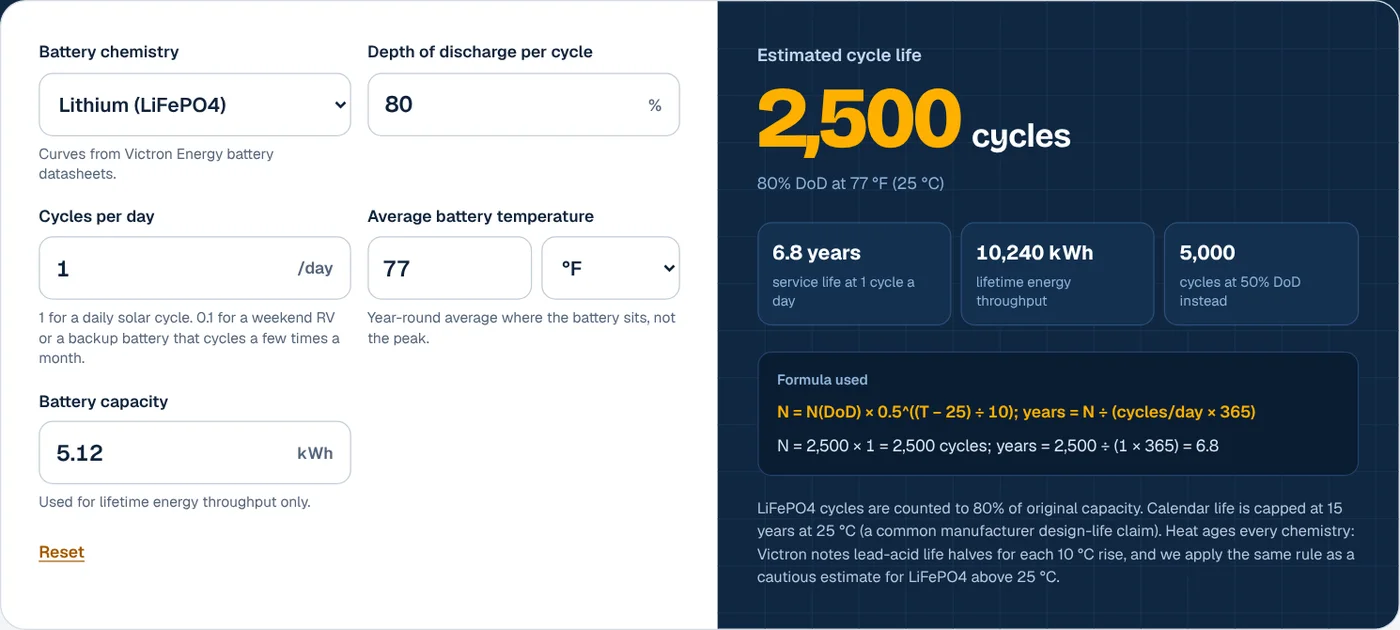
Battery cycle life depends mainly on depth of discharge and temperature. Victron’s datasheet rates its LiFePO4 batteries at 2,500 cycles at 80% depth of discharge, 3,000 at 70% and 5,000 at 50%. At one cycle a day, 2,500 cycles is 2,500 ÷ 365 = 6.8 years. AGM batteries manage about 600 cycles at 50%.
How to use the battery cycle life calculator
- Choose the battery chemistry. Pick LiFePO4, AGM or gel. Each uses its own depth of discharge curve from Victron Energy datasheets.

- Enter the depth of discharge. Type how much of the battery you use in a typical cycle. A battery that drops from 100% to 20% each night runs at 80% depth of discharge.

- Enter the cycles per day. Use 1 for daily solar cycling. A weekend RV or a backup battery that cycles a few times a month might be 0.1 to 0.3.

- Enter the average temperature. Type the year-round average where the battery lives, in °F or °C. Heat shortens life, so a hot garage matters.

- Read the result. The large number is the estimated cycle count. The cards show the service life in years, the lifetime energy throughput for your capacity and the cycles you would get at a shallower depth of discharge.

Battery cycle life formula
The calculator reads the cycle count from the datasheet curve for your depth of discharge, adjusts it for temperature, then turns cycles into years.
Where:
- N(DoD) is the rated cycle count at your depth of discharge, interpolated between datasheet points on a log scale.
- T is the average battery temperature in °C, and T ref is the datasheet reference: 25 °C (77 °F) for LiFePO4 and 20 °C (68 °F) for lead-acid.
- Calendar life caps the years: 15 for LiFePO4, 8 for AGM and 12 for gel at the reference temperature, also halved for every 10 °C of heat.
- kWh is the battery’s rated energy.
The temperature rule comes from Victron’s Energy Unlimited guide, which states that lead-acid service life halves for every 10 °C rise. We apply the same rule to LiFePO4 above 25 °C as a cautious estimate, since lithium cells also age faster in heat. Cold below the reference is not credited with extra life.
Worked examples
Example 1: daily solar cycling with LiFePO4 at 80%
A 5.12 kWh battery cycled this way delivers 2,500 × 0.8 × 5.12 = 10,240 kWh over its life. This is the default example in the calculator.
Example 2: the same battery at 50% depth of discharge
Halving the depth of discharge doubles the cycle count, and the lifetime throughput rises to 5,000 × 0.5 × 5.12 = 12,800 kWh. Using a bigger battery more gently can lower the cost per kWh delivered. The battery calculator sizes a bank for a target depth of discharge.
Example 3: AGM in a hot garage
An AGM battery cycled daily to 50% at an average of 86 °F (30 °C):
That is less than a year of daily use. The same battery at 68 °F (20 °C) gives 600 cycles, about 1.6 years. Daily cycling is where LiFePO4 earns its higher price.
Depth of discharge vs cycle life
Cycle counts at the datasheet reference temperature. Bold values are published in the Victron LiFePO4 Smart datasheet (to 80% of original capacity) and the Victron AGM and gel Deep Cycle datasheet. Other values are interpolated or extrapolated by the calculator. Figures as of October 2026.
| Depth of discharge | LiFePO4 (cycles) | AGM (cycles) | Gel (cycles) |
|---|---|---|---|
| 30% | 8,333 | 1,500 | 1,800 |
| 40% | 6,455 | 949 | 1,162 |
| 50% | 5,000 | 600 | 750 |
| 60% | 3,873 | 524 | 655 |
| 70% | 3,000 | 458 | 572 |
| 80% | 2,500 | 400 | 500 |
| 90% | 2,083 | 349 | 437 |
| 100% | 1,736 | 305 | 382 |
Values outside the published points, such as LiFePO4 at 30% or 100%, are extrapolations and are flagged in the calculator. Other brands publish different curves: the EG4 LifePower4 48 V rack battery, for example, is rated at more than 6,000 cycles at 80% depth of discharge. Enter your own brand’s figure into the comparison if it differs.
What affects the result
Depth of discharge
Shallow cycles stress the electrodes less. For lead-acid, the effect is dramatic: Victron’s AGM drops from 1,500 cycles at 30% to 400 at 80%. LiFePO4 is far more tolerant, but it still doubles its cycle count between 80% and 50%.
Temperature
Heat speeds up the chemical reactions that age a battery. Victron’s float-life table for AGM shows 7 to 10 years at 68 °F (20 °C), 4 years at 86 °F (30 °C) and 2 years at 104 °F (40 °C). Keep batteries in a shaded, ventilated space. Cold reduces capacity for the moment but does not age the battery the same way, though LiFePO4 must not be charged below 32 °F (0 °C).
Charge rate and full charges
Fast charging and discharging add heat and stress. Lead-acid also needs regular full charges, because a battery left partly charged sulfates and loses capacity quickly. Datasheet cycle figures assume the battery is fully recharged after every cycle.
Calendar aging
Batteries age even when they sit idle. A backup battery that cycles a few times a year will reach the end of its calendar life long before it uses up its cycles, which is why the calculator caps the years.
Frequently asked questions
How many cycles does a LiFePO4 battery last?
Victron rates its LiFePO4 Smart batteries at 2,500 cycles at 80% depth of discharge, 3,000 at 70% and 5,000 at 50%, counted to 80% of original capacity. Some home and rack batteries claim 6,000 cycles or more at 80%. Heat, high charge rates and frequent full discharges reduce the real figure.
How many years will my battery last?
Divide the cycle count by the cycles you use per year. A 2,500-cycle battery cycled daily lasts about 6.8 years. Cycled every other day, it lasts about 13.7 years, though calendar aging usually limits life to around 10 to 15 years for LiFePO4 and well under 10 years for AGM.
Does depth of discharge really matter for lithium?
Yes, though less than for lead-acid. Victron’s LiFePO4 data shows 2,500 cycles at 80% and 5,000 at 50%, so shallower cycles double the count. Lifetime energy throughput also rises, from 2,000 to 2,500 full-capacity cycles’ worth, so a slightly larger battery used gently can deliver more energy overall.
What does end of life mean for a battery?
Cycle life is usually counted until the battery holds 80% of its original capacity. The battery still works after that, just with less runtime. A 100 Ah battery at end of life holds about 80 Ah, and it keeps aging more slowly or more quickly depending on use.
How does temperature affect battery life?
Heat shortens it. Victron states that lead-acid service life halves for every 10 °C (18 °F) rise in temperature, and its AGM data shows life falling from 7 to 10 years at 20 °C to 2 years at 40 °C. Lithium also ages faster in heat, so keep batteries out of hot attics and direct sun.