Tumble Dryer Running Cost Calculator
Find what your vented, condenser or heat pump tumble dryer costs per load and per year at the current UK price cap rate.
Quick answer
An 8 kg condenser tumble dryer uses about 4.63 kWh per full load, so each load costs about £1.22 at the Ofgem price cap rate of 26.32p/kWh (1 October to 31 December 2026). At 4 loads a week, that adds up to about £254 a year. An 8 kg heat pump dryer uses about 1.87 kWh, which is 49p a load and about £103 a year.

How to use the tumble dryer running cost calculator
- Choose your dryer type. Pick vented, condenser or heat pump to use typical energy figures for that technology, or choose Custom kWh to enter the exact figure from your own dryer.
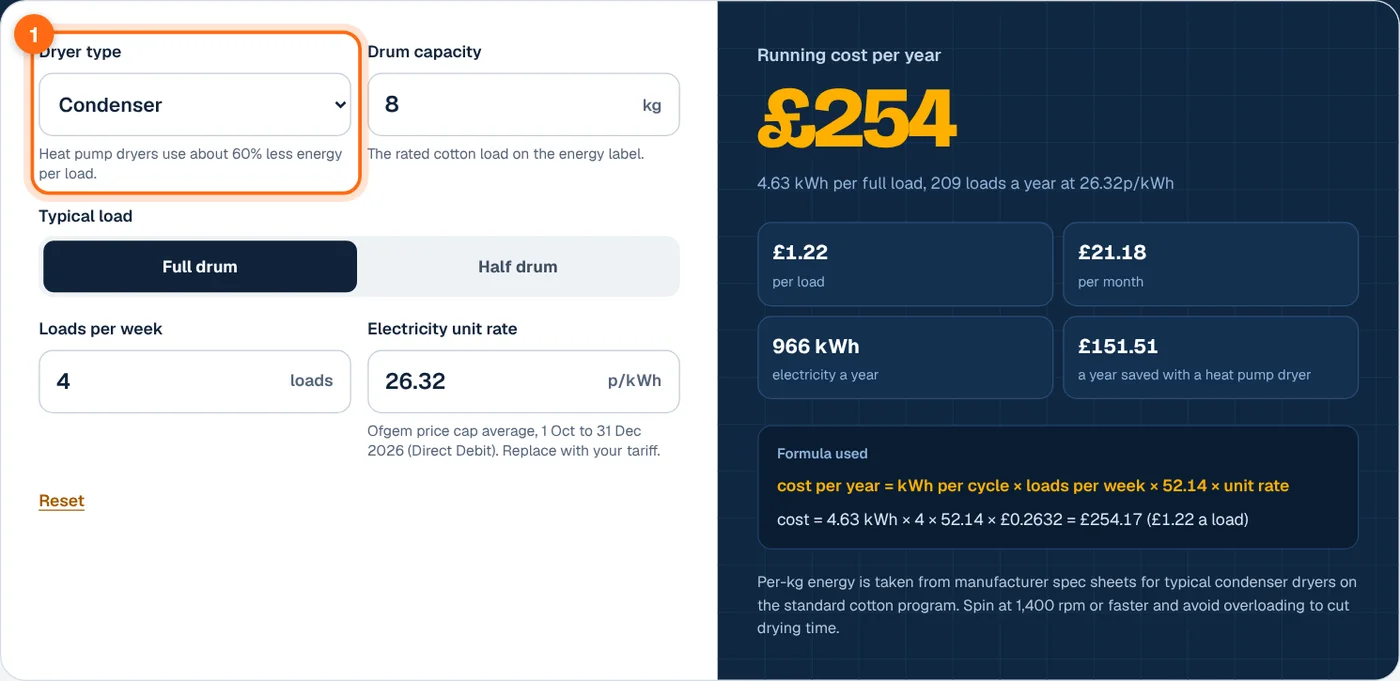
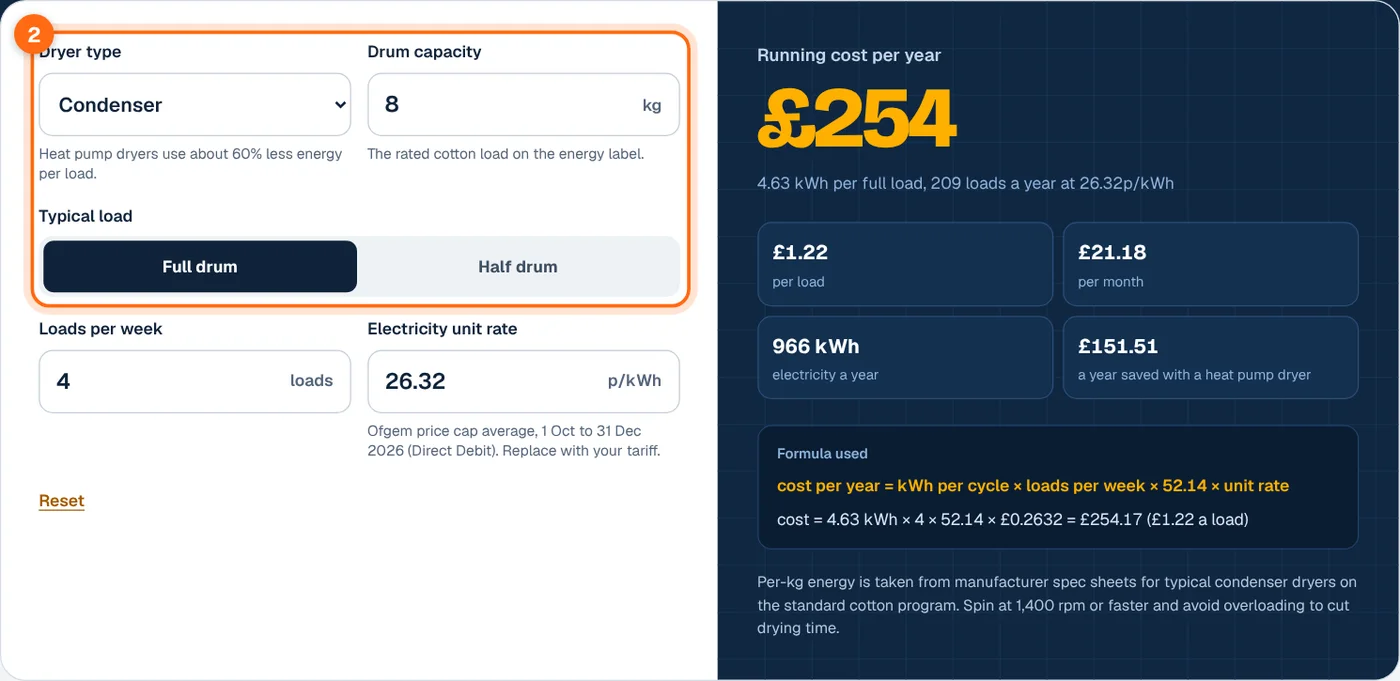
- Enter the drum size and typical load. Type the rated capacity in kg from the energy label, then choose whether you usually dry a full or a half drum. With Custom kWh, enter the energy per cycle from the product fiche instead.
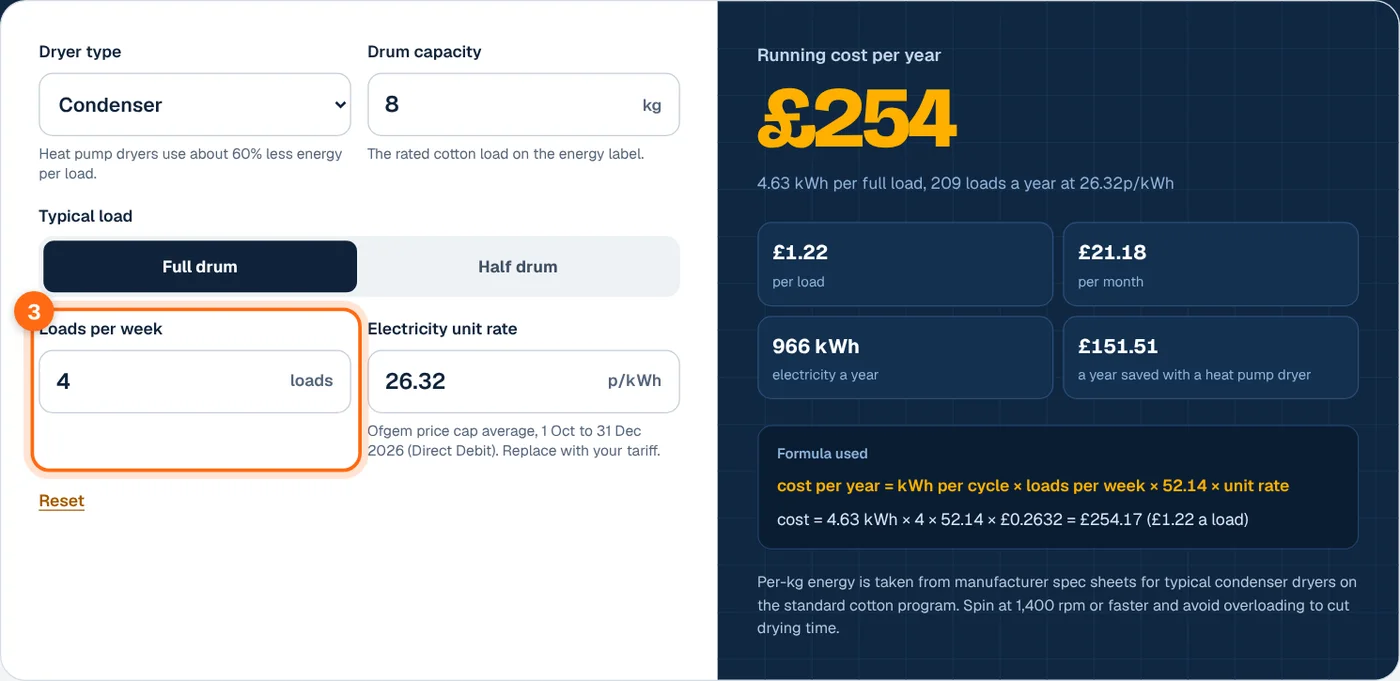
- Enter loads per week. Count every drying cycle. Families often run 4 to 6 a week in winter.
- Check the electricity unit rate. The default is the Ofgem price cap average of 26.32p/kWh. Replace it with the unit rate on your bill, or your off-peak rate if you dry overnight on Economy 7.
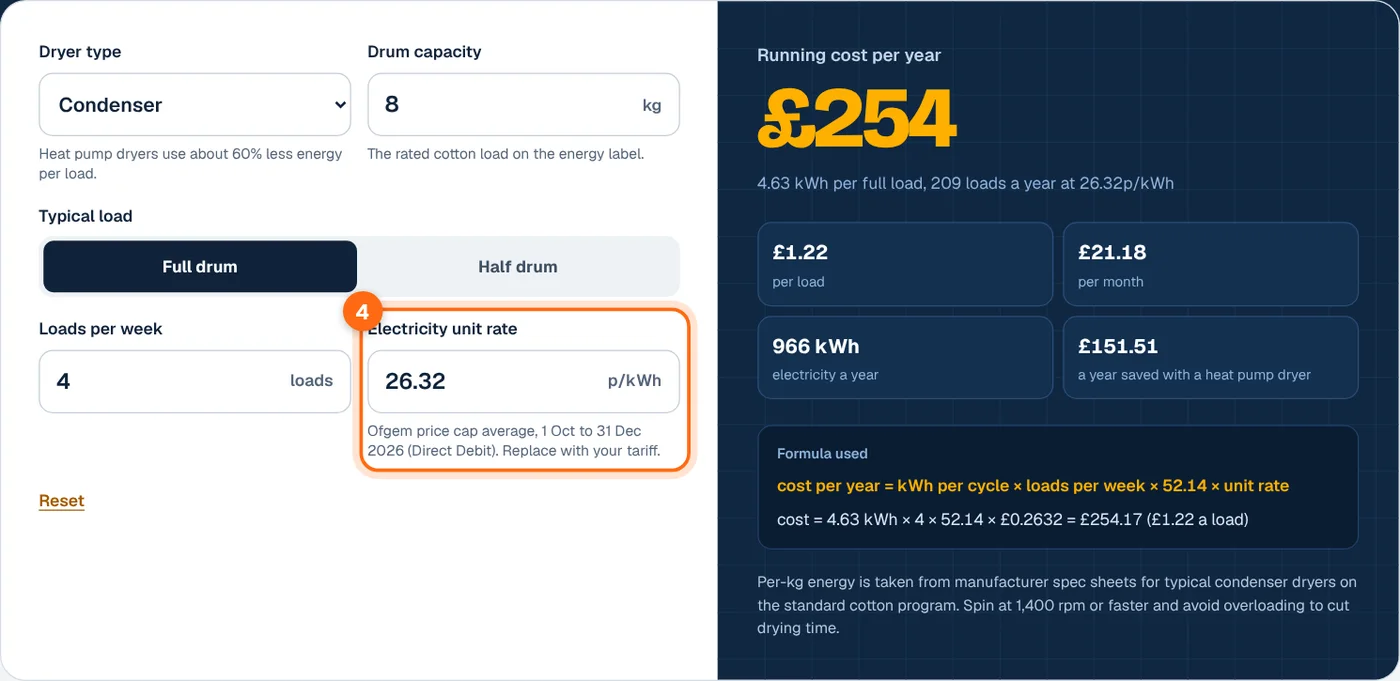
- Read the running cost per year. The large number is the yearly cost. The cards show the cost per load, per month, the kWh used each year and how much a heat pump dryer would save.

Tumble dryer running cost formula
The calculator works out the energy per cycle, then the yearly energy, then prices it.
Where:
- Ecycle is the electricity used per drying cycle in kWh.
- k is the energy per kg of rated capacity on the standard cotton program: 0.557 kWh/kg (vented), 0.579 kWh/kg (condenser) and 0.234 kWh/kg (heat pump) for a full load. Half loads use 0.327, 0.326 and 0.143 kWh/kg.
- C is the drum capacity in kg.
- N is the number of loads per week, and 52.14 is the number of weeks in a year (365 ÷ 7).
- R is the unit rate in £ per kWh, such as £0.2632.
The per-kg values come from manufacturer spec sheets for typical current models. The Bosch WTG86402GB datasheet, for example, lists 4.63 kWh at full load and 2.61 kWh at half load for an 8 kg B-rated condenser dryer. A 7 kg C-rated vented model from the same maker lists 3.9 kWh, and an 8 kg A++ heat pump model lists 1.87 kWh.
Worked examples
Example 1: 8 kg condenser dryer, 4 loads a week
This is the calculator’s default. Energy per load is 0.579 × 8 = 4.63 kWh.
That is 966 kWh a year, £1.22 a load and £21.18 a month. Switching to an 8 kg heat pump dryer at 1.87 kWh a load would save about £151.51 a year at the same rate.
Example 2: 9 kg vented dryer, 5 loads a week
A larger family dries more often. Energy per load is 0.557 × 9 = 5.01 kWh.
Each load costs £1.32, and the dryer uses about 1,307 kWh a year. The same pattern on a 9 kg heat pump dryer (2.10 kWh a load) costs about £144.36 a year.
Example 3: 8 kg heat pump dryer, half loads, 3 a week
A couple who dry smaller loads use the half-load figure of 1.14 kWh.
Each half load costs about 30p. Drying full loads less often would be cheaper per kg, because a full heat pump load uses only 64% more energy than a half load for twice the laundry.
Tumble dryer cost per load and per year by size
Full loads on the standard cotton program at 26.32p/kWh, with yearly figures for 4 loads a week.
| Capacity | Vented kWh / cost per load | Condenser kWh / cost per load | Heat pump kWh / cost per load | Yearly cost (vented / condenser / heat pump) |
|---|---|---|---|---|
| 7 kg | 3.90 kWh / £1.03 | 4.05 kWh / £1.07 | 1.64 kWh / 43p | £214 / £222 / £90 |
| 8 kg | 4.46 kWh / £1.17 | 4.63 kWh / £1.22 | 1.87 kWh / 49p | £245 / £254 / £103 |
| 9 kg | 5.01 kWh / £1.32 | 5.21 kWh / £1.37 | 2.10 kWh / 55p | £275 / £286 / £115 |
| 10 kg | 5.57 kWh / £1.47 | 5.79 kWh / £1.52 | 2.34 kWh / 62p | £306 / £318 / £128 |
What affects the result
Dryer technology
Vented and condenser dryers heat air with an electric element of around 2 to 2.5 kW. A vented model blows the moist air outside, while a condenser model cools it to collect the water in a tank, which costs a little extra energy. A heat pump dryer recycles the heat through a refrigerant circuit, so it uses roughly 60% less electricity per load, though cycles take longer.
Your electricity rate
The default 26.32p/kWh is the average Direct Debit unit rate under the Ofgem energy price cap for 1 October to 31 December 2026, as of October 2026. Regional rates differ, and fixed or time-of-use tariffs can be much cheaper overnight. To compare drying with other appliances, try the electricity cost calculator.
Spin speed and load size
Laundry that leaves the washer at 1,400 rpm holds far less water than laundry spun at 1,000 rpm, so the dryer runs for less time. Overloading the drum blocks airflow and lengthens cycles, while very small loads waste heat.
Maintenance
A clogged lint filter or a dusty condenser unit restricts airflow and can add a noticeable amount of energy per load. Clean the lint filter after every cycle and rinse the condenser or heat pump filter as the manual advises.
Drying with solar power
If you have solar panels, running the dryer around midday uses your own generation instead of grid electricity. The solar self-consumption calculator shows how shifting loads like this changes your savings.
Frequently asked questions
How much does it cost to run a tumble dryer per hour?
A vented or condenser dryer draws around 2 to 2.5 kW while its heater is on, so an hour costs roughly 53p to 66p at 26.32p/kWh. Heat pump dryers draw about 0.6 to 1 kW. Cost per load is more useful than cost per hour, because a typical condenser cycle on cottons runs for one and a half to two hours.
Is a heat pump tumble dryer worth it?
For regular use, usually yes. An 8 kg heat pump dryer costs about 49p a load against £1.22 for a condenser model at the October 2026 cap rate. At 4 loads a week that saves about £150 a year, so a price difference of £200 to £300 pays back in two years or so. For occasional use the saving is small.
Is it cheaper to use a tumble dryer at night?
Only if you are on a time-of-use tariff such as Economy 7 or an EV tariff with a cheaper overnight rate. On a single-rate tariff the price per kWh is the same all day. If you use night rates, enter your off-peak price in the unit rate field and check your dryer’s fire safety guidance on unattended use.
How many kWh does a tumble dryer use per year?
An 8 kg condenser dryer used 4 times a week uses about 966 kWh a year, and a vented model of the same size about 930 kWh. A heat pump dryer uses about 390 kWh. The annual figure printed on the old energy label assumes 160 cycles a year, a mix of full and partial loads.
Does the calculator include the standing charge?
No. The standing charge of about 54.83p a day under the October to December 2026 cap is billed whether or not you use the dryer, so it does not change the cost of drying. The calculator prices only the electricity each load uses, which is the part you can reduce.