3 Phase Power Calculator
Calculate three-phase kW, kVA and kVAR from voltage, current and power factor, or the line current for a known load.
Quick answer
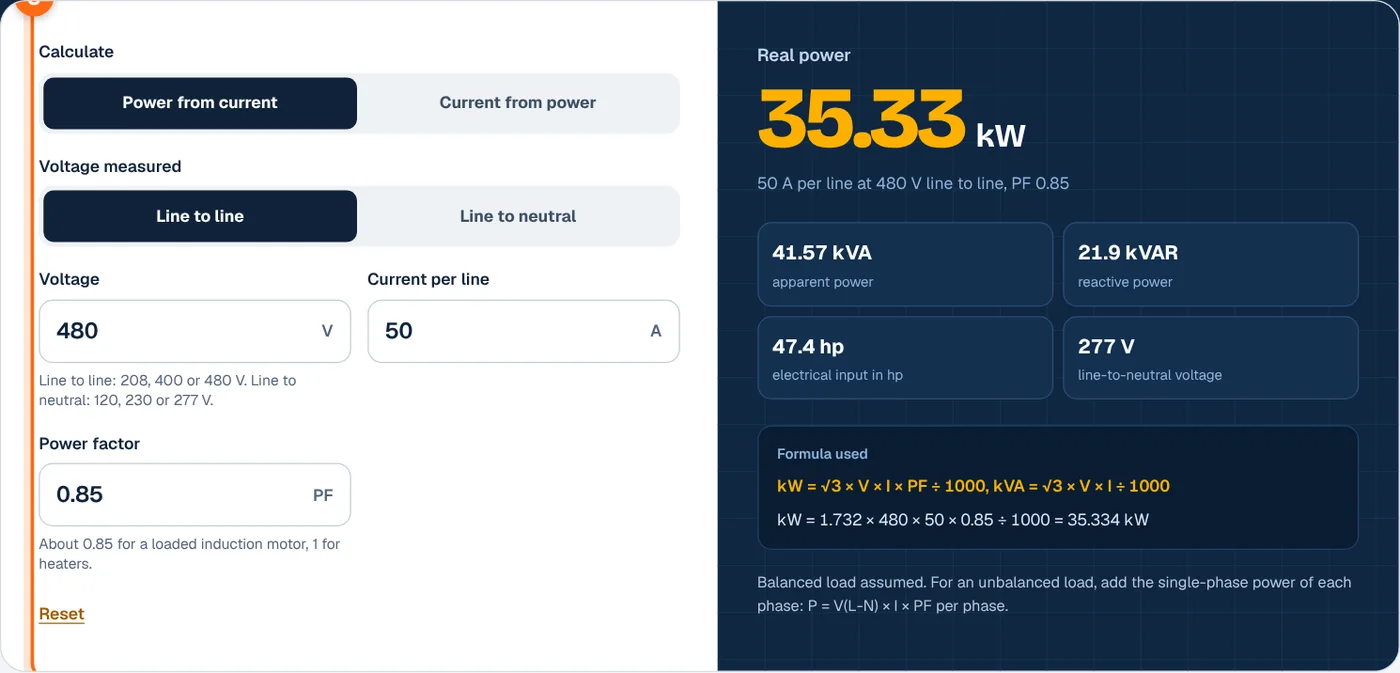
Three-phase power is P = √3 × V × I × PF, using line-to-line voltage. A balanced load drawing 50 A per line at 480 V and PF 0.85 uses 1.732 × 480 × 50 × 0.85 ÷ 1,000 = 35.33 kW, with 41.57 kVA apparent power and 21.9 kVAR reactive power. With line-to-neutral voltage, use 3 in place of √3.
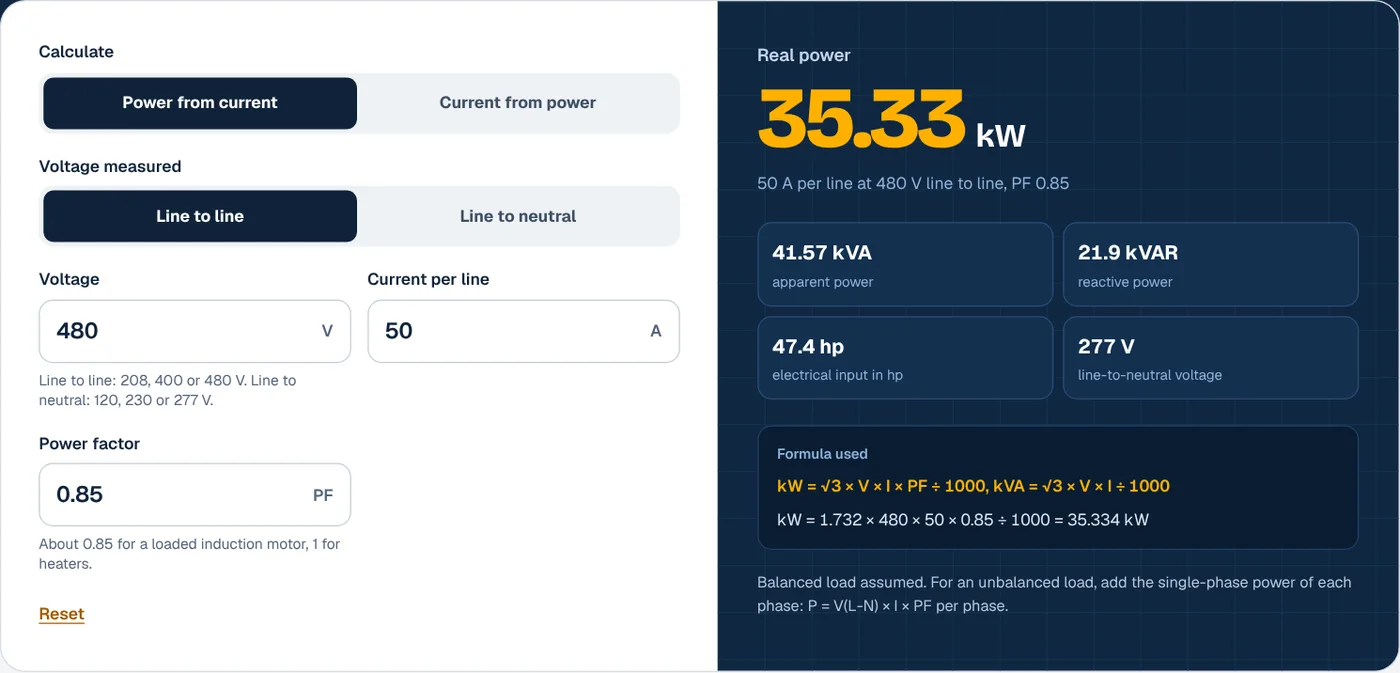
How to use the 3 phase power calculator
- Choose what to calculate. Pick power from current to turn a clamp-meter reading into kW, kVA and kVAR. Pick current from power to find the line current for a motor, heater or drive of known size.
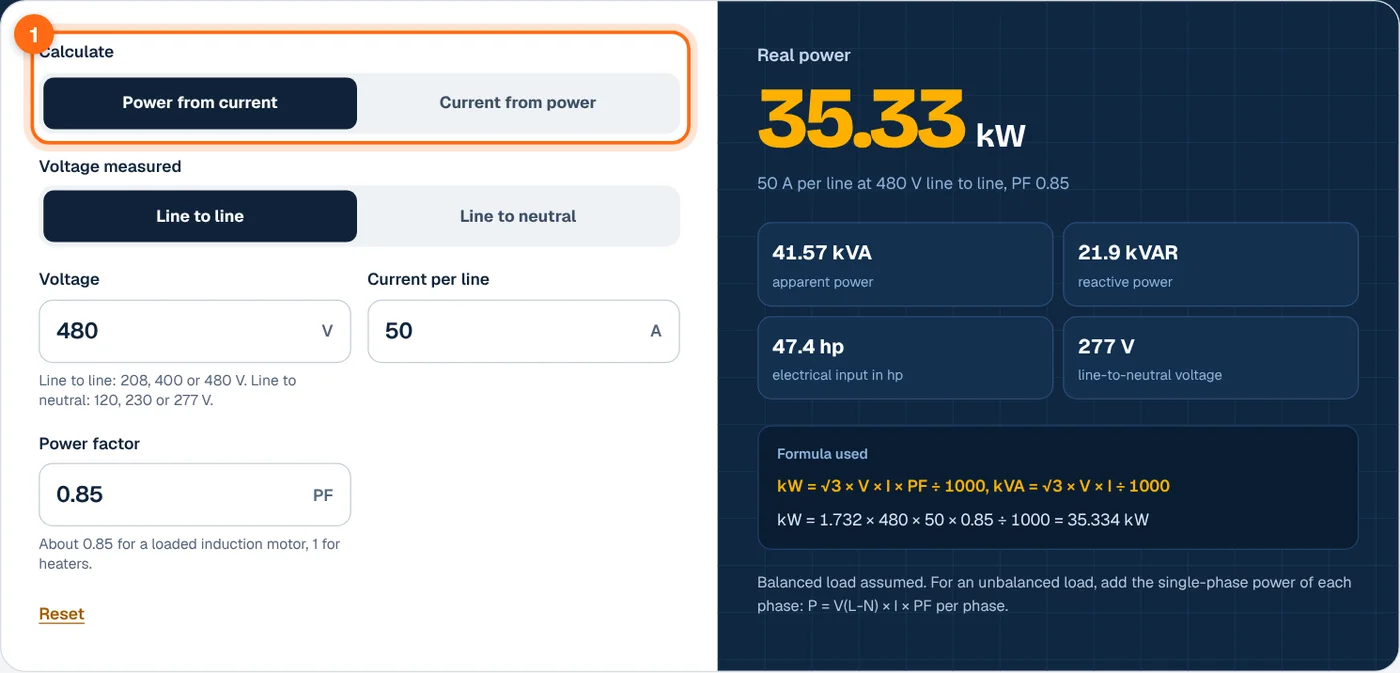
- Say how the voltage was measured. Line to line is the voltage between two phases, such as 208, 400 or 480 V. Line to neutral is phase to neutral, such as 120, 230 or 277 V.
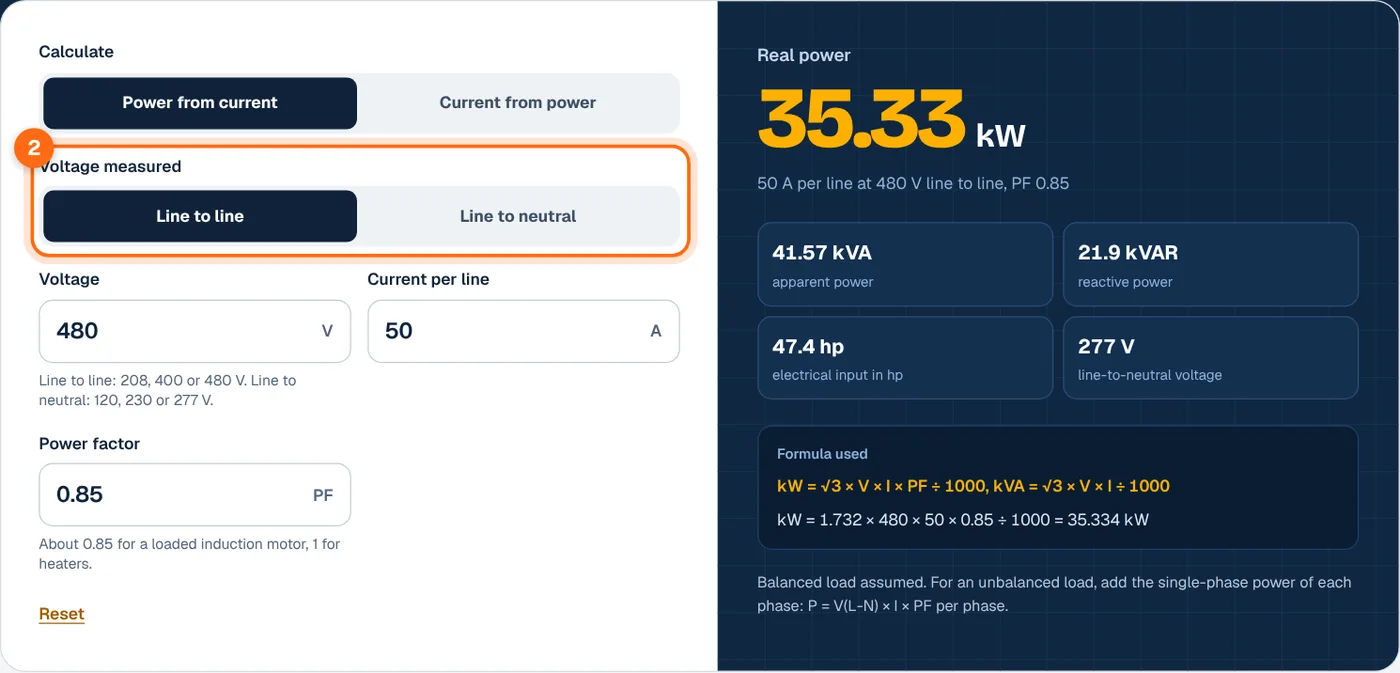
- Enter the voltage. Type the value that matches your choice, or pick one from the list.
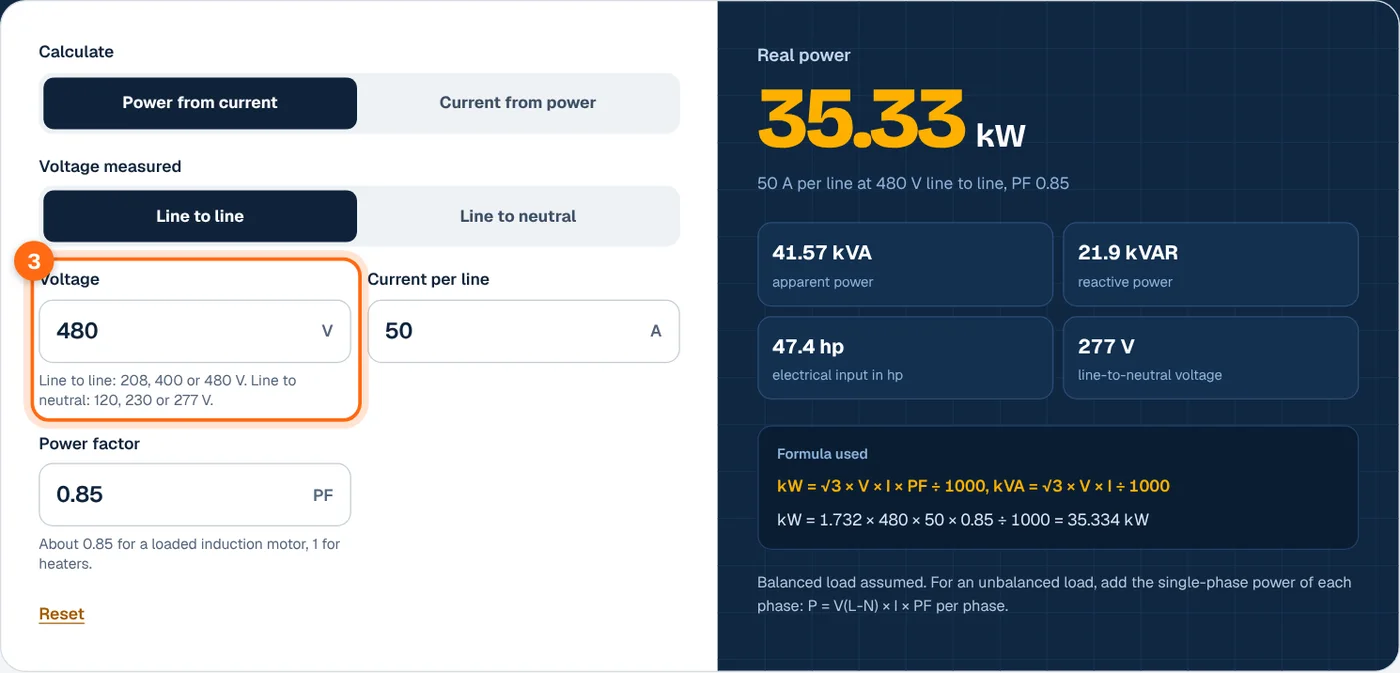
- Enter the current or the power. In power mode, enter the current in one line. In current mode, enter kW, or choose hp for a motor and enter its nameplate efficiency.
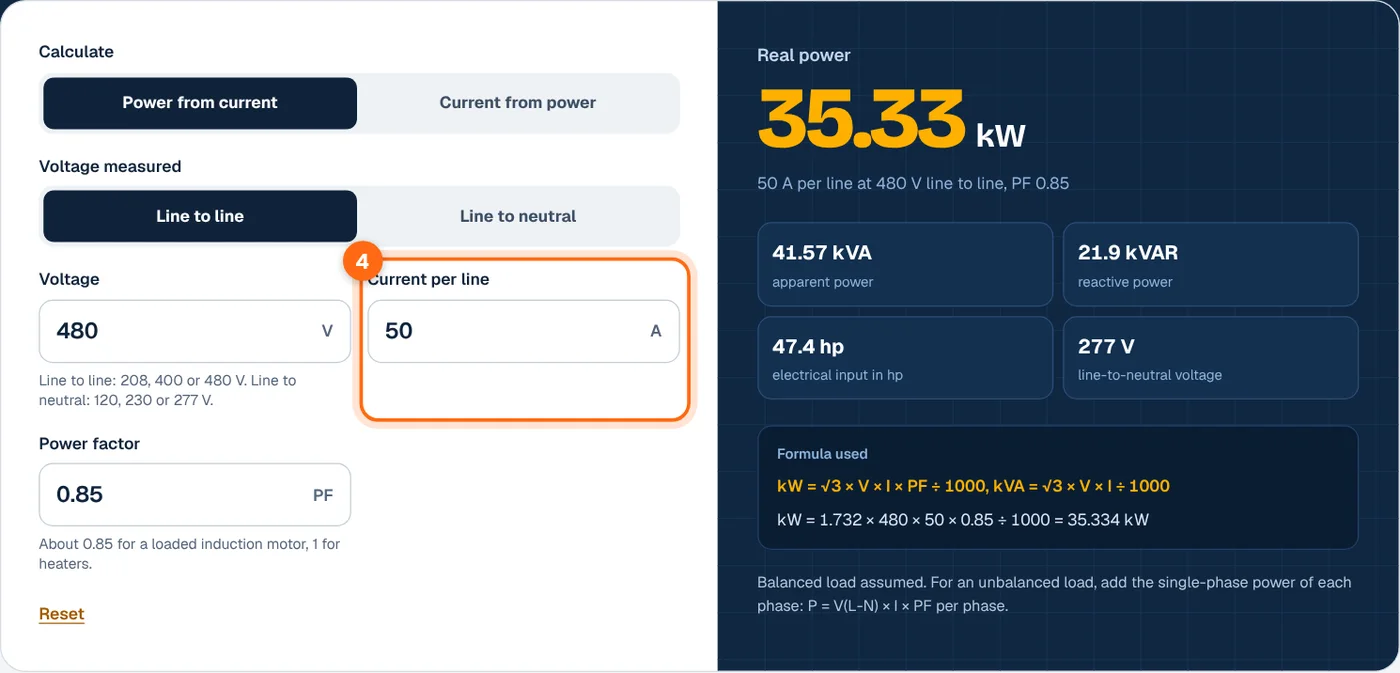
- Read the result. Set the power factor first (0.85 suits a loaded induction motor), then read real power or line current in the large number, with kVA, kVAR and the other voltage reference in the cards.
Three-phase power formula
The U.S. Department of Energy gives the same three-phase input power equation, Pi = V × I × PF × √3 ÷ 1,000, in its guide to measuring motor load.
Power from current, line-to-line voltage
Power from current, line-to-neutral voltage
Current from power
Where:
- V(L-L) is line-to-line voltage and V(L-N) is line-to-neutral. V(L-L) = √3 × V(L-N).
- I is the current in each line of a balanced load.
- PF is the power factor.
- kVAR = √(kVA² − kW²).
- η is motor efficiency as a decimal. 1 hp = 0.746 kW of shaft output.
Worked examples
Example 1: 50 A per line at 480 V, PF 0.85
This is the default. The same load read line to neutral on a 480Y/277 V system gives 3 × 277 × 50 × 0.85 ÷ 1,000 = 35.32 kW, the tiny gap coming from rounding 277.1 V to 277 V.
Example 2: 50 hp motor at 480 V, 93% efficient, PF 0.86
The motor needs 46.64 kVA. Nameplate full-load amps or the NEC motor tables should still govern conductor sizing; use the wire size calculator once you have the design current.
Example 3: 40 kW load at 400 V, PF 0.85
On a European or UK 400 V supply, a 40 kW load draws about 68 A per phase. The line-to-neutral voltage is 231 V.
Three-phase power per amp chart
Real power at PF 0.85 for common line-to-line voltages and line currents, computed with kW = √3 × V × I × 0.85 ÷ 1,000.
| Voltage L-L (L-N) | 10 A | 25 A | 50 A | 100 A |
|---|---|---|---|---|
| 208 V (120 V) | 3.06 kW | 7.66 kW | 15.31 kW | 30.62 kW |
| 240 V (139 V) | 3.53 kW | 8.83 kW | 17.67 kW | 35.33 kW |
| 400 V (231 V) | 5.89 kW | 14.72 kW | 29.44 kW | 58.89 kW |
| 415 V (240 V) | 6.11 kW | 15.27 kW | 30.55 kW | 61.1 kW |
| 480 V (277 V) | 7.07 kW | 17.67 kW | 35.33 kW | 70.67 kW |
| 600 V (346 V) | 8.83 kW | 22.08 kW | 44.17 kW | 88.33 kW |
What affects the result
Voltage reference
Using line-to-neutral voltage in the √3 formula understates power by 42%, and using line-to-line voltage in the 3× formula overstates it by 73%. Choose the measurement first and the calculator applies the matching factor.
Power factor
Induction motors run near 0.85 at full load and much lower when lightly loaded. Variable frequency drives often present a PF near 0.95 to the supply. If you have kW and kVA readings, the power factor calculator gives the exact figure and the capacitor kVAR needed to correct it.
Load balance
The formulas assume equal current in each line. For an unbalanced load, compute each phase as V(L-N) × I × PF and add the three. Large imbalance also raises neutral current and heats motors.
Motor efficiency
Nameplate hp is shaft output. Electrical input is higher by the efficiency, typically 90% to 96% for premium-efficiency motors above 10 hp. Ignoring efficiency underestimates current by the same margin.
Frequently asked questions
How do I calculate 3 phase power?
Multiply 1.732 by the line-to-line voltage, the line current and the power factor, then divide by 1,000 for kW. For 50 A at 480 V and PF 0.85, that is 35.33 kW. Without the power factor you get kVA, which is 41.57 kVA here.
Why is √3 used in three-phase power?
The three phase voltages are 120° apart, so the voltage between two lines is √3 times the voltage from line to neutral. Total power is three times the per-phase power, 3 × V(L-N) × I × PF, which equals √3 × V(L-L) × I × PF after substitution.
How many amps does a 3 phase motor draw?
Convert hp to input kW with hp × 0.746 ÷ efficiency, then divide kW × 1,000 by 1.732 × voltage × PF. A 50 hp motor at 93% efficiency and PF 0.86 on 480 V draws about 56 A. Always check the nameplate full-load amps, which take priority for code sizing.
Is 3 phase power more efficient than single-phase?
For the same power and voltage, three-phase needs less conductor material because each line carries a smaller current. It also delivers constant power to motors, so they run smoother and start more easily. That is why commercial buildings and industry use three-phase supplies, while most homes use single-phase.
How do I convert 3 phase amps to kVA only?
Multiply 1.732 by the line-to-line voltage and the current, then divide by 1,000. Power factor is not needed. 100 A at 480 V is 83.14 kVA. The amps to kVA calculator does this and suggests the next standard transformer size.