kW to kVA Calculator
Convert kW to kVA with any power factor, see the kVAR and phase angle, and add a sizing margin for generators.
Quick answer
To convert kW to kVA, divide real power by the power factor: kVA = kW ÷ PF. An 80 kW load at PF 0.8 needs 80 ÷ 0.8 = 100 kVA of generator or transformer capacity, with 60 kVAR of reactive power. At PF 1, kW and kVA are equal.

How to use the kW to kVA calculator
- Enter the real power in kW. Add up the running kW of the loads you need to supply, or take the kW rating from a load schedule or meter reading.
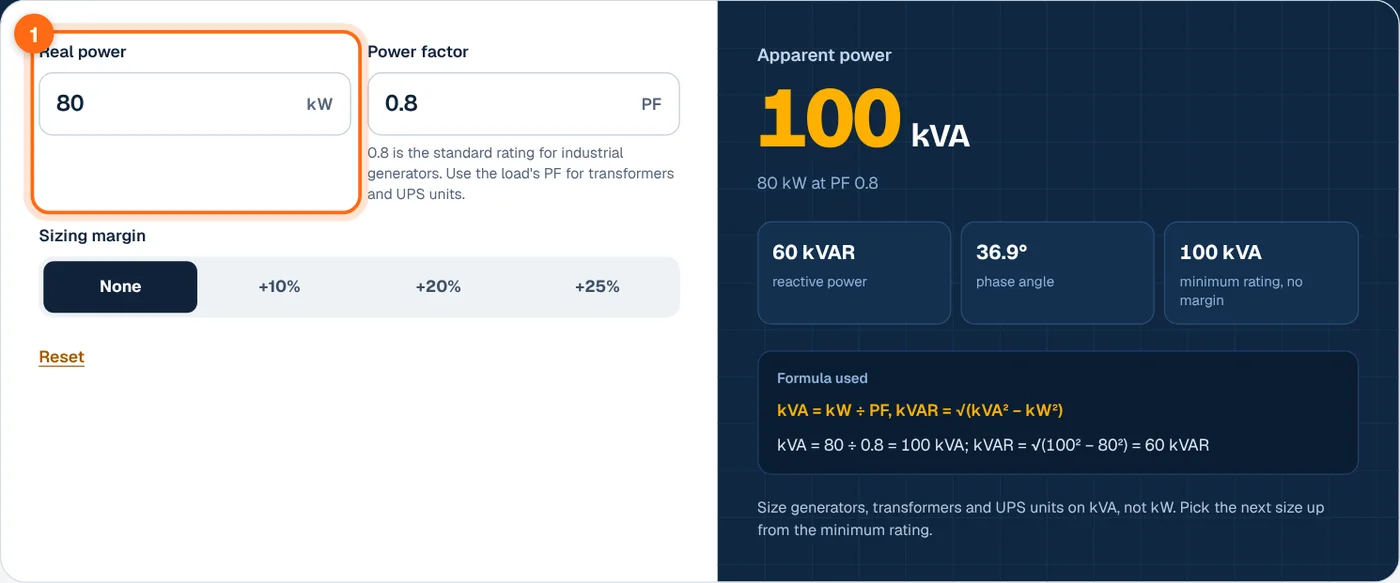
- Enter the power factor. Use 0.8 when sizing a standby generator, since most are rated at that figure. For a known load, use its measured or nameplate PF. Resistive loads are close to 1.

- Choose a sizing margin. Add 10% to 25% headroom if you are choosing a generator, transformer or UPS, so the unit is not run at its limit and has room for future loads.

- Read the result. The large number is apparent power in kVA. The cards show reactive power in kVAR, the phase angle and the minimum rating once your margin is added.

kW to kVA formula
kW, kVAR and kVA form the power triangle. kVA is the hypotenuse, kW is the side along the base, and the power factor is the cosine of the angle between them. The U.S. Department of Energy power factor fact sheet uses the same triangle to show how 100 kW at PF 0.70 needs 142 kVA.
Apparent power
Reactive power
Phase angle
Where:
- kW is real power, the part that does work and that your meter bills.
- kVA is apparent power, voltage times current. Cables, windings and breakers must carry it.
- kVAR is reactive power, which magnetizes motors and transformers but does no useful work.
- PF is the power factor, from 0 to 1.
Worked examples
Example 1: 80 kW at PF 0.8
This is the default. A 100 kVA generator rated at 0.8 PF is exactly loaded, so in practice you would pick the next size up.
Example 2: 400 kW facility at PF 0.9 with 25% margin
A 750 kVA transformer would cover this with room to grow. To check the current that rating delivers, use the kVA to amps calculator.
Example 3: 10 kW heating load at PF 1
Pure resistive loads draw no reactive power, so the kVA equals the kW.
kW to kVA conversion chart
kVA for common real-power loads at five power factors, computed with kVA = kW ÷ PF.
| kW | PF 0.7 | PF 0.8 | PF 0.85 | PF 0.9 | PF 0.95 |
|---|---|---|---|---|---|
| 5 | 7.14 | 6.25 | 5.88 | 5.56 | 5.26 |
| 10 | 14.29 | 12.5 | 11.76 | 11.11 | 10.53 |
| 20 | 28.57 | 25 | 23.53 | 22.22 | 21.05 |
| 50 | 71.43 | 62.5 | 58.82 | 55.56 | 52.63 |
| 80 | 114.29 | 100 | 94.12 | 88.89 | 84.21 |
| 100 | 142.86 | 125 | 117.65 | 111.11 | 105.26 |
| 200 | 285.71 | 250 | 235.29 | 222.22 | 210.53 |
| 500 | 714.29 | 625 | 588.24 | 555.56 | 526.32 |
| 1,000 | 1,428.57 | 1,250 | 1,176.47 | 1,111.11 | 1,052.63 |
What affects the result
The power factor you choose
Low power factor inflates kVA quickly. 100 kW needs 105 kVA at PF 0.95 but 143 kVA at PF 0.7. Raising PF with capacitors can let an existing transformer carry more real load. Work out the capacitor size with the power factor calculator.
Generator ratings
Industrial generators are usually rated in kVA at 0.8 PF, so their kW rating is 80% of the kVA. Small portable generators are often rated in watts at PF 1. Compare like with like when shopping.
Motor starting
Motors can draw several times their running kVA while starting. A generator sized only on running kVA may stall when a large motor starts. Soft starters and variable frequency drives cut this surge.
Non-linear loads
LED drivers, computers and drives without power factor correction draw distorted current. This adds harmonic current that heats transformers beyond what the kW and displacement PF suggest. Allow extra margin, or a K-rated transformer, where these loads dominate.
Frequently asked questions
How many kVA is 1 kW?
It depends on the power factor. At PF 0.8, 1 kW needs 1.25 kVA. At PF 0.9 it needs 1.11 kVA, and at PF 1 it needs exactly 1 kVA. Divide kW by the power factor to get kVA. There is no single fixed ratio, which is why the calculator asks for PF.
What size generator do I need for 80 kW?
At the usual 0.8 rating PF, 80 kW needs 100 kVA. Add a margin of about 20% for motor starting and future loads, giving roughly 120 kVA, then choose the next standard size up. Large motor loads may need more, so check starting kVA with the generator maker’s sizing tool.
Why is kVA larger than kW?
kVA includes both real power (kW) and reactive power (kVAR). Reactive power flows back and forth to build magnetic fields in motors and transformers. It does no useful work but still needs current, so the supply must be sized for the larger kVA figure. The two are equal only at PF 1.
Can I convert kVA back to kW here?
This page converts kW to kVA only. For the reverse, use the kVA to kW calculator, which multiplies kVA by the power factor and also shows the full-load current. Both tools use the same power triangle, so the results always agree.
Does voltage change the kW to kVA conversion?
No. kW and kVA are both power, so the ratio between them depends only on the power factor. Voltage matters when you turn kVA into current. 100 kVA is 278 A at 208 V three-phase but only 120 A at 480 V three-phase, which changes the cable and breaker sizes.