Volts to Watts Calculator
Convert volts to watts from current or resistance, for DC, single-phase and three-phase AC with power factor.
Quick answer
Volts alone do not give watts; you also need the current or the resistance. For DC, watts = volts × amps, so 12 V at 10 A is 120 W. For single-phase AC, multiply by the power factor too: 120 V × 10 A × 0.9 = 1,080 W. With resistance, watts = volts² ÷ ohms, so 120 V across 9.6 Ω is 1,500 W.

How to use the volts to watts calculator
- Choose the values you know. Pick volts and amps if you have a current reading or a rated current. Pick volts and ohms for a heating element, resistor or other resistive load.

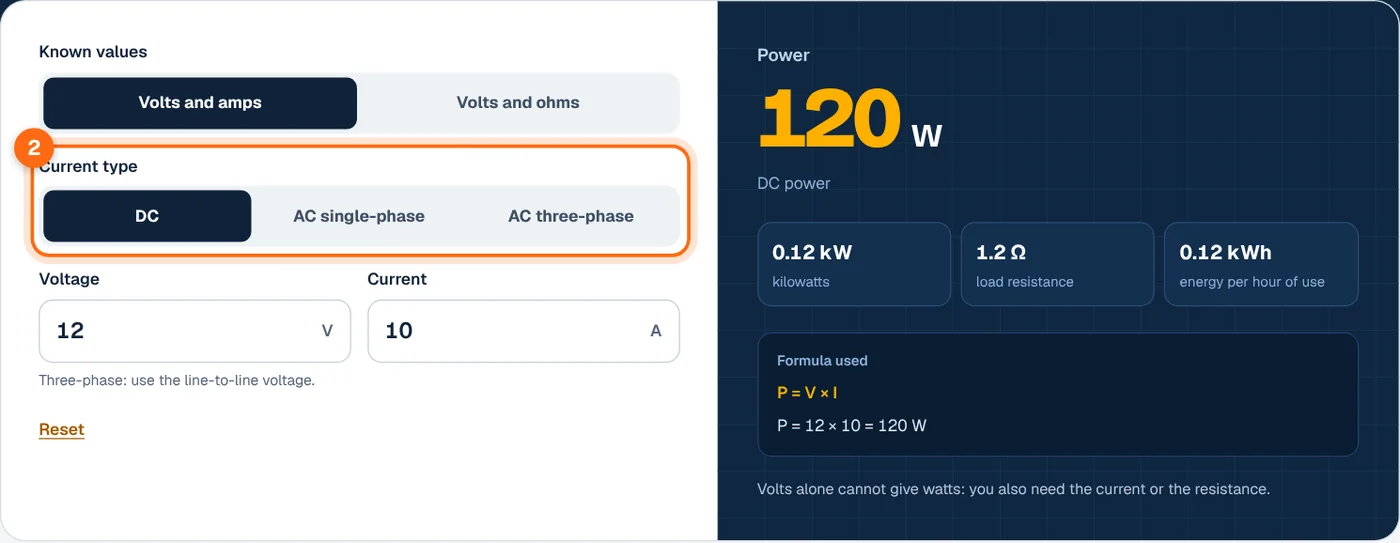
- Choose the current type. In volts and amps mode, select DC for batteries, solar and 12 V or 24 V systems, single-phase AC for household circuits, or three-phase AC for commercial supplies.
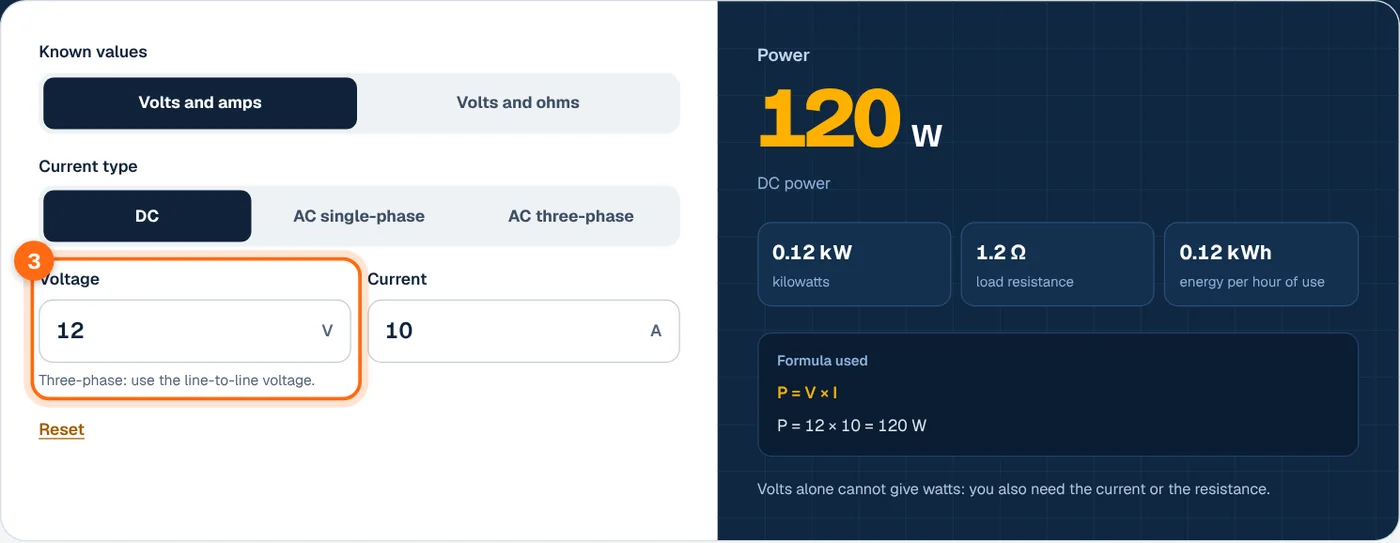
- Enter the voltage. Use the voltage across the load. For three-phase, use the line-to-line voltage, such as 208 V or 480 V.
- Enter the current or resistance, and the power factor. Type the current in amps, or the resistance in Ω or kΩ. For AC, enter the power factor: 1 for heaters, about 0.9 for typical mixed loads, 0.8 to 0.85 for motors.

- Read the result. The large number is real power in watts. The cards show kW, kWh per hour of use, and the apparent power in VA or the load resistance or current.

Volts to watts formula
Electrical power is voltage times current. Ohm’s law lets you swap current for resistance when you know the load’s ohms.
DC
Single-phase AC
Three-phase AC
From volts and ohms
Where:
- P is real power in watts.
- V is voltage in volts; line-to-line for three-phase.
- I is current in amps, per line for three-phase.
- R is resistance in ohms.
- PF is the power factor from 0 to 1. V × I without it gives apparent power in VA.
Worked examples
Example 1: 12 V DC at 10 A
This is the default. A 12 V fridge or inverter drawing 10 A uses 120 W, or 0.12 kWh every hour. The load behaves like a 1.2 Ω resistance at that moment.
Example 2: 120 V single-phase at 10 A, PF 0.9
The circuit carries 1,200 VA, but only 1,080 W does work. Breakers and wiring see the full 10 A. To go the other way, from watts to current, use the watts to amps calculator.
Example 3: 120 V heater element of 9.6 Ω
This is a standard 1,500 W space heater. It draws 120 ÷ 9.6 = 12.5 A. Run on 240 V, the same element would make 6,000 W, four times the power, and would quickly burn out.
Example 4: 480 V three-phase at 20 A, PF 0.85
The apparent power is 16,628 VA. For kW and kVAR on larger three-phase loads, see the 3 phase power calculator.
Volts to watts chart
DC or unity power factor watts for common voltages and currents, using P = V × I.
| Voltage | 1 A | 5 A | 10 A | 15 A | 20 A |
|---|---|---|---|---|---|
| 5 V | 5 W | 25 W | 50 W | 75 W | 100 W |
| 12 V | 12 W | 60 W | 120 W | 180 W | 240 W |
| 24 V | 24 W | 120 W | 240 W | 360 W | 480 W |
| 48 V | 48 W | 240 W | 480 W | 720 W | 960 W |
| 120 V | 120 W | 600 W | 1,200 W | 1,800 W | 2,400 W |
| 230 V | 230 W | 1,150 W | 2,300 W | 3,450 W | 4,600 W |
| 240 V | 240 W | 1,200 W | 2,400 W | 3,600 W | 4,800 W |
For AC loads with a power factor below 1, multiply the table value by the PF.
What affects the result
Power factor
Motors, compressors and older fluorescent fixtures draw current that is out of step with the voltage. Multiplying volts by amps then overstates the real power. Resistive loads such as kettles, toasters and electric heaters run at PF 1, so volts × amps is exact.
Voltage changes
For a resistive load, power rises with the square of voltage. A 1,500 W heater at 120 V makes about 1,389 W if the supply sags to 115.5 V. Long cable runs cause this kind of sag; check it with the voltage drop calculator.
Nameplate versus measured current
Nameplate amps are a maximum. Many appliances, especially those with thermostats or inverter compressors, run well below that most of the time. A clamp meter reading under typical use gives a better energy estimate.
Battery voltage
A 12 V battery sits anywhere from about 11.8 V to 14.4 V depending on charge and charging state. For DC loads on batteries, use the voltage at the time you measure current.
Frequently asked questions
How many watts is 120 volts?
It depends on the current. At 120 V, 1 A is 120 W, 10 A is 1,200 W, and a 15 A circuit at full load is 1,800 W. Volts are only half of the answer. Multiply volts by amps, and by the power factor for AC loads that are not purely resistive.
How many watts is 12 volts?
At 12 V, each amp is 12 W. A 5 A load is 60 W, 10 A is 120 W and 20 A is 240 W. For a LiFePO4 battery system use 12.8 V, the nominal voltage, which gives 128 W at 10 A.
Can I find watts from volts and ohms?
Yes. Square the voltage and divide by the resistance: P = V² ÷ R. 120 V across 9.6 Ω gives 1,500 W. This only works for resistive loads, such as heating elements and resistors, where resistance stays fairly constant. The Ohm’s law calculator solves all four values from any two.
What is the difference between watts and VA?
VA is volts times amps, the apparent power the wiring must carry. Watts are the real power that does work. They are equal for DC and resistive AC loads. For motors and other inductive loads, watts = VA × power factor, so a 1,200 VA load at PF 0.9 uses 1,080 W.
How do I convert amps to watts at a fixed voltage?
Multiply the amps by the voltage and, for AC, the power factor. At 240 V and PF 1, 30 A is 7,200 W. The amps to watts calculator is built around current as the main input, while this page starts from a known voltage.