Power Factor Calculator
Find power factor from kW and kVA or from watts, volts and amps, plus the capacitor kVAR needed to correct it.
Quick answer
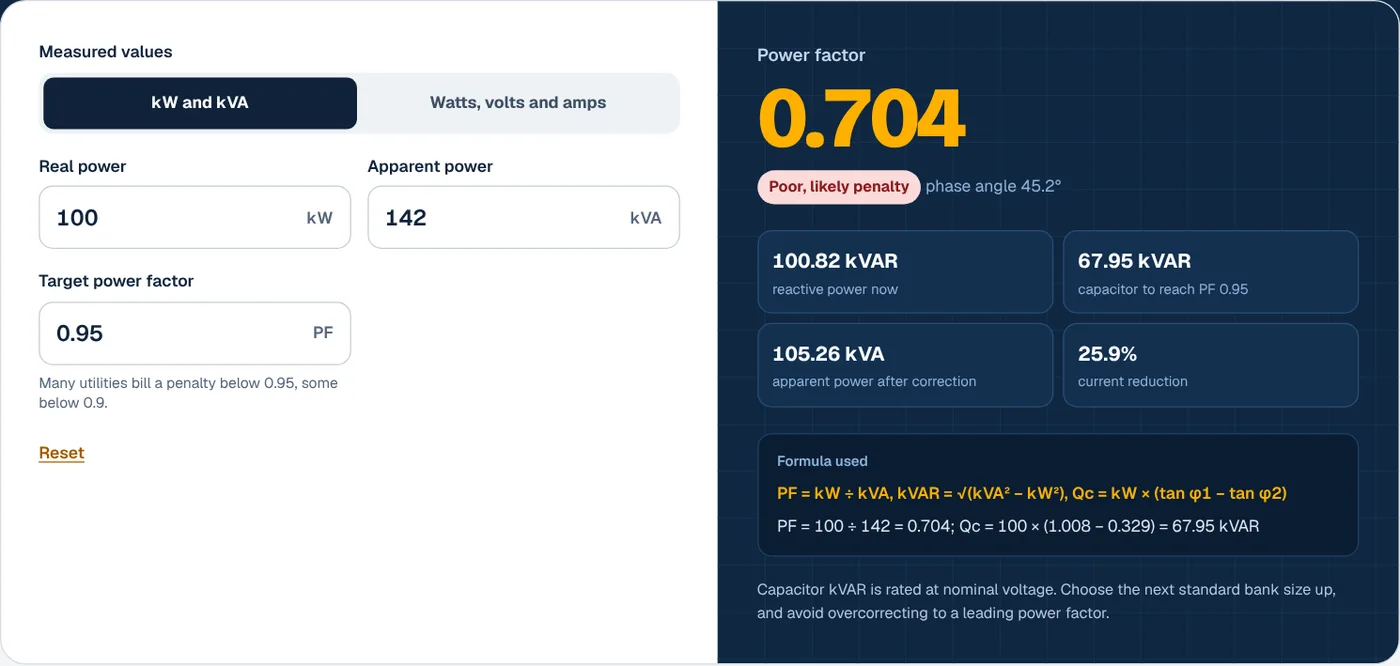
Power factor is real power divided by apparent power: PF = kW ÷ kVA. A plant drawing 100 kW and 142 kVA runs at PF 0.704. Correcting it to 0.95 needs about 68 kVAR of capacitors, which cuts apparent power to 105.3 kVA and line current by about 26%.
How to use the power factor calculator
- Choose what you measured. Pick kW and kVA if you have a power meter or utility bill that shows both. Pick watts, volts and amps if you have a wattmeter reading plus clamp-meter current and a voltage reading.
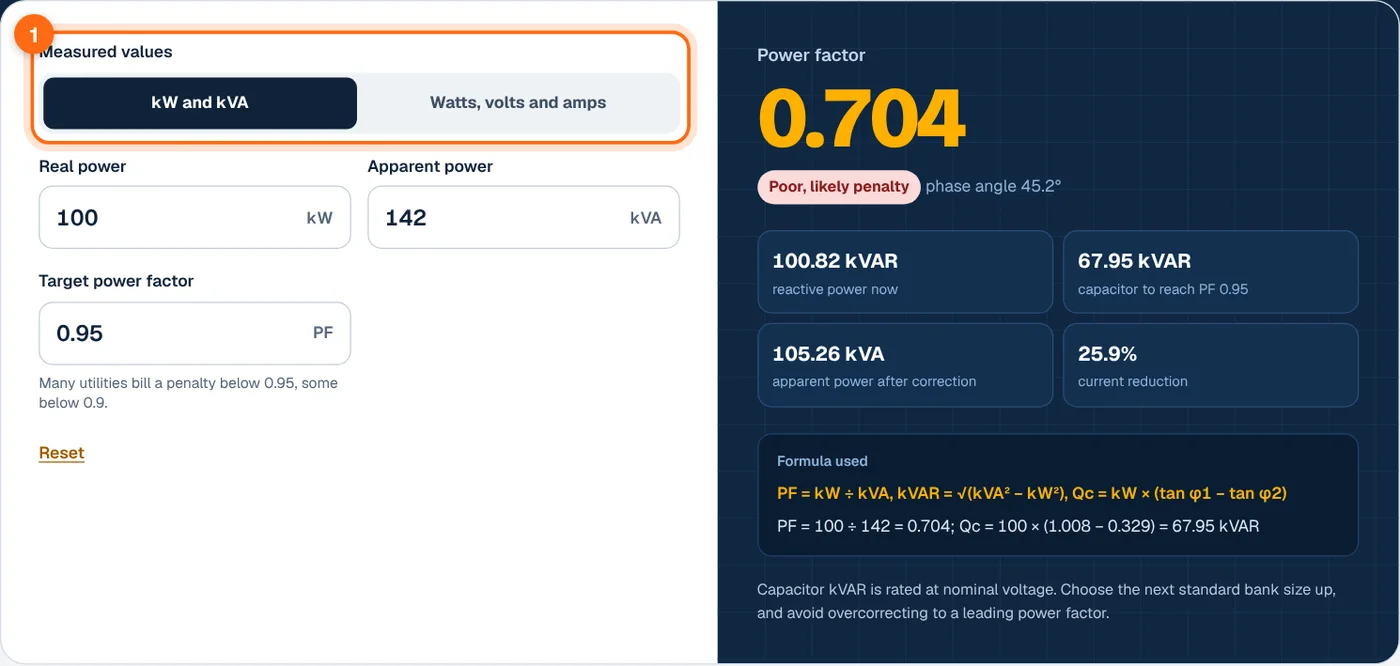
- Enter real power. Type kW, or watts in the second mode. This is the power your energy meter records.
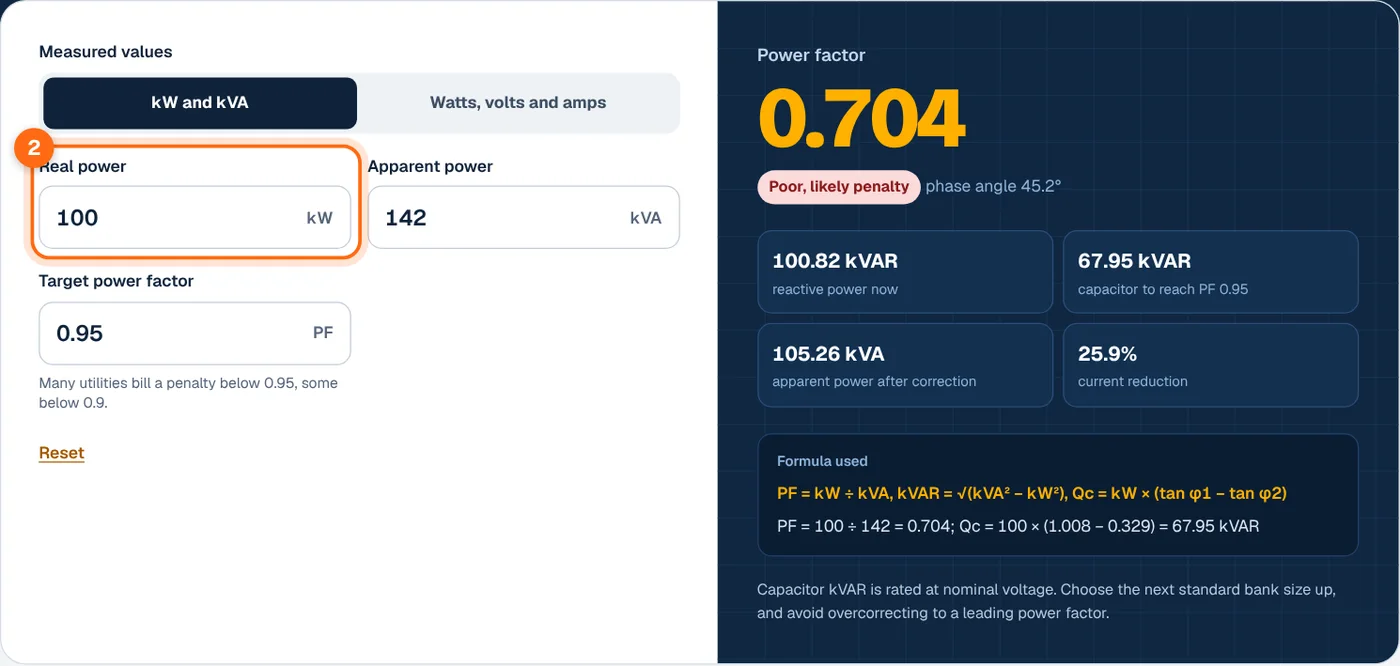
- Enter apparent power, or volts and amps. In kW mode, enter kVA from the meter or demand bill. In the volts and amps mode, set the phase, then enter the voltage and the measured current, and the calculator works out kVA.

- Set the target power factor. 0.95 is a common utility threshold. Use your utility’s tariff value if it differs.

- Read the result. The large number is your power factor with a rating chip. The cards show reactive power now, the capacitor kVAR needed to reach the target, apparent power after correction and the current reduction.

Power factor formula
Real, reactive and apparent power form a right triangle. The power factor is the cosine of the angle φ between kW and kVA. Capacitors supply reactive power locally, which shrinks the kVAR side and the angle.
Power factor
From watts, volts and amps
Reactive power and capacitor size
Where:
- kW is real power and kVA is apparent power.
- kVAR is reactive power.
- φ1 is the present phase angle, arccos of the present PF, and φ2 is the angle at the target PF.
- Qc is the capacitor rating needed, in kVAR.
- V is line-to-line voltage for three-phase, and I is line current.
Worked examples
Example 1: 100 kW at 142 kVA
This is the default, and it matches the U.S. Department of Energy power factor fact sheet, where a 67 kVAR capacitor raises a 100 kW load from PF 0.70 to 0.95 and drops apparent power from 142 kVA to 105 kVA. In practice you would install a 75 kVAR bank.
Example 2: single-phase load, 1,200 W at 120 V and 12 A
The load draws 1,440 VA for 1,200 W of real work. Small single-phase loads are rarely corrected individually, but the result shows how much of the circuit capacity goes to reactive current.
Example 3: three-phase motor, 30 kW at 480 V and 45 A
A 12.5 kVAR capacitor at the motor raises it to PF 0.95, cutting the line current by 15.6%. For full three-phase power and current figures, use the 3 phase power calculator.
Capacitor kVAR multiplier table
Multiply your kW by the factor to get the capacitor kVAR needed. Each value is tan φ1 − tan φ2, computed in code.
| Present PF | To 0.90 | To 0.95 | To 0.98 | To 1.00 |
|---|---|---|---|---|
| 0.60 | 0.849 | 1.005 | 1.130 | 1.333 |
| 0.65 | 0.685 | 0.840 | 0.966 | 1.169 |
| 0.70 | 0.536 | 0.692 | 0.817 | 1.020 |
| 0.75 | 0.398 | 0.553 | 0.679 | 0.882 |
| 0.80 | 0.266 | 0.421 | 0.547 | 0.750 |
| 0.85 | 0.135 | 0.291 | 0.417 | 0.620 |
| 0.90 | 0 | 0.156 | 0.281 | 0.484 |
Example: 200 kW at PF 0.75 corrected to 0.95 needs 200 × 0.553 = 110.6 kVAR.
What affects power factor
Induction motors and their loading
Motors are the largest source of low power factor in most facilities. A motor near full load may run at 0.85, but the same motor at a quarter load can fall well below 0.6 because its magnetizing current stays roughly constant. Right-sizing motors raises PF without any capacitors.
Transformers and lighting
Lightly loaded transformers and older magnetic-ballast lighting also draw reactive current. Modern LED drivers and electronic ballasts usually include power factor correction.
Utility penalties
Many utilities add a charge when PF falls below 0.95, and some use 0.9 or bill demand on kVA. Check your tariff. Correcting from 0.70 to 0.95 lowers billed kVA by about 26% in the default example.
Overcorrection and harmonics
Too much capacitance pushes PF leading, which can raise voltage at light load. Capacitors can also resonate with harmonic currents from drives. Use automatic switched banks or detuned reactors where loads vary or drives are common.
Frequently asked questions
What is a good power factor?
0.95 or higher is considered good, and many utilities use it as the penalty threshold. 0.85 to 0.95 is fair. Below 0.85 usually means significant reactive current, higher cable losses and often extra charges. A PF of 1 means all current does useful work, which is typical of resistive heating loads.
How do I calculate power factor from volts and amps?
You also need real power in watts. Divide watts by volts times amps for single-phase, or by 1.732 × volts × amps for three-phase. A 1,200 W load drawing 12 A at 120 V has PF 1,200 ÷ 1,440 = 0.833. Volts and amps alone only give apparent power.
How many kVAR of capacitors do I need?
Multiply real power by tan φ1 minus tan φ2, where φ1 and φ2 are the arccos of the present and target PF. For 100 kW from PF 0.70 to 0.95 that is 100 × 0.692 = 69.2 kVAR, or 67.95 kVAR from the exact 0.704. Round up to the next standard bank size.
Does improving power factor lower my electric bill?
It lowers bills where the utility charges for low PF or bills demand in kVA. It does not change the kWh your meter records, because real power stays the same. It also frees transformer and cable capacity and slightly reduces I²R losses in your own wiring.
What is the difference between kW, kVA and kVAR?
kW is real power that does work. kVAR is reactive power that builds magnetic fields in motors and transformers. kVA combines both and sets the current. They form a right triangle, so kVA² = kW² + kVAR². The kW to kVA calculator converts between them for any power factor.