Solar Panel Series and Parallel Calculator
Work out array voltage, current and power for solar panels wired in series strings and parallel strings.
Quick answer
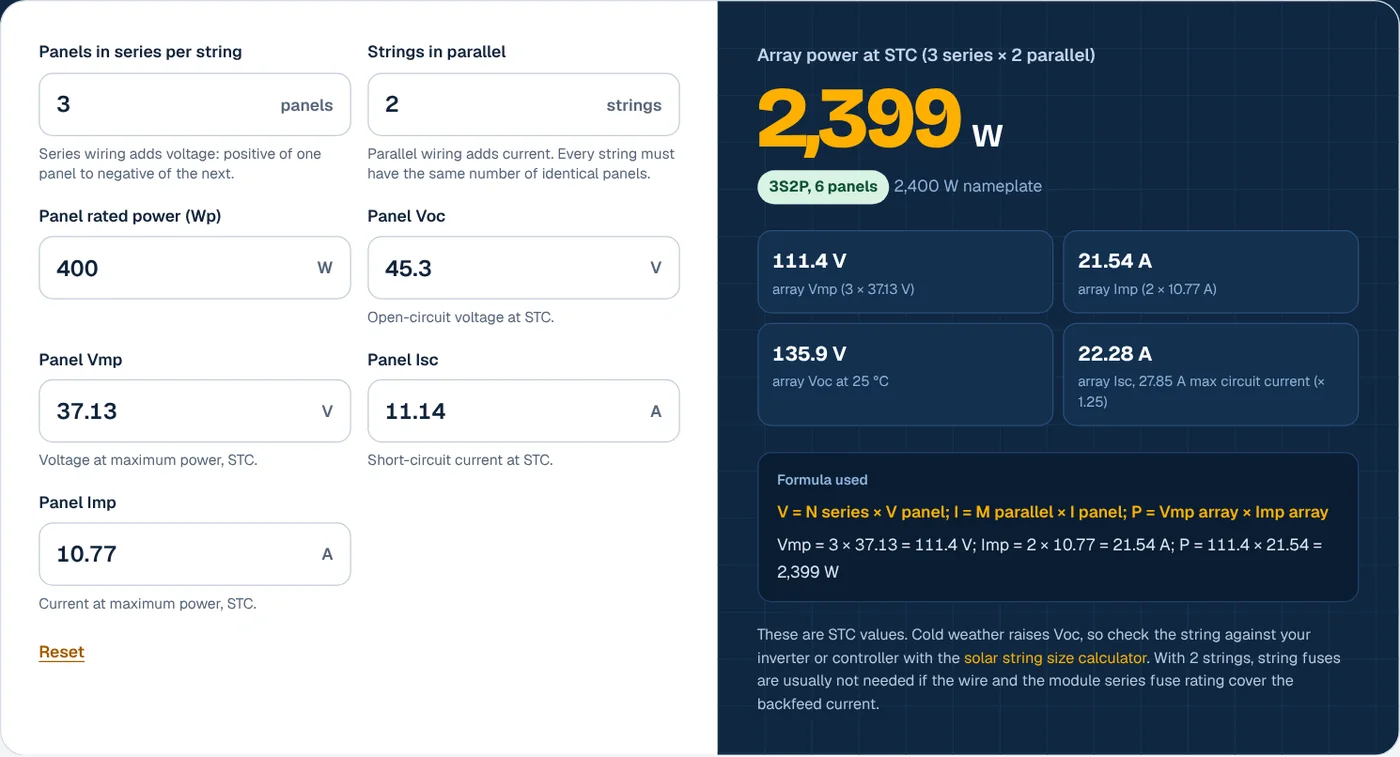
Panels in series add voltage and panels in parallel add current: Varray = N × Vpanel and Iarray = M × Ipanel. Six 400 W panels wired 3S2P (3 in series, 2 strings in parallel) give 111.4 V Vmp, 21.54 A Imp, 135.9 V Voc and 22.28 A Isc, for 2,400 W. Total power is the same whichever way you wire them; only voltage and current change.
How to use the solar panel series and parallel calculator
- Enter the wiring layout. Type how many panels go in series in each string and how many strings run in parallel. Six panels as 3S2P means 3 in series and 2 strings.
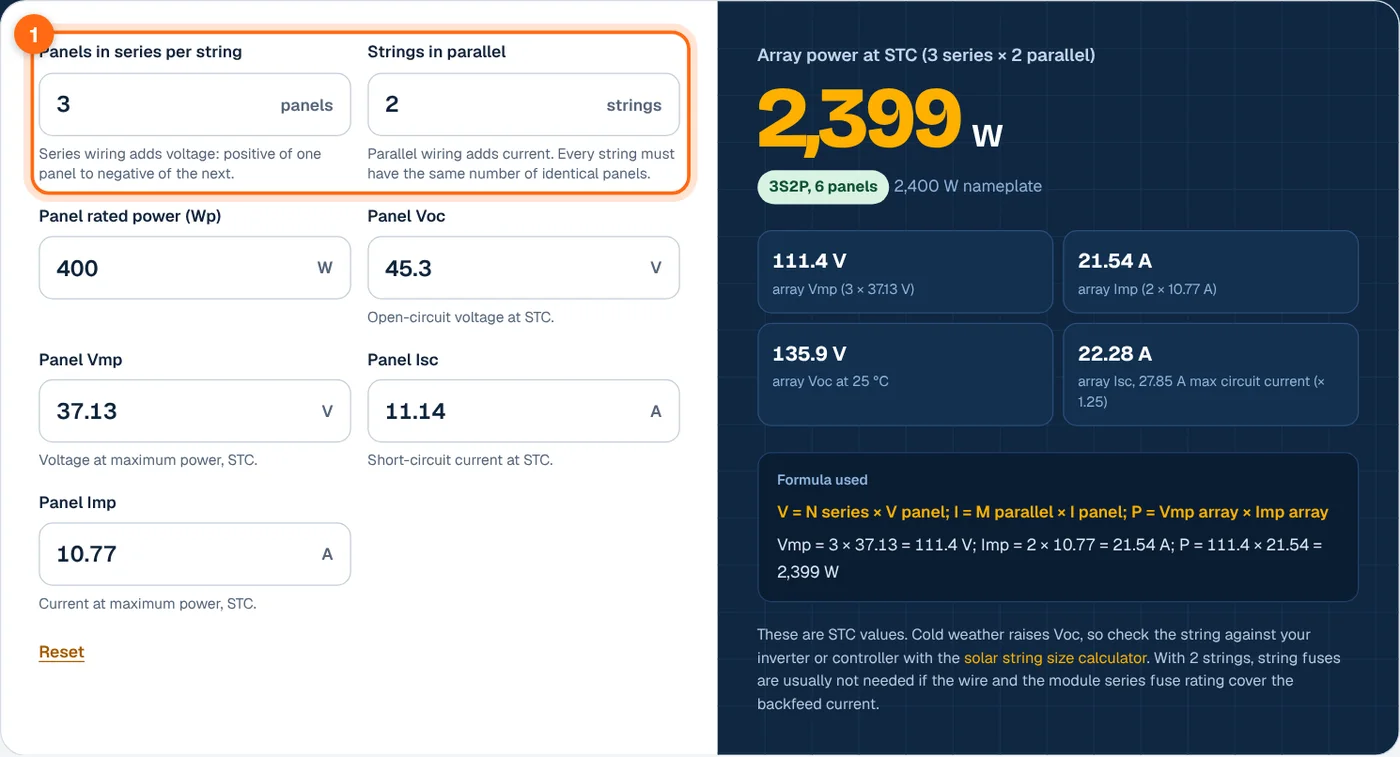
- Enter the panel power. Use the rated Wp from the datasheet. The calculator uses it to check that the voltage and current values agree.

- Enter the panel voltages and currents. Copy Voc, Vmp, Isc and Imp at STC from the datasheet or the label on the back of the panel.

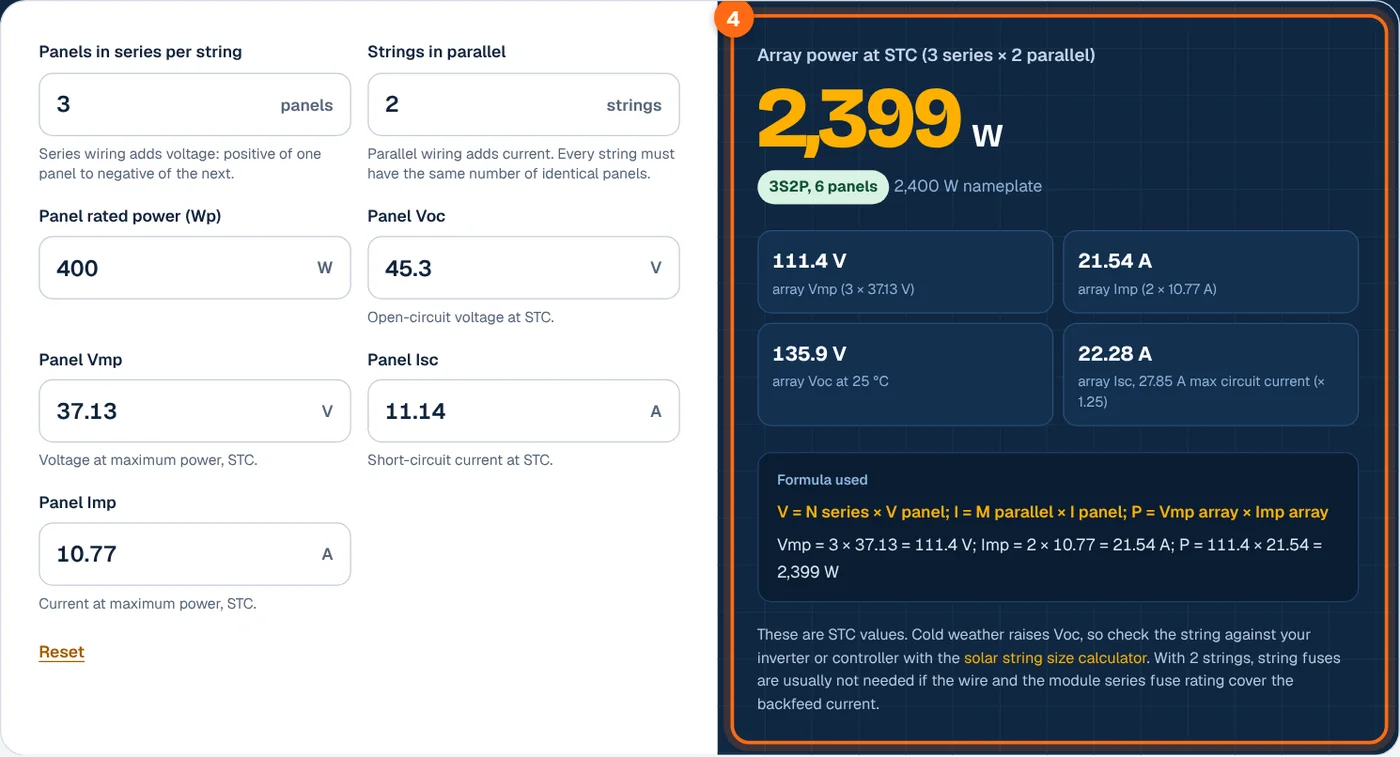
- Read the array power. The big number is array power at the maximum power point. The cards show array Vmp, Imp, Voc and Isc, and the maximum circuit current for wire and fuse sizing.
Series and parallel wiring formulas
In series, the same current flows through every panel, and the voltages add. In parallel, every string sees the same voltage, and the currents add.
Where:
- Ns is the number of panels in series in each string.
- Np is the number of strings in parallel.
- Voc, Vmp, Isc and Imp are the panel’s open-circuit voltage, maximum power voltage, short-circuit current and maximum power current at STC.
- 1.25 is the NEC 690.8(A) factor for PV circuit current, which allows for sunlight above 1,000 W/m².
Worked examples
Example 1: six 400 W panels as 3S2P
Panel data: Voc 45.3 V, Vmp 37.13 V, Isc 11.14 A, Imp 10.77 A.
The maximum circuit current is 22.28 × 1.25 = 27.85 A, which is what the combined output cable must carry. The 1 W gap from 2,400 W is just datasheet rounding.
Example 2: the same six panels as 6S1P
Power is identical, but the current is halved. Lower current means thinner wire and less voltage drop, as long as the voltage suits the inverter.
Example 3: four 100 W 12 V panels three ways
Panel data: Voc 24.3 V, Vmp 20.4 V, Isc 5.21 A, Imp 4.91 A.
- 4P (1S4P): 20.4 V × 19.64 A = 401 W. Suits a PWM controller on a 12 V battery.
- 2S2P: 40.8 V × 9.82 A = 401 W. A good match for a 12 V or 24 V MPPT controller.
- 4S (4S1P): 81.6 V × 4.91 A = 401 W, with 97.2 V Voc. Needs an MPPT controller rated well above 100 V in cold weather.
Wiring layouts compared
Six 400 W panels (Voc 45.3 V, Vmp 37.13 V, Isc 11.14 A, Imp 10.77 A), all at STC.
| Layout | Array Vmp | Array Voc | Array Imp | Array Isc | Max circuit current | Power |
|---|---|---|---|---|---|---|
| 6S1P | 222.8 V | 271.8 V | 10.77 A | 11.14 A | 13.93 A | 2,399 W |
| 3S2P | 111.4 V | 135.9 V | 21.54 A | 22.28 A | 27.85 A | 2,399 W |
| 2S3P | 74.3 V | 90.6 V | 32.31 A | 33.42 A | 41.78 A | 2,399 W |
| 1S6P | 37.1 V | 45.3 V | 64.62 A | 66.84 A | 83.55 A | 2,399 W |
The 2S3P and 1S6P layouts have three or more strings in parallel, so each string needs its own fuse. Size them with the solar fuse size calculator.
What affects series and parallel wiring
Inverter or controller voltage limits
Series strings must stay below the maximum DC input voltage even on the coldest morning, when Voc rises, and above the MPPT minimum on hot afternoons. This calculator gives STC values. Use the solar string size calculator to check temperature-corrected string limits against your inverter.
Shading and mismatch
In a series string, one shaded panel pulls down the current of the whole string, although bypass diodes limit the damage. Parallel strings are more tolerant because each string works on its own. Put panels with different orientations on separate strings or MPPT inputs.
Current, wire size and fuses
Every extra parallel string adds current, which needs thicker wire and, from three strings up, string fuses. Series wiring keeps current low. The solar cable size calculator sizes the cable for the array current you get here.
Mixing different panels
Panels in one string should have matching current, and strings in parallel should have matching voltage. Mixing models wastes power because the array runs at the weakest panel’s current or the lowest string’s voltage.
Frequently asked questions
Is it better to wire solar panels in series or parallel?
For grid-tied and MPPT systems, series is usually better: higher voltage, lower current, thinner wire and less loss. Parallel suits PWM controllers on 12 V batteries and roofs with partial shade. Most medium systems use a mix, such as 3S2P, to fit the controller’s voltage window.
What happens to voltage and current in series?
Voltage adds and current stays the same. Three panels with 37.13 V Vmp and 10.77 A Imp in series give 111.4 V at 10.77 A. In parallel the opposite happens: the voltage stays at 37.13 V and the current adds to 32.31 A. Power is the same both ways.
Can I connect two strings of different lengths in parallel?
You should not. Strings in parallel are forced to the same voltage, so a shorter string drags the longer one away from its maximum power point and both lose output. Put unequal strings on separate MPPT inputs instead, which most modern inverters provide.
What does 2S2P mean?
It means two panels in series per string and two strings in parallel, four panels in total. The array voltage is twice one panel’s voltage and the array current is twice one panel’s current. Four 100 W 12 V panels as 2S2P give about 40.8 V and 9.8 A.
Why multiply Isc by 1.25?
On clear days with reflection from clouds or snow, sunlight can exceed the 1,000 W/m² used to rate panels, so current can rise above Isc. NEC 690.8(A) therefore sets the maximum PV circuit current at 125% of the summed Isc. Wire and fuses are then sized from that current.