Daylight Hours Calculator
Calculate the day length for any location and date, with the longest and shortest days and a month-by-month chart.
Quick answer
Day length is the time from sunrise to sunset. New York gets 9 h 15 min of daylight on December 21, 2026 and 15 h 06 min on June 20, while London ranges from 7 h 50 min to 16 h 38 min. At the equinoxes every place on Earth gets about 12 h 10 min, slightly more than 12 hours because of refraction and the size of the sun’s disc.

How to use the daylight hours calculator
- Set your location. Search for a city, town or ZIP code, or use your device location. Day length depends only on latitude and the date, so nearby towns give almost the same answer.

- Choose the date. Pick the month and day. Change the year if you need a past or future date; the yearly scan and chart follow the year you enter.
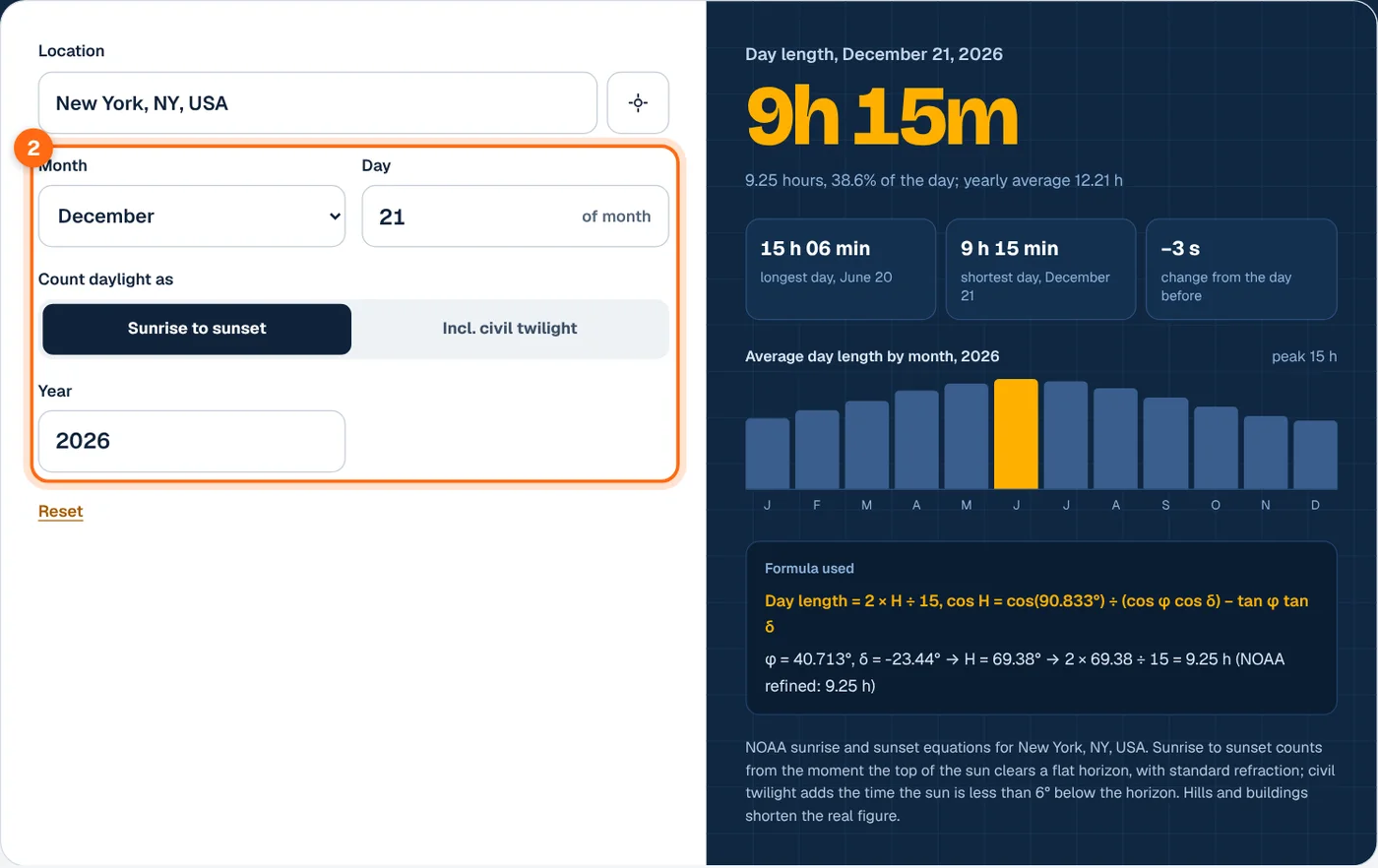
- Choose how to count daylight. Sunrise to sunset is the standard day length. Including civil twilight adds the bright periods before sunrise and after sunset when the sun is less than 6° below the horizon.
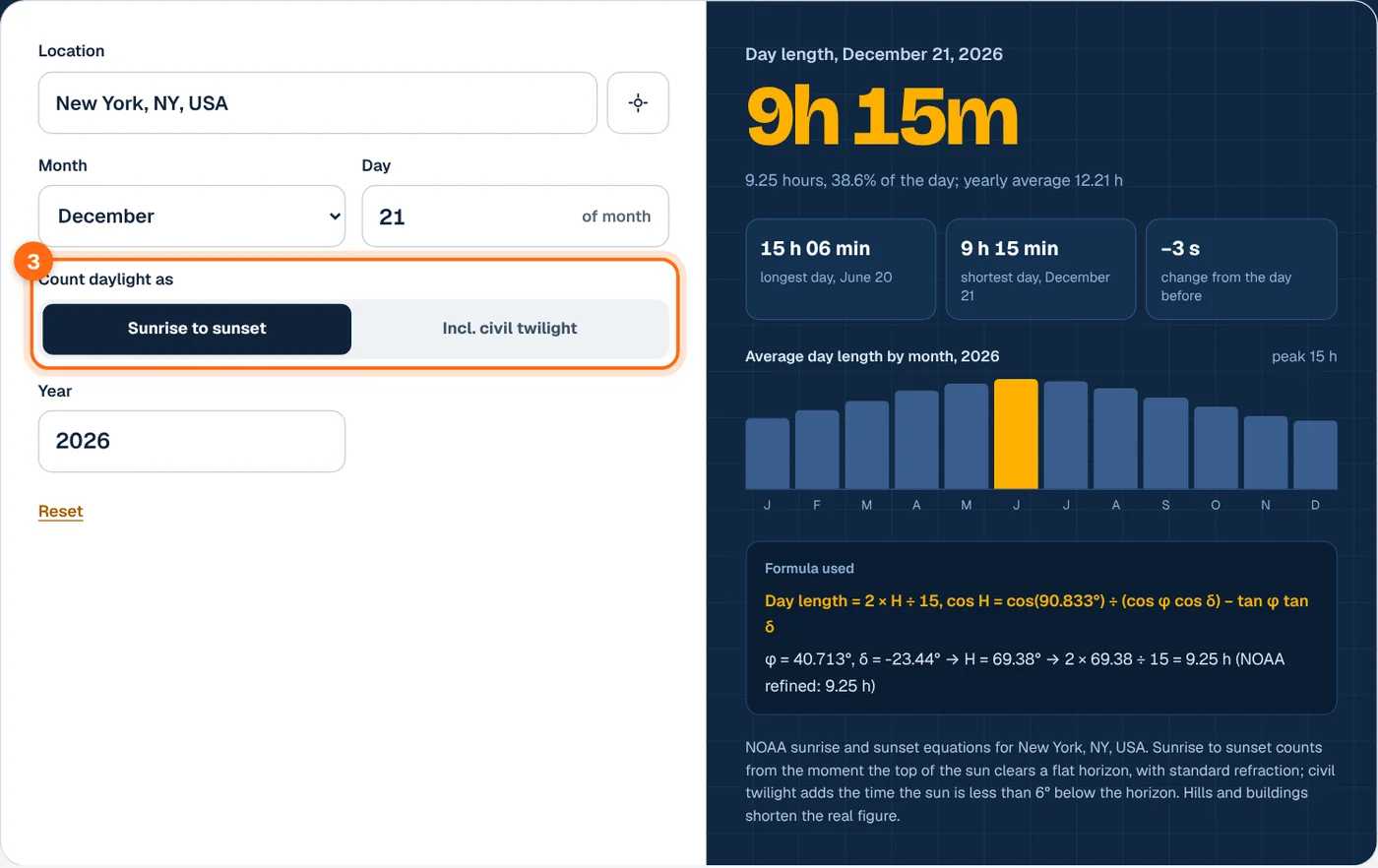
- Read the day length. The big number is the daylight on your date. The cards show the longest and shortest days of the year and the change from the day before, and the chart shows the average day length in each month.

Day length formula
The sun rises and sets when it sits at a fixed angle below the horizontal. The hour angle at that moment gives half the day, and the earth turns 15° an hour.
Where:
- H is the sunrise hour angle in degrees, the angle the earth turns between sunrise and solar noon.
- φ is your latitude, positive north and negative south.
- δ is the solar declination on that date, from +23.44° at the June solstice to −23.44° at the December solstice.
- 90.833° is the zenith angle at sunrise and sunset: 90° plus 0.833° for atmospheric refraction and the radius of the sun’s disc. For civil twilight the calculator uses 96°.
If the right side of the first equation is above 1, the sun never rises (polar night). If it is below −1, the sun never sets (midnight sun). The calculator refines each sunrise and sunset with the declination at that exact moment, following the NOAA solar calculation method, which is accurate to about a minute within ±72° latitude. It then repeats the calculation for every day of the year to find the monthly averages and the longest and shortest days.
Worked examples
Example 1: New York on the winter solstice
Latitude 40.713° N, December 21, 2026. The declination is −23.44°.
The day is shrinking by only 3 seconds compared with December 20, because the solstice is the turning point. The longest day of 2026 in New York is June 20 at 15 h 06 min.
Example 2: London at midsummer
Latitude 51.507° N, June 21, 2026. The declination is +23.44°.
On December 21 the same city gets only 7 h 50 min. That 8 h 48 min swing is one reason UK solar output in December is under a third of June output.
Example 3: Anchorage, a high-latitude city
Latitude 61.218° N. On December 21, 2026, H = 40.87°.
On June 20 Anchorage gets 19 h 22 min of daylight. With civil twilight included, December still offers 7 h 32 min of usable light.
Day length by city
Computed with this calculator for 2026, sunrise to sunset. Southern hemisphere seasons are reversed.
| City | Latitude | March 20 | June 21 | September 22 | December 21 |
|---|---|---|---|---|---|
| Miami, FL | 25.8° N | 12h 07m | 13h 45m | 12h 08m | 10h 32m |
| Phoenix, AZ | 33.4° N | 12h 08m | 14h 22m | 12h 08m | 9h 56m |
| Los Angeles, CA | 34.1° N | 12h 08m | 14h 26m | 12h 08m | 9h 53m |
| New York, NY | 40.7° N | 12h 09m | 15h 06m | 12h 09m | 9h 15m |
| Chicago, IL | 41.9° N | 12h 09m | 15h 14m | 12h 10m | 9h 08m |
| Seattle, WA | 47.6° N | 12h 11m | 15h 59m | 12h 10m | 8h 26m |
| London, UK | 51.5° N | 12h 10m | 16h 38m | 12h 13m | 7h 50m |
| Edinburgh, UK | 56.0° N | 12h 11m | 17h 37m | 12h 14m | 6h 58m |
| Anchorage, AK | 61.2° N | 12h 15m | 19h 22m | 12h 14m | 5h 27m |
| Sydney, Australia | 33.9° S | 12h 09m | 9h 54m | 12h 06m | 14h 25m |
Over a full year every location averages a little over 12 hours of daylight a day: 12.21 h in New York and 12.27 h in London.
What affects day length
Latitude
Near the equator day length barely changes: Miami’s range is about 3 hours. Farther from the equator the seasonal swing grows quickly, reaching about 14 hours in Anchorage. Above the Arctic and Antarctic circles the sun stays up or down for whole days. To see how high the sun climbs on any of these dates, use the sun position calculator.
Season
Day length changes fastest around the equinoxes, by about 2 min 43 s a day in New York and 4 min 41 s a day in Edinburgh in March, and slowest at the solstices. The monthly chart shows this as a smooth wave.
Horizon and terrain
The calculation assumes a flat, open horizon. Mountains, valleys and tall buildings delay sunrise and bring sunset forward, sometimes by an hour or more in deep valleys.
Daylight is not solar energy
A long summer day does not translate into equal solar output, because morning and evening light is weak. For energy, use the peak sun hours calculator, which counts the sunlight on a panel rather than the hours the sun is up.
Frequently asked questions
Why is the day longer than 12 hours at the equinox?
Sunrise is counted when the top edge of the sun appears, and sunset when the last edge disappears. The atmosphere also bends light, letting you see the sun when it is just below the horizon. Together these add about 7 to 15 minutes, so equinox days are about 12 h 10 min long.
When is the longest day of the year?
In the northern hemisphere it falls on June 20 or 21, the June solstice. In 2026 the calculator shows June 20 for New York and June 21 for London, because the day lengths differ by only seconds around the solstice. In the southern hemisphere the longest day is around December 21 or 22.
What is civil twilight?
Civil twilight is the period when the sun is between 0° and 6° below the horizon. There is enough light for most outdoor activities without lamps. Including it adds roughly 30 to 60 minutes to the day at mid latitudes, and much more in high latitude summers.
Does more daylight mean more solar power?
More daylight helps, but sun height and cloud matter more. London’s 16-hour June days still give less solar energy than Phoenix’s 14-hour days, because the sun is lower and skies are cloudier. Day length is a useful guide to when panels produce, not how much they produce.
How accurate is this day length calculator?
It uses the NOAA sunrise and sunset equations, accurate to about a minute between ±72° latitude for a flat horizon. Actual sunrise and sunset can shift by a minute or two with temperature and air pressure, and by much more where hills or buildings block the horizon.