Solar Irradiance Calculator
Find the yearly and monthly solar irradiation in kWh/m² on a tilted or flat surface at your location, with mean W/m².
Quick answer
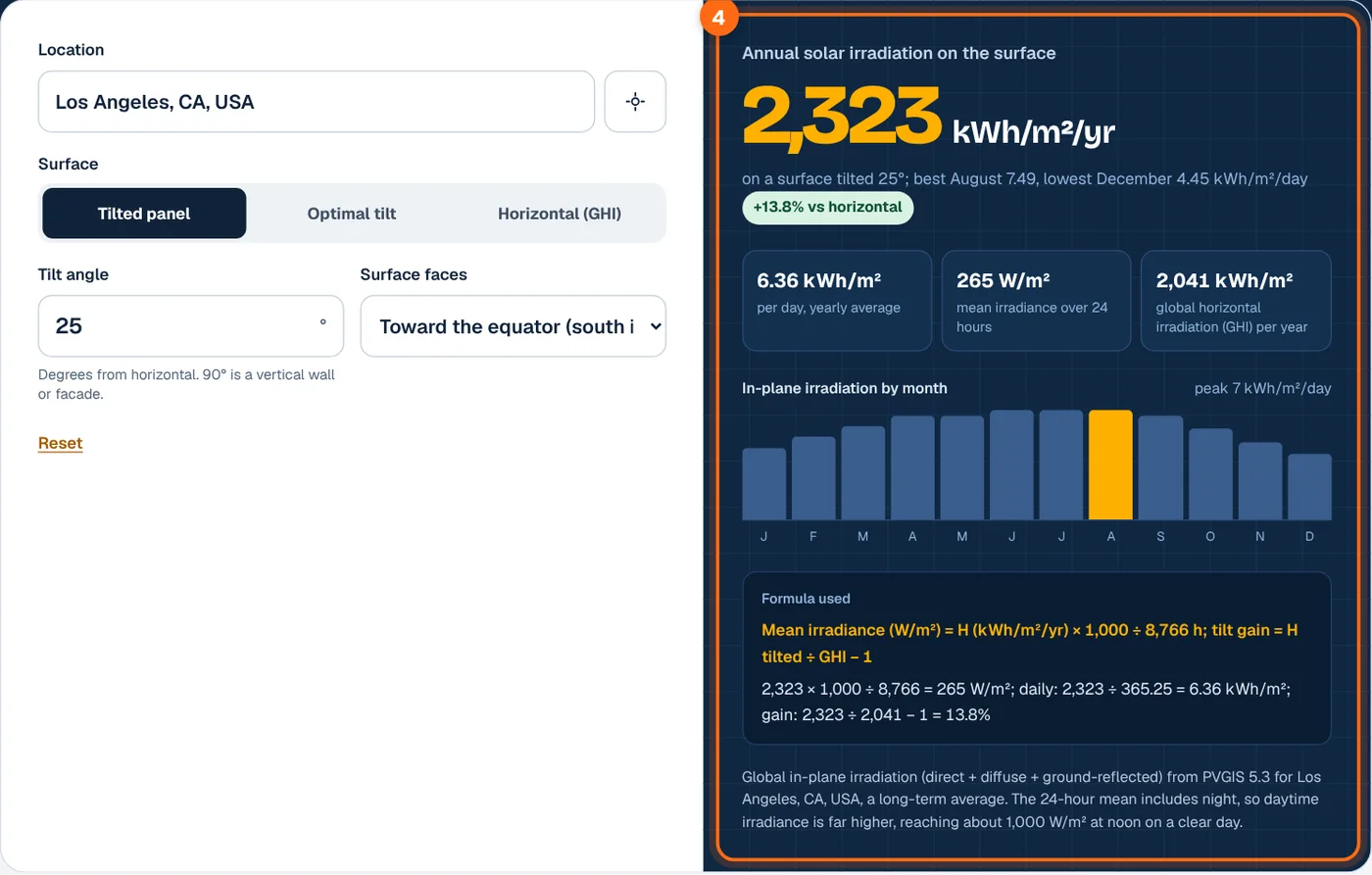
Solar irradiation is the solar energy that falls on a surface, in kWh per square meter. Los Angeles receives about 2,041 kWh/m² a year on flat ground and 2,323 kWh/m² on a south-facing surface tilted 25°, which is 6.36 kWh/m² a day, or a 24-hour mean irradiance of 265 W/m². London gets about 1,070 kWh/m² horizontally and 1,264 kWh/m² at its best tilt.

How to use the solar irradiance calculator
- Set your location. Search for a city, town or ZIP code, or use your device location. The calculator reads long-term irradiation data for that point from PVGIS.
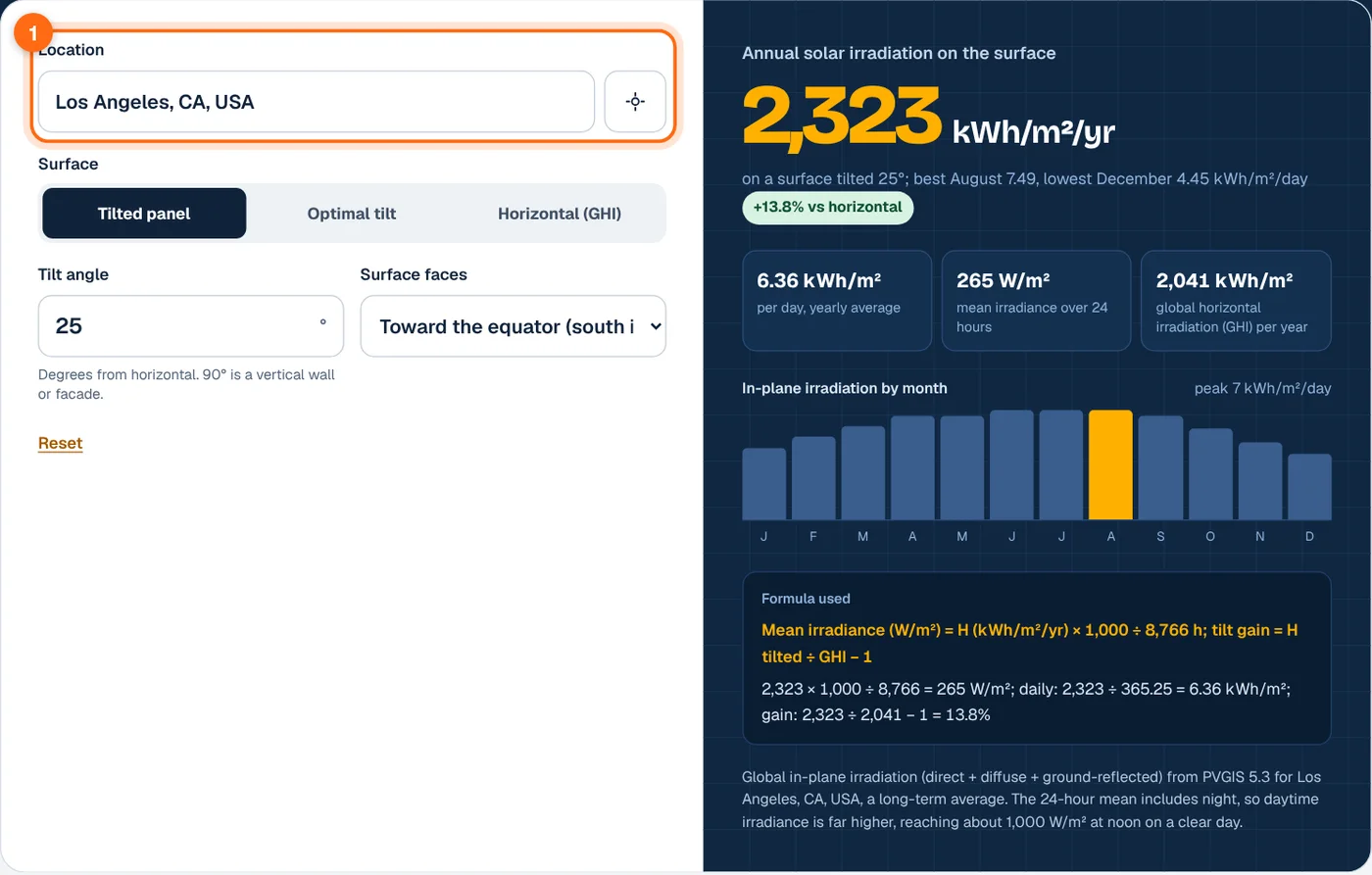
- Choose the surface. Tilted panel lets you set any angle and direction. Optimal tilt uses the angle that collects the most energy over the year. Horizontal (GHI) gives the sunlight on flat ground, the figure weather services publish.

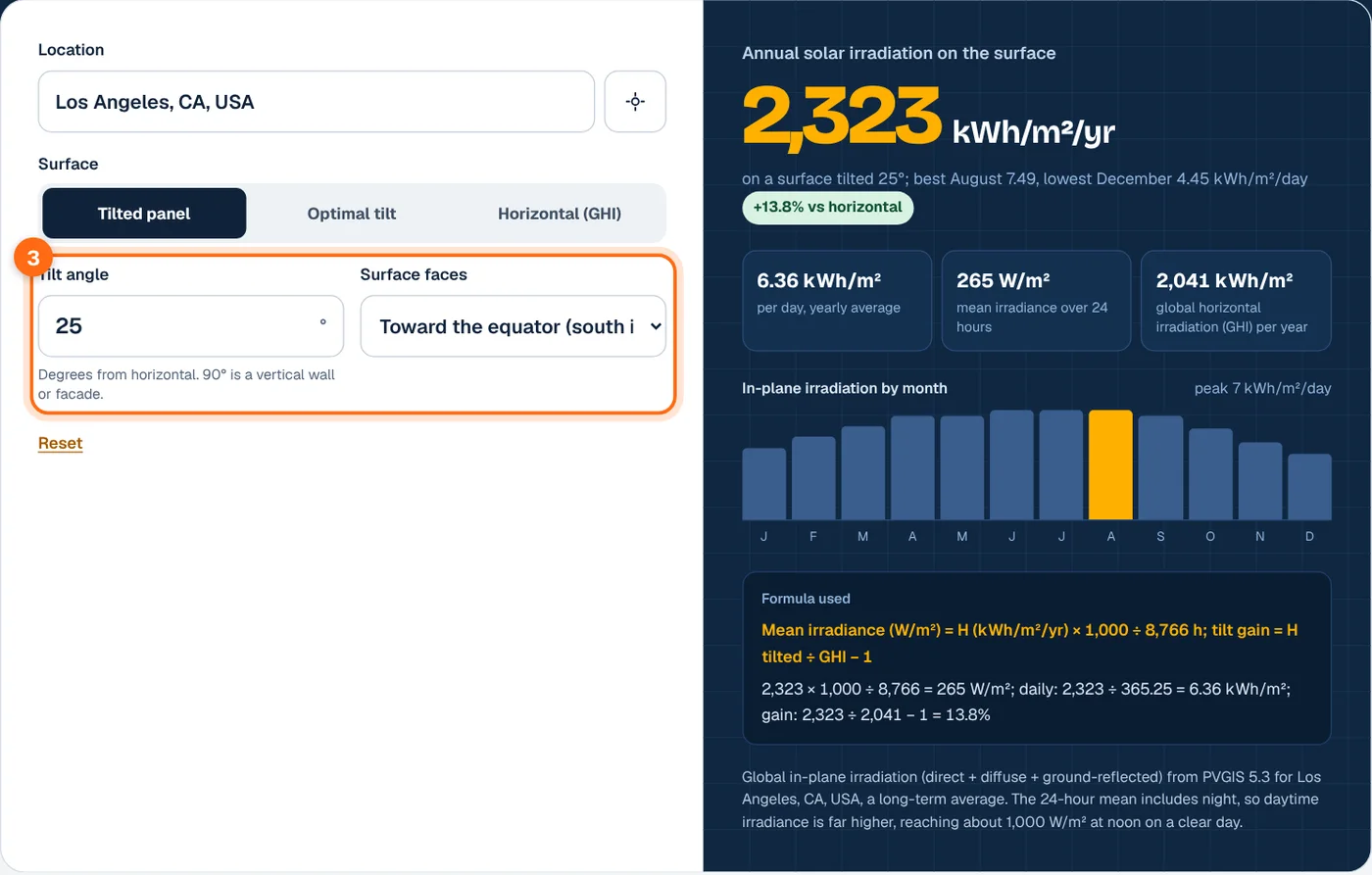
- Enter the tilt and direction. For a tilted panel, enter degrees from horizontal (90° is a vertical wall) and choose the direction it faces.
- Read the irradiation. The big number is the yearly total on your surface in kWh/m². The cards give the daily average, the 24-hour mean in W/m² and the horizontal (GHI) total, and the chart shows kWh/m² per day for each month.
Solar irradiance formula
Irradiance is power per area at one moment, in W/m². Irradiation is irradiance added up over time, in kWh/m². The calculator takes the yearly and monthly in-plane irradiation from PVGIS and converts it.
Where:
- H is global in-plane irradiation: direct beam, diffuse sky light and light reflected from the ground, on your surface.
- GHI is global horizontal irradiation, the same quantity on flat ground.
- 8,766 is the average number of hours in a year (365.25 × 24).
- Gmean is the round-the-clock average irradiance, including night. Clear-sky noon irradiance is about four times higher, close to 1,000 W/m².
PVGIS builds these totals from satellite and reanalysis data and models how light hits a tilted plane. The PVGIS user manual describes the monthly “global irradiation, selected angle” output in kWh/m² that this calculator reads.
The daily figure in kWh/m² has the same value as peak sun hours, since one peak sun hour is 1 kWh/m². If you want sun hours for sizing a system, the peak sun hours calculator reports them directly.
Worked examples
All values are PVGIS 5.3 long-term averages, checked October 2026.
Example 1: Los Angeles, south-facing at 25°
PVGIS gives 2,323 kWh/m² a year on the tilted surface and 2,041 kWh/m² on flat ground.
The best month is August at 7.49 kWh/m² a day and the lowest is December at 4.45.
Example 2: London, horizontal vs optimal
Horizontal irradiation is 1,070 kWh/m² a year. At the optimal 40° facing south it rises to 1,264 kWh/m².
Tilting matters more at high latitudes, where the sun is low for much of the year.
Example 3: A vertical south wall in Phoenix
A south-facing facade at 90° receives 1,513 kWh/m² a year against 2,145 kWh/m² on the ground.
A wall collects most in winter, when the sun is low, which can suit solar facades and balcony panels.
Solar irradiation by city
PVGIS 5.3 yearly irradiation in kWh/m², equator-facing surfaces, checked October 2026. The mean W/m² column is for the 25° surface.
| City | Horizontal (GHI) | 25° tilt | Optimal tilt | Vertical | Mean W/m² at 25° |
|---|---|---|---|---|---|
| Phoenix, AZ | 2,145 | 2,444 | 2,464 (33°) | 1,513 | 279 |
| Los Angeles, CA | 2,041 | 2,323 | 2,340 (32°) | 1,435 | 265 |
| Denver, CO | 1,886 | 2,250 | 2,315 (40°) | 1,598 | 257 |
| Miami, FL | 1,855 | 1,998 | 2,003 (26°) | 1,091 | 228 |
| New York, NY | 1,476 | 1,724 | 1,759 (38°) | 1,207 | 197 |
| Chicago, IL | 1,439 | 1,648 | 1,711 (38°) | 1,103 | 188 |
| Seattle, WA | 1,236 | 1,449 | 1,482 (39°) | 1,041 | 165 |
| London, UK | 1,070 | 1,236 | 1,264 (40°) | 929 | 141 |
| Manchester, UK | 942 | 1,077 | 1,097 (39°) | 810 | 123 |
| Berlin, Germany | 1,109 | 1,286 | 1,314 (40°) | 955 | 147 |
| Sydney, Australia | 1,714 | 1,955 | 1,973 (34°) | 1,261 | 223 |
| Perth, Australia | 1,970 | 2,178 | 2,182 (30°) | 1,264 | 249 |
What affects solar irradiation
Latitude and sun height
The lower the sun, the more atmosphere its light crosses and the more it spreads over the ground. That is why GHI falls from about 2,100 kWh/m² in Phoenix to under 1,000 in Manchester. The sun position calculator shows how high the sun climbs at your location.
Cloud and climate
Cloud cuts direct beam light sharply. Denver beats Miami on a tilted surface despite being much farther north, because of its dry, clear air at altitude.
Tilt and direction
Tilting toward the equator raises yearly irradiation by about 8 to 20% in these cities, with the largest gains in clear, higher-latitude places like Denver. Facing away from the equator, or going vertical, reduces it.
Diffuse light
Under cloud, much of the light is diffuse and comes from the whole sky. Diffuse-heavy climates such as the UK gain less from steep tilts than their latitude suggests, so their optimal angle is flatter than the old “tilt equals latitude” rule.
Frequently asked questions
What is the difference between irradiance and irradiation?
Irradiance is instantaneous power, measured in W/m². Bright noon sun is roughly 1,000 W/m². Irradiation is energy accumulated over time, measured in kWh/m² per day, month or year. Solar panel datasheets use irradiance, while yield estimates use irradiation, because energy is what you get paid for.
What is GHI?
Global horizontal irradiation is the total solar energy on a flat, horizontal surface, including direct and diffuse light. Weather stations and solar maps usually publish GHI. Panels tilted toward the equator receive more, so the calculator also shows the in-plane value for your tilt and the gain over GHI.
Why is the mean irradiance so far below 1,000 W/m²?
The mean in this calculator is averaged over all 8,766 hours of the year, including nights, mornings, evenings and cloudy days. A clear noon can reach 1,000 W/m², but averaged around the clock a sunny place like Phoenix comes out near 280 W/m², and London about 140 W/m².
How much solar irradiation does a solar panel turn into electricity?
A typical system delivers about 74 to 82% of the energy implied by in-plane irradiation and the panel rating, a figure called the performance ratio. For 1 kWp of panels, yearly kWh is about irradiation in kWh/m² × 0.8. The kWh per kWp calculator gives the exact figure for your location.
Where does this irradiance data come from?
From PVGIS 5.3, run by the European Commission’s Joint Research Centre. It uses satellite-derived radiation databases where available and ERA5 reanalysis elsewhere, then models the light on your tilted surface. Values are multi-year averages, so a single year can be several percent higher or lower.