Ah to Amps Calculator
Find the current a battery can supply over a set runtime, and check it against the battery's maximum C rating.
Quick answer
To convert Ah to amps, divide the amp-hours by the runtime in hours: A = Ah ÷ h. A 100 Ah battery that must last 10 hours can supply 100 ÷ 10 = 10 A on average. The most it can deliver at once is set by its C rating: a 1C limit on 100 Ah means 100 A.

How to use the Ah to amps calculator
- Enter the battery capacity. Type the amp-hour rating from the label. For batteries in parallel, add their amp-hours together.

- Enter the runtime. Type how long the battery should supply the load and pick hours or minutes. The result is the steady current that would use the full capacity in that time.
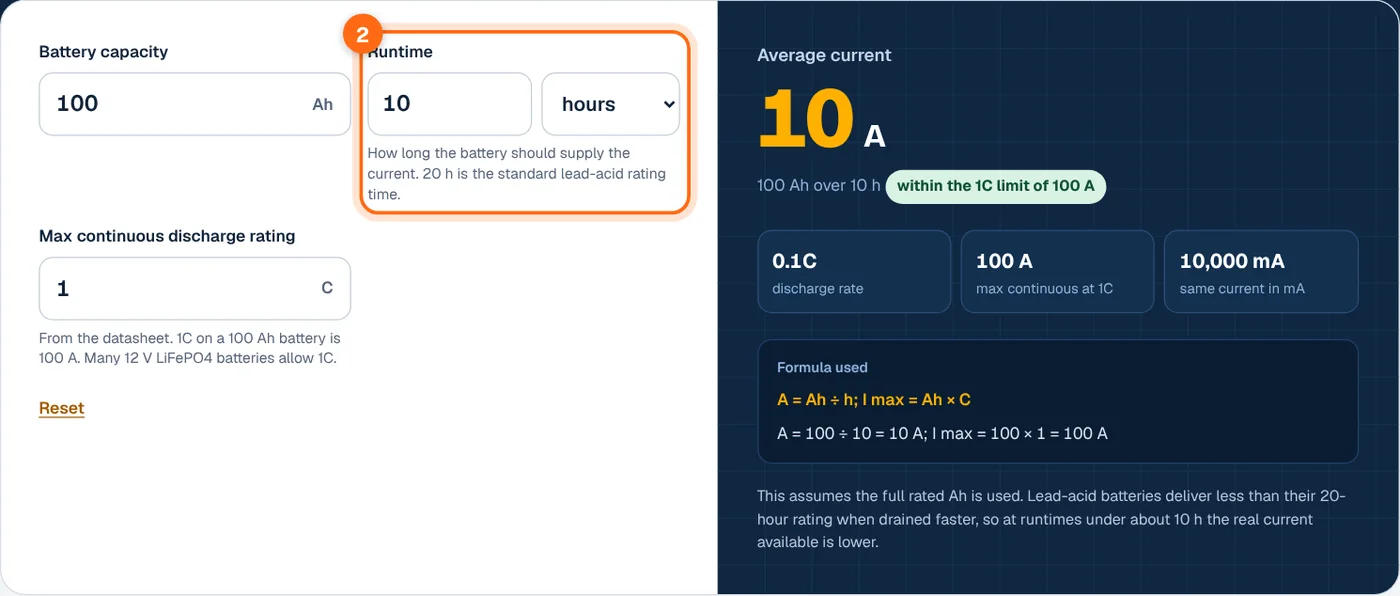
- Enter the max discharge rating. Copy the maximum continuous discharge rating from the datasheet as a C-rate. Many 12 V LiFePO4 batteries allow 1C. The chip checks your current against it.

- Read the result. The large number is the average current in amps. The cards show the discharge rate, the maximum continuous current and the same current in milliamps.

Ah to amps formula
Amp-hours are a quantity of charge. Spread that charge over a period of time and you get a current. The C rating sets a separate ceiling that has nothing to do with runtime.
Where:
- A is the average current in amps that uses the whole capacity in the chosen time.
- Ah is the battery capacity in amp-hours.
- h is the runtime in hours. Divide minutes by 60.
- I max is the highest continuous current the battery or its BMS allows.
- C rating is that limit expressed as a multiple of capacity. 1C on 100 Ah is 100 A, and 0.5C is 50 A.
The two figures answer different questions. Ah ÷ h tells you what current a runtime target implies. Ah × C tells you whether the battery can physically supply it. The C-rate calculator covers charge and discharge limits by chemistry in more depth.
Worked examples
Example 1: 100 Ah over 10 hours
The 10 A average is a gentle 0.1C discharge and well inside the 1C limit. This is the default example in the calculator.
Example 2: a 7 Ah alarm battery over 30 minutes
Thirty minutes is 0.5 h.
That is a 2C discharge. A small sealed lead-acid battery cannot deliver its full 7 Ah that fast. Victron’s AGM data shows only 42% of rated capacity at a 15-minute rate and 55% at a 30-minute rate, so expect roughly 3 to 4 Ah before the voltage collapses. The calculator flags 14 A as above a 1C limit.
Example 3: checking a 2,000 W inverter on a 200 Ah battery
A 2,000 W inverter at 90% efficiency on 12.8 V draws about 2,000 ÷ 0.9 ÷ 12.8 = 174 A. Enter 200 Ah, a runtime of 1.15 h and a C rating of 1: the average current is 174 A against a 200 A limit, so the battery can supply it. With a 0.5C battery the limit is 100 A, and you would need a second battery in parallel.
Ah to amps chart
Average current in amps that empties each battery in the stated time. The column headings show the matching C-rate.
| Capacity (Ah) | 1 h (1C) | 5 h (C/5) | 10 h (C/10) | 20 h (C/20) |
|---|---|---|---|---|
| 7 | 7 | 1.4 | 0.7 | 0.35 |
| 20 | 20 | 4 | 2 | 1 |
| 50 | 50 | 10 | 5 | 2.5 |
| 100 | 100 | 20 | 10 | 5 |
| 200 | 200 | 40 | 20 | 10 |
| 280 | 280 | 56 | 28 | 14 |
Lead-acid batteries are rated at the 20-hour rate, so the right-hand column is the only one where a lead-acid battery delivers its full label capacity. The Victron LiFePO4 Smart battery datasheet lists 1C as the recommended discharge and 2C as the maximum continuous for its 100 Ah and 200 Ah models.
What affects the result
Usable capacity
The calculator spreads the full rated capacity over the runtime. If you plan to use only 80% of a LiFePO4 battery or 50% of a lead-acid battery, multiply the result by that fraction. A 100 Ah lead-acid battery used to 50% over 10 hours supports 5 A, not 10 A.
Discharge rate and Peukert effect
Lead-acid capacity shrinks as current rises. Victron’s AGM table gives 92% of rated capacity at a 10-hour rate, 85% at 5 hours and 65% at 1 hour. LiFePO4 delivers close to its rating at 1C, which is one reason it suits inverters and trolling motors.
BMS and fuse limits
For lithium batteries, the battery management system often sets the real limit. A 100 Ah battery with a 100 A BMS will shut off above 100 A even if the cells could deliver more. Size cables and fuses for the maximum current, not the average.
Temperature
Cold batteries deliver less current and fewer amp-hours. Lead-acid capacity falls to roughly 80% at 14 °F (−10 °C), and many LiFePO4 batteries limit discharge current in freezing conditions.
Frequently asked questions
How do you convert Ah to amps?
Divide the amp-hours by the number of hours you want the battery to last. A 50 Ah battery over 5 hours gives 10 A. You cannot convert Ah to amps without a time, because Ah is a quantity of charge and amps are a rate of flow. The C rating gives the maximum current instead.
How many amps can a 100 Ah battery deliver?
On average, 100 ÷ hours: 5 A over 20 hours, 10 A over 10 hours, 100 A over 1 hour. The maximum continuous current depends on the C rating. Many 100 Ah LiFePO4 batteries allow 100 A (1C), some 200 A (2C). Lead-acid batteries can surge high but lose capacity quickly at high currents.
What does 1C mean on a battery?
1C is a current equal to the battery capacity in amp-hours, so 1C on a 100 Ah battery is 100 A. At 1C a full battery empties in about one hour. 0.5C is half that current and two hours, and C/20 or 0.05C is the 20-hour rate used for lead-acid ratings.
How many amps is 7 Ah?
It depends on the time. A 7 Ah battery supplies 0.35 A for 20 hours, 1.4 A for 5 hours or 7 A for 1 hour. Small sealed lead-acid batteries of this size are rated at the 20-hour rate, so at a 1-hour rate they deliver only about 65% of their label capacity.
Is a higher Ah battery able to supply more amps?
Usually, yes. For the same chemistry and C rating, maximum current scales with capacity, so a 200 Ah battery at 1C supplies 200 A while a 100 Ah battery supplies 100 A. It also runs the same load for twice as long. Check the datasheet, because BMS limits do not always scale with capacity.