Off-Grid Solar Calculator
Size a full off-grid solar system for your worst month: array, panel count, battery bank, charge controller and inverter.
Quick answer
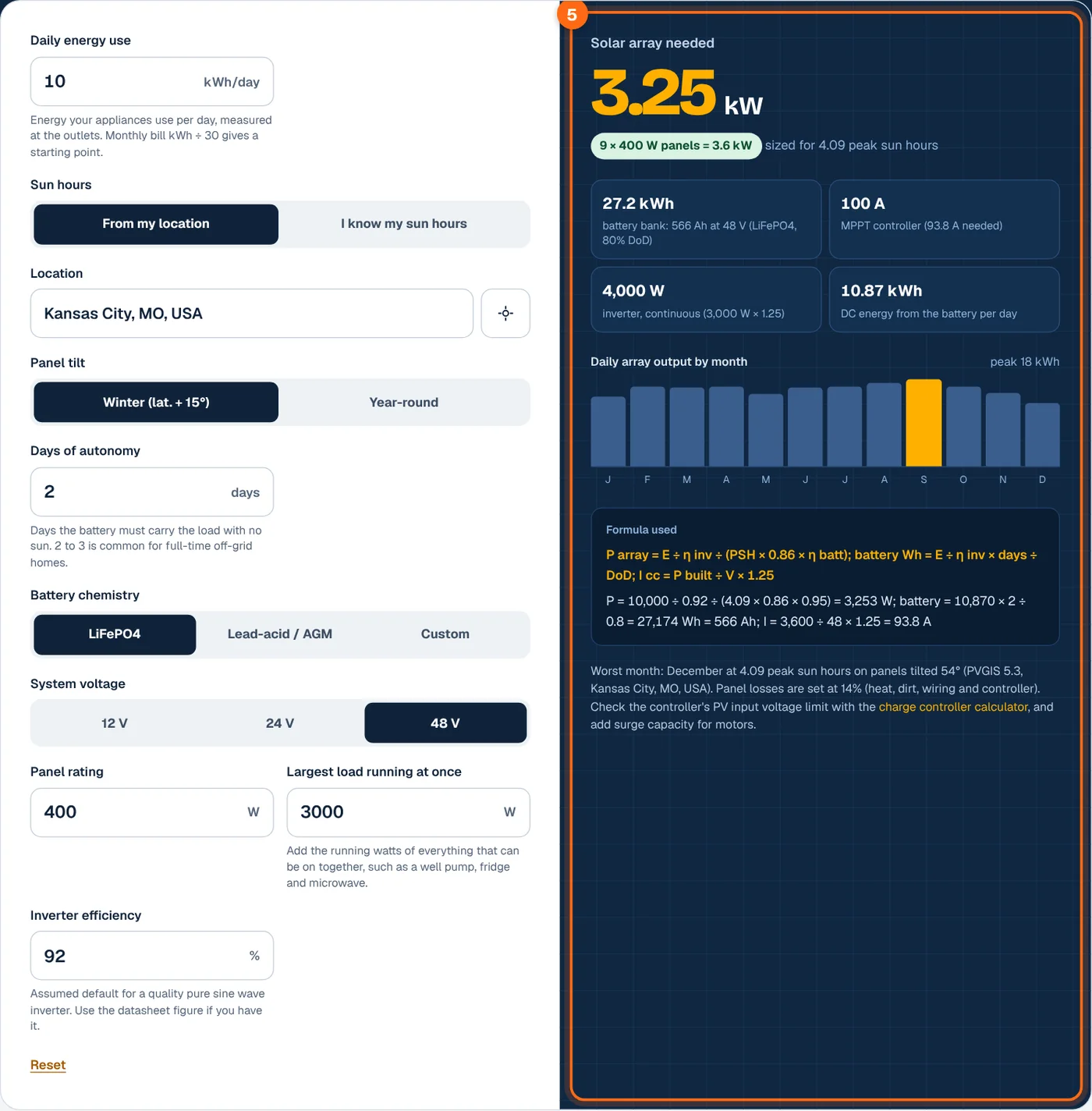
To go off grid with solar, size the array for your darkest month and the battery for the days without sun. Array W = daily Wh ÷ inverter efficiency ÷ (worst-month peak sun hours × 0.86 × battery efficiency). A home using 10 kWh a day in Kansas City needs about 3.25 kW of panels (9 × 400 W), a 27.2 kWh LiFePO4 bank for 2 days, a 100 A MPPT controller at 48 V and a 4,000 W inverter.

How to use the off-grid solar calculator
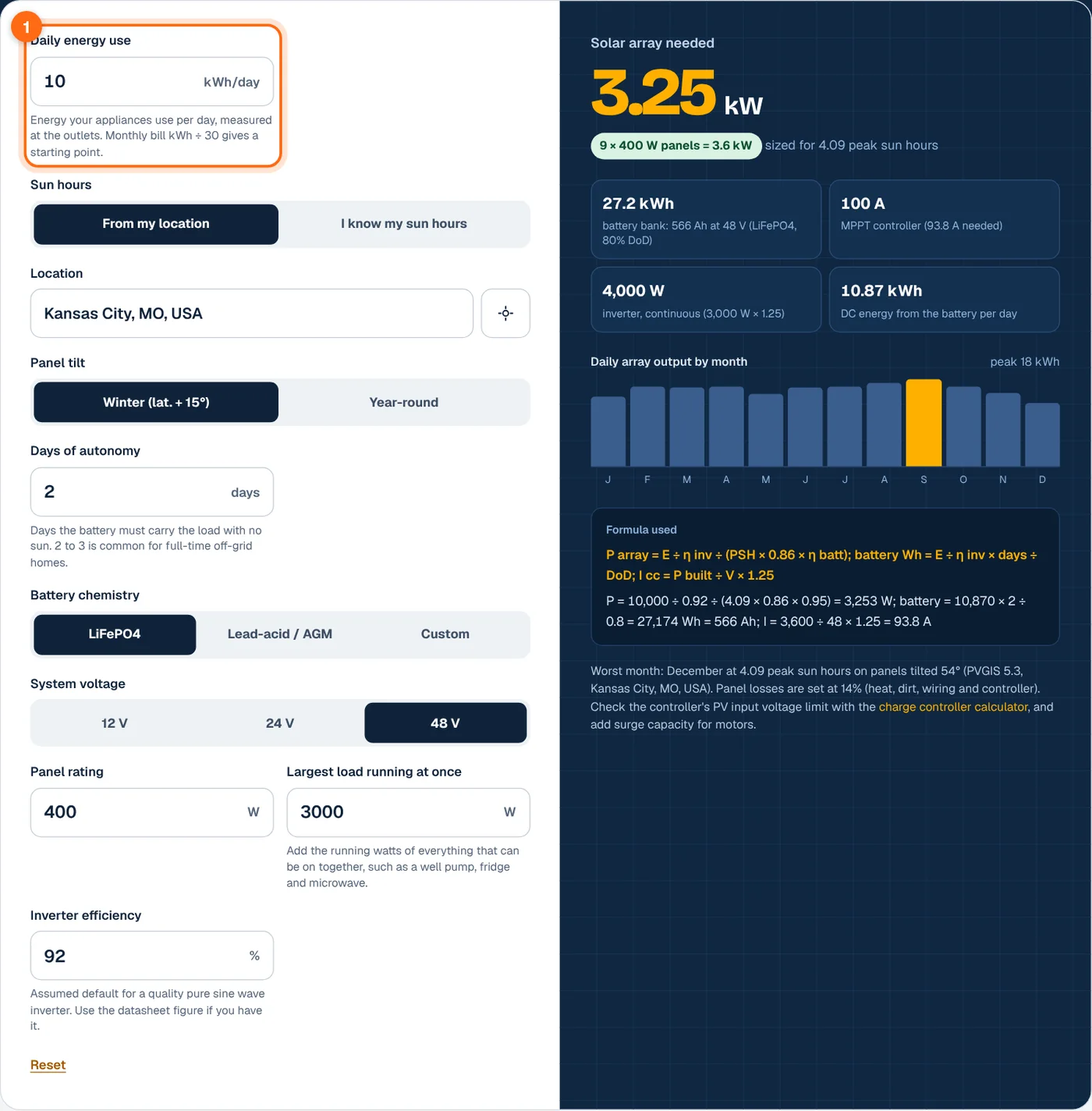
- Enter your daily energy use. Use kWh per day measured at the outlets. A grid bill divided by 30 is a starting point, but most people cut their use when they go off grid, so a load list from the solar load calculator is more accurate.
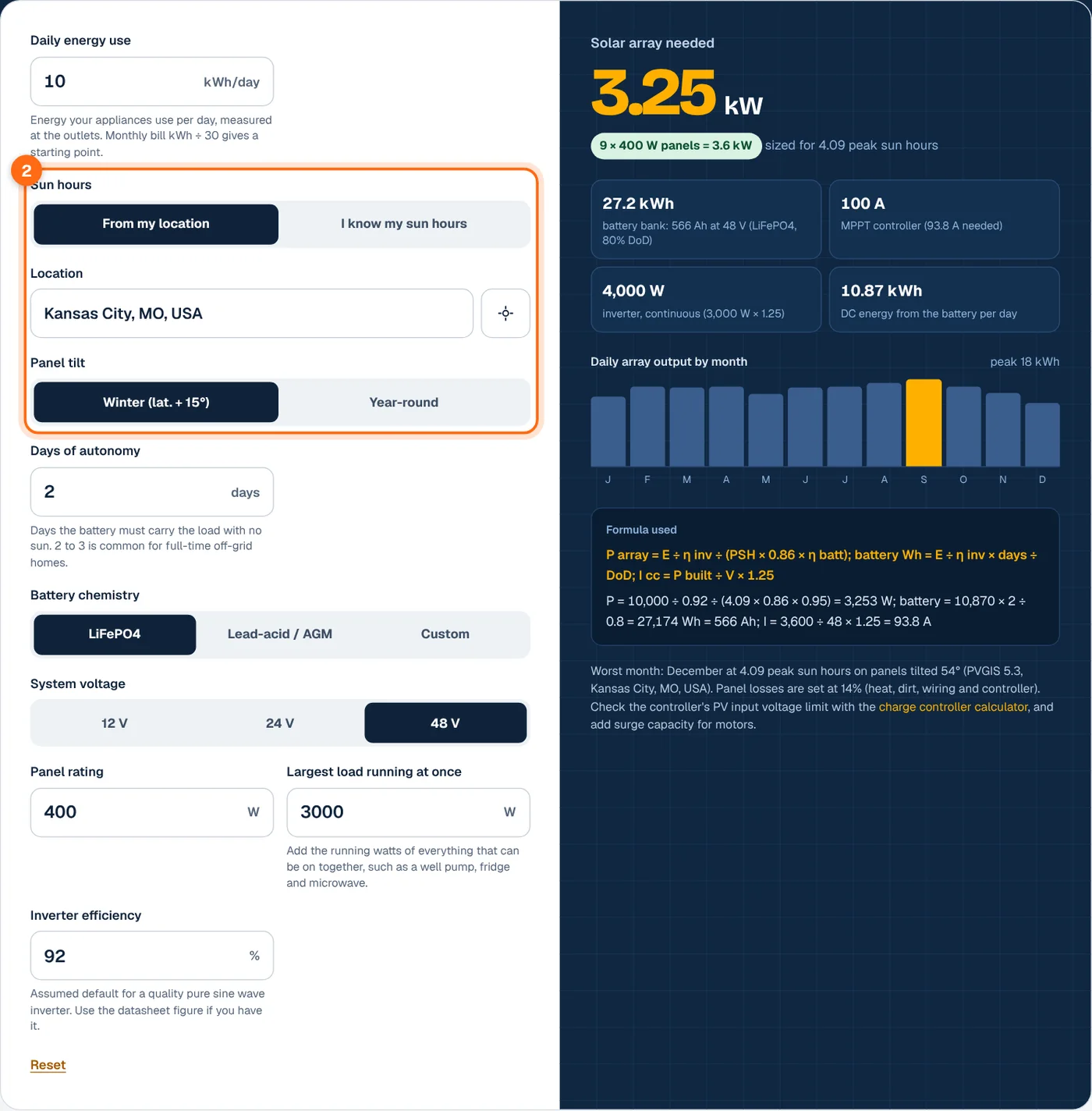
- Set your sun hours. Pick From my location and search your town to pull monthly sunlight from PVGIS, then choose the winter tilt (latitude + 15°) or the year-round optimal tilt. The calculator takes the worst month automatically. If you already know your worst-month peak sun hours, enter them instead.
- Choose autonomy and the battery. Enter the days the bank must run with no sun, then pick LiFePO4 (80% depth of discharge, 95% efficiency), lead-acid (50%, 85%) or your own values.

- Set the system details. Choose 12, 24 or 48 V, the panel rating you plan to buy, the largest load running at once and the inverter efficiency.

- Read the system size. The big number is the array in kW, with the panel count below it. The cards show the battery in kWh and Ah, the charge controller current, the inverter rating and the DC energy drawn from the battery. The chart shows what the array makes in each month.
Off-grid solar formula
With no grid to fall back on, every part is sized for the dullest month and a run of cloudy days.
Where:
- Eday is the daily AC energy your appliances use, in Wh.
- ηinv is inverter efficiency, and ηbatt is battery round-trip efficiency.
- PSHmin is peak sun hours per day in the worst month on your tilted panels.
- 0.86 allows 14% for heat, dirt, wiring and controller losses, the same figure PVGIS uses by default.
- D is days of autonomy and DoD the usable share of the battery.
- Pbuilt is the panel count rounded up, times the panel rating. Ppeak is the largest load running at once.
The sun data come from the European Commission’s PVGIS 5.3 database. The PVGIS user manual explains how it reports monthly irradiation on a fixed, tilted plane.
Worked examples
Example 1: 10 kWh a day in Kansas City
With panels at the winter tilt of 54°, PVGIS gives Kansas City its worst month in December at 4.09 peak sun hours. The home uses 10 kWh a day on a 48 V LiFePO4 system with a 92% inverter.
The controller needs 3,600 ÷ 48 × 1.25 = 93.8 A, so a 100 A MPPT unit (or two 50 A units). A 3,000 W peak load needs a 4,000 W inverter. At the year-round optimal tilt of 37°, December drops to 3.71 peak sun hours and the array grows to 3.59 kW.
Example 2: weekend cabin on lead-acid
A cabin uses 3 kWh a day, gets 3 peak sun hours in its worst month and needs 3 days of storage on a 24 V lead-acid bank with 200 W panels and a 1,500 W peak load.
The controller needs 83.3 A (a 100 A unit) and the inverter 2,000 W. Lead-acid makes the bank almost as large in kWh as the 10 kWh home in Example 1, because only half of it is usable.
Example 3: 20 kWh a day in a sunny climate
At 5.4 worst-month peak sun hours, a 20 kWh home on 48 V LiFePO4 with 450 W panels and a 5,000 W peak load needs 4.93 kW (11 panels), a 54.3 kWh bank (1,132 Ah), 128.9 A of MPPT capacity (a 150 A unit) and an 8,000 W inverter.
Array size per kWh of daily use
Panel watts needed for each 1 kWh of daily AC use, at a 92% inverter and 14% panel losses. Multiply by your kWh per day.
| Worst-month peak sun hours | LiFePO4 (95%) | Lead-acid (85%) |
|---|---|---|
| 2 h | 665 W | 743 W |
| 3 h | 443 W | 496 W |
| 4 h | 333 W | 372 W |
| 5 h | 266 W | 297 W |
| 6 h | 222 W | 248 W |
Battery storage per 1 kWh of daily use is 1,359 Wh per day of autonomy for LiFePO4 at 80% DoD and 2,174 Wh for lead-acid at 50% DoD. Two days of autonomy doubles those figures.
What affects the result
The worst month, not the average
Sizing on the yearly average leaves you short every winter. In Kansas City the yearly average is near 5.2 peak sun hours, but December gives 4.09 even on steep panels.
Battery chemistry
Victron’s Energy Unlimited guide advises never leaving a lead-acid battery more than 50% discharged and puts its charge efficiency between 80% and 95%. LiFePO4 accepts deeper cycles with smaller losses, which shrinks both the bank and the array.
System voltage
The battery energy in kWh does not change with voltage, but the current does. A 3.6 kW array would push 375 A into a 12 V bank, which is impractical. Most whole-home systems above 2 kW use 48 V.
Peak load and surge
The inverter must carry everything that can run together, and motors such as well pumps need several times their running watts for a moment at start-up. Check the surge rating with the inverter size calculator.
Frequently asked questions
How many solar panels do I need to go off grid?
Divide the array size by the panel rating and round up. A home using 10 kWh a day in a place with 4 worst-month peak sun hours needs about 3.3 kW, or 9 panels of 400 W. A frugal cabin using 3 kWh needs about 1.5 kW. The calculator finds your worst month from PVGIS data.
How big a battery bank do I need for off-grid solar?
Multiply the daily DC energy by the days of autonomy and divide by the depth of discharge. For 10 kWh a day of appliance use, a 92% inverter and 2 days on LiFePO4 at 80% DoD, that is about 27 kWh. The same home on lead-acid at 50% DoD needs about 43 kWh.
Can I go off grid with solar and no generator?
Yes, but it costs more. Without a generator the array must cover the darkest month and the battery must cover the longest cloudy spell, often 3 to 5 days in northern climates. Many owners add a small generator for a few days a year, which lets them cut both the array and the bank.
Should I use 12 V, 24 V or 48 V for an off-grid home?
Use 48 V for most homes. It carries the same power at a quarter of the 12 V current, so cables, fuses and controllers are smaller and cheaper. 12 V suits small cabins under about 1 kW of panels, and 24 V suits mid-size systems of 1 to 2 kW.
How much does it cost to go off grid with solar?
The calculator gives the sizes to price. For the 10 kWh example, that is about 3.6 kW of panels, 27 kWh of LiFePO4 storage, a 100 A MPPT controller and a 4,000 W inverter, plus mounting, wiring and labor. The battery is usually the largest single cost, so cutting daily use pays off most.