Wh to Ah Calculator
Turn a watt-hour load budget or power station rating into the amp-hours you need at 12, 24 or 48 V.
Quick answer
To convert Wh to Ah, divide the watt-hours by the battery voltage: Ah = Wh ÷ V. A 2,000 Wh daily load on a 12.8 V LiFePO4 battery needs 2,000 ÷ 12.8 = 156.3 Ah. To size a battery that you only drain to 80%, divide again by 0.8, which gives 195.3 Ah, so a 200 Ah battery fits.

How to use the Wh to Ah calculator
- Enter the energy in Wh. Type a daily load budget, the Wh rating of a power station or power bank, or any other watt-hour figure. For kWh, multiply by 1,000.

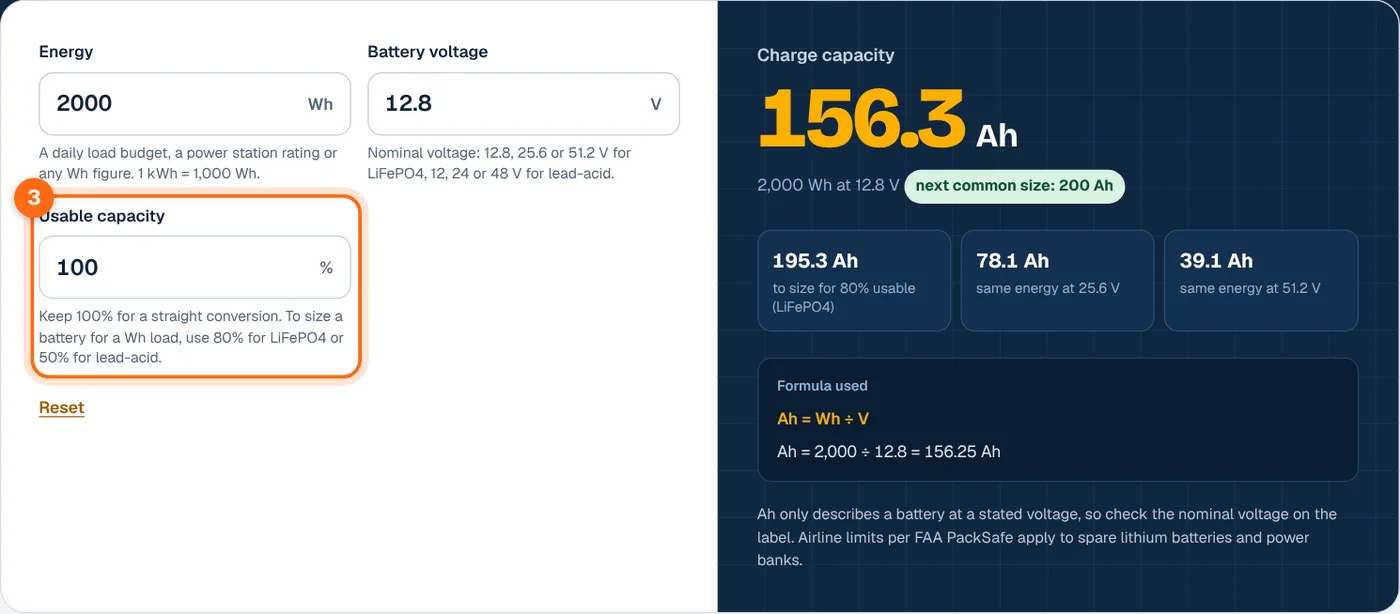
- Enter the battery voltage. Use the nominal voltage of the battery you are converting to: 12.8, 25.6 or 51.2 V for LiFePO4, or 12, 24 or 48 V for lead-acid.
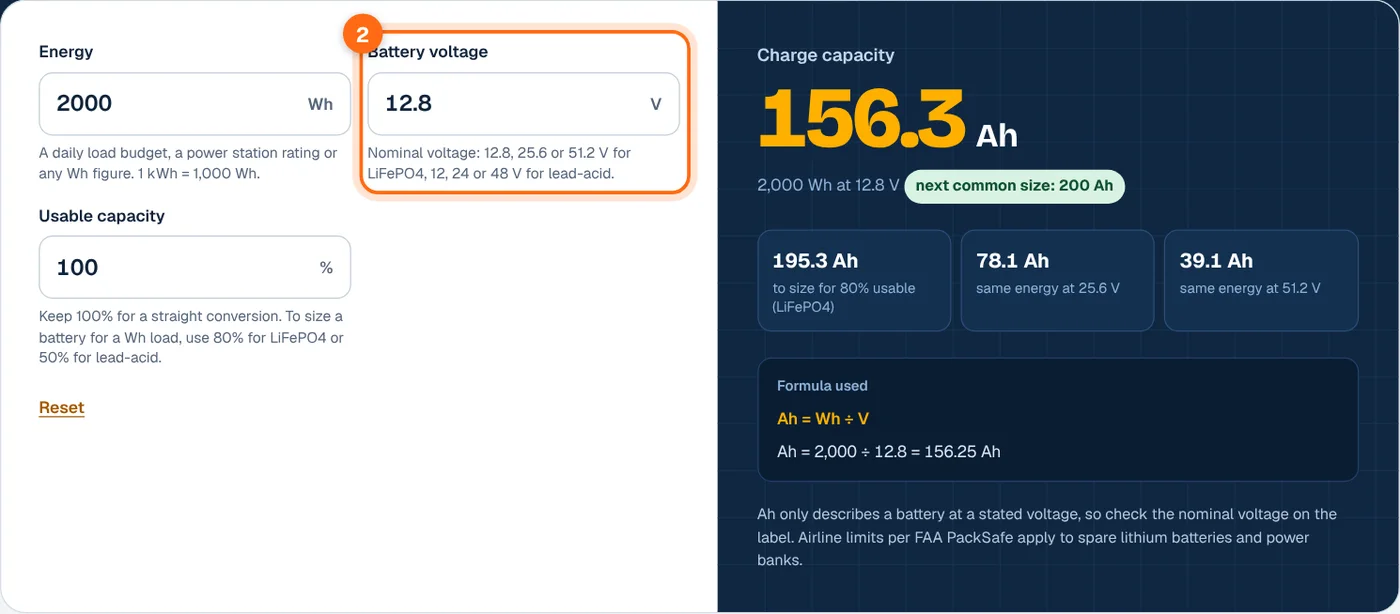
- Set the usable capacity. Leave 100% for a straight unit conversion. To size a battery for a load, enter the share you plan to use, such as 80% for LiFePO4 or 50% for lead-acid.
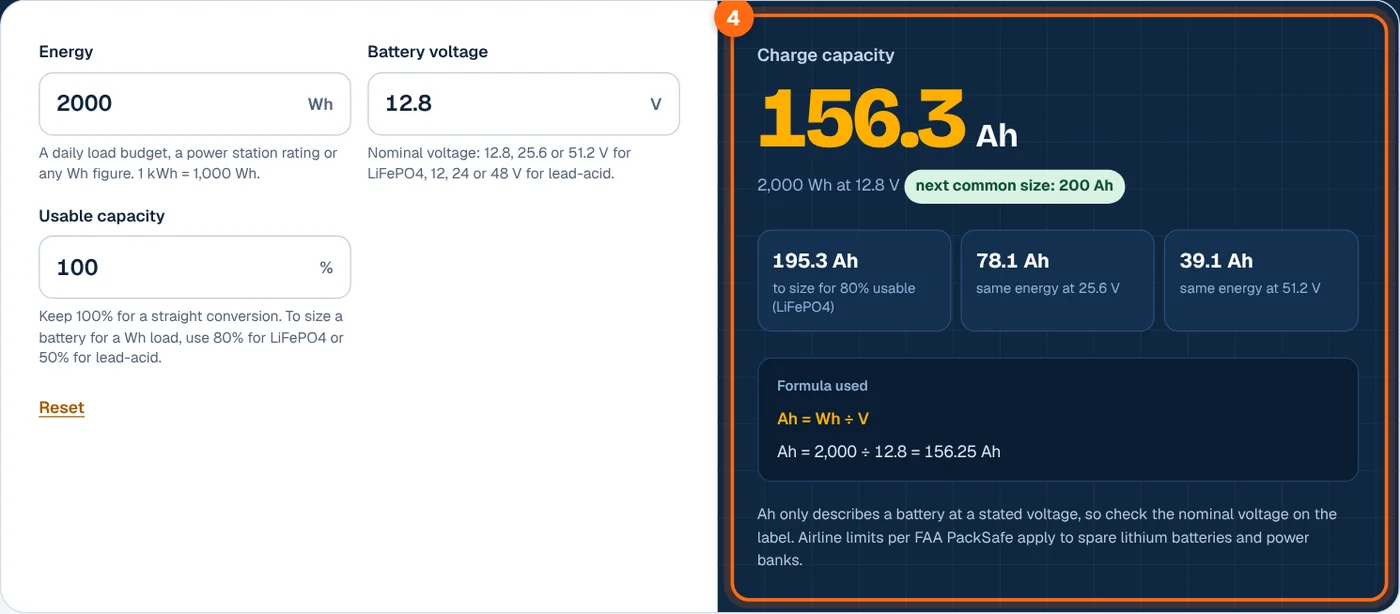
- Read the result. The large number is the amp-hours. The chip shows the next common battery size, or the airline category for small batteries, and the cards repeat the answer at 25.6 V and 51.2 V.
Wh to Ah formula
Watt-hours measure energy. Amp-hours measure charge. Dividing energy by voltage gives charge, so the voltage you choose decides the answer.
Where:
- Ah is the charge capacity in amp-hours.
- Wh is the energy in watt-hours. 1 kWh = 1,000 Wh.
- V is the nominal battery voltage.
- usable fraction is the share of the battery you plan to use, such as 0.8 for 80%.
The live Ah to Wh calculator also converts in both directions for a battery you already own. This page is built for the other job: starting from an energy figure and finding the amp-hours you need.
Worked examples
Example 1: sizing a battery from a daily load budget
An off-grid cabin uses 2,000 Wh a day: lights, a fridge, a laptop and a water pump. On a 12.8 V LiFePO4 battery:
A 200 Ah battery covers one day. The same budget at 51.2 V needs only 2,000 ÷ (51.2 × 0.8) = 48.8 Ah, which is why larger systems move to 48 V. For lead-acid at 50% usable on 12 V, you would need 2,000 ÷ (12 × 0.5) = 333 Ah.
Example 2: a 1,024 Wh power station in 12 V amp-hours
Portable power stations are rated in Wh. To compare one with a 12 V battery:
So a 1,024 Wh power station holds the same energy as an 80 Ah 12 V LiFePO4 battery. Its internal cells may run at a different voltage, but energy is energy, and Wh is the fair comparison.
Example 3: airline limits for a camera battery
A battery pack is labeled 99 Wh with 3.7 V cells.
The FAA PackSafe rules allow lithium-ion batteries up to 100 Wh in carry-on bags, and up to two spares of 101 to 160 Wh with airline approval. That is why so many travel power banks sit just under 27,000 mAh.
Wh to Ah chart
Amp-hours for common energy figures at standard battery voltages. These are straight conversions at 100% usable.
| Energy (Wh) | 12 V | 12.8 V | 24 V | 25.6 V | 48 V | 51.2 V |
|---|---|---|---|---|---|---|
| 100 | 8.3 | 7.8 | 4.2 | 3.9 | 2.1 | 2 |
| 500 | 41.7 | 39.1 | 20.8 | 19.5 | 10.4 | 9.8 |
| 1,000 | 83.3 | 78.1 | 41.7 | 39.1 | 20.8 | 19.5 |
| 2,000 | 166.7 | 156.3 | 83.3 | 78.1 | 41.7 | 39.1 |
| 3,000 | 250 | 234.4 | 125 | 117.2 | 62.5 | 58.6 |
| 5,000 | 416.7 | 390.6 | 208.3 | 195.3 | 104.2 | 97.7 |
| 10,000 | 833.3 | 781.3 | 416.7 | 390.6 | 208.3 | 195.3 |
For a load budget, divide the value in the table by your usable fraction. For example, 3,000 Wh at 25.6 V is 117.2 Ah, and at 80% usable you need 146.5 Ah.
What affects the result
Choosing the right voltage
The same Wh gives very different Ah at different voltages. Always use nominal voltage, not the full-charge voltage. A 12 V LiFePO4 battery is four cells at 3.2 V, so 12.8 V. Using 12 V overstates the Ah by about 7%.
Usable capacity
Sizing a battery is not the same as converting units. If a load needs 2,000 Wh and you only use 80% of the battery, the battery must hold 2,500 Wh. The battery bank calculator adds days of autonomy and inverter losses on top of this.
Inverter and conversion losses
If your Wh budget is measured on the AC side, the battery must supply more to cover inverter losses. Divide AC watt-hours by about 0.9 before converting. DC loads that run straight from the battery need no adjustment.
Rated Wh on power stations
Power station labels show the energy in the cells. Expect roughly 80 to 90% of that at the AC outlets, so a 1,024 Wh unit delivers around 820 to 920 Wh to an appliance.
Frequently asked questions
How many Ah is 1,000 Wh?
It depends on the voltage. 1,000 Wh is 83.3 Ah at 12 V, 78.1 Ah at 12.8 V, 41.7 Ah at 24 V and 19.5 Ah at 51.2 V. Divide the watt-hours by the battery voltage. If you are sizing a battery rather than converting units, divide again by the share you plan to use.
How many amp-hours do I need for 2,000 Wh a day?
At 12.8 V and 80% usable, you need 2,000 ÷ (12.8 × 0.8) = 195.3 Ah, so a 200 Ah LiFePO4 battery covers one day. At 12 V lead-acid with 50% usable, you need about 333 Ah. For more than one day without sun, multiply by the number of days.
How do I convert a power station’s Wh to 12 V Ah?
Divide its Wh rating by 12.8 for a LiFePO4 comparison or by 12 for lead-acid. A 2,048 Wh power station equals 160 Ah at 12.8 V. This tells you which 12 V battery holds the same energy, which is the fairest way to compare prices.
Can I take a 100 Wh battery on a plane?
Yes. The FAA allows lithium-ion batteries and power banks of 100 Wh or less in carry-on bags. Spares from 101 to 160 Wh need airline approval and are limited to two. Spare lithium batteries are not allowed in checked bags, and airlines may set stricter rules.
Why does my Ah figure differ from the battery label?
Most often the voltage is different. A pack listing 3.7 V cells and a 12 V output will give two different Ah figures for the same Wh. Use the voltage that the label’s Ah rating refers to, usually the cell or pack nominal voltage, and the numbers will match.