mAh to kWh Calculator
Convert milliamp-hours to kilowatt-hours for e-bikes, power banks and phones, and see what a full charge costs.
Quick answer
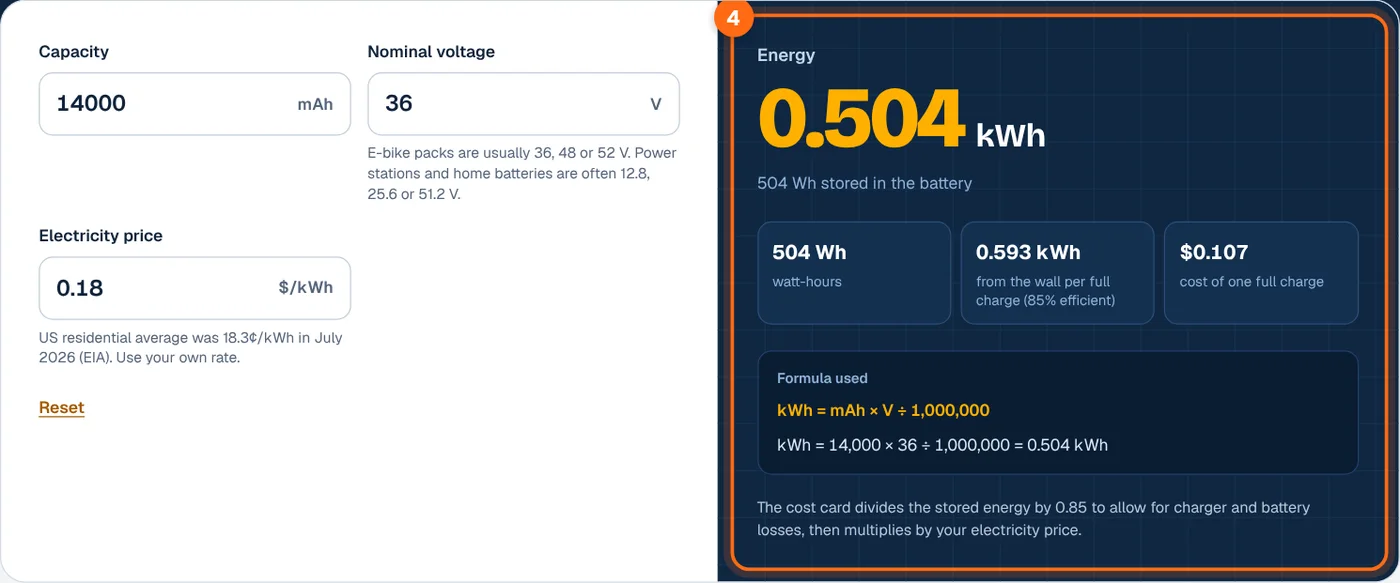
To convert mAh to kWh, multiply the milliamp-hours by the voltage and divide by 1,000,000. kWh = mAh × V ÷ 1,000,000. A 36 V e-bike battery rated 14,000 mAh holds 14,000 × 36 ÷ 1,000,000 = 0.504 kWh. At 18¢ per kWh, one full charge from the wall costs about 11 cents.

How to use the mAh to kWh calculator
- Enter the capacity in mAh. Type the milliamp-hour rating. If your battery is rated in Ah, as most e-bike and power station batteries are, multiply by 1,000: a 14 Ah pack is 14,000 mAh.

- Enter the nominal voltage. Use the pack voltage on the label. E-bike batteries are usually 36 V, 48 V or 52 V. Power stations and LiFePO4 batteries are 12.8 V, 25.6 V or 51.2 V. Phones and power banks are 3.7 V to 3.85 V.

- Enter your electricity price. Type your rate in dollars per kWh from your utility bill. The default of $0.18 is close to the US residential average.

- Read the energy in kWh. The large number is the stored energy in kilowatt-hours. The cards show it in Wh, the energy drawn from the wall to fill the battery once, and what that full charge costs.
mAh to kWh formula
A kilowatt-hour is one million milliwatt-hours. Multiplying mAh by volts gives milliwatt-hours, so one division by 1,000,000 finishes the job.
Where:
- kWh is the energy stored in the battery in kilowatt-hours.
- mAh is the charge capacity in milliamp-hours, and Ah the same in amp-hours.
- V is the nominal pack voltage.
- 0.85 is an allowance for charger and battery losses of about 15%.
- price is your electricity rate in $ per kWh.
Worked examples
Example 1: 36 V e-bike battery
A commuter e-bike has a 36 V, 14 Ah (14,000 mAh) battery.
Charging fully three times a week uses about 92.5 kWh a year, or roughly $16.65 at 18¢. If the battery takes you 20 miles, that is about 25 Wh per mile.
Example 2: 52 V e-bike battery
A performance e-bike uses a 52 V pack rated 17,500 mAh.
Drawing about 1.07 kWh from the wall, a full charge costs around 19 cents. Note that many airlines and shipping services treat any battery over 160 Wh as cargo only, and this pack holds 910 Wh.
Example 3: a year of phone charging
A phone with a 5,000 mAh battery at 3.85 V:
One full charge a day pulls about 0.0226 kWh from the wall, so a year adds up to roughly 8.3 kWh. At 18¢ that is about $1.49 a year. A 20,000 mAh power bank at 3.7 V holds 0.074 kWh and costs under 2 cents to fill.
mAh to kWh conversion table
Stored energy in kWh, calculated as mAh × V ÷ 1,000,000.
| Capacity (mAh) | 3.7 V | 12.8 V | 36 V | 48 V | 51.2 V |
|---|---|---|---|---|---|
| 10,000 | 0.037 | 0.128 | 0.36 | 0.48 | 0.512 |
| 14,000 | 0.0518 | 0.1792 | 0.504 | 0.672 | 0.7168 |
| 17,500 | 0.0648 | 0.224 | 0.63 | 0.84 | 0.896 |
| 20,000 | 0.074 | 0.256 | 0.72 | 0.96 | 1.024 |
| 50,000 | 0.185 | 0.64 | 1.8 | 2.4 | 2.56 |
| 100,000 | 0.37 | 1.28 | 3.6 | 4.8 | 5.12 |
| 200,000 | 0.74 | 2.56 | 7.2 | 9.6 | 10.24 |
Above about 50,000 mAh, batteries are almost always labeled in Ah or directly in kWh. The 200,000 mAh row at 51.2 V is a 200 Ah, 10.24 kWh home battery.
What affects the result
Pack voltage
At these sizes the voltage is the biggest lever. The same 14,000 mAh holds 0.504 kWh at 36 V and 0.672 kWh at 48 V. E-bike sellers sometimes advertise Ah alone, so check the voltage before comparing two batteries.
Charging losses
The stored kWh is less than the energy you pay for. Chargers convert AC to DC with some loss, and the battery itself warms as it charges. The 85% allowance is a reasonable middle figure for e-bike and phone chargers; a good power station can do better, a cheap charger worse.
Your electricity price
The US residential average was 18.31¢ per kWh in July 2026, according to the EIA Electric Power Monthly, and that month state averages ran from about 12.7¢ in Louisiana to 48¢ in Hawaii. Use the energy charge from your own bill. The electricity cost calculator covers appliances in the same way.
Usable capacity
Battery management systems keep a reserve at the top and bottom of the charge range, and capacity fades with age. A three year old e-bike battery may hold 80% to 90% of its label rating. For how long that energy lasts under a load, use the battery life calculator.
Frequently asked questions
How many kWh is 10,000 mAh?
At 3.7 V, a 10,000 mAh power bank holds 0.037 kWh, which is 37 Wh. At 36 V the same 10,000 mAh is 0.36 kWh, and at 48 V it is 0.48 kWh. Multiply mAh by volts and divide by 1,000,000 to get kWh for any battery.
How many mAh are in 1 kWh?
It depends on voltage. 1 kWh is about 270,270 mAh at 3.7 V, 78,125 mAh at 12.8 V and 20,833 mAh at 48 V. The kWh to mAh calculator does this direction for any voltage and shows the result in Ah too.
How much does it cost to charge an e-bike battery?
A 36 V 14 Ah battery holds 0.504 kWh and pulls about 0.59 kWh from the wall. At the US average of about 18¢ per kWh, a full charge costs around 11 cents. A 48 V 20 Ah battery costs about 20 cents. Even daily charging rarely adds more than $5 a month.
Why is kWh used for big batteries instead of mAh?
kWh is the unit on your electricity bill and on solar and EV specifications, so it lets you compare batteries directly with energy use and cost. Writing a 10 kWh home battery as 195,313 mAh at 51.2 V is accurate but tells you far less at a glance.
Does a phone use a lot of electricity to charge?
No. A 5,000 mAh phone battery holds about 0.019 kWh. Charging it every day for a year uses roughly 8 kWh, around $1.50 at typical US rates. The charger left plugged in with nothing attached draws a small standby load, but usually well under a watt.