Solar Self-Consumption Calculator
Find how much of your solar you use at home, how much you export, and what each kWh saves, with or without a battery.
Quick answer
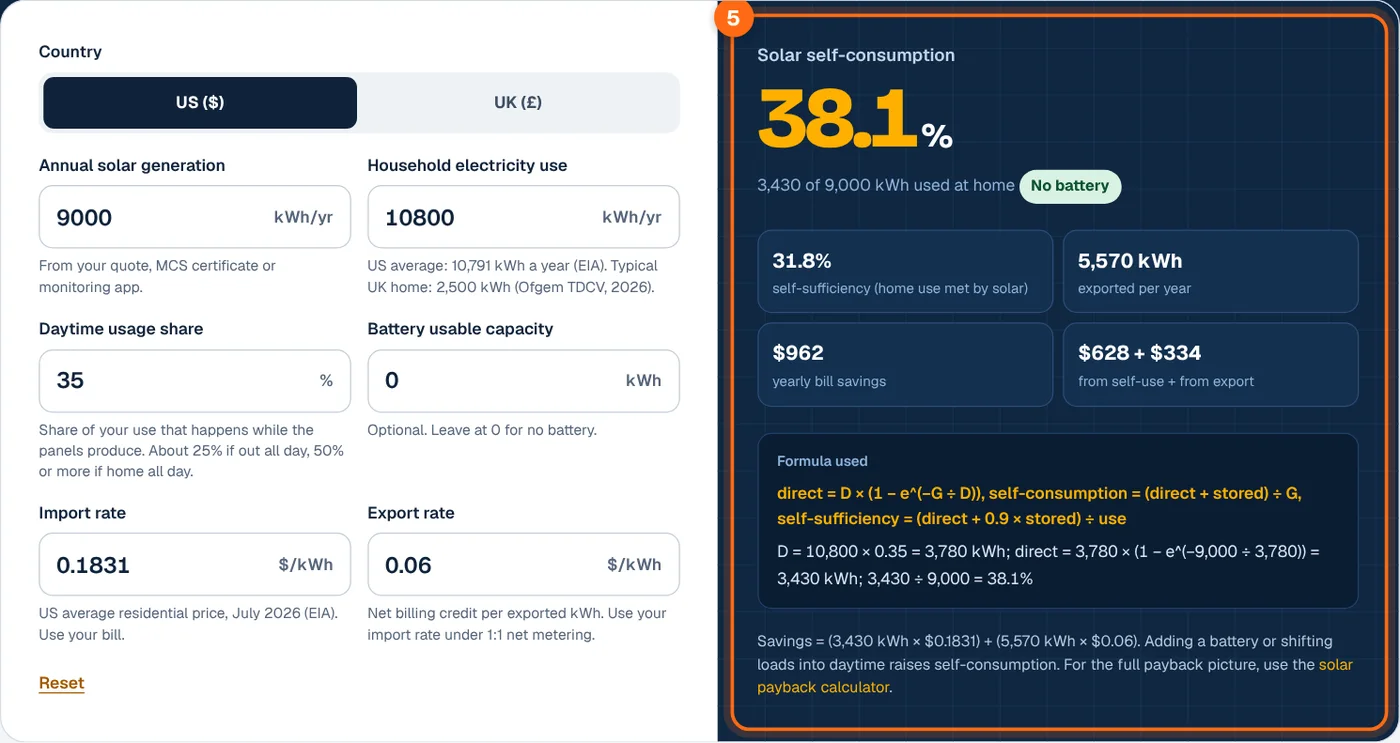
Solar self-consumption is the share of your panels’ output that you use at home instead of exporting. A US home using 10,800 kWh a year, 35% of it in daylight, with a 9,000 kWh array uses about 3,430 kWh directly: 38.1% self-consumption and 31.8% self-sufficiency. A 10 kWh battery lifts self-consumption to about 68.5%.

How to use the solar self-consumption calculator
- Choose your country. US loads dollar rates for net billing. UK loads pound rates with the Ofgem price cap and a Smart Export Guarantee rate.
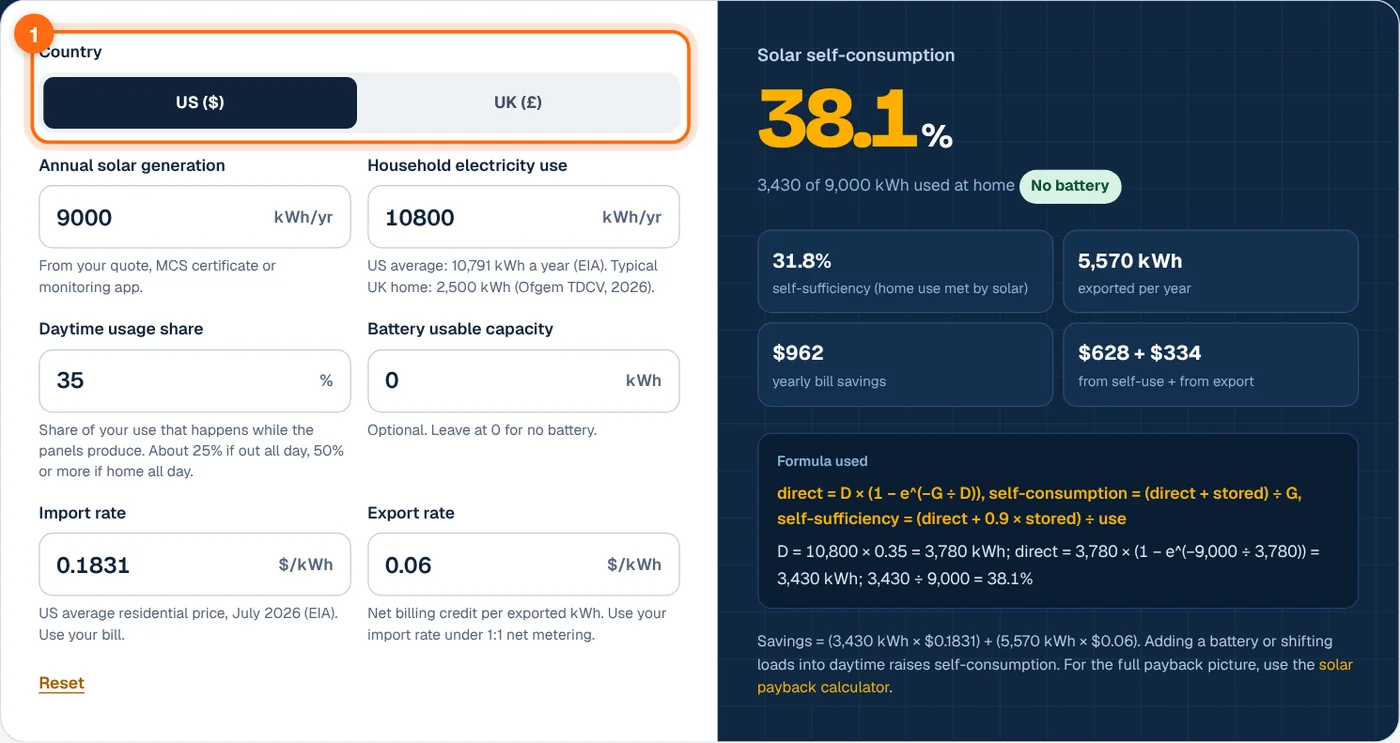
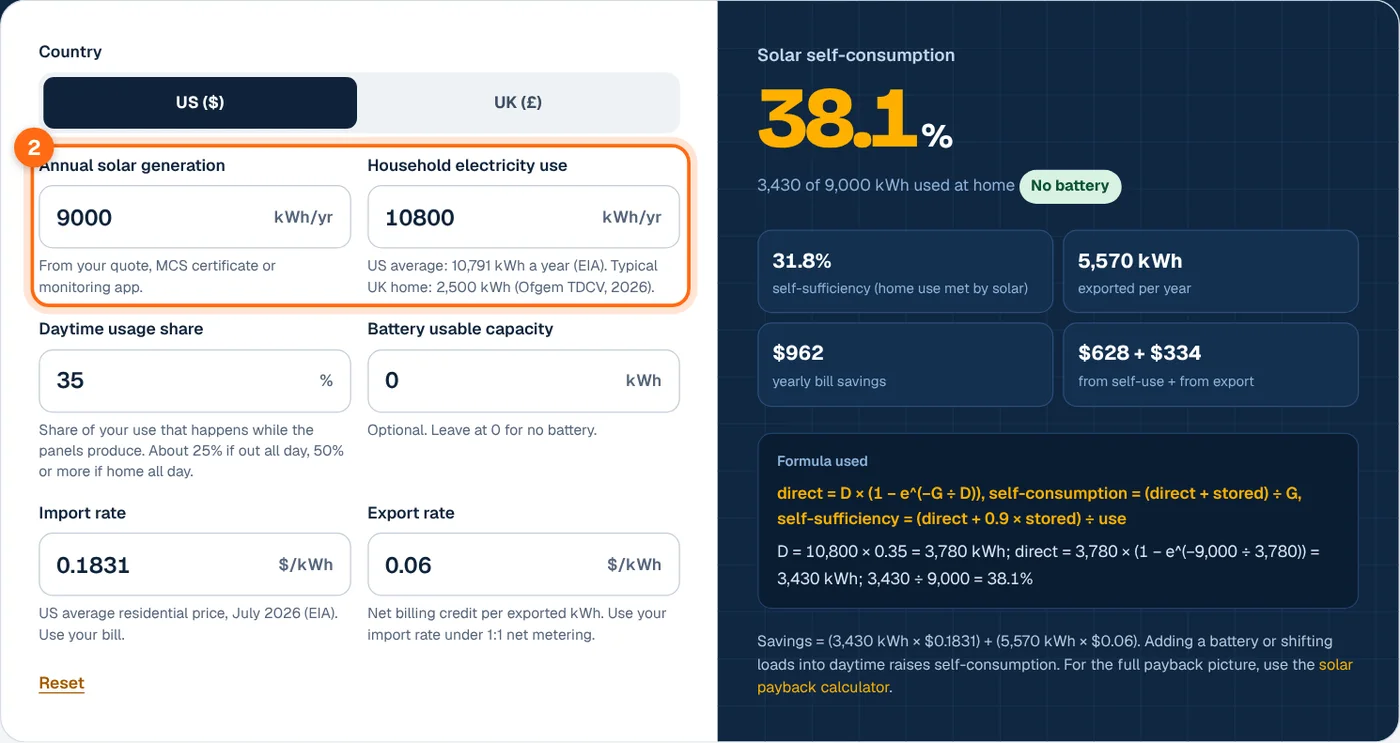
- Enter generation and household use. Type your yearly solar output from a quote or monitoring app, then your yearly electricity use from your bills.
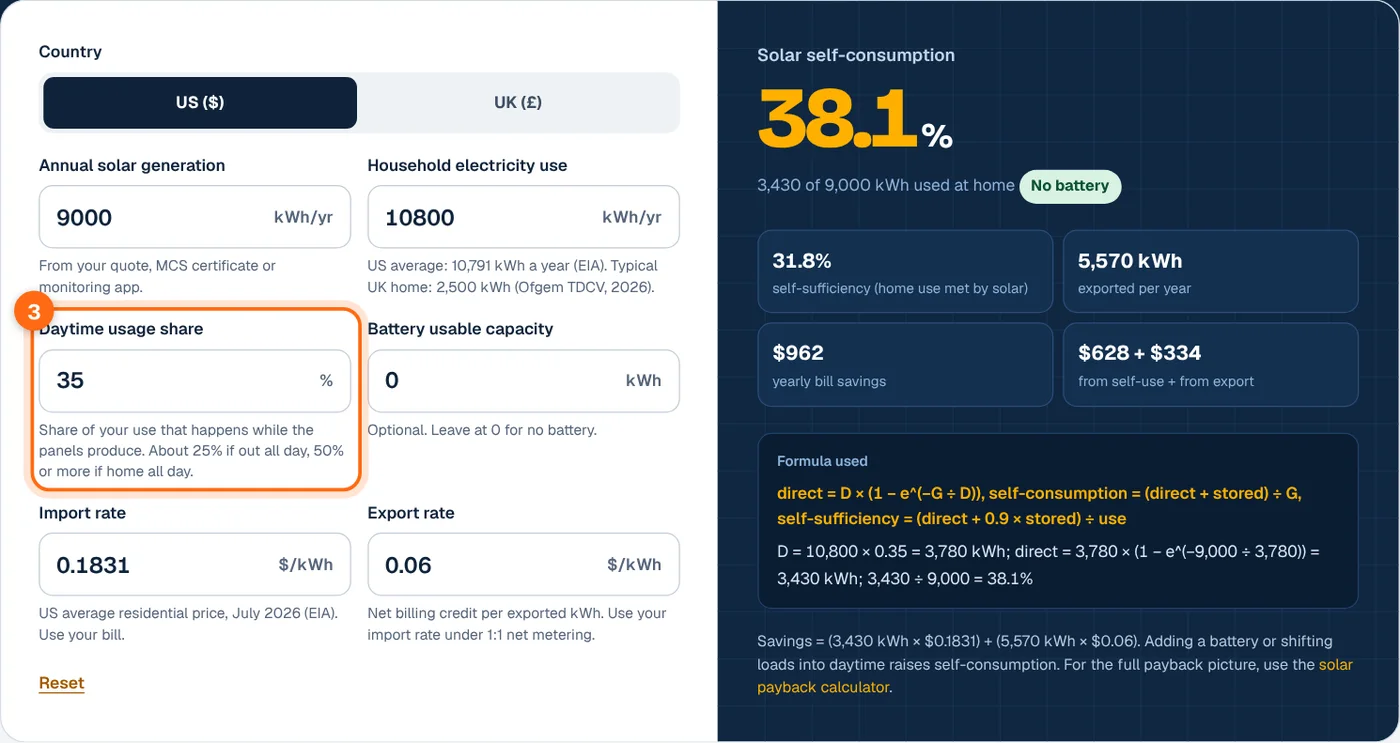
- Set your daytime usage share. This is the part of your use that happens while the panels produce. About 25% suits a home that is empty on weekdays, 50% or more a home with people in all day.
- Add a battery and your rates. Enter the usable battery capacity, or leave 0. Then enter the price you pay per imported kWh and the credit you get per exported kWh.
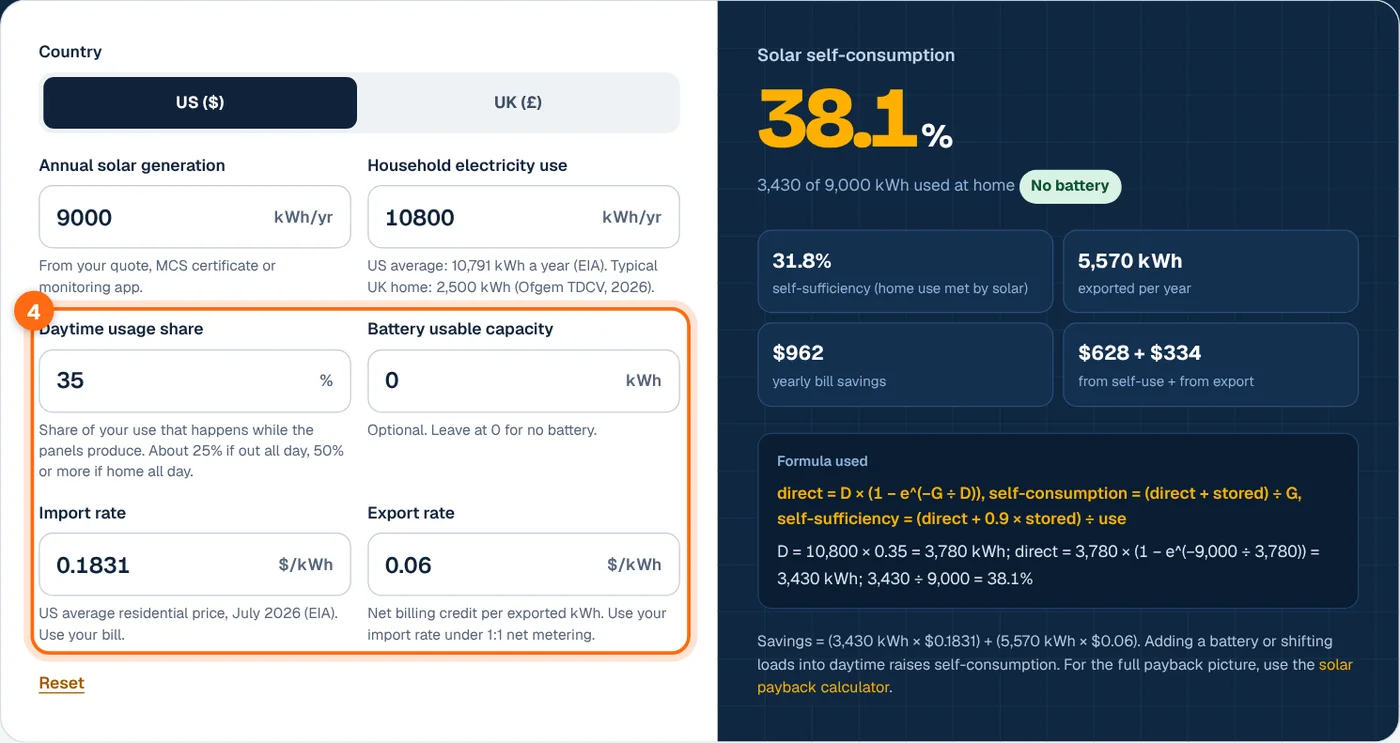
- Read the result. The large number is self-consumption. The cards show self-sufficiency, yearly export, total bill savings and how those savings split between self-use and export.
Solar self-consumption formula
Self-consumption and self-sufficiency answer two different questions. The first asks how much of your solar you keep. The second asks how much of your home’s demand the solar covers.
Where:
- U is yearly household use and s is the daytime share, so D is the demand that falls in solar hours.
- G is yearly solar generation in kWh.
- Direct is solar used the moment it is made. The exponential curve captures diminishing returns: a small array is almost all used, while a large array mostly exports once daytime demand is met.
- B is usable battery capacity. The model charges it from surplus on about three days in four and assumes 90% round-trip efficiency.
- Savings = (Direct + 0.9 × Stored) × import rate + exported kWh × export rate.
This is a planning model built from yearly totals. Half-hourly data from a smart meter gives a more exact figure, but the model lands in the same range as measured homes.
Worked examples
Example 1: US home without a battery
The home uses 10,800 kWh a year, close to the US average of 10,791 kWh reported by the US Energy Information Administration. The array makes 9,000 kWh and 35% of use is in daylight.
Self-sufficiency is 3,430 ÷ 10,800 = 31.8%. The other 5,570 kWh is exported. At $0.1831 import and $0.06 export, savings are $628 from self-use plus $334 from export, about $962 a year.
Example 2: the same home with a 10 kWh battery
Surplus is 5,570 kWh. The battery can take up to 10 × 365 × 0.75 = 2,738 kWh a year, which the evening load can absorb.
Self-sufficiency rises to 54.6% and export falls to 2,832 kWh. Savings rise to about $1,249 a year, or $287 more than without the battery. Compare that gain with the battery price using the home battery savings calculator.
Example 3: UK home on a 12p SEG tariff
A UK home uses 2,500 kWh a year, the 2026 Ofgem typical medium value. A 3,600 kWh array runs while 40% of use is in daylight. Daytime demand is 1,000 kWh, so direct use is 973 kWh.
Self-sufficiency is 38.9%. At 26.32p import and 12p export, the home saves £256 on bills and earns £315 for 2,627 kWh exported, about £571 a year. A 5 kWh battery raises self-consumption to 65.0% and savings to about £731.
Self-consumption by daytime share and battery size
Values from the calculator for a 9,000 kWh array and a 10,800 kWh home. Each cell shows self-consumption, then self-sufficiency.
| Daytime share | No battery | 5 kWh | 10 kWh | 13.5 kWh |
|---|---|---|---|---|
| 25% (out all day) | 28.9% / 24.1% | 44.1% / 35.5% | 59.3% / 46.9% | 70.0% / 54.9% |
| 35% (typical) | 38.1% / 31.8% | 53.3% / 43.2% | 68.5% / 54.6% | 79.2% / 62.6% |
| 50% (home all day) | 48.7% / 40.6% | 63.9% / 52.0% | 79.1% / 63.4% | 89.7% / 71.4% |
A battery adds more self-consumption than any change in routine, but shifting dishwashers, laundry and EV charging into daylight is free.
What affects the result
Array size relative to use
The larger the array compared with daytime demand, the lower the self-consumption percentage. A big array still saves more money in total, but each extra kWh is more likely to be exported at the lower rate.
When you use power
Self-consumption depends on timing, not on total use. Heat pumps, pool pumps, water heaters on timers and daytime EV charging all move demand into solar hours.
Battery size and efficiency
A battery stores surplus for the evening. Gains flatten once the battery is large enough to cover the night load, and in winter a big battery rarely fills from solar alone. About 10% of stored energy is lost on the round trip.
The gap between import and export rates
Self-consumption matters in money terms only when export pays less than import. Under 1:1 net metering, where export earns the full retail rate, self-consumption has little effect on savings. The net metering calculator compares the two billing schemes.
Frequently asked questions
What is a good solar self-consumption rate?
Homes without a battery usually use 25 to 40% of their solar output directly. People who are home in the day, or who run heat pumps and EV chargers on timers, can reach 50%. A battery sized to the evening load typically lifts the figure to 60 to 80%. Higher is better when export rates are low.
What is the difference between self-consumption and self-sufficiency?
Self-consumption is the share of your solar output that you use at home. Self-sufficiency is the share of your home’s demand that solar covers. A large array in a small home can have low self-consumption but high self-sufficiency, because it covers most demand and still exports a lot.
How much does a battery increase self-consumption?
In the default example, a 10 kWh battery raises self-consumption from 38.1% to 68.5% and self-sufficiency from 31.8% to 54.6%. The gain depends on how much surplus you have and how much you use in the evening. Beyond the size of your overnight load, extra capacity adds little.
How can I raise self-consumption without a battery?
Run flexible loads in daylight. Set the dishwasher, washing machine and dryer to start around midday, heat water with a solar diverter or timer, and charge an EV at home in the afternoon. A smart thermostat can also pre-heat or pre-cool the house while the panels produce.
Does self-consumption matter with net metering?
Very little. Under 1:1 net metering each exported kWh earns the same credit as a kWh you would have bought, so using it yourself saves nothing extra. Self-consumption matters on net billing, Smart Export Guarantee and feed-in tariffs, where export pays much less than import.