Radiator Output Calculator
Convert a radiator's ΔT50 rating to its real heat output at any flow, return and room temperature, using the EN 442 method.
Quick answer
A radiator’s actual output is its ΔT50 rating multiplied by (ΔT ÷ 50)1.3, where ΔT is the mean water temperature minus the room temperature. A 1,500 W radiator on a heat pump at 50°C flow and 45°C return in a 21°C room has a ΔT of 26.5°C, so it gives 1,500 × 0.438 = 657 W, or 43.8% of its rating. On a boiler at 75/65°C in a 20°C room it gives the full 1,500 W.

How to use the radiator output calculator
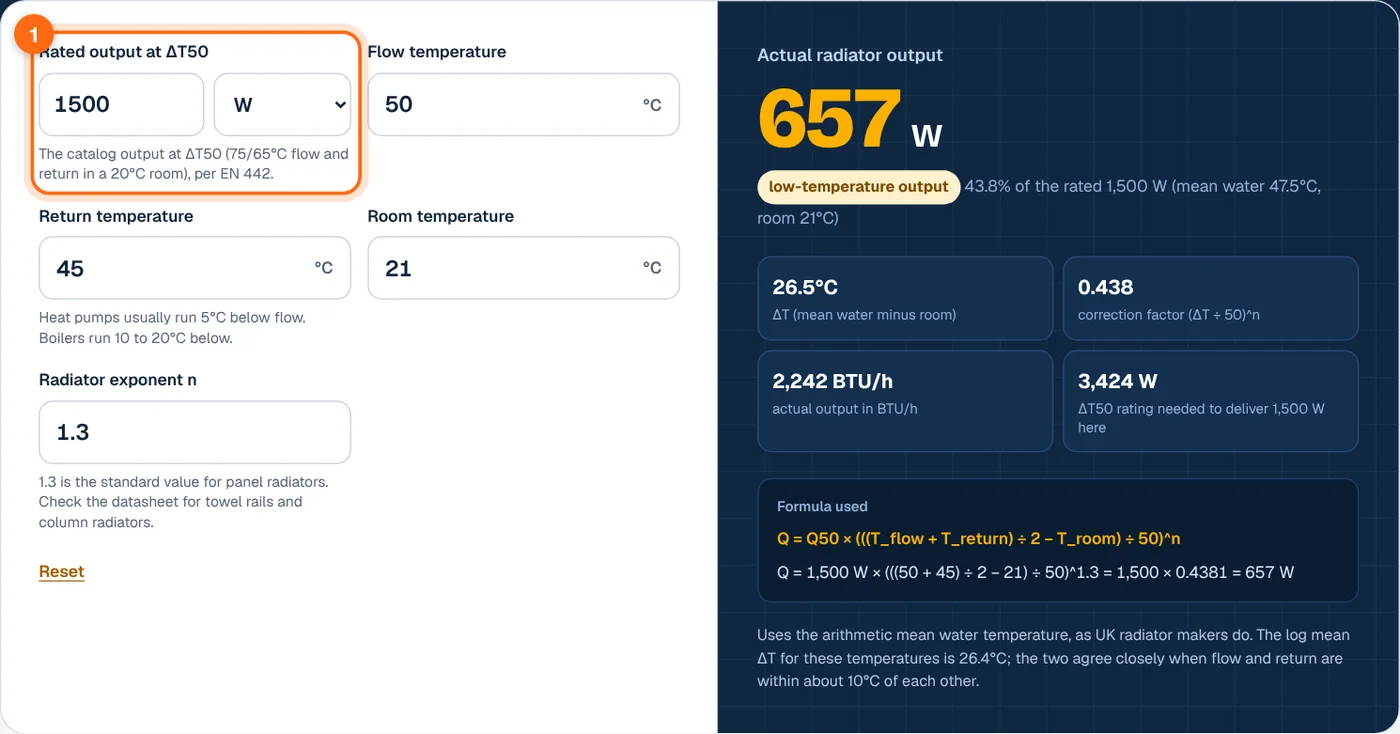
- Enter the rated output at ΔT50. Type the figure from the manufacturer’s catalog or datasheet and choose W or BTU/h. UK catalogs quote outputs at ΔT50 to EN 442.
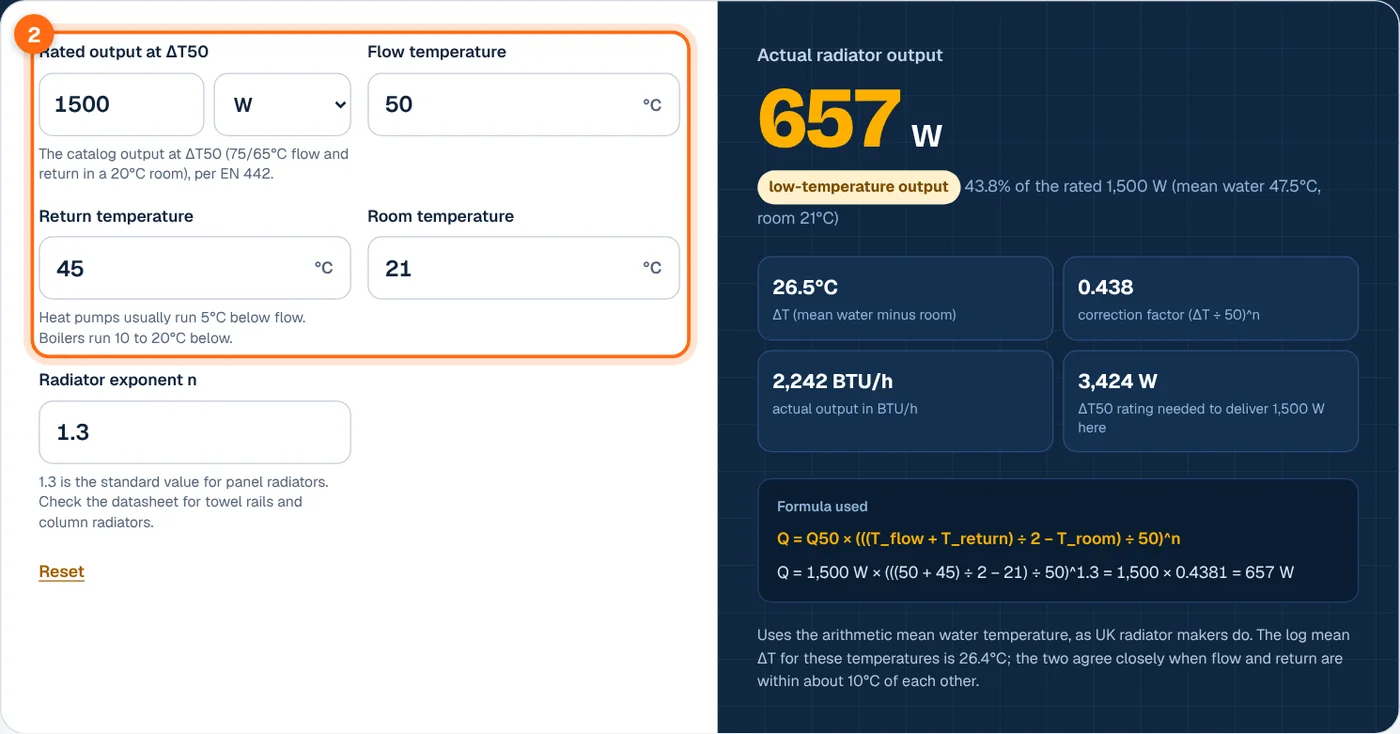
- Enter the flow and return temperatures. Flow is the water temperature entering the radiator and return is the temperature leaving it. Heat pumps typically run 5°C between the two, and boilers 10 to 20°C.
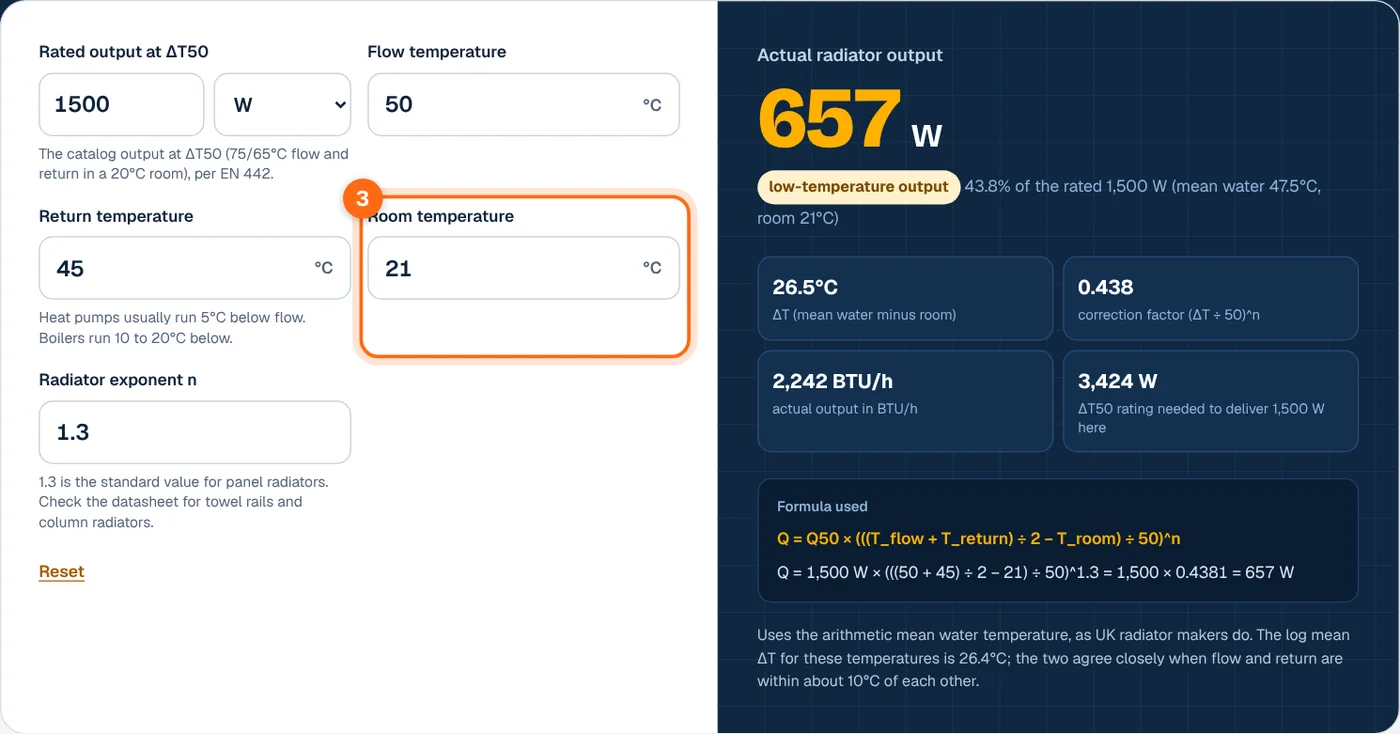
- Enter the room temperature. Use the temperature you want the room to reach, such as 21°C for a living room or 18°C for a bedroom.
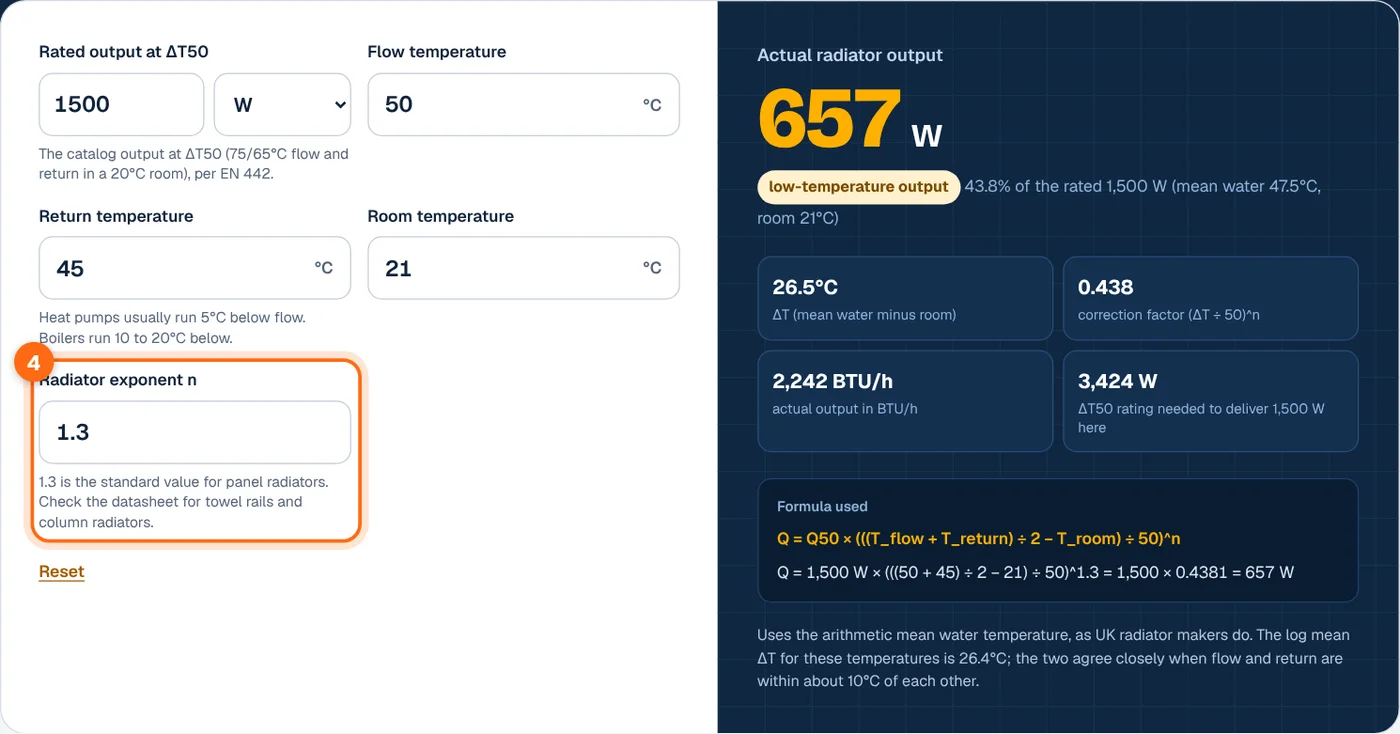
- Check the exponent. Leave n at 1.3 for standard steel panel radiators. Some column radiators and towel rails list a different value on their datasheet.
- Read the actual output. The large number is the real heat output at your temperatures. The cards show the ΔT, the correction factor and the ΔT50 rating you would need to get the original output at these temperatures.

Radiator output formula
Radiator output rises faster than the temperature difference, because hotter surfaces also lose more heat by convection. EN 442 describes this with a power law.
Where:
- ΔT is the mean water-to-air temperature difference in °C.
- Tflow and Treturn are the water temperatures in and out of the radiator, and Troom is the air temperature.
- F is the correction factor, also called the conversion factor.
- n is the radiator exponent, 1.3 for typical panel radiators.
- Q50 is the rated output at ΔT50 and Q is the actual output, both in W. Multiply watts by 3.412 for BTU/h.
To go the other way, divide the heat you need by F. That is how the calculator finds the ΔT50 rating needed at low temperatures. Zehnder’s correction factor guide uses the same arithmetic mean and n = 1.3.
Worked examples
Example 1: heat pump at 50/45°C
The default. A 1,500 W radiator, 50°C flow, 45°C return, 21°C room. The mean water temperature is 47.5°C, so ΔT = 26.5°C.
To get the full 1,500 W at these temperatures you would need a radiator rated about 3,424 W at ΔT50.
Example 2: condensing boiler at 70/50°C
A 1,000 W radiator on a condensing boiler set to 70°C flow with a 20°C drop, in a 20°C room. ΔT = 60 − 20 = 40°C.
The lower return temperature helps the boiler condense and run more efficiently, but the radiator gives 25% less heat.
Example 3: heat pump at 55/50°C
A 1,200 W radiator in a 20°C room, with 55°C flow and 50°C return. ΔT = 52.5 − 20 = 32.5°C.
Raising the flow temperature by 5°C over Example 1 adds output but lowers the heat pump’s efficiency, so larger radiators are usually the better fix.
Radiator correction factor table (n = 1.3)
Output of a radiator rated 1,000 W at ΔT50, and the multiplier to apply to the heat you need to find the ΔT50 rating to buy.
| Flow / return / room (°C) | ΔT | Correction factor | Output of a 1,000 W radiator | Oversize factor |
|---|---|---|---|---|
| 75 / 65 / 20 | 50 | 1.000 | 1,000 W | 1.00 |
| 70 / 60 / 20 | 45 | 0.872 | 872 W | 1.15 |
| 70 / 50 / 20 | 40 | 0.748 | 748 W | 1.34 |
| 60 / 50 / 20 | 35 | 0.629 | 629 W | 1.59 |
| 55 / 45 / 20 | 30 | 0.515 | 515 W | 1.94 |
| 55 / 50 / 21 | 31.5 | 0.548 | 548 W | 1.82 |
| 50 / 45 / 21 | 26.5 | 0.438 | 438 W | 2.28 |
| 45 / 40 / 21 | 21.5 | 0.334 | 334 W | 3.00 |
| 40 / 35 / 21 | 16.5 | 0.237 | 237 W | 4.23 |
| 35 / 30 / 21 | 11.5 | 0.148 | 148 W | 6.76 |
Manufacturers’ printed tables can differ in the third decimal place because some use a slightly different exponent for each model.
What affects the result
Flow temperature
Flow temperature has the biggest effect. Every 5°C drop in mean water temperature near ΔT30 cuts output by roughly a fifth. That is why a heat pump designer either keeps the flow temperature low and fits larger radiators, or accepts a lower efficiency at a higher flow temperature. The heat pump running cost calculator shows what that efficiency difference costs.
Room temperature
The same water temperature gives more heat in a cooler room. A radiator at 50/45°C gives 438 W per 1,000 W rated in a 21°C living room, but about 504 W in an 18°C bedroom (ΔT 29.5°C).
Arithmetic or log mean ΔT
UK makers use the simple average of flow and return. The more exact log mean temperature difference is slightly lower when the drop across the radiator is large. At 50/45°C in a 21°C room the log mean is 26.4°C against 26.5°C, so the difference is negligible for heat pumps.
Radiator type and installation
The exponent n varies from about 1.25 to 1.35 between panel, column and fan-assisted designs. Covers, shelves, curtains and painting with metallic paints all reduce output. To size radiators from scratch, use the radiator size calculator.
Frequently asked questions
What is delta T on a radiator?
Delta T (ΔT) is the difference between the radiator’s mean water temperature and the room air temperature. The mean is the average of the flow and return temperatures. A radiator at 75°C flow and 65°C return has a 70°C mean, so in a 20°C room ΔT is 50°C, the standard rating condition.
How do I convert ΔT50 to ΔT30?
Multiply the ΔT50 output by (30 ÷ 50)1.3, which is 0.515. A 2,000 W radiator at ΔT50 gives about 1,030 W at ΔT30. To find the rating you need, divide the room’s heat loss by 0.515, which is the same as multiplying it by 1.94.
Why does my radiator give less heat with a heat pump?
A heat pump heats water to around 45 to 55°C instead of 70 to 75°C from a gas boiler. A smaller temperature difference between the water and the room means less heat flows out, and the 1.3 exponent makes the drop steeper. At 50/45°C a radiator gives under half its rating.
What is the EN 442 radiator exponent?
EN 442 is the European standard for testing radiators. Each model is tested at several temperatures and the results are fitted to the equation Q = K × ΔTn. For most steel panel radiators n is close to 1.3, which is the value this calculator uses by default.
Can a radiator work at ΔT20?
Yes, but it gives only about 30% of its ΔT50 rating. Low ΔT operation suits underfloor heating or very well insulated homes with large radiators. In a typical UK home, running at ΔT20 usually means two or three times the radiator area, or fan-assisted radiators.