C-Rate Calculator
Work out a battery's C-rate from current and capacity, or the current and time for any C-rate, with limits by chemistry.
Quick answer
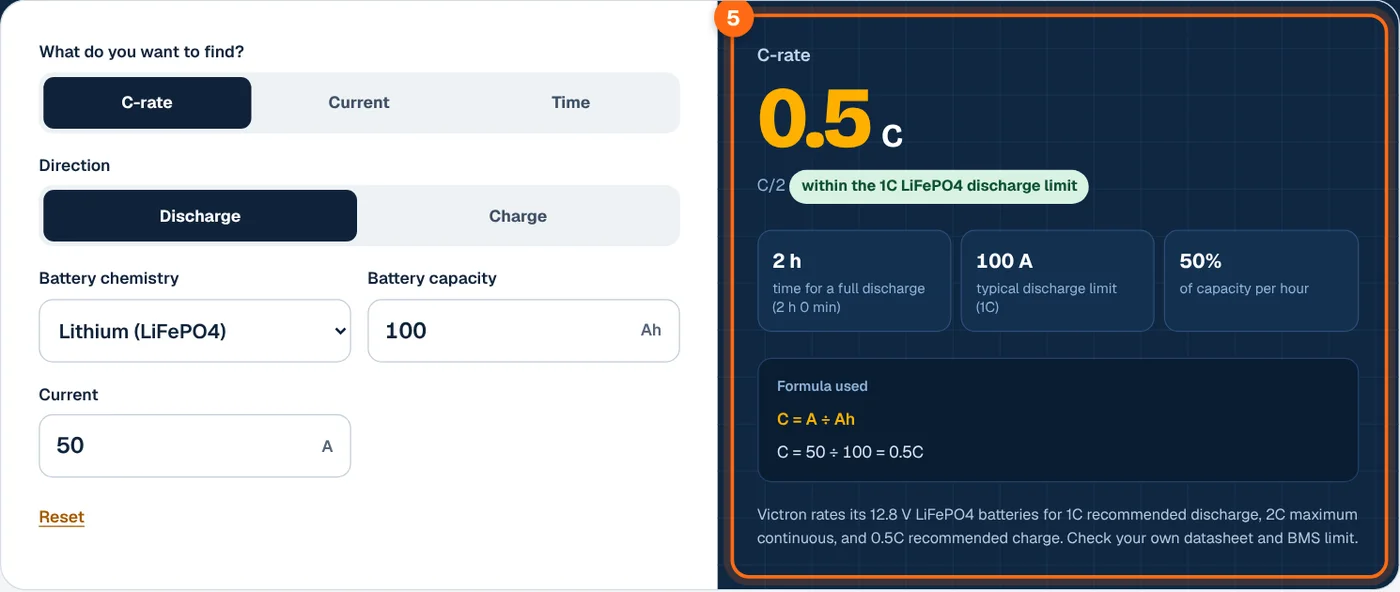
A battery’s C-rate is its current divided by its capacity: C = A ÷ Ah. A 100 Ah battery delivering 50 A runs at 50 ÷ 100 = 0.5C, which empties it in about 2 hours. To go the other way, current = C × Ah, and time in hours = 1 ÷ C.
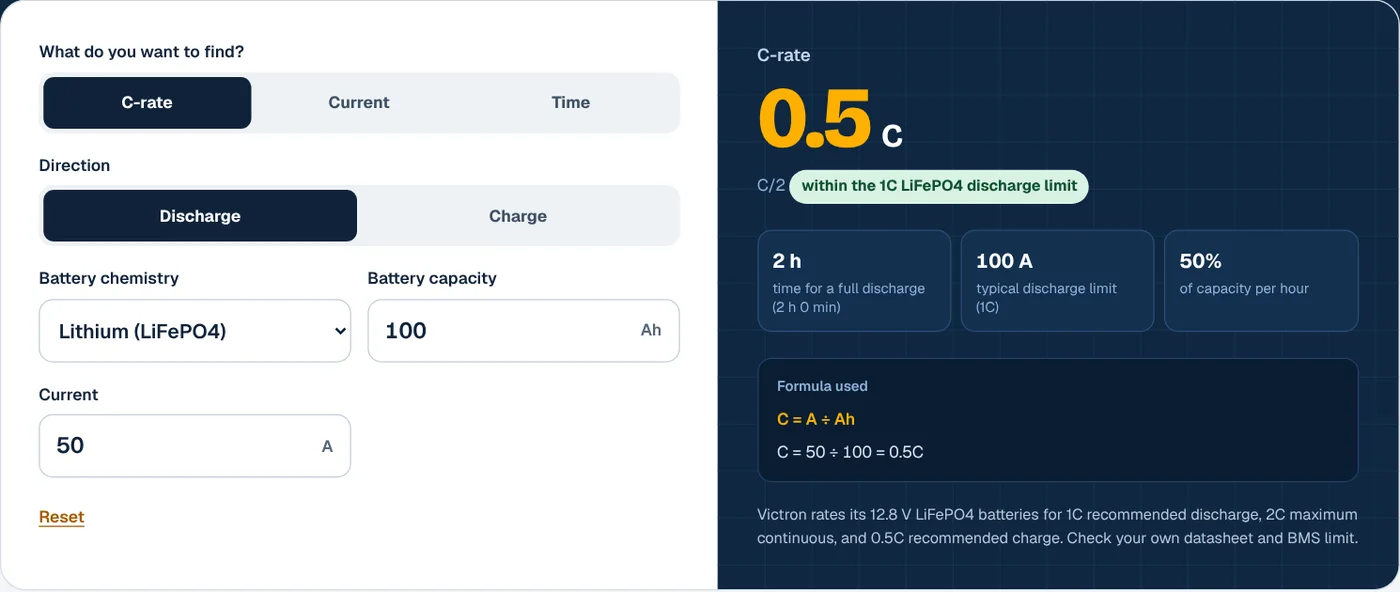
How to use the C-rate calculator
- Choose what to find. Pick C-rate to find it from a current, Current to find amps from a C-rate, or Time to find how long a full charge or discharge takes.

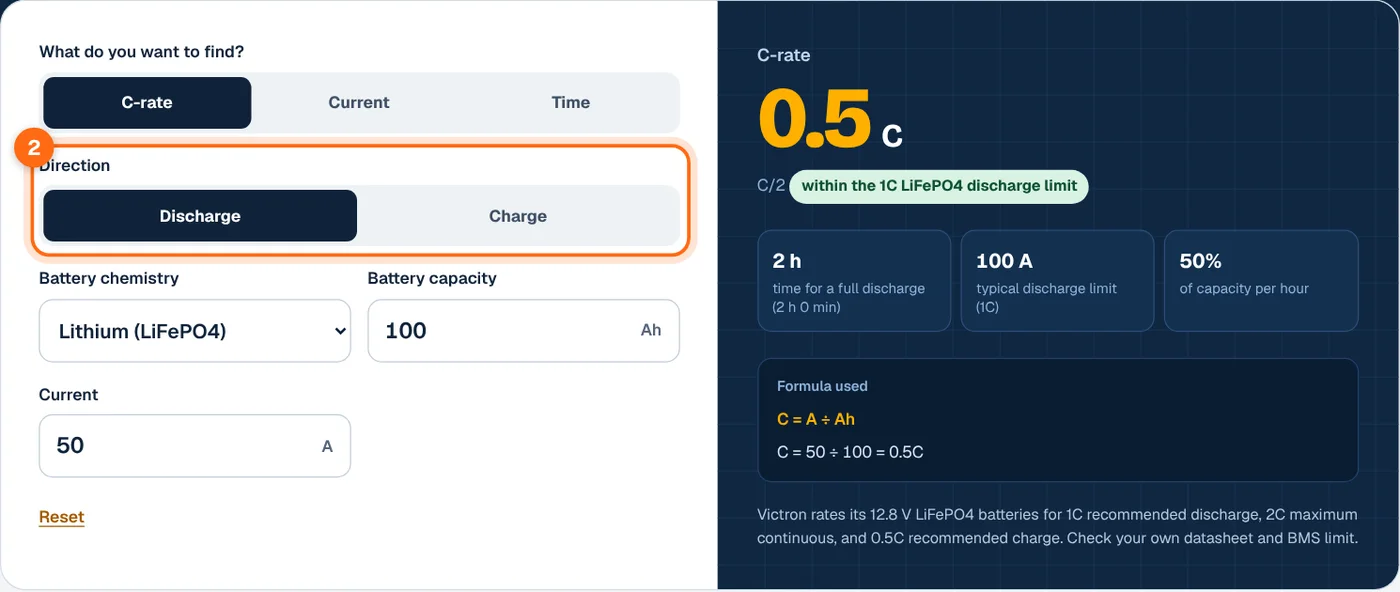
- Choose the direction. Pick Discharge or Charge. Batteries have different limits for each, and the chip compares your rate with the right one.
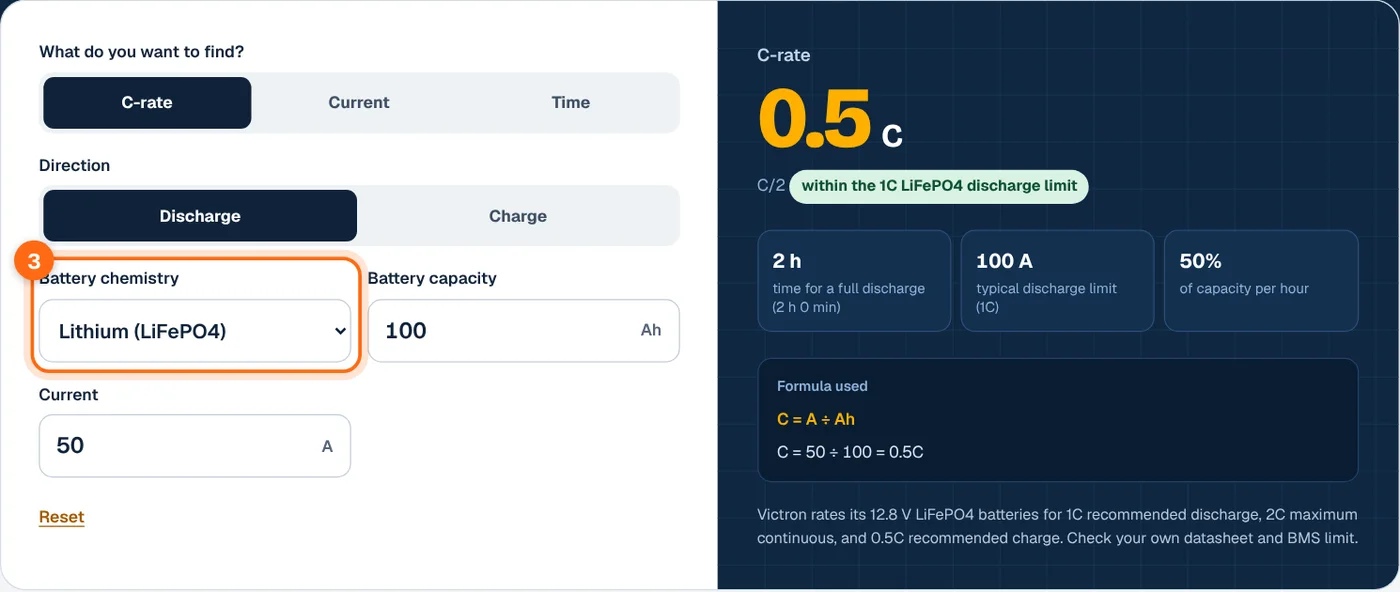
- Choose the chemistry. Pick LiFePO4, AGM or flooded lead-acid. For lead-acid discharges, the calculator also shows how much of the rated capacity you actually get at that rate.
- Enter the capacity and current or C-rate. Type the battery’s Ah rating, then the current in amps or the C-rate, depending on the mode.
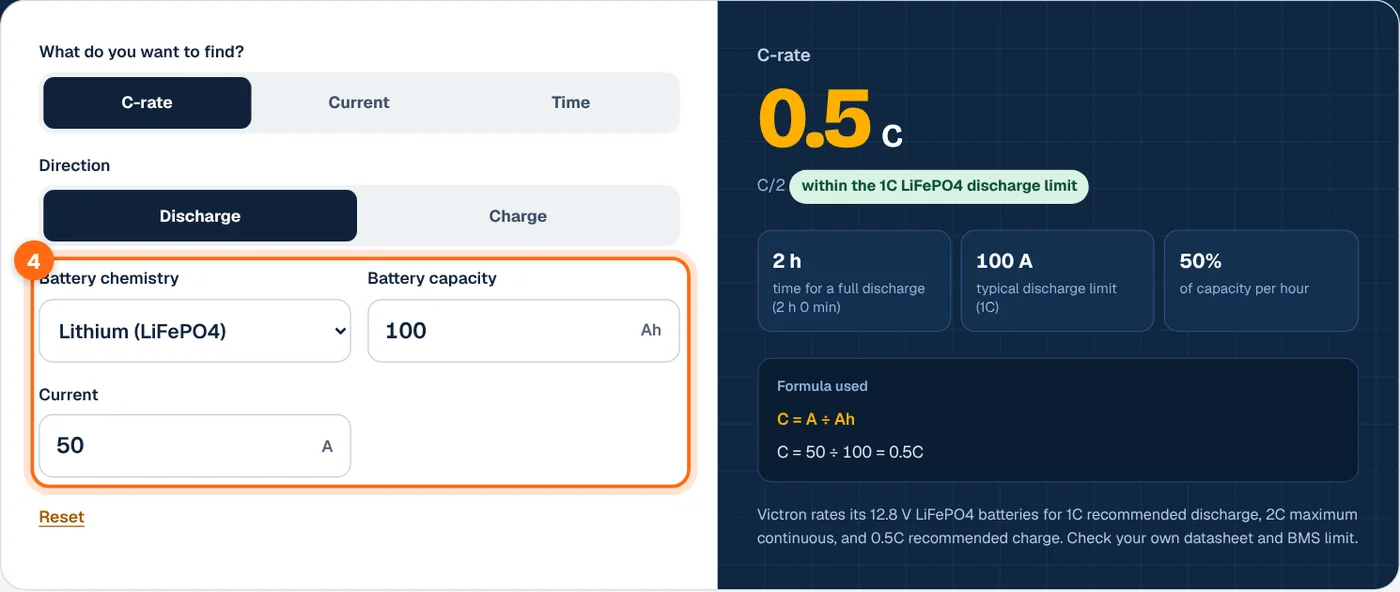
- Read the result. The large number is the C-rate, current or time. The chip rates it against typical limits, and the cards show the full-cycle time, the typical limit in amps and the capacity per hour or delivered capacity.
C-rate formula
The C-rate expresses current as a multiple of capacity. That makes it easy to compare a 7 Ah alarm battery with a 280 Ah home battery cell.
Where:
- C is the C-rate. 1C is a current equal to the capacity, 0.5C is half that, 2C is double.
- A is the charge or discharge current in amps.
- Ah is the rated capacity in amp-hours.
- t is the ideal time for a full charge or discharge in hours.
Fractions are common too. C/20 means 0.05C, the 20-hour rate used to rate lead-acid batteries. C/10 is 0.1C and C/5 is 0.2C. Real times are longer than 1 ÷ C for charging, because of losses and taper, and shorter for lead-acid discharging, because capacity falls at high rates. The battery charging time calculator includes those effects.
Worked examples
Example 1: 50 A from a 100 Ah LiFePO4 battery
Within the 1C recommended discharge for most LiFePO4 batteries. This is the default example.
Example 2: the same 50 A from a 100 Ah AGM battery
Still 0.5C, but now well above the 0.2C that suits lead-acid. The Victron AGM and gel datasheet gives 78% of rated capacity at a 3-hour discharge and 65% at 1 hour. Interpolating for a 2-hour rate gives about 73% of 100 Ah, so the battery lasts roughly 1.46 hours, not 2.
Example 3: charge current for an AGM battery at C/10
A 10 A charger is a comfortable C/10 for a 100 Ah AGM battery. Victron recommends charging its AGM and gel batteries at no more than 0.2C, so 20 A is the upper end.
C-rate chart for a 100 Ah battery
Current, ideal time and the share of rated capacity an AGM battery delivers at each discharge rate. AGM figures come from Victron’s datasheet table; the 0.5C value is interpolated.
| C-rate | Fraction | Current for 100 Ah (A) | Time (h) | AGM capacity delivered |
|---|---|---|---|---|
| 2C | 2 × C | 200 | 0.5 | 55% |
| 1C | C | 100 | 1 | 65% |
| 0.5C | C/2 | 50 | 2 | about 73% |
| 0.2C | C/5 | 20 | 5 | 85% |
| 0.1C | C/10 | 10 | 10 | 92% |
| 0.05C | C/20 | 5 | 20 | 100% |
LiFePO4 delivers close to its full rating across this whole range, which is why it handles inverters and trolling motors so well.
Typical C-rate limits by chemistry
These are typical values from manufacturer datasheets. Your battery’s own datasheet and BMS limit always take priority.
- LiFePO4: discharge 1C recommended and 2C maximum continuous; charge 0.5C recommended. These match the Victron LiFePO4 Smart range. Many budget batteries cap discharge at 1C through the BMS, and the EG4 LifePower4 48 V rack battery suggests 30 to 50 A of regular charge current on 100 Ah, or 0.3 to 0.5C.
- AGM and gel: charge at 0.2C or less. Discharge capacity falls steadily above 0.05C, as the table shows.
- Flooded lead-acid: charge at 0.1C to 0.2C, with C/10 preferred for large banks. Like AGM, it is rated at the 20-hour rate.
What affects the result
Rated capacity and its rating time
C-rate is always relative to the rated Ah. For lead-acid, that rating is at the 20-hour rate, so the same battery has a lower effective capacity at higher C-rates. Compare batteries rated at the same discharge time.
Charge versus discharge limits
Most batteries accept charge more slowly than they deliver it. A LiFePO4 battery that can discharge at 1C may be rated to charge at 0.5C. Pushing charge current harder heats the cells and shortens life.
Temperature
Cold batteries accept less current. Most LiFePO4 batteries must not be charged below 32 °F (0 °C), and many BMS units reduce current near that limit. Hot batteries tolerate current but age faster.
Cables and fuses
A high C-rate on a big battery means a large current. A 280 Ah battery at 1C is 280 A, which needs heavy cable and a correctly rated fuse. Use the wire size calculator once you know the current.
Frequently asked questions
What is a battery C rating?
The C rating expresses current relative to capacity. A battery rated for 1C can deliver a current equal to its amp-hour rating, so 100 A for a 100 Ah battery. A 2C rating means 200 A. Datasheets often give separate ratings for continuous discharge, peak discharge and charging.
How do I calculate C-rate?
Divide the current by the capacity in amp-hours. A 20 A charger on a 100 Ah battery is 20 ÷ 100 = 0.2C. A 300 A inverter draw on a 200 Ah battery is 1.5C. To find time, divide 1 by the C-rate: 0.2C takes about 5 hours.
What C-rate is safe for LiFePO4?
Most LiFePO4 batteries are comfortable discharging at up to 1C continuously, with some rated to 2C. Charging is usually recommended at 0.5C or less. For long life, many owners charge at 0.2C to 0.3C. Check your battery’s datasheet and BMS limit, which may be lower.
What does C/20 mean?
C/20 is a current that would discharge the battery in 20 hours, which equals 0.05C. Lead-acid batteries are usually rated at this rate, so a 100 Ah battery is rated at 5 A. At higher currents it delivers less than 100 Ah.
Does a higher C-rate damage a battery?
Running above the rated limit generates heat and stresses the cells, which shortens battery life. Staying within the datasheet limits is safe. For lead-acid, high C-rates also reduce the capacity you get from each discharge, so the battery seems smaller than its label.