Amps to kW Calculator
Convert amps to kilowatts for DC, single-phase and three-phase AC, with line-to-line or line-to-neutral voltage.
Quick answer
To convert amps to kW, multiply current by voltage and power factor, then divide by 1,000. A 30 A load on 240 V single-phase at PF 1 uses 30 × 240 ÷ 1,000 = 7.2 kW. For three-phase with line-to-line voltage, multiply by √3 as well: 100 A at 480 V and PF 0.9 is 74.8 kW.

How to use the amps to kW calculator
- Choose the current type. Pick DC for batteries and solar arrays, single-phase AC for household circuits, or three-phase AC for motors, pumps and commercial panels.

- Enter the current in amps. Use the measured running current or the nameplate full-load amps. For three-phase, enter the current in one line, not the sum of all three.
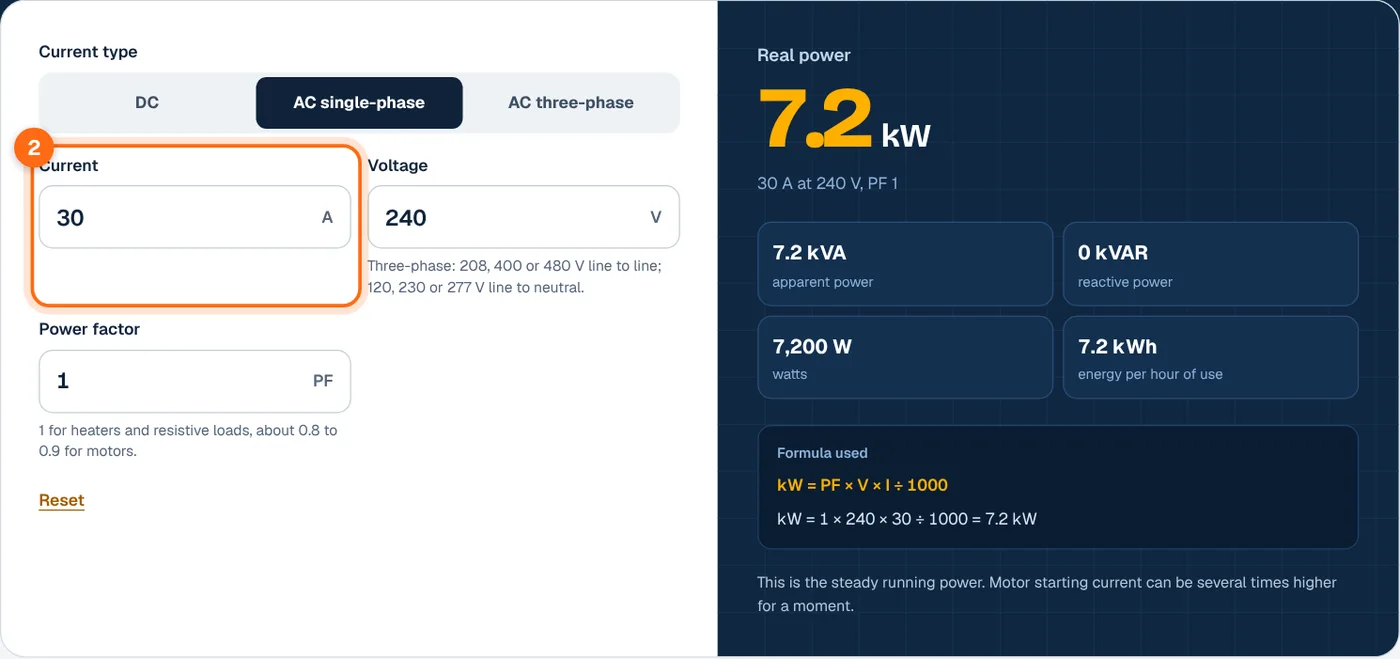
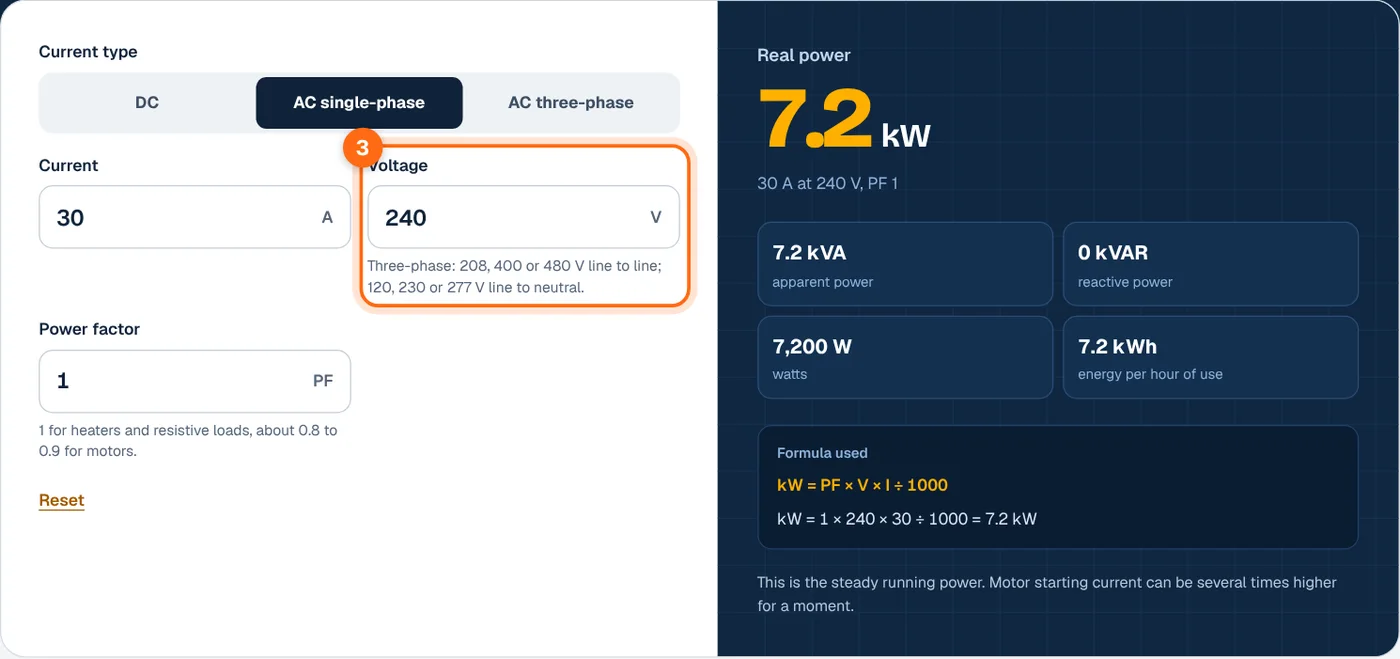
- Set the voltage. For three-phase, first say whether you measured line to line (208, 400 or 480 V) or line to neutral (120, 230 or 277 V), then type the value. For single-phase or DC, enter the voltage across the load.
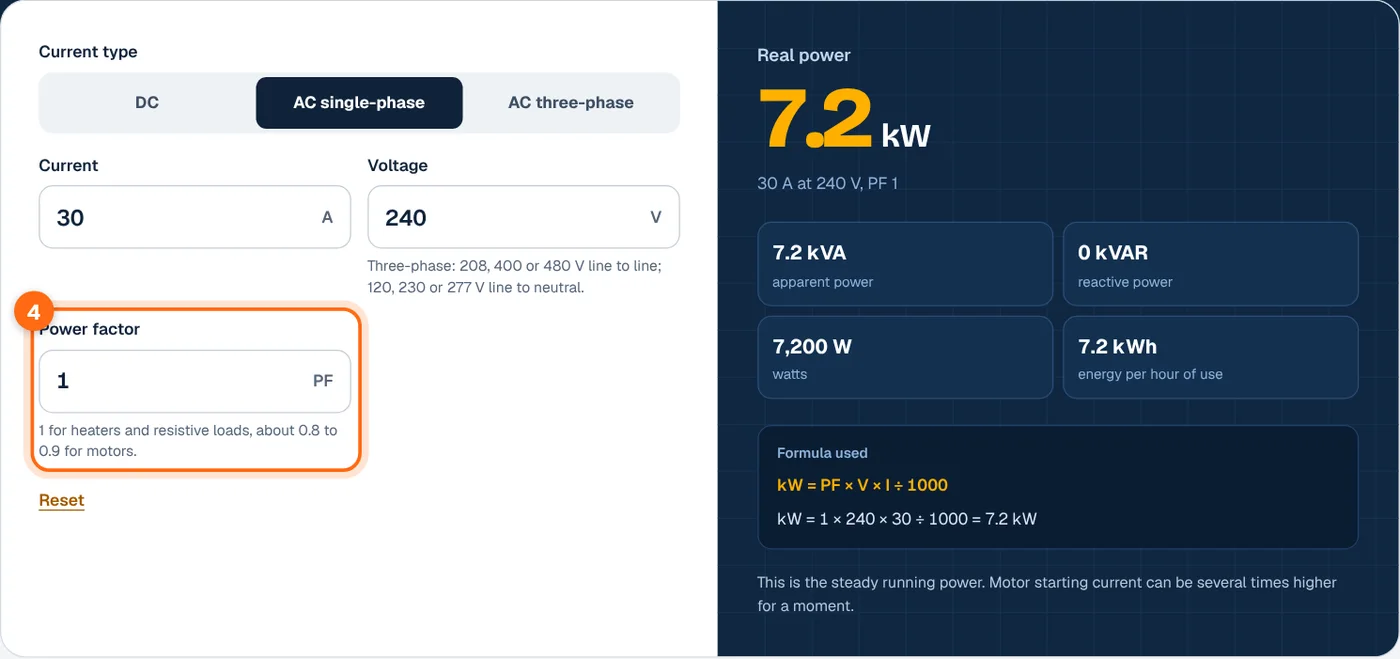
- Enter the power factor. Leave 1 for heaters, water heaters and other resistive loads. Use 0.8 to 0.9 for induction motors, or the value on the nameplate. DC has no power factor, so the box hides.
- Read the result. The large number is real power in kW. The cards add kVA, kVAR, watts and the kWh used per hour of running.

Amps to kW formula
Real power is voltage times current times power factor. Three-phase adds a factor that depends on how the voltage was measured. The U.S. Department of Energy uses the same three-phase power equation when it estimates motor load from field readings.
DC
Single-phase AC
Three-phase AC, line-to-line voltage
Three-phase AC, line-to-neutral voltage
Where:
- I is current in amps. For three-phase it is the current in each line of a balanced load.
- V is voltage in volts. V(L-L) = √3 × V(L-N), so 480 V line to line is 277 V line to neutral.
- PF is the power factor, between 0 and 1.
- √3 is about 1.732. It appears because the three phase voltages are 120° apart.
Worked examples
Example 1: 30 A at 240 V single-phase
A 30 A water heater or EV charger running flat out uses 7.2 kW, which is 7.2 kWh for every hour it runs. This is the calculator’s default.
Example 2: 100 A at 480 V three-phase, PF 0.9
The apparent power is 1.732 × 480 × 100 ÷ 1,000 = 83.14 kVA, and the reactive power is 36.24 kVAR. The kVA figure is what a transformer or generator must supply. See the amps to kVA calculator for sizing on kVA alone.
Example 3: same load measured line to neutral
Measuring the same 480Y/277 V system line to neutral gives 277 V. Select line to neutral and enter 277 V.
The small difference from 74.82 kW comes from 277 V being a rounded figure for 480 ÷ √3 = 277.1 V.
Amps to kW conversion chart
Real power for common currents. Single-phase columns use PF 1, the 208 V three-phase column uses PF 1, and the 480 V column uses PF 0.9.
| Amps | 120 V 1-phase | 240 V 1-phase | 208 V 3-phase, PF 1 | 480 V 3-phase, PF 0.9 |
|---|---|---|---|---|
| 5 A | 0.6 kW | 1.2 kW | 1.8 kW | 3.74 kW |
| 10 A | 1.2 kW | 2.4 kW | 3.6 kW | 7.48 kW |
| 15 A | 1.8 kW | 3.6 kW | 5.4 kW | 11.22 kW |
| 20 A | 2.4 kW | 4.8 kW | 7.21 kW | 14.96 kW |
| 30 A | 3.6 kW | 7.2 kW | 10.81 kW | 22.45 kW |
| 40 A | 4.8 kW | 9.6 kW | 14.41 kW | 29.93 kW |
| 50 A | 6 kW | 12 kW | 18.01 kW | 37.41 kW |
| 60 A | 7.2 kW | 14.4 kW | 21.62 kW | 44.89 kW |
| 100 A | 12 kW | 24 kW | 36.03 kW | 74.82 kW |
| 200 A | 24 kW | 48 kW | 72.05 kW | 149.65 kW |
What affects the result
Power factor
The same current carries less real power when the power factor is low. A motor drawing 20 A at 240 V and PF 0.8 uses 3.84 kW, not 4.8 kW. The rest is reactive power that magnetizes the motor. If you only have kW and kVA readings, find the factor with the power factor calculator.
Which voltage you measured
On three-phase systems, mixing up line-to-line and line-to-neutral voltage is the most common mistake. Using 277 V with the √3 formula understates power by 42%. The voltage selector applies the right factor for you.
Running versus starting current
Motors draw five to seven times their running current for a second or two when they start. Converting that inrush figure to kW gives a misleading number. Use the steady running current for energy and cost estimates.
Balanced versus unbalanced loads
The three-phase formula assumes each line carries the same current. If the line currents differ, convert each phase separately as single-phase using line-to-neutral voltage and add the results.
Frequently asked questions
How many kW is 100 amps?
It depends on the voltage. At 240 V single-phase and PF 1, 100 A is 24 kW. At 208 V three-phase it is 36.03 kW, and at 480 V three-phase with PF 0.9 it is 74.82 kW. Amps alone cannot be turned into kW without the voltage and, for AC, the power factor.
How do I convert amps to kW for three-phase?
Multiply 1.732 by the line-to-line voltage, the line current and the power factor, then divide by 1,000. For 50 A at 400 V and PF 0.85, that is 1.732 × 400 × 50 × 0.85 ÷ 1,000 = 29.44 kW. With line-to-neutral voltage, use 3 in place of 1.732.
What power factor should I use?
Use 1 for resistive loads such as heaters, ovens, kettles and incandescent lamps. Induction motors at full load run around 0.8 to 0.9 and lower when lightly loaded. Modern electronics with power factor correction, such as EV chargers and server power supplies, typically run above 0.95. The nameplate value is best.
Is amps to kW the same as amps to kVA?
Only when the power factor is 1. kVA is voltage times current and ignores the phase shift, while kW multiplies by the power factor. At PF 0.8, a load of 10 kVA is only 8 kW. Generators and transformers are sized on kVA; energy bills are based on kW.
How do I convert kW back to amps?
Divide kW × 1,000 by the voltage and power factor, and by 1.732 more for three-phase. 7.2 kW at 240 V single-phase and PF 1 is 30 A. The kW to amps calculator handles all three current types and shows the apparent power as well.