Amps to kVA Calculator
Convert amps to kVA for single-phase and three-phase supplies and see the next standard transformer size.
Quick answer
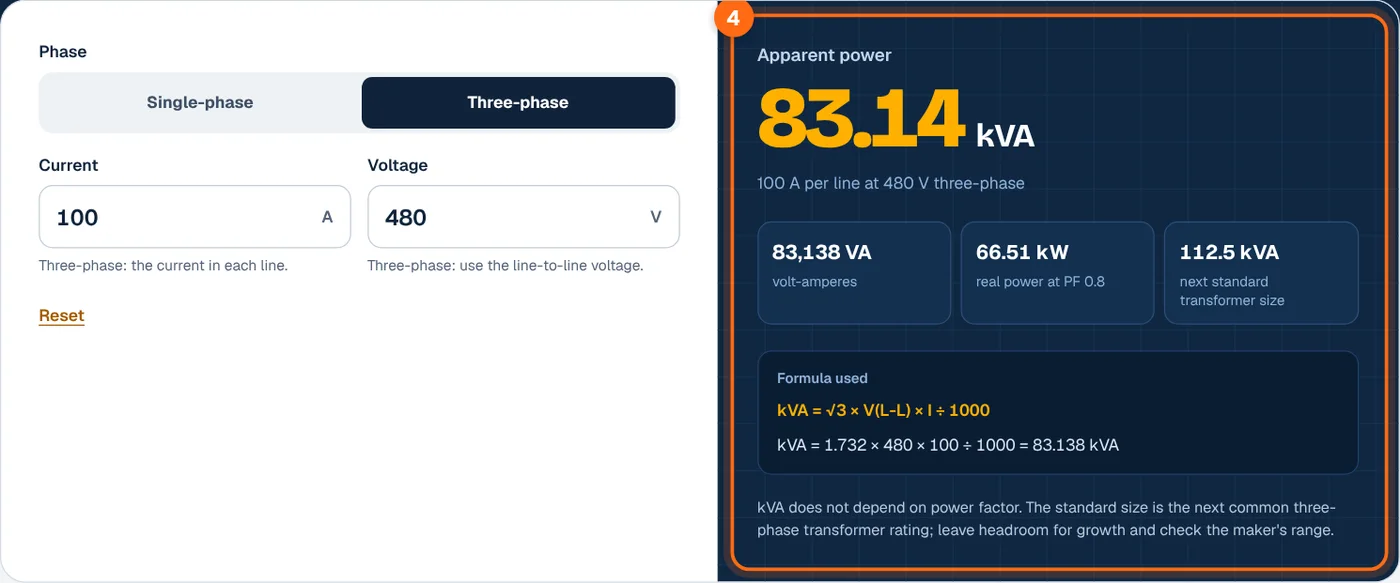
To convert amps to kVA, multiply current by voltage and divide by 1,000. For three-phase, multiply by √3 (1.732) as well. 100 A at 480 V three-phase is 1.732 × 480 × 100 ÷ 1,000 = 83.14 kVA, so a 100 kVA transformer covers it. 200 A at 240 V single-phase is 48 kVA.

How to use the amps to kVA calculator
- Choose the phase. Pick single-phase for 120/240 V homes and small businesses. Pick three-phase for 208 V, 400 V and 480 V commercial and industrial supplies.

- Enter the current. Use the load current, the main breaker rating or a clamp-meter reading. For three-phase, enter the current in one line of a balanced load.

- Enter the voltage. For three-phase, use the line-to-line voltage. For single-phase, use the voltage across the load.

- Read the result. The large number is apparent power in kVA. The cards show the same figure in VA, the real power at PF 0.8 and the next common transformer size for that phase.
Amps to kVA formula
kVA is apparent power: the product of voltage and current with no power factor applied. That is why transformers, generators and UPS units are rated in kVA. Their heating limit depends on current, whatever the load type.
Single-phase
Three-phase
Where:
- kVA is apparent power in kilovolt-amperes.
- V is voltage. Three-phase uses the line-to-line value.
- I is current in amps, per line for three-phase.
- √3 is about 1.732.
Worked examples
Example 1: 100 A at 480 V three-phase
This is the default. A standard 100 kVA three-phase transformer has enough capacity, with about 17% spare. At PF 0.8 the load uses 66.51 kW of real power.
Example 2: 200 A residential service at 240 V
A fully loaded 200 A service is 48 kVA. Real homes rarely draw the full rating for long, which is why utilities often serve several houses from a single 50 kVA transformer. For a standby generator, size on the actual peak demand, not the breaker rating.
Example 3: 60 A at 208 V three-phase
A 60 A, 208 V panel needs at least a 30 kVA three-phase transformer, the next standard size above 21.62 kVA. To see how much real power that current delivers at a given power factor, use the amps to kW calculator.
Amps to kVA conversion chart
Apparent power for common currents at four supply voltages.
| Amps | 240 V 1-phase | 208 V 3-phase | 400 V 3-phase | 480 V 3-phase |
|---|---|---|---|---|
| 20 A | 4.8 kVA | 7.21 kVA | 13.86 kVA | 16.63 kVA |
| 30 A | 7.2 kVA | 10.81 kVA | 20.78 kVA | 24.94 kVA |
| 50 A | 12 kVA | 18.01 kVA | 34.64 kVA | 41.57 kVA |
| 60 A | 14.4 kVA | 21.62 kVA | 41.57 kVA | 49.88 kVA |
| 100 A | 24 kVA | 36.03 kVA | 69.28 kVA | 83.14 kVA |
| 125 A | 30 kVA | 45.03 kVA | 86.6 kVA | 103.92 kVA |
| 150 A | 36 kVA | 54.04 kVA | 103.92 kVA | 124.71 kVA |
| 200 A | 48 kVA | 72.05 kVA | 138.56 kVA | 166.28 kVA |
| 400 A | 96 kVA | 144.11 kVA | 277.13 kVA | 332.55 kVA |
| 800 A | 192 kVA | 288.21 kVA | 554.26 kVA | 665.11 kVA |
What affects the result
Measured versus rated current
A breaker rating is a maximum, not the load. Utilities and engineers size transformers on measured or calculated demand, because few services ever run at their full breaker rating for long. Sizing a transformer on a 400 A main breaker gives 332.55 kVA at 480 V, but the real peak demand might be half that. Use a demand reading or a load calculation where you can, then add headroom.
Voltage reference
Three-phase kVA uses line-to-line voltage. With line-to-neutral voltage, multiply by 3 in place of 1.732. The 3 phase power calculator lets you choose either measurement.
Unbalanced phases
The formula assumes equal current in all three lines. If one phase carries more, the transformer is limited by that phase. Use the highest line current for a conservative kVA figure.
Standard sizes and growth
Transformers come in fixed steps. Common three-phase ratings include 15, 30, 45, 75, 112.5, 150, 225, 300, 500 and 750 kVA. Common single-phase ratings include 10, 15, 25, 37.5, 50, 75, 100 and 167 kVA. The calculator suggests the next size up for the phase you picked.
Frequently asked questions
How many kVA is 100 amps?
At 240 V single-phase, 100 A is 24 kVA. At 208 V three-phase it is 36.03 kVA, at 400 V three-phase 69.28 kVA and at 480 V three-phase 83.14 kVA. Multiply volts by amps, and by 1.732 for three-phase, then divide by 1,000.
Why is kVA used instead of kW for transformers?
Transformer and generator windings heat up according to the current flowing through them, and current is set by kVA. A 100 kVA unit carries the same current at full load whether the power factor is 1 or 0.7, even though the real power differs. kVA ratings therefore stay valid for any load.
Does power factor change amps to kVA?
No. kVA is volts times amps, so power factor plays no part. Power factor matters when you want kW: multiply kVA by PF. 83.14 kVA at PF 0.8 is 66.51 kW. To go from kVA to real power, use the kVA to kW calculator.
What size transformer do I need for 200 amps?
At 240 V single-phase, 200 A is 48 kVA, so a 50 kVA transformer is the next size up. At 208 V three-phase, 200 A is 72.05 kVA, so a 75 kVA unit works, though 112.5 kVA gives more growth room. Size on expected demand plus about 20% headroom.
How do I go from kVA back to amps?
Divide kVA × 1,000 by the voltage, and by 1.732 more for three-phase. 83.14 kVA at 480 V three-phase is 100 A. The kVA to amps calculator does this for any rating and also shows the 125% continuous-load current used for breaker checks.